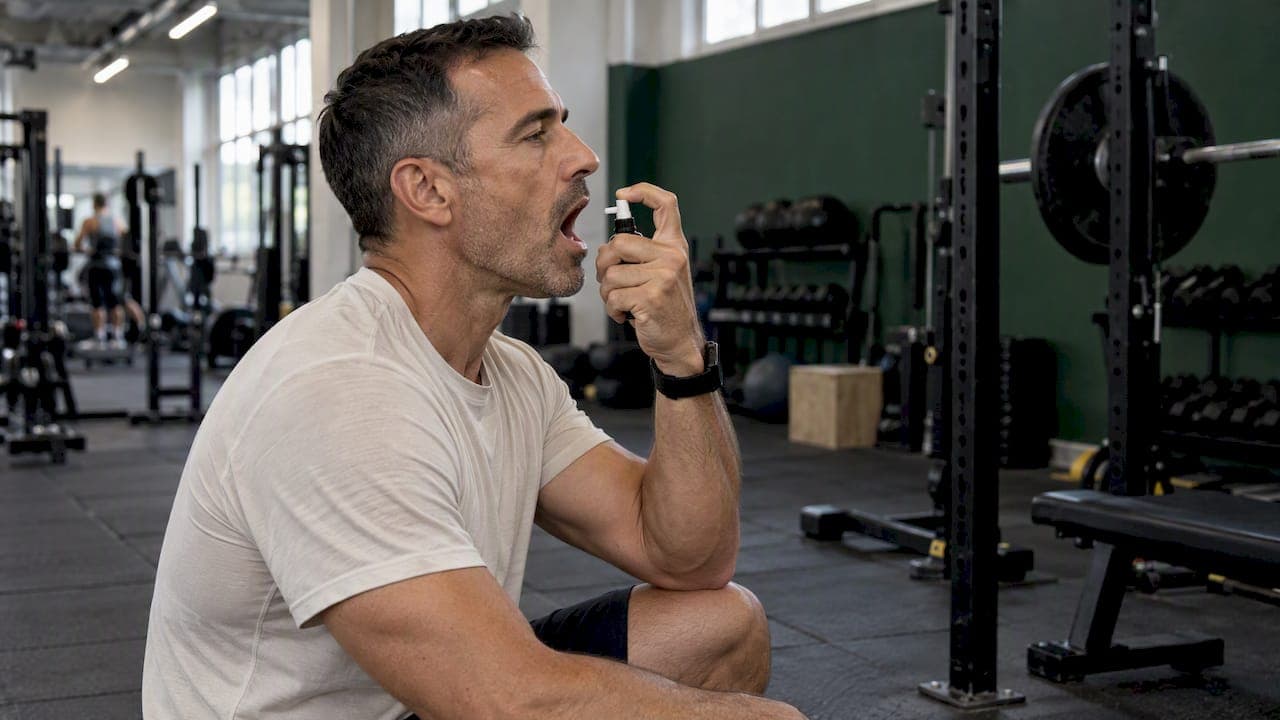
A mouth spray before training can make your mouth feel more comfortable for a short time. That is the honest scope. It moistens or stimulates saliva for a few hours at most, and it does not change how your muscles, heart or hormones perform. Men who search for "munspray före träning" are usually asking one of two things: how to keep a dry mouth from ruining a session, or whether a spray can sharpen performance. This guide separates the two, shows what the research supports, and explains where a sublingual performance spray belongs in a disciplined routine.
TL;DR
- Moisturizing and saliva-stimulating sprays manage the sensation of dry mouth. They do not restore salivary gland function, and the effect lasts a few hours at most.
- Evidence for any topical dry-mouth product is low quality. Evidence for carbohydrate and caffeine mouth rinses is stronger for performance, and menthol rinses show little overall benefit.
- Check labels for xylitol, glycerin or malic acid. Avoid sugar-containing and acidic products.
- A sublingual performance spray is a different category from a mouth-freshening or saliva spray, with a different purpose and routine.
- Dry mouth that persists despite self-care is a conversation for a dentist or physician.
Table of Contents
- Two products people mean by "mouth spray"
- Why your mouth dries out when you train
- What the evidence supports
- How to use a saliva spray around a workout
- What to check on the label
- Our perspective
- Where a sublingual performance spray fits
- Membership and access
- Fueling around the session
- When dry mouth is a medical question
- FAQ
- Sources
Two products people mean by "mouth spray"
The phrase covers products with very little in common. Sorting them first saves money and sets realistic expectations.

Saliva and moisture sprays. These are made for dry mouth. They use humectants such as glycerin, thickeners such as sodium carboxymethylcellulose, or xylitol to make the mouth feel moist. Some stimulate your own saliva with a mild acid such as malic acid.
Freshness sprays. Menthol or mint sprays that mask breath and give a cool sensation. They are cosmetic. If you are weighing options in this group, our overview of menthol freshness spray alternatives explains how to compare them.
Sublingual supplement sprays. These deliver an active formulation under the tongue. They are taken for what they contain, not for how the mouth feels. We return to this category below.
The top results for this query in Sweden show how muddled the search is: nasal sprays, treadmill lubricant, xylitol sprays and cooling sports sprays all appear. If you came for any of those, the sections on saliva sprays and rinses are the relevant ones.
Why your mouth dries out when you train
Heavy breathing through the mouth, sweating, dehydration and dry gym air all contribute. A company guide on dry mouth in daily life lists exactly these factors for exercise and suggests lightly moistening the mouth before and during activity, for example with a personal water mister.
This matters because a dry mouth during a session is often a hydration and breathing issue before it is a saliva issue. Early morning sessions add another factor: you wake after hours of mouth breathing, and saliva flow is naturally lower at night. Men who train fasted often notice it most. If that is your pattern, our guide to a fasted sublingual spray routine covers sequencing around water and the first meal.
Also consider individual tolerance. Research on hydration in athletes notes that gastric tolerance and familiarity with fluid intake differ between people, so a plan that works for a training partner may not suit you. Test drinking and spraying habits in ordinary sessions, never on a race or competition day.
What the evidence supports
Saliva sprays: a modest, temporary comfort
The strongest summary is cautious. A 2021 Cochrane review of topical dry-mouth products found no strong evidence that any topical product relieves dry-mouth sensation. The same review saw some evidence that an oxygenated glycerol triester spray performed better than an electrolyte spray.
A 2019 systematic review found that a spray containing 1% malic acid may improve dry-mouth sensation compared with placebo, while rating the quality of evidence as low. Note what these studies measured: sensation in people with diagnosed dry mouth, not athletes in a gym.
On limits, the UK NHS Specialist Pharmacy Service is direct: artificial saliva products do not restore natural gland function and only manage symptoms for a short time.
Mouth rinses: where the performance research sits
If your real question is whether something in the mouth can lift performance, the research is about rinsing, not spraying. Carbohydrate, caffeine and menthol rinses are studied as non-ingestive strategies, and a 2026 meta-analysis in Frontiers in Nutrition reports outcome-specific advantages for them.
- Carbohydrate. A systematic review found a mean improvement of 5.05 W during moderate- to high-intensity exercise, with results that varied across studies. The proposed explanation is that oral receptors connect to reward areas in the brain, which would explain a benefit without swallowing calories.
- Menthol. A 2024 meta-analysis found no significant improvement in overall exercise capacity, though endurance athletes may benefit.
- Caffeine. Included in the 2026 analysis above, with outcome-specific effects.
The practical reading: these are small, situational effects tested in controlled trials with a rinse of a defined volume and duration. A spritz of a saliva spray is not the same intervention, and nobody should expect a transformation from it.
How to use a saliva spray around a workout
Labels vary, so follow the one on your product. The general pattern for artificial saliva products is consistent: effects last no more than a few hours, so use as often as needed, including before and during meals. A workable routine:
- Hydrate first. Drink water in the hour before training so you start from a baseline, not from a dry mouth.
- Spray 10 to 15 minutes before. This is a practical suggestion, not a label rule. It lets you check the taste and feel before you begin.
- Breathe through the nose when you can. On easy sets and warm-ups this lowers the drying effect at no cost.
- Repeat between blocks if needed. Short-lived effects mean one application will not carry a 90-minute session.
- Keep it separate from other products. If you also take a sublingual supplement, give each its own window so you know what is doing what. Our note on the best time for a sublingual spray by objective lays out the sequencing.
On safety, one 2021 randomized trial of a stimulant spray with 1% malic acid, 10% xylitol and 0.05% sodium fluoride reported no adverse effects with use up to eight times a day. That is a single product in one trial, not a blanket assurance for every spray.
What to check on the label
A guideline from Iowa Head and Neck Protocols lists the typical ingredients of moisturizing and stimulating products. Cochrane also advises avoiding acidic and sugar-containing products to protect oral health.
| Ingredient | Role | Watch for |
|---|---|---|
| Xylitol | Moisturizes, non-sugar sweetener | Large amounts can upset the stomach in some people |
| Glycerin | Humectant, coats the mouth | Can feel sticky if overused |
| Sodium carboxymethylcellulose | Thickener that holds moisture | Texture, which some find heavy during hard effort |
| Malic acid | Stimulates your own saliva | Acidic, so check the concentration and rinse with water |
| Sugar | Sweetener | Avoid: it is not suited to frequent oral use |
| Alcohol | Solvent in some sprays | Can dry the mouth further, see below |
If alcohol appears on a label, ask how much per dose. Our checklist on alcohol content in mouth sprays explains why milligrams per dose is the number to demand. Shelf life is the other detail worth checking, covered in how to verify mouth spray shelf life.
Our perspective
We build a sublingual spray, so we are careful about this subject. The mouth is a surface with real biology: saliva, a thin mucosa, taste receptors. A product that works there should be judged on what it claims and what it can show.
A saliva spray has a narrow job and does it for a few hours. We would not ask it to do more, and we would be wary of any brand that does. Disciplined men tend to over-engineer the pre-training window with five products and no way of knowing which one mattered. Our view is the opposite: keep the routine small, change one variable at a time, and write down what you notice.
That is also how we approach our own formulation. Small-batch Swedish production, traceable records and inspectable reasoning exist so that you can judge what you take, not so that you must take our word. Support for professional judgment, not a replacement for it. A sublingual spray is a daily discipline built over months, not a pre-workout trick, and we say so plainly.
— Joakim
Where a sublingual performance spray fits
The delivery philosophy behind a sublingual spray is different from a saliva spray. Under the tongue, the formulation meets a thin mucosal surface instead of passing straight through digestion. We explain the logic in our piece on mouth spray bioavailability for executives, and compare how the category stacks up in premium performance spray alternatives.
Viridos is a plant-derived performance supplement for men, formulated as a precision oral spray with proprietary extraction, made in small batches in Sweden. It is built for men in demanding roles who value drive, clarity and consistency over years, and it is not marketed as a way to stop a dry mouth. For many members the natural slot is the morning, before the gym and before the first meeting. Our morning oral spray routine walks through priming, placement and checking Swedish rules.
Membership and access
Viridos is available by application and approval, as a membership with regular shipments. The Member plan is $99 per month and the Professional plan is $299 per month; details are on the pricing page, and the membership page explains how applications work.

If you are building a long-term plan around training, recovery and focus, our longevity performance strategy page sets out the framework we work from.
Fueling around the session
Mouth comfort is one part of a session. What you eat afterward matters for the next one, especially in a cutting phase, when hunger can derail discipline. For ideas that keep you full, see these post-workout snack ideas for cutting.
When dry mouth is a medical question
A dry mouth only in the gym, easing with water and nose breathing, is usually situational. A dry mouth most days, at rest, at night or while eating is a different matter. Persistent dryness raises the risk of dental problems, and a dentist can look at it directly.
In Sweden, regional guidance such as Terapirekommendationer Halland describes fluoride-containing saliva substitutes and saliva-stimulating agents as options for dry mouth, which is a decision for a dentist or physician. The Cochrane authors note that for many people dry mouth is chronic, so the long-term effect on quality of life matters, not just the first minute of relief. The Swedish health service 1177 likewise advises talking to healthcare staff when self-care advice is not enough. Book an appointment with your tandläkare or vårdcentral if dryness is constant, comes with mouth sores or trouble swallowing, or began after a new medication.

FAQ
Does a mouth spray before training improve performance?
A saliva or freshness spray is not shown to improve performance. Its job is comfort. The performance research concerns carbohydrate and caffeine rinses, which show small, variable effects, while menthol rinses show no significant overall improvement.
How long before exercise should I use a mouth spray?
Follow the label. As a general pattern, effects of artificial saliva products last a few hours at most, so a spray 10 to 15 minutes before training, with repeats during the session, is sensible. Hydrating first matters more than the spray.
What ingredients should I look for?
Xylitol, glycerin and sodium carboxymethylcellulose are common in moisturizing products, and malic acid in stimulating ones. Avoid sugar-containing and acidic products, and ask how much alcohol is in each dose if it is listed.
Is a sublingual supplement spray the same as a saliva spray?
No. A saliva spray is for mouth comfort. A sublingual supplement spray delivers a formulation under the tongue for a defined purpose, and its routine, timing and quality standards are different.
When should I see a professional about a dry mouth?
See a dentist or physician if dryness is frequent, appears at rest or at night, or does not ease with water and nasal breathing. Self-care tips are not a replacement for professional advice.
Sources
- NHS Specialist Pharmacy Service: artificial saliva products in dentistry
- Cochrane: topical therapies for dry mouth
- PubMed: saliva substitutes and stimulants review
- Frontiers in Nutrition: carbohydrate, caffeine and menthol mouth rinses
- PMC: carbohydrate mouth rinse and performance
- Sports Medicine Open: menthol mouth rinsing
- Iowa Head and Neck Protocols: dry mouth management
- PubMed: randomized trial of a salivary stimulant spray
- Terapirekommendationer Halland: muntorrhet
- 1177: syrgasbehandling
- Saliwell: dry mouth in everyday situations
- PMC: preexercise hydration and fluid intake