
Autonomy, clear process goals, and small, frequent wins increase drive faster than any single motivational tactic. These three levers work because they satisfy the psychological needs behind sustained effort and trigger the brain's reward circuitry on a short, reliable cycle rather than waiting for a distant outcome. You do not need to wait for inspiration.
Do this in the next 60 minutes:
- Pick one task and reframe it as your choice, not an obligation imposed on you.
- Write one process goal with a specific action and a near-term deadline.
- Complete the smallest possible first step, then log it somewhere visible.
- Autonomy restores a sense of ownership over the work.
- Process goals convert vague intent into a trackable action.
- Small wins deliver the feedback loop that sustains momentum.
Key Takeaways
Increasing drive reliably requires autonomy, well-specified process goals, and frequent small wins, applied on a consistent schedule rather than in occasional bursts.
| Point | Details |
|---|---|
| Start smaller than feels necessary | Use the two-minute rule to remove initiation friction before motivation ever needs to show up. |
| Set process goals, not outcome goals | Control the input you can act on today rather than a result you cannot guarantee. |
| Match difficulty to skill | Apply the Goldilocks Rule and raise the challenge once a task stops feeling engaging. |
| Review weekly, reset quarterly | Track completed goals and accountability quality, then rebuild rituals before they decay. |
| Consider structured support | Viridos membership pairs a performance journal and small-batch Swedish supplement for readers who want a supported, consistency-focused path. |
Table of Contents
- What Increases Drive, and What Does "Motivation" Actually Mean?
- Intrinsic vs. Extrinsic Motivation: Which One Drives Better Results?
- Which Strategies Actually Increase Motivation?
- How Do You Apply These Methods at Work?
- An 8-Step Plan to Increase Drive, Starting Today
- Addressing Common Motivational Setbacks and How to Overcome Them
- How to Monitor and Adjust Your Motivation Strategy Over Time
- Sources
What Increases Drive, and What Does "Motivation" Actually Mean?
Motivation is the direction, persistence, and intensity you bring to goal-directed behavior. It is not a mood. It is a function of how a task is structured and how closely it connects to something you value.
Three frameworks explain most of what follows in this guide. Self-Determination Theory, developed by psychologists Edward Deci and Richard Ryan, holds that motivation depends on satisfying needs such as autonomy, competence, and relatedness. SMART goals (specific, measurable, achievable, relevant, time-bound) turn ambition into execution. The Goldilocks Rule states that motivation peaks when a task is neither too easy nor too hard, roughly at the edge of your current ability.
Pro Tip: Ask yourself: would I still do this task if no one were watching or rewarding me? If yes, it is intrinsically driven. If no, examine whether the extrinsic reward is worth the effort, or whether the task needs reframing.
- Direction: what you are working toward
- Persistence: how long you sustain effort
- Vigor: the intensity you bring to the work
Intrinsic vs. Extrinsic Motivation: Which One Drives Better Results?
Intrinsic motivation, the drive that comes from interest or satisfaction in the work itself, tends to sustain complex, creative, and high-agency work better than external rewards do. Extrinsic motivators, bonuses, titles, deadlines imposed by others, can push simple, repetitive tasks forward but often undermine engagement on work that requires judgment or originality.
Self-Determination Theory explains why: humans perform best when autonomy, competence, and relatedness are satisfied at the same time. Autonomy means you experience choice in how the work gets done. Competence means you see yourself improving. Relatedness means the work connects you to people or a mission that matters.
Carol Dweck's research on growth mindset adds a second lever. Framing a setback with the word "yet," as in "I haven't solved this yet," keeps the brain oriented toward improvement rather than failure. That single word changes how a mistake gets processed.
A fixed mindset treats a stumble as evidence of a ceiling. A growth mindset treats the same stumble as data on the way to a ceiling that has not been reached yet.
- Intrinsic motivation: durable, self-sustaining, best for complex work
- Extrinsic motivation: useful short-term, risks eroding engagement on demanding tasks
- Growth mindset language: reframes setbacks as sequence, not verdict
Which Strategies Actually Increase Motivation?
The research converges on three needs and a handful of execution tools. Get the needs right and the tools become far easier to apply.
Autonomy. Give yourself, or your team, real decision latitude on method, even when the outcome is fixed. A leader who dictates the how as well as the what removes the one variable that keeps people engaged.
Competence. Progress you can see, not progress you assume, builds motivation. Deliberate practice, work at the edge of your current skill with fast feedback, builds competence faster than repetition alone.
Purpose. Connect the task to something you actually value. A deliverable tied to a mission survives a bad week better than one tied only to a deadline.
From there, the tools:
- SMART goals replace vague ambition with a target you can actually hit or miss. Well-specified, challenging goals consistently outperform vague ones on both motivation and results.
- Process goals over outcome goals. "Write for 45 minutes" beats "finish the report" on a bad day, because you control the input, not just the result.
- The two-minute rule. Commit to two minutes of a dreaded task. Starting, not motivation, is usually the real obstacle. Behavioral guidance on procrastination recommends shrinking the first action until it takes almost no willpower.
- Backcasting. Work backward from a finished outcome to identify the very next step, which clarifies action better than forecasting forward.
- Visualization. Rehearsing the process, not just the outcome, mentally primes execution.
- Scheduling and ritual. Fixed times and repeated cues remove the daily decision of when to start; motivation often follows action rather than preceding it.
- Accountability partners. A standing check-in with someone else raises the cost of quietly letting a goal slide.
Pro Tip: Build in a micro-feedback moment, checking off a line, a one-sentence log entry, a quick self-rating, every time you complete a step. That small signal is enough to trigger the reward response that keeps you moving to the next one.
Autonomy-supportive environments with frequent feedback show measurably higher engagement and persistence than environments run on control and infrequent review.
How Do You Apply These Methods at Work?
A one-week project runs cleaner with a short checklist at the start:
- Set one process goal per day, not one outcome goal for the week.
- Build in a choice point, let yourself decide the sequence or method.
- Schedule a micro-feedback check at the midpoint.
- Fix a ritual, same time, same trigger, for the deliverable's hardest phase.
For a strategic deliverable, a quarterly plan or an investment memo, set the process goal as "draft section one for 90 minutes before lunch" rather than "finish the memo." For administrative drag, expense reports, compliance forms, apply the two-minute rule: open the form and complete one field. Initiation inertia, not the task itself, is usually what stalls these.
At the team level, autonomy-supportive leadership beats close supervision. Public progress markers, a shared board, a weekly written update, create accountability without a manager checking in on every step. Peer accountability, two colleagues reporting to each other, often works better than reporting up a hierarchy, since it removes the power dynamic that makes accountability feel like surveillance.
An 8-Step Plan to Increase Drive, Starting Today
- Name one tiny start action. Something under five minutes that begins the work.
- Fix a time and trigger. Same hour, same cue, every day for the first week.
- Write one process goal per day. Specific, time-bound, within your control.
- Set a micro-reward. A checked box, a one-line log entry, immediately after each step.
- Recruit an accountability partner. One person who expects a short update.
- Add two minutes of physical activation. A short walk or mobility break before the hardest task.
- Visualize the process, not just the win. Thirty seconds picturing the actual steps ahead.
- Review at day's end. Three lines: what got done, what got easier, what to adjust tomorrow.
Morning checklist:
- Today's one process goal, written down
- Trigger time set
- Two-minute activation completed
- Accountability update sent, if scheduled
Pro Tip: Pair your habit trigger with a brief physical activation, two minutes of mobility, a short walk, before the task that matters most. The body signals the brain to shift into working mode, which is part of the performance longevity approach Viridos builds its own protocols around.
When Low Motivation Signals Something More Serious
Ordinary motivation dips pass within days. Persistent low drive lasting several weeks, alongside anhedonia (losing interest in things you used to enjoy), disrupted sleep or appetite, or a real drop in work performance, is a different signal.
- Low motivation lasting more than two to three weeks with no clear cause
- Loss of interest in activities you previously valued
- Sleep or appetite changes alongside the drop in drive
- Noticeable decline in job performance or relationships
If any of these apply, a conversation with an occupational health provider, a mental health professional, or, for pattern-specific performance concerns, an executive coach is the right next step. This guide addresses ordinary motivational fluctuation, not clinical conditions, and nothing here substitutes for a professional evaluation.
Addressing Common Motivational Setbacks and How to Overcome Them
Every professional hits the same handful of walls. Recognizing which one you are facing usually matters more than the fix itself.
Plateau fatigue. Progress that once felt fast slows down, and the drive that came from visible improvement fades. The Goldilocks Rule explains this directly: the task has become too easy relative to your skill. Raise the difficulty slightly, a tighter deadline, a harder client, a new metric, and competence-driven motivation returns.

Goal fog. A goal set months ago stops feeling connected to anything real. This is a purpose failure, not a discipline failure. Rewrite the goal in one sentence that names who benefits and why it matters to you specifically.
Overload paralysis. Too many open commitments freeze initiation entirely. The fix is not more willpower; it is fewer visible options. Pick one process goal for the day and hide the rest of the list.
Setback spiral. A missed deadline or a public error triggers a mindset shift from "I haven't solved this yet" back to "I can't do this." Self-compassion, treating the setback as data rather than verdict, shortens the recovery window considerably compared to self-criticism.
Ritual decay. A routine that once triggered focus automatically stops working after the environment changes, a new office, a new team, a new season. Rebuild the trigger deliberately rather than assuming it will reassert itself.
How to Monitor and Adjust Your Motivation Strategy Over Time
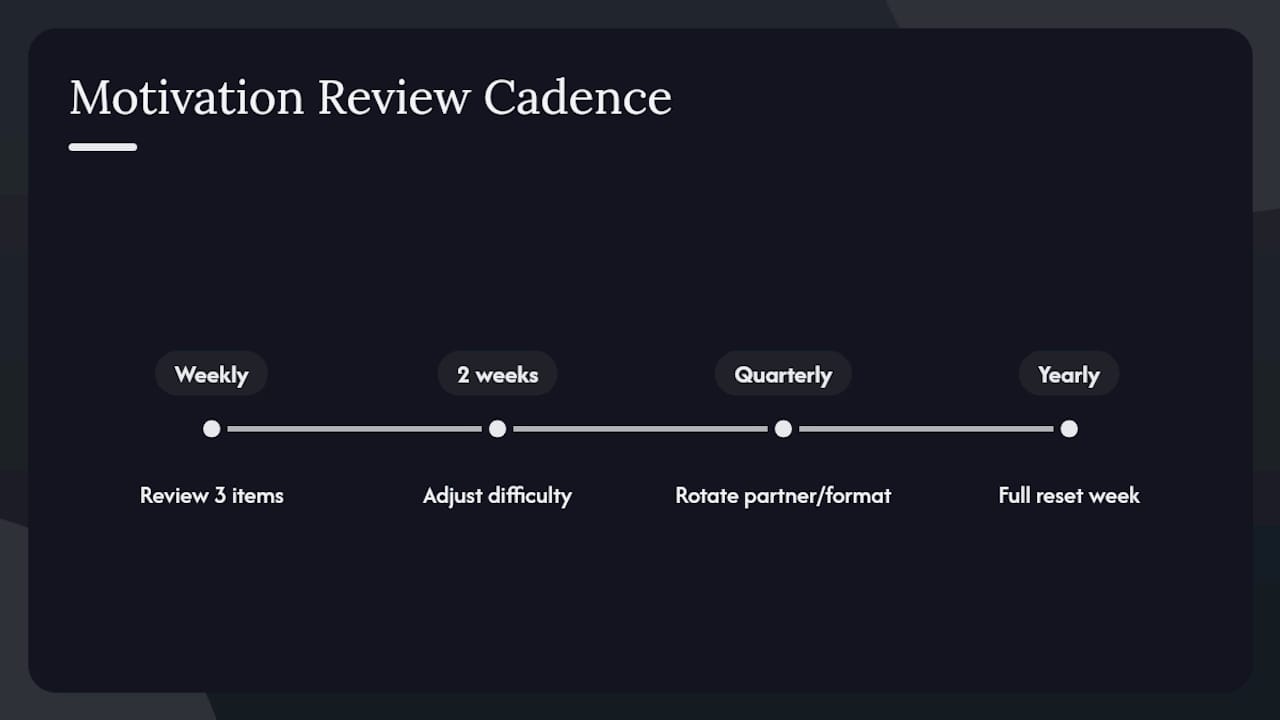
Motivation systems degrade quietly. A weekly, not daily, review catches the drift before it becomes a pattern.
Track three things at the end of each week: which process goals actually got completed, where the two-minute rule failed to get you started, and whether your accountability check-ins still feel useful or have become a formality. A structured performance journal makes this review faster because the data already exists in your own daily notes rather than in memory, which reconstructs the week inaccurately more often than people expect.
Adjust the difficulty dial before you adjust the goal itself. If a process goal has felt easy for two straight weeks, the Goldilocks zone has shifted upward, and the task needs to get harder, not different. If a goal has felt punishing for two straight weeks, scale it down rather than abandoning it; a goal you keep missing trains you to expect failure.
Rotate your accountability partner or format every quarter. The same check-in structure, repeated for months, tends to become background noise rather than a genuine external signal. A habit-tracking tool can supplement the human check-in, but it works best as a record, not a replacement for someone who actually asks how the week went.
Expect at least one full reset per year, a week where you rebuild triggers and rituals from scratch. Life changes, roles change, and a system built for last year's calendar rarely survives this year's unchanged.
Why This Approach Fits Disciplined Professionals
I built this guide around research, not slogans, because disciplined men in demanding roles do not need more motivation content; they need methods that hold up under scrutiny. Performance longevity comes from stacking small, repeatable disciplines, not from chasing a single breakthrough hack. The professionals who sustain an edge over decades treat drive as infrastructure, something maintained on a schedule, the same way they treat physical conditioning or financial discipline.
A Structured Option for Readers Who Want a Supported Path
Some readers will build this system entirely on their own, and the framework above holds up without any product attached to it. For others, particularly those managing demanding schedules with little margin for trial and error, a structured support layer helps the discipline hold under real pressure.

Viridos offers a controlled-access membership built around a precision oral spray, formulated with plant-derived compounds and produced in small batches in Sweden, alongside a performance journal designed for the process-goal and micro-feedback habits outlined in this guide. The membership is a support structure, not a substitute for the fundamentals: autonomy, process goals, and consistent review still do the underlying work. It is also not a substitute for professional mental-health evaluation when the signs point that direction.
For a professional who has the framework right but wants a premium, done-for-you layer around daily tracking and consistency, Viridos membership is worth reviewing directly.
Sources
- Goals and motivation
- The power of goal setting: an academic insight into success
- Motivation: The Scientific Guide on How to Get and Stay Motivated
- How to Increase Intrinsic Motivation (According to Science)