
After 40, the physiological and cognitive shifts that quietly erode executive performance are not a matter of willpower. Testosterone begins declining at roughly 1% per year after 30, cortisol dysregulation becomes more common under sustained pressure, and sleep architecture changes in ways that cut into deep recovery. The result is a gradual but measurable drop in focus, resilience, and decision-making quality. Most executives push harder instead of smarter, treating the symptoms rather than the system. The good news: modern science has mapped the mechanisms behind long-term performance, and there are clear, evidence-based actions you can take to not just maintain your edge but extend it well into your 50s and 60s.
Table of Contents
- Assessing your current performance foundation
- Essential pillars: Lifestyle habits that drive long-term executive performance
- Integrating advanced monitoring and real-time feedback
- Overcoming psychological barriers and optimizing mental resilience
- Why most executive longevity advice doesn't work—and what actually does
- Put your longevity plan into action with expert support
- Frequently asked questions
Key Takeaways
| Point | Details |
|---|---|
| Track what matters | Measure key biomarkers and lifestyle data to create a personalized longevity plan. |
| Prioritize foundational habits | Consistent sleep, movement, nutrition, and stress management are the building blocks for lasting executive health. |
| Leverage technology wisely | Use modern wearables to gather feedback but act on the essentials before chasing advanced tools. |
| Mental health multiplies results | Strong psychological resilience is critical for sustaining high performance over time. |
Assessing your current performance foundation
To build a strategy that works, start by establishing a clear understanding of your current baseline. You cannot optimize what you have not measured, and vague self-assessments like "I feel tired" or "I think my diet is decent" do not give you enough signal to act on. The first step is a structured self-audit across four domains: energy levels throughout the day, quality of focus during deep work, sleep consistency, and your subjective stress load.
From there, move to objective data. The metrics that matter most for executive longevity are:
- Testosterone and cortisol (free and total, morning draw)
- Fasting glucose and HbA1c (metabolic health markers)
- Sleep quality and duration (tracked via wearable or sleep study)
- Heart rate variability (HRV) (a proxy for autonomic nervous system resilience)
- VO2 max (the single strongest predictor of long-term mortality risk)
- Body composition (lean mass vs. fat mass, not just weight)
- Inflammatory markers (CRP, IL-6 if accessible)
As biomarker tracking shows, measuring hormones, blood sugar, and inflammation alongside real-time wearable data forms the backbone of any serious performance longevity plan. This is not about becoming obsessed with numbers. It is about having a map before you start the journey.
| Metric | Tool | Frequency |
|---|---|---|
| Testosterone / cortisol | Blood panel | Quarterly |
| Fasting glucose / HbA1c | Blood panel | Quarterly |
| Sleep quality | Oura Ring / WHOOP | Daily |
| HRV | Smart ring / chest strap | Daily |
| VO2 max | Fitness watch / lab test | Every 6 months |
| Body composition | DEXA scan | Every 6 months |
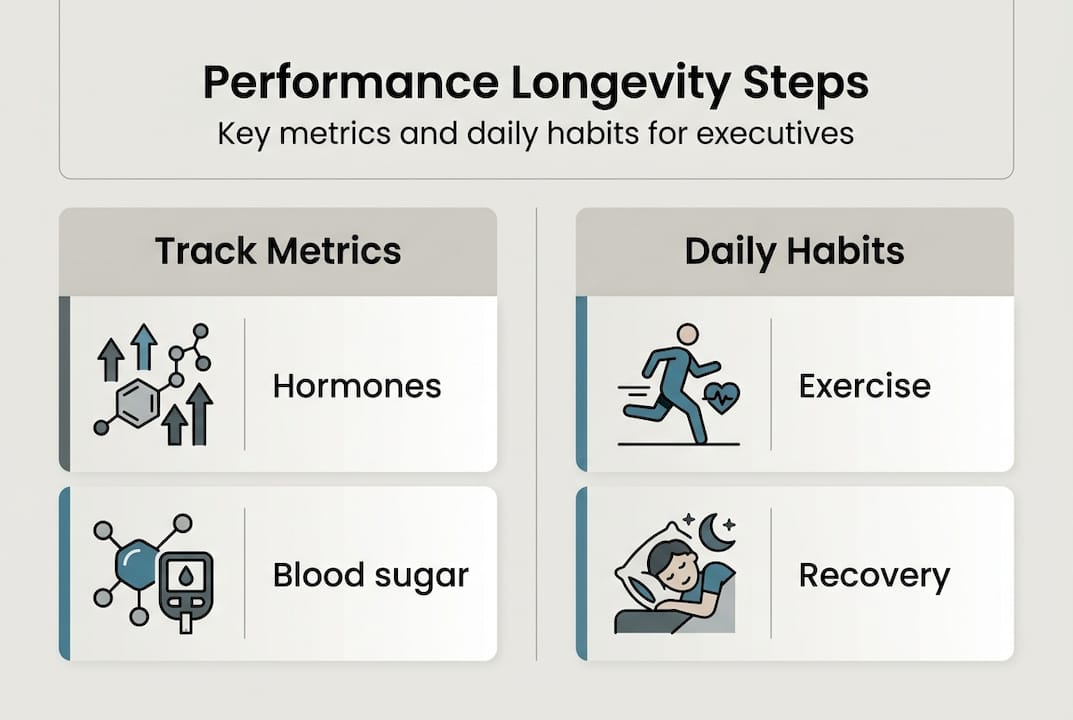
Once you have this data, you can use a structured longevity checklist to map your results against evidence-based benchmarks. The goal is not perfection. The goal is direction. Knowing that your HRV has been trending down for three weeks tells you something is off before your performance visibly drops. That lead time is the entire advantage of data-driven longevity. If you want to understand why this matters at a deeper level, the case for why you should optimize performance longevity starts with exactly this kind of baseline clarity.
Essential pillars: Lifestyle habits that drive long-term executive performance
Armed with your baseline, focus on cementing the core behaviors proven to affect vitality and resilience. Before you add any complexity, the fundamentals need to be locked in. Nutrition, sleep, exercise, and stress reduction consistently outperform trendy interventions like cryotherapy or red light therapy when it comes to sustained performance gains. That is not an opinion. It is the pattern that shows up across the research.
Here are the three most impactful daily habits for executive longevity, adapted for demanding schedules:
- Sleep architecture first. Aim for 7 to 8 hours with a consistent sleep and wake time, even on weekends. Protect the last 90 minutes before bed: no screens, no alcohol, cool room temperature. Deep sleep is when testosterone is released and cortisol is cleared. Skimping here costs you more than any supplement can give back.
- Zone 2 cardio and strength training. Zone 2 cardio (a pace where you can hold a conversation but feel challenged) trains your mitochondria and improves metabolic efficiency. Aim for 150 to 180 minutes per week. Add two to three strength sessions to preserve lean mass, which drops significantly after 40 without deliberate resistance work.
- Nutrient-dense, metabolically stable eating. Prioritize whole protein sources, fibrous vegetables, and healthy fats. Minimize ultra-processed foods and refined carbohydrates that spike glucose and drive inflammation. You do not need a complicated diet plan. You need consistency with the basics.
For executive health tips that translate these principles into realistic daily schedules, the key is integration, not addition. The executives who sustain high performance are not doing more. They are protecting what matters most. Explore proven lifestyle routines for vitality to see how these habits stack in practice.
Pro Tip: Block exercise and recovery on your calendar the same way you block board meetings. If it is not scheduled, it will be displaced by urgent tasks. Treat your recovery as a non-negotiable operating cost, not a luxury.

Integrating advanced monitoring and real-time feedback
With the essential habits established, leverage technology to take your performance longevity plan to the next level. Wearables and continuous monitoring tools have matured significantly. The best of them give you actionable signal, not just noise.
Here is a step-by-step process for integrating real-time feedback into your routine:
- Assess. Start with one or two devices. An Oura Ring or WHOOP for sleep and HRV is a strong starting point. Add a continuous glucose monitor (CGM) for a two to four week period to understand your personal glucose response to meals, stress, and exercise.
- Test. Introduce one variable at a time. Change your dinner composition, adjust your sleep timing, or modify your pre-workout nutrition. Let the data tell you what your body responds to.
- Adapt. Use weekly reviews to spot trends. A drop in HRV over several consecutive days signals that your system is under load, whether from travel, poor sleep, or overtraining. Adjust before it becomes a problem.
- Repeat. Longevity monitoring is a continuous loop, not a one-time project. As real-time monitoring with wearables demonstrates, the value compounds over time as you build a personal dataset.
| Tool | Primary use | Best for |
|---|---|---|
| Oura Ring | Sleep, HRV, readiness | Daily recovery tracking |
| WHOOP | Strain, recovery, sleep | Training load management |
| CGM (e.g., Levels) | Glucose patterns | Metabolic health |
| Garmin / Apple Watch | VO2 max, fitness trends | Cardio performance |
| Withings Body Comp | Body composition | Monthly progress |
For practical energy management tips that connect wearable data to daily decisions, the key insight is that data without action is just noise. Build a simple weekly review ritual: 10 minutes on Sunday to check your trends and set one behavioral adjustment for the coming week. That discipline is what separates executives who sustain elite performance from those who collect data and change nothing.
Overcoming psychological barriers and optimizing mental resilience
Physical optimization must be matched by mental resilience for sustainable impact. This is the part most executive longevity plans skip, and it is often where the real performance gap lives.
Chronic psychological distress does serious biological damage. Untreated psychological distress suppresses testosterone, elevates cortisol and inflammation, shortens telomeres, and impairs executive function. Depression specifically reduces working memory and processing speed, which are the exact cognitive tools you rely on in high-stakes decisions.
"The executive who ignores his mental state is not being stoic. He is quietly degrading the very hardware his performance depends on."
The practical interventions with the strongest evidence base for busy leaders are:
- HRV-guided breathing. Five minutes of slow, controlled breathing (five seconds in, five seconds out) measurably shifts your autonomic nervous system toward recovery. This is not meditation. It is a physiological reset you can do between meetings.
- Mindfulness practice. Even 10 minutes of daily mindfulness reduces cortisol and improves attentional control. The research on this is consistent and robust. You do not need an app or a retreat. You need a consistent practice.
- Professional support. High-performing men are statistically the least likely to seek psychological support and among the most likely to benefit from it. A skilled executive coach or therapist is not a sign of weakness. It is leverage.
For a fuller picture of what high-performance living looks like when mental and physical health are integrated, the research is clear: the men who sustain peak performance longest are not the ones who push hardest. They are the ones who manage their internal environment with the same rigor they apply to their business. Explore resilience strategies for leaders for frameworks that translate directly into daily practice.
Why most executive longevity advice doesn't work—and what actually does
Having explored the steps, here is an honest look at why most longevity approaches fail and what really works. The pattern is consistent: executives get excited about a new protocol, invest in the technology, and then quietly abandon it within three months. Not because the tools are wrong, but because the foundation was never solid.
The allure of biohacks is real. Cryotherapy, peptide stacks, hyperbaric chambers. These are interesting. Some have genuine supporting data in specific contexts. But they are additions, not replacements. When fundamentals before biohacks is the consistent message from performance medicine, it is because the basics have decades of evidence behind them and biohacks mostly do not.
The biggest obstacles are not lack of information. They are inconsistency, information overwhelm, and the underestimation of how much the basics actually move the needle. An executive sleeping 6 hours a night and skipping strength training will not fix his performance with a CGM and cold plunges. But that same executive, sleeping 7.5 hours consistently and training three times a week, will feel and perform measurably better within weeks. To see how this plays out over the long arc of a career, the case for how to thrive on healthspan is worth your time.
Pro Tip: Before adding any new protocol or device, audit your sleep, training, and nutrition consistency for the past 30 days. If any of the three is below 80%, that is where your return on investment is. Recommit to the fundamentals before adding complexity.
Put your longevity plan into action with expert support
Building a performance longevity strategy that actually holds up under the demands of executive life is not something you piece together from articles alone. The executives who sustain their edge over decades are the ones who combine personal discipline with expert-guided frameworks.
At VIRIDOS, we have built our approach around the biological principles for performance that the research consistently supports, not trends. If you are ready to move from information to action, explore how VIRIDOS longevity solutions can support your strategy with precision, science-backed protocols, and a premium membership experience designed for men who expect results.
Frequently asked questions
What is the most important factor for performance longevity in executives?
Fundamentals like nutrition, sleep, exercise, and stress management have the biggest measurable impact on long-term executive performance, consistently outperforming advanced biohacks or supplements when applied consistently.
How does psychological stress affect performance longevity?
Chronic stress suppresses testosterone, elevates cortisol and inflammation, shortens telomeres, and directly impairs the working memory and processing speed that executives rely on for high-stakes decisions.
Which metrics or tools should executives track for longevity?
Prioritize hormones, blood sugar, HRV, and VO2 max tracked through quarterly blood panels and daily wearables like smart rings and CGMs for the most actionable performance data.
How long does it take to see results from a longevity strategy?
Most executives notice meaningful improvements in energy and focus within four to six weeks of consistent habit changes, with deeper health markers improving over three to six months of sustained practice.