
TL;DR:
- Peak performance is a trainable neurobiological state achieved through deliberate practice over at least 10 weeks, leading to durable automaticity.
- Sustaining peak performance involves aligning deep work with biological rhythms, maintaining healthy lifestyle habits, and incorporating psychological re-centering techniques.
Peak performance is defined as the consistent execution of activities at one's maximum potential, driven by specific neurobiological and psychological processes rather than willpower or motivation alone. The field draws on neuroscience, cognitive psychology, and behavioral science to explain why some professionals operate at a sustained high level while others plateau or burn out. Research from M1 Performance Group, 4Neuroscience, and the work popularized by Tim Ferriss and Anders Ericsson has produced a clear picture: peak performance is not a personality trait. It is a trainable, measurable state with identifiable characteristics, triggers, and timelines.
What is peak performance and how does neuroscience explain it?
Peak performance, in formal psychological terms, refers to a state of optimal functioning where cognitive, emotional, and behavioral systems align to produce maximum output with minimum wasted effort. The most studied expression of this state is flow, a term introduced by psychologist Mihaly Csikszentmihalyi to describe complete absorption in a challenging task. Flow is not a metaphor. It has a specific neurobiological signature.
During flow, the brain undergoes transient hypofrontality: the lateral prefrontal cortex, responsible for self-monitoring and second-guessing, reduces its activity. The inner critic goes offline. What remains is fast, automatic, highly efficient processing. This is why elite performers describe the state as effortless despite the objective difficulty of what they are doing.
The neurochemical profile of flow is equally specific. Dopamine, norepinephrine, anandamide, serotonin, and endorphins combine to create a cortical pattern unlike any other cognitive state. Dopamine drives motivation and pattern recognition. Norepinephrine sharpens focus. Anandamide expands lateral thinking. This combination explains why decisions made in flow tend to be both faster and more creative than those made under normal conditions.
The key characteristics of peak performance include:
- Automaticity: Skilled behaviors execute without conscious deliberation, freeing cognitive bandwidth for higher-order decisions.
- Optimal challenge calibration: Tasks pitched at approximately 4% above current skill maximize engagement without triggering anxiety. Too easy produces boredom; too hard hyperactivates the prefrontal cortex and blocks flow entirely.
- Sustained focus: Entry into flow requires 15 to 25 minutes of uninterrupted, directed attention before the neurochemical cascade fully activates.
- Emotional regulation: High performers detect and correct cognitive drift quickly rather than suppressing stress entirely.
"Peak mental performance consists of stable cognitive, emotional, and behavioral skills developed progressively, not momentary boosts." — M1 Performance Group
This distinction matters for executives. A strong cup of coffee or a high-stakes deadline can produce short-term alertness. That is not peak performance. Peak performance is the durable capacity to operate at that level repeatedly, across weeks and months, without degradation.
How long does it take to develop peak mental performance sustainably?
The honest answer is longer than most productivity frameworks suggest. Durable neural adaptations require a minimum of 10 weeks of structured deliberate practice. Skills reach genuine automaticity at around the 6-month mark. This timeline is not a limitation. It is the mechanism. The brain physically rewires itself through repetition and progressive challenge, and that process cannot be meaningfully compressed.
Anders Ericsson's research on deliberate practice established that expertise is not accumulated through passive experience but through structured, feedback-rich repetition at the edge of current ability. Tim Ferriss applied similar principles to skill acquisition in professional contexts, emphasizing the importance of identifying the minimum effective dose of practice and applying it with precision. Both frameworks converge on the same conclusion: peak performance is a sustained adaptation, not a shortcut.
The practical development sequence looks like this:
- Weeks 1 to 4: Establish baseline habits. Identify your highest-leverage cognitive tasks and begin scheduling them in protected blocks. Expect inconsistency. The neural pathways are forming.
- Weeks 5 to 10: Apply progressive overload. Incrementally increase the difficulty or duration of focused work sessions. Track output quality, not just time spent.
- Months 3 to 6: Consolidation phase. Skills that required conscious effort begin to execute automatically. Decision speed and quality under pressure improve measurably.
- Month 6 onward: Maintenance and expansion. Introduce new challenge layers to prevent plateau. Recovery becomes as deliberate as the work itself.
Pro Tip: Treat your cognitive training the way a serious athlete treats physical conditioning. Log your focus sessions, note the quality of output, and increase difficulty by roughly 4% per week. Consistency over 10 weeks produces structural change. Intensity without consistency produces fatigue.
The executives who sustain peak performance over years are not more gifted. They are more systematic. They understand that the goal is not a single brilliant quarter but a compounding trajectory of capability.
What practical strategies support achieving and sustaining peak performance?
The research on peak performance strategies converges on four domains: timing, psychological technique, lifestyle, and stress management. Each is necessary. None is sufficient alone.
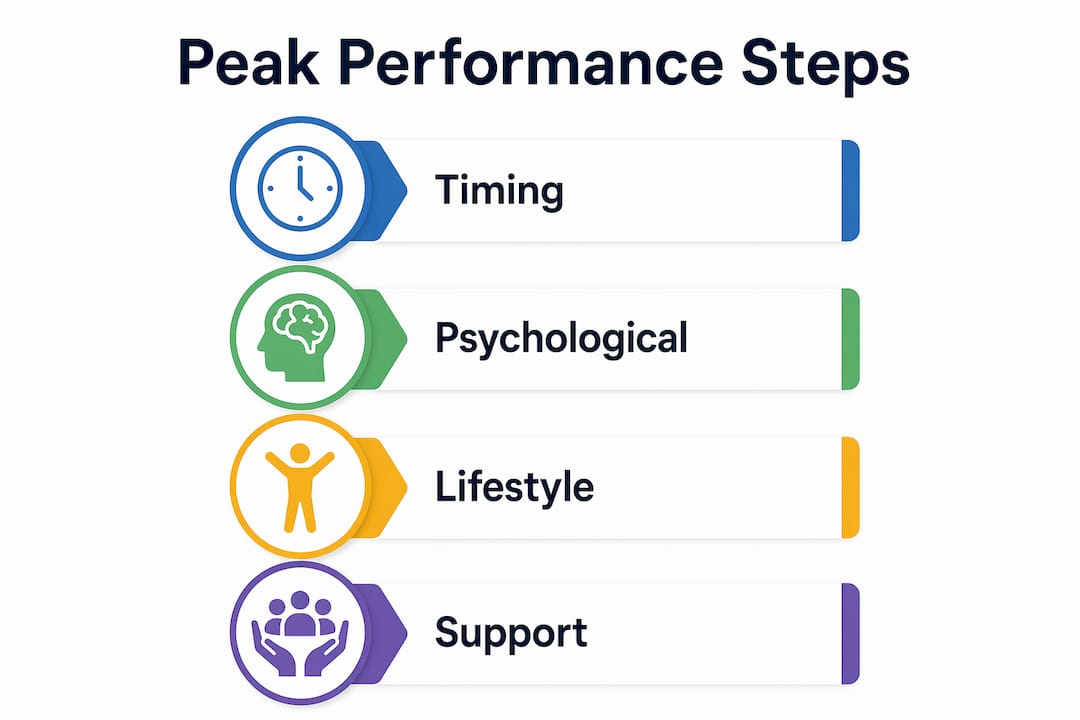
Timing your work to match cognitive cycles
Optimal work sessions aligned to ultradian rhythms last 90 to 120 minutes. The brain cycles through periods of high alertness and recovery roughly every 90 minutes throughout the day. Scheduling your most demanding cognitive work within these windows, and protecting the first 15 to 25 minutes from interruption, maximizes the probability of entering flow. A single notification during that induction window resets the neurochemical clock entirely.

Psychological techniques that hold up under pressure
A 4-week intervention combining breathing control and self-talk across 16 sessions produced significant improvements in concentration and performance under pressure. These are not soft skills. Controlled breathing directly modulates the autonomic nervous system, reducing cortisol and stabilizing attention. Self-talk protocols, when structured around process cues rather than outcome goals, maintain focus during high-stakes execution.
Psychological re-centering is the ability to detect cognitive drift and return to focused engagement quickly. In competitive and executive contexts, this skill separates consistent performers from those whose output degrades under pressure. The goal is not to eliminate stress. It is to shorten the recovery arc when stress disrupts focus.
Pro Tip: Before any high-stakes meeting or deep work session, spend 3 minutes on box breathing: 4 counts in, 4 counts hold, 4 counts out, 4 counts hold. Pair it with a single process-focused self-talk cue. This primes the nervous system for focused execution rather than reactive response.
Lifestyle foundations that stabilize cognitive output
| Habit | Mechanism | Practical standard |
|---|---|---|
| Sleep consistency | Stabilizes dopamine pathways and circadian rhythms | Same sleep and wake time, 7 to 9 hours |
| Nutrition timing | Regulates blood glucose and neurotransmitter precursors | Protein-anchored meals; avoid large carbohydrate loads before deep work |
| Hydration | Maintains cerebral blood flow and cognitive speed | 35 ml per kg of body weight daily |
| Exercise | Increases BDNF and prefrontal cortex volume | 150 minutes of moderate aerobic activity weekly |
Habitual sleep, nutrition, hydration, and exercise stabilize the biological systems that peak mental output depends on. These are not optional lifestyle upgrades. They are the substrate on which every cognitive strategy operates.
How does peak performance differ across contexts?
The neurobiological mechanisms of peak performance are consistent across domains. The application differs significantly depending on whether the context is athletic, executive, or creative.
In athletic performance, the challenge-skill calibration is managed through structured training periodization. In executive performance, the equivalent is workload design: structuring your week so that the highest-leverage decisions occur during peak cognitive windows, not at the end of a meeting-heavy afternoon. In creative work, the primary variable is environmental design. Removing friction from the entry into deep work, whether through ritual, physical space, or digital boundaries, determines how reliably flow is accessed.
What remains constant across all three domains is the role of recovery and discipline in maintaining output quality over time. Burnout is not caused by working hard. It is caused by working hard without adequate recovery, progressive challenge calibration, or psychological re-centering skills. The professionals who sustain high performance into their 50s and 60s are those who treat recovery as a performance variable, not a reward for effort.
Performance longevity is the capacity to maintain elite-level output across years and decades rather than sprinting to exhaustion. This requires building resilience into the system: varied challenge levels, deliberate rest, and motivation strategies that do not depend on external pressure. The executive who performs at 85% consistently for 20 years produces more than the one who performs at 100% for 3 years and then declines.
Key takeaways
Peak performance is a trainable neurobiological state that requires at least 10 weeks of deliberate practice to produce durable change, and 6 months to reach genuine automaticity.
| Point | Details |
|---|---|
| Core definition | Peak performance is consistent maximum-potential execution driven by neuroscience, not willpower. |
| Flow induction | Protect 15 to 25 minutes of uninterrupted focus to trigger the neurochemical cascade required for flow. |
| Development timeline | Durable neural adaptation takes 10 weeks minimum; automaticity requires 6 months of structured practice. |
| Challenge calibration | Set tasks at roughly 4% above current skill to stay in the optimal zone between boredom and anxiety. |
| Lifestyle substrate | Sleep consistency, nutrition, hydration, and exercise are not optional. They are the biological foundation of sustained cognitive output. |
What I've learned about peak performance that most frameworks miss
Most content on peak performance focuses on the entry point: how to get into flow, how to structure a morning routine, how to optimize a single day. That framing is useful but incomplete. The professionals I respect most are not optimizing individual days. They are building systems that make high performance the default state rather than the exception.
The single most underrated element of peak performance is the protection of the first 20 minutes of a work session. Not the first hour. Not the morning. Just those first 20 minutes of a focused block. That window is where the neurochemical conditions for flow either form or collapse. A single interruption, a glance at email, a quick message answered, resets the entire process. Most executives I observe surrender this window without realizing its cost.
The second thing most frameworks miss is the relationship between progressive challenge and motivation. When tasks stay at or below current skill level, dopamine release flattens and motivation erodes. This is not a discipline problem. It is a calibration problem. The fix is not more willpower. It is deliberately introducing a 4% difficulty increment into your most important work.
The Viridos approach to performance aligns with this precisely: quality over volume, precision over haste, and a long-term view of what sustained capability actually requires. Peak performance is not a state you visit occasionally. It is a standard you build toward, protect, and maintain through consistent, disciplined practice.
— Joakim
How Viridos supports sustained executive performance

The research is clear: sustained peak performance requires more than strategy. It requires a biological and psychological foundation that holds up under the demands of a high-responsibility career. Viridos is a premium Swedish men's performance brand built specifically for that context. The Viridos Membership provides access to small-batch executive formulations developed with precision, alongside resources designed to support resilience, motivation, and long-term cognitive output. This is not a supplement subscription. It is a structured approach to performance longevity for men who take their edge seriously. Explore the membership to understand what disciplined, sustained optimization looks like in practice.
FAQ
What is the definition of peak performance?
Peak performance is the consistent execution of activities at one's maximum potential, supported by specific neurobiological states including flow, and developed through deliberate practice over time. It is a trainable capacity, not a fixed trait.
How long does it take to achieve peak performance?
Durable neural adaptations from structured practice require a minimum of 10 weeks, with full skill automaticity developing around the 6-month mark. Short-term performance boosts are not the same as sustained peak performance.
What are the key characteristics of peak performance?
The core characteristics include automaticity, optimal challenge calibration at roughly 4% above current skill, sustained uninterrupted focus, and the ability to detect and correct cognitive drift under pressure.
What drives peak performance in professional contexts?
Peak performance in executive and professional settings is driven by aligned timing of deep work to ultradian rhythms, psychological re-centering skills, lifestyle habits that stabilize brain function, and progressive challenge that prevents plateau.
Can peak performance be sustained long-term without burnout?
Yes, when recovery is treated as a performance variable rather than a reward. Consistent sleep, deliberate rest periods, and calibrated challenge levels allow high performers to sustain elite output across years rather than burning out within months.