
A performance mindset is a deliberate, trainable focus on controllable, process-based skills rather than outcome fixation — and neuroplasticity is the mechanism that makes rewiring those defaults possible. For executives and founders in high-responsibility roles, this distinction is not academic. It is the difference between consistent output and cycles of pressure-driven overreach. Viridos is built around exactly this architecture: precision, process, and longevity over short-lived intensity.
Pro Tip: Tonight, spend two minutes writing three process-based actions you controlled today — not results, not outcomes. This single prompt, repeated nightly, begins reorienting your attentional system toward what you can actually govern.
Table of Contents
- What does a performance mindset actually mean?
- Why a performance mindset sustains clarity and resilience over time
- The core principles that define a performance mindset
- A training plan you can start this week
- Why this approach works: the science and expert observations
- Realistic timelines, and the mistakes that derail progress
- Key Takeaways
- The discipline of process, not the theater of effort
- The Viridos Performance Journal and Membership
- Useful sources
What does a performance mindset actually mean?
The clearest operational definition: a performance mindset prioritizes the inputs you control — effort, focus, preparation quality, and response to adversity — over the outputs you cannot guarantee, such as promotions, deal closings, or quarterly numbers.
Three distinctions that matter in practice:
- Process goal: "I will prepare three clear decision frameworks before the board meeting." Controllable, repeatable, measurable.
- Outcome goal: "I will impress the board." Dependent on others' reactions, uncontrollable, and anxiety-producing under pressure.
- The gap: Outcome fixation produces performance anxiety; process focus produces readiness.
Three myths worth correcting. A performance mindset is not raw willpower — willpower depletes; trained processes do not. It is not volume of work — grinding more hours without cognitive framing produces diminishing returns. And it is not an innate trait reserved for elite athletes. It is trainable, systematically, through repeated behavioral intervention.
Consider a concrete leadership scenario. A VP preparing for a difficult restructuring announcement has two options: fixate on how the team will react (outcome), or focus on preparing clear messaging, rehearsing responses to hard questions, and managing his own physiological state beforehand (process). The second approach does not guarantee a perfect meeting. It does guarantee he arrives at his best.
Why a performance mindset sustains clarity and resilience over time

Process focus produces measurable gains in consistency and resilience because it removes the cognitive load of chasing uncontrollable variables. When your attentional system is anchored to inputs, it has a stable target. Neuroplasticity explains the mechanism: consistent, intentional behavioral interventions prune unhelpful cognitive patterns — self-doubt, catastrophizing, procrastination — and strengthen the pathways that support sustained clarity and energy.
For executives specifically, three benefits stand out:
- Decision clarity: Process anchors reduce decision fatigue by narrowing focus to what is actionable right now.
- Recovery under pressure: Men who frame setbacks as data rather than verdicts return to baseline faster after high-stakes failures.
- Sustainable energy: Outcome-chasing depletes; process-driven work sustains. The learner/performer balance — blending short-term results orientation with ongoing development — is what prevents the burnout that ends careers prematurely.
Picture a founder mid-pitch, numbers softer than projected. Outcome panic looks like over-explaining, hedging, losing the room. Process control looks like returning to the prepared narrative, reading the room deliberately, and adjusting tone. Same facts, entirely different performance.
The core principles that define a performance mindset
Six principles form the operational framework. Each one is trainable and measurable.
- Process goals over outcome targets. Set goals around effort, preparation quality, and specific behaviors. Example: "Complete one focused 45-minute practice block daily" rather than "become a better communicator."
- Decouple preparation from execution. Applied sport psychologists recommend an intense, corrective mindset during preparation and a relaxed, outcome-detached focus during performance. Mixing the two causes over-trying and choking.
- Learner/performer balance. Alternate between periods of deliberate skill-building (learner mode) and periods of applying those skills under pressure (performer mode). Neither alone sustains long-term growth.
- Intentional routines. Small, repeatable daily habits drive neural change more reliably than occasional high-intensity effort.
- Focused recovery. Planned rest is not lost time. It is when consolidation occurs.
- Measure small inputs. Track what you did, not what happened. Reps logged, prompts completed, minutes of focused practice.
Preparation vs. execution: the mental states you need
| Dimension | Preparation mindset | Execution mindset |
|---|---|---|
| Primary focus | Corrective, analytical | Present, process-anchored |
| Emotional tone | Intense, critical | Relaxed, confident |
| Self-talk | "What needs to improve?" | "Trust the work done." |
| Cue to switch | End of practice session | Pre-performance routine begins |
Pro Tip: To pick the single input metric to track this month, ask yourself one question: "What is the one behavior, if done consistently, that would most directly improve my output?" Track only that. One metric, one month.
A training plan you can start this week
This plan is designed for a 45–60 minute daily investment, scalable down to 20 minutes on constrained days.
Daily structure:
- Morning (5 min): Write one process goal for the day. No outcomes. One controllable behavior.
- Pre-performance (3 min): Run a brief checklist — physiological state, key process cues, one visualization of executing the next task well, including a realistic obstacle.
- Midday reset (2 min): One slow breath cycle. Restate the day's process goal.
- Evening reflection (5 min): WWW/WWI — What Went Well / What's Worth Improving. Three items each. No self-judgment, only data.
Weekly structure:
- Monday: Set the week's single process focus. Schedule practice blocks.
- Wednesday: One deliberate rehearsal session (presentation, decision scenario, difficult conversation).
- Friday: Journal review. What patterns appeared? What adjusts next week?
- Sunday: Planned rest. No performance review. Consolidation.
12-week progression:
| Weeks | Focus | Measurable behavior |
|---|---|---|
| — | Habit ignition | Daily journal completed most days |
| 3 | Process goal precision | Goals written in behavioral, not outcome, terms |
| 5–6 | Preparation/execution decoupling | Pre-performance checklist used before key events |
| 7 | Learner mode activation | One deliberate skill session per week logged |
| — | Recovery integration | Planned rest days honored without guilt |
| 12 | Measurement and recalibration | Monthly input metric reviewed and adjusted |
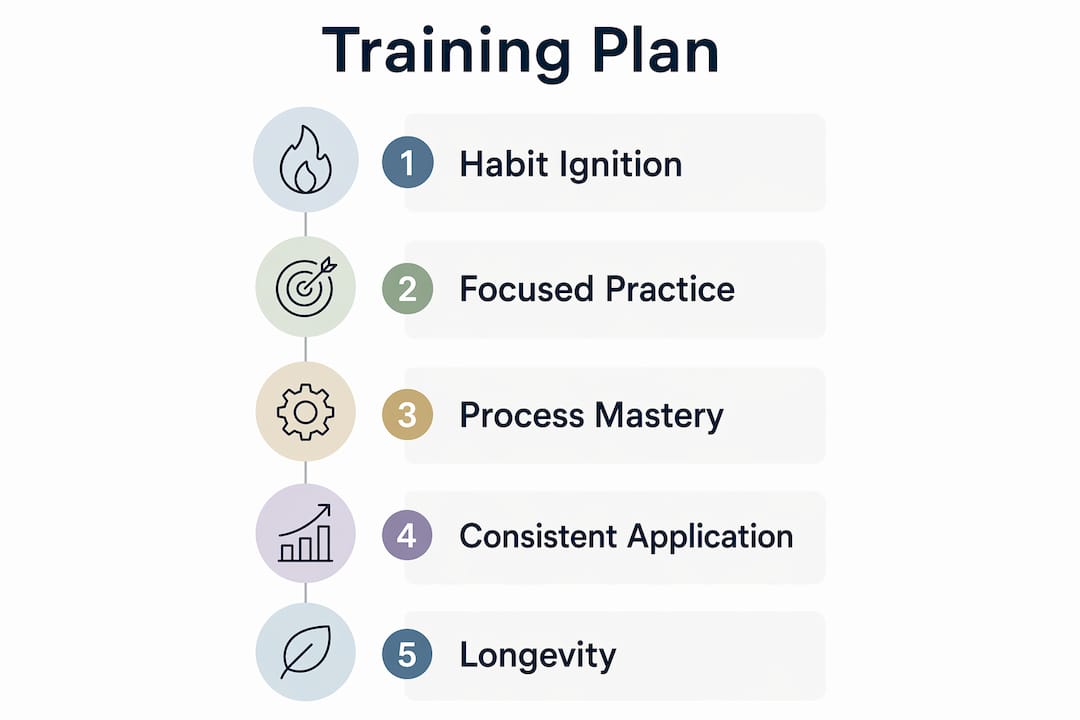
For elite performance longevity, the ceiling is not how much you do in week one. It is how consistently you sustain the minimum effective dose across twelve weeks.
Why this approach works: the science and expert observations
Neuroplasticity is the biological basis for everything in this plan. Repeated, intentional behavioral interventions physically reshape neural pathways — strengthening attentional circuits, pruning avoidance patterns, and building the default cognitive architecture of a high performer. This is not metaphor. It is the mechanism by which small routines create durable behavioral change.
Five mechanisms linking practice to lasting change:
- Repetition strengthens attentional pathways, making process focus the default rather than the effortful choice.
- Reflection updates strategy by converting experience into usable data rather than emotional residue.
- Visualization primes motor and cognitive systems for execution before the actual event.
- Recovery consolidates learning; without it, repetition produces fatigue, not growth.
- Growth framing — treating mistakes as information, a key strategy in boosting golf confidence — sustains persistence through the inevitable plateaus.
Condor Performance's applied sport psychologists make a precise observation: many high-performers underperform not from lack of skill but from failing to decouple preparation from execution. The corrective mindset needed in practice actively interferes with performance when carried into competition or the boardroom.
That framing shift — from self-evaluation to data collection — is what separates men who sustain performance across decades from those who peak early and plateau.
Realistic timelines, and the mistakes that derail progress
Three markers tell you the plan is working:
- 2 weeks: You notice when you slip into outcome thinking. Awareness precedes change.
- 6 weeks: Process behaviors begin to feel automatic. The pre-performance checklist takes 90 seconds, not five minutes of effort.
- 12 weeks: Measurable shifts appear in the input metrics you have been tracking. Consistency rates improve. Recovery quality improves.
Common mistakes and their corrections:
- Outcome fixation: You are journaling results, not behaviors. Fix: rewrite every goal in behavioral terms before the week begins.
- Excessive volume: Adding more practice blocks when the existing ones are not yet consistent. Fix: build executive resilience through consolidation before expansion.
- Skipping recovery: Treating rest days as wasted. Fix: schedule them as deliberately as practice sessions.
- Poor measurement: Tracking feelings instead of behaviors. Fix: log only observable actions — reps, minutes, prompts completed.
- Conflating effort with effectiveness: Busy is not the same as trained. Fix: one focused 45-minute block outperforms three distracted hours.
Key Takeaways
A performance mindset is a trainable, process-first architecture — built through small, repeated behavioral interventions that neuroplasticity converts into durable cognitive defaults.
| Point | Details |
|---|---|
| Process over outcomes | Set goals around controllable behaviors, not results you cannot guarantee. |
| Neuroplasticity is the mechanism | Repeated small interventions rewire default brain pathways for sustained clarity and resilience. |
| Decouple preparation and execution | Use an intense, corrective mindset in practice; a relaxed, anchored focus during performance. |
| 12-week progression | Measurable behavioral shifts appear by week 12 when the minimum effective dose is sustained consistently. |
| Viridos supports the plan | The Viridos Performance Journal and Membership provide templates, weekly cycles, and structured accountability for this exact framework. |
The discipline of process, not the theater of effort
The conventional wisdom on performance mindset tends to emphasize motivation — the idea that you need to want it badly enough, that intensity of desire is the differentiating variable. That framing is wrong, and it is worth saying plainly.
Desire is not scarce among executives and founders. What is scarce is the structural discipline to redirect that desire toward process rather than outcome. The men who sustain performance into their fifties and sixties are not more motivated than those who plateau. They have built better cognitive architecture. They have learned to measure inputs, honor recovery, and treat every setback as a data point rather than a verdict.
The precision lifestyle choices that support this kind of longevity are not glamorous. They are consistent. And consistency, compounded across twelve weeks and then twelve months, is what produces the durable edge that no single high-intensity sprint can replicate.
The Viridos Performance Journal and Membership

The training plan in this article maps directly to two Viridos tools built for disciplined executives. The Viridos Performance Journal provides structured templates for the daily WWW/WWI reflection, the weekly process goal cycle, and the 12-week progression table — so you are not building the system from scratch while also trying to use it. The Viridos Membership adds a peer accountability layer: structured weekly cycles and a cohort of high-agency professionals who hold the same standard you do.
Both are produced with the same precision and restraint that defines Viridos's small-batch Swedish approach. No noise, no filler. If you are ready to move from understanding the framework to running it, the Journal is where that starts.
Useful sources
- Premier Sport Psychology — The Power Five: Performance Mindset: Foundational framework for process-vs-outcome framing and the WWW/WWI reflection method.
- Tiffany Julie — What Is a High Performance Mindset?: Primary source on neuroplasticity as the trainability mechanism and the role of consistent behavioral intervention.
- Condor Performance — Performance Mindset: Applied sport psychology perspective on decoupling preparation from execution and reducing performance anxiety.
- Atlassian — Learner vs. Performer Mindset: Organizational psychology research on balancing short-term performance with long-term development to prevent burnout.
- JENEWEIN — What Is a High Performance Mindset?: Expert perspective on growth framing, mistake-as-data orientation, and persistence under pressure.
- Viridos Blog — High-Performance Mindset: A 2026 Guide for Executives: Viridos's long-form executive guide expanding on the principles and practices covered here.