
TL;DR:
- A high-performance mindset is a trainable cognitive system that enables consistent peak output under pressure. It combines solution-focused thinking, strategic attention management, stress reframing, and disciplined recovery to sustain long-term achievement.
A high-performance mindset is defined as the cognitive and behavioral framework that enables consistent peak output under pressure, complexity, and sustained demand. This is the standard psychological term for what performance researchers also call "peak cognitive functioning" or "high-achievement orientation." The framework combines growth orientation, deliberate practice, stress resilience, and disciplined cognitive energy management. Stanford University psychologist Carol Dweck's foundational research on growth mindset, along with more recent performance neuroscience findings, confirms that this mental operating system is built, not inherited. For executives, founders, and high-responsibility men navigating demanding roles, understanding what is high-performance mindset is the first step toward building one that lasts.
What is a high-performance mindset, and what defines it cognitively?
A high-performance mindset is a cultivated cognitive system built through deliberate practice, flow management, and grit rather than an innate personality trait. This distinction matters because it means the mindset is trainable at any age or career stage.
The core cognitive patterns that define it include:
- Solution-focused energy allocation. Elite performers direct roughly 70% of their mental energy toward solution-oriented strategies rather than dwelling on problems. That ratio is not accidental. It reflects a trained habit of redirecting attention before rumination takes hold.
- Strategic attention management. Top performers categorize attention into four blocks: strategic, proactive, reactive, and recovery. Each block serves a different cognitive function. Mixing them indiscriminately burns mental fuel without proportional output.
- Growth orientation plus stress reframing. Research published in 2022 shows that combining a growth mindset with the belief that stress enhances rather than impairs performance creates a synergistic mindset that outperforms growth mindset alone. The implication is clear: believing stress is useful makes it useful.
- Neural efficiency under pressure. Elite performers allocate prime cognitive hours, when the dorsolateral prefrontal cortex operates at peak capacity, to high-leverage strategic tasks. Low-value reactive work gets scheduled around those windows, not inside them.
Pro Tip: Map your four attention blocks before your workweek starts. Assign your highest-leverage decisions to your strategic block, typically the first 90 minutes after waking. Guard that window as you would a board meeting.
The high-performance mindset is not a mood or a motivational state. It is a structured approach to how cognitive resources are allocated, protected, and replenished across a full day and a full career.
How does a high-performance mindset differ from grind culture?
High performance is about precision, not endurance. Sustainable cognitive output requires working in peak cognitive states with sufficient recovery, not accumulating hours until the system degrades. Grind culture confuses volume with output. The high-performance mindset measures neither.
The confusion runs deep in executive culture. Many high-responsibility men equate exhaustion with commitment and rest with weakness. Both assumptions are wrong, and both accelerate the kind of cognitive erosion that ends careers early.
"High-performance mindset research by Mary Murphy and Carol Dweck shows that embracing difficulty and high standards, not uncritical positivity, is what drives sustained achievement. Comfort is not the goal. Calibrated discomfort is."
Positive thinking, as a standalone practice, also misses the point. Blind optimism without honest self-assessment produces poor decisions under pressure. The high-performance mindset requires accurate self-perception, willingness to confront hard feedback, and the discipline to act on it. That is a fundamentally different cognitive posture than repeating affirmations.
Recovery systems must be designed as rigorously as work itself. Sleep architecture, decompression routines, and deliberate cognitive rest are not luxuries. They are the maintenance schedule for a high-output mental system. Executives who skip this step do not perform harder. They perform worse, more slowly, and with greater error rates.
What practical strategies build and sustain a high-performance mindset?
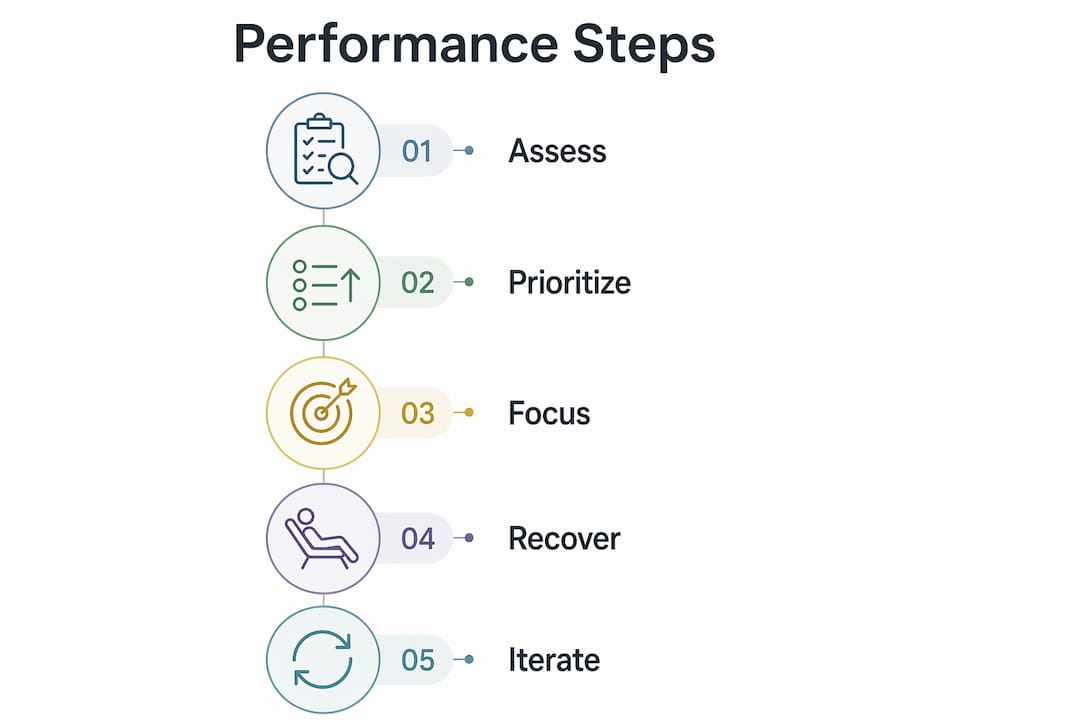
Building a high-performance mindset follows a 30/60/90-day cycle of micro-practices, controlled experiments, and iteration based on performance feedback. This framework, endorsed by practitioner guidelines in 2026, prevents the common failure mode of attempting wholesale behavioral change and abandoning it within two weeks.
The 30/60/90-day framework in practice
- Days 1–30: Micro-practices. Identify two or three specific cognitive habits to install. Examples include a five-minute morning intention-setting practice, a single daily review of decisions made under pressure, and a fixed end-of-day shutdown ritual. Small and repeatable beats ambitious and inconsistent.
- Days 31–60: Controlled experiments. Test one new approach to a recurring challenge. Apply the two-model minimum rule: run your primary mental approach against an opposing framework to avoid cognitive blind spots. For example, if your default is first-principles reasoning, stress-test the conclusion using inversion.
- Days 61–90: Iteration. Review what worked, what degraded, and what produced unexpected results. Adjust the system based on evidence, not preference.
Pro Tip: Track your cognitive state, not just your task completion. Note your energy level, focus quality, and decision confidence at the end of each strategic block. Patterns emerge within two weeks and tell you more than any productivity app.
Cognitive energy management in daily practice
| Approach | What it does | When to apply it |
|---|---|---|
| Strategic block scheduling | Reserves peak cognitive hours for high-leverage work | First 90 minutes of the workday |
| Stress reframing | Converts pressure into performance signal | Before high-stakes meetings or decisions |
| Recovery block design | Restores prefrontal capacity between demands | Midday and post-work decompression |
| Deliberate practice with feedback | Builds skill through discomfort and correction | Weekly review of decisions and outcomes |
The cognitive energy management approach used by elite performers is not about doing more. It is about doing the right things when the brain is best equipped to do them.
What are the long-term benefits of high-performance thinking?
The benefits of high-performance thinking compound over time in ways that short-term motivation never does. Professionals who build this mindset report measurably better outcomes across productivity, resilience, and career longevity.
Key documented benefits include:
- Sustained output under pressure. Precise state management and cognitive awareness allow professionals to maintain peak performance across longer time horizons without system degradation.
- Better decisions under stress. The synergistic mindset, combining growth orientation with stress-as-enhancing beliefs, produces stronger mental health outcomes and measurable academic and professional progress compared to growth mindset alone.
- Reduced burnout risk. Executives who design recovery into their performance system reduce the cumulative cognitive load that leads to burnout. The system stays intact because it is maintained, not just driven.
- Stronger grit and long-term motivation. Growth mindset research from Stanford University confirms that professionals who embrace difficulty and high standards sustain motivation longer than those who rely on external rewards or comfort.
- Sharper decision-making. Top performers who apply mental models like inversion and first principles reduce blind spots and improve strategic outcomes at the executive level.
The importance of a high-performance mindset is not theoretical. For men in demanding roles at 40, 50, or 60, it is the difference between a career that compounds and one that plateaus. The executive performance edge belongs to those who manage their cognitive system with the same discipline they apply to their business.
Key Takeaways
A high-performance mindset is a trained cognitive system built on solution-focused thinking, strategic attention management, stress reframing, and disciplined recovery, not willpower or endurance alone.
| Point | Details |
|---|---|
| Core definition | A high-performance mindset is a cultivated cognitive framework, not an innate trait or a motivational state. |
| 70/30 energy rule | Elite performers direct 70% of mental energy toward solutions, not problems, as a trained habit. |
| Synergistic mindset | Combining growth orientation with stress-as-enhancing beliefs outperforms growth mindset alone. |
| Recovery is non-negotiable | Designing recovery systems as rigorously as work prevents cognitive degradation and burnout. |
| 30/60/90-day rewiring | Building mindset habits through micro-practices, experiments, and iteration produces lasting change. |
What I've learned about mindset in men who carry real weight
The executives I observe most closely are not the ones who talk about mindset. They are the ones who have quietly built systems around it. That distinction took me years to fully appreciate.
The most common failure I see in high-responsibility men is not lack of ambition. It is the inability to distinguish between productive intensity and cognitive erosion. They push through fatigue as a point of pride, then wonder why their judgment degrades in the fourth quarter of a demanding year. The answer is always the same: they treated their mind like a machine with no maintenance schedule.
What actually works is less dramatic than most mindset content suggests. It is the man who protects his strategic morning block with the same firmness he applies to a shareholder call. It is the executive who schedules a genuine midday recovery window and does not apologize for it. It is the founder who reviews his decisions weekly, not to judge himself, but to calibrate his system.

Achieving a high-performance mindset at 45 or 55 is not about reinvention. It is about precision. You already have the experience. The work is learning to manage stress as an asset rather than a liability, and building the recovery architecture that keeps the system running at the level your role demands.
High performance is a lifelong practice. The men who sustain it are not the most talented. They are the most disciplined about how they manage the one resource that cannot be delegated: their own cognitive capacity.
— Joakim
Viridos and the executive performance edge

Viridos is built for men who take their cognitive and physical performance as seriously as their professional decisions. The Viridos membership provides controlled access to advanced executive performance formulation, developed in small-batch Swedish production with the precision and quality that discerning professionals expect.
Every element of the Viridos approach reflects the same principles covered here: disciplined practice, recovery by design, and sustained vitality over the long term. This is not a supplement program. It is a performance membership for men who understand that longevity at the top requires the same rigor applied to the mind as to the business.
Explore the Viridos membership and see how it fits into a performance system built to last.
FAQ
What is a high-performance mindset in simple terms?
A high-performance mindset is a trained cognitive framework that enables consistent peak output under pressure. It combines growth orientation, deliberate practice, stress resilience, and disciplined energy management.
Is a high-performance mindset the same as a growth mindset?
No. A growth mindset is one component. Research shows that combining it with the belief that stress enhances performance creates a synergistic mindset that produces stronger outcomes than growth mindset alone.
How long does it take to develop a high-performance mindset?
Practitioner guidelines recommend a 30/60/90-day cycle of micro-practices, experiments, and iteration. Meaningful cognitive habit change typically becomes measurable within 60–90 days of consistent practice.
Can high performance be sustained without burning out?
Yes, but only when recovery is treated as part of the performance system. Experts define sustainable high performance as working in peak cognitive states with sufficient recovery, not accumulating effort until the system degrades.
What is the biggest mistake executives make with mindset work?
The most common error is confusing endurance with performance. Grind culture rewards volume, but high-performance thinking rewards precision, state management, and the discipline to protect cognitive recovery as rigorously as productive output.