
TL;DR:
- Executive resilience is a skill that enables leaders to adapt, recover, and sustain performance under high pressure. Building resilience involves developing optimism, self-compassion, and a growth mindset through deliberate practice and structured routines. Effective recovery, cognitive reframing, and organizational governance processes are essential for maintaining resilience over time.
Executive resilience is defined as the capacity to adapt, recover, and sustain performance under high-stakes pressure through deliberate, learnable skills. According to Wharton Executive Education, resilience is not a fixed personality trait. It is a skill set that includes personal stress management, team focus, and contingency planning. This guide explains how to build executive resilience through structured mindset work, recovery discipline, cognitive reframing, and governance integration. The methods here draw from randomized controlled trials, Egon Zehnder research, and CEOWORLD's 3R resilience architecture. If you lead under pressure and want a repeatable system, this is where to start.
What foundational skills and mindsets build executive resilience?
Building leadership resilience starts with three core psychological assets: optimism, self-compassion, and a growth mindset. These are not soft concepts. A web-based resilience intervention called RESIST demonstrated through mediation analysis that optimism and self-compassion are the primary drivers of measurable resilience improvement. That finding matters because it tells you where to focus first.
A growth mindset reframes setbacks as data rather than verdicts. When a board meeting goes poorly or a key hire fails, the growth-oriented leader asks what the situation revealed rather than what it confirmed about their limitations. This shift is not automatic. It requires deliberate practice, including exercises like writing a personal model of resilience or mapping your resilience self-image against real past challenges.
Self-compassion is often the most underdeveloped skill in high-performing executives. Men in demanding roles tend to apply rigorous standards to themselves without the recovery buffer those standards demand. Developing self-compassion means acknowledging difficulty without catastrophizing and maintaining performance expectations without self-punishment.
Key mindset practices for developing executive resilience:
- Write a personal resilience model. Map two or three past challenges and identify what helped you recover. This builds pattern recognition for future stress.
- Practice optimism as a discipline. Each morning, identify one realistic positive outcome for the day's hardest task.
- Build a resilience self-image. Define in writing who you are under pressure. Leaders who articulate this perform more consistently when tested.
- Reframe uncertainty as information. Uncertainty is not a threat signal. It is a prompt to gather data and adjust.
Pro Tip: Spend five minutes each Sunday reviewing one setback from the prior week. Write one sentence on what it taught you. Over 90 days, this builds a personal resilience archive that recalibrates how you interpret future difficulty.
How can executives implement effective recovery strategies?
Recovery is the most underfunded asset in executive performance. IMD research identifies a recovery paradox: the executives who most need rest are the ones most likely to stigmatize it. That stigma is not just personal. It shapes organizational culture and signals to teams that overwork is the standard.

Microbreaks are the most practical recovery tool available to a working executive. Pauses of 5–15 minutes taken regularly boost energy and restore attention without requiring schedule disruption. The key is intentionality. A microbreak spent checking email is not a microbreak. It is a continuation of cognitive load.
Social recovery is a common but often counterproductive choice for overworked leaders. Leisure-time socializing can keep the work loop active by sustaining the same conversational and status-monitoring circuits that drive executive stress. True recovery requires psychological detachment from work content entirely.
Effective recovery strategies for high-pressure executives:
- Schedule microbreaks as calendar blocks. Treat a 10-minute midday walk the same way you treat a board call.
- Choose restorative activities that require no performance. Reading fiction, walking without a destination, or sitting in silence qualify. Networking lunches do not.
- Model recovery publicly. When senior leaders take breaks visibly, it reduces recovery stigma across the organization.
- Use physical movement as a reset. Brief physical activity interrupts the attention capture cycle and provides a physiological reset.
Pro Tip: Block two 10-minute recovery windows into your calendar before 2 p.m. every day for two weeks. Track your afternoon decision quality. Most executives report a measurable difference within the first week.
For a deeper look at recovery discipline and how it compounds over time, the Viridos performance blog covers this in detail.
What cognitive techniques help manage threat perception?
Threat salience is an innate cognitive bias. Egon Zehnder research confirms that executives under sustained pressure default to threat-focused processing, which narrows judgment and accelerates exhaustion. The solution is not to suppress threat awareness. It is to install deliberate counterweights that restore cognitive balance.
Four reframing counterweights that recalibrate threat perception:
- History. Ask: "Have I navigated something this difficult before?" Anchoring in past performance reduces the perceived novelty of current threats.
- Gratitude. Identify two specific things that are working well in the current situation. This is not positive thinking. It is a cognitive rebalancing exercise.
- Service. Reconnect with who depends on your leadership. Purpose-anchoring reduces anxiety by shifting focus from self-preservation to contribution.
- Learning. Ask what this situation is teaching you that no easier circumstance could. This converts threat into curriculum.
"Instead of increasing vigilance, leaders benefit from cognitive counterweights to restore balance and reduce overload." — Egon Zehnder on Leadership Endurance
The "phone a friend" approach is underused in executive circles. Calling a trusted peer not to solve a problem but to gain perspective is one of the fastest ways to interrupt threat-focused rumination. Shared perspective breaks the isolation loop that amplifies anxiety in senior roles.
These techniques work best when integrated into daily routines rather than reserved for crisis moments. A two-minute reframing check at the start of each day costs nothing and compounds significantly over a quarter. For more on resilient performance strategies built around cognitive discipline, the Viridos blog provides a practical framework.
How do you operationalize resilience as a measurable program?
Resilience training for leaders produces the strongest results when it follows a structured, recurring protocol. A randomized controlled trial protocol published in Frontiers in Psychology combines 20 weekly resilience sprints with questionnaire-based progress tracking. That structure matters. Ad hoc resilience work produces ad hoc results.
The first operational step is a resilience audit. RISEUP Global recommends identifying one to two high-impact resilience pillars to address first rather than attempting broad improvement across all areas simultaneously. This staged approach avoids the common failure mode of treating resilience as a wellness initiative rather than a performance discipline.
The 3R resilience architecture from CEOWORLD provides a governance-level framework:
| Pillar | Focus Area | Leadership Action |
|---|---|---|
| Risk Anticipation | Identify and map emerging threats | Integrate into board-level scenario planning |
| Reputation Governance | Protect organizational credibility under pressure | Assign ownership at C-suite level |
| Recovery for Continuity | Sustain operations and leadership capacity post-disruption | Build recovery protocols into decision frameworks |
This architecture works because it treats resilience as a governance function, not a personal wellness habit. When resilience is top-owned and embedded in decision-making, it becomes organizational infrastructure rather than individual coping.
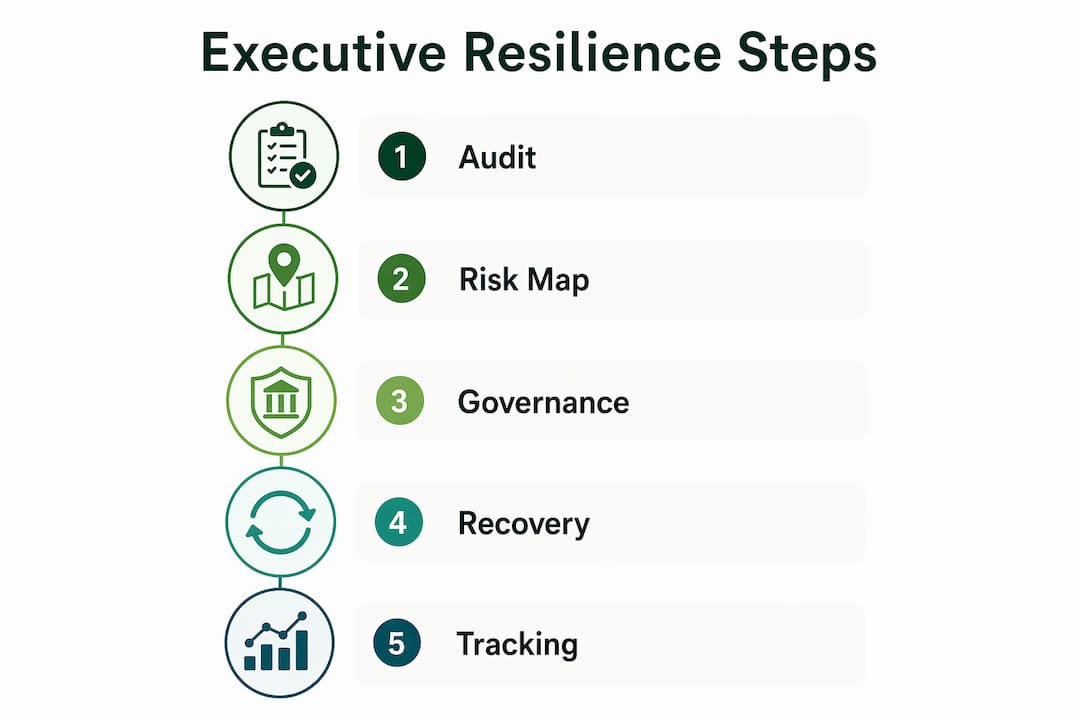
Tracking progress is non-negotiable. Weekly self-assessments against defined resilience indicators, combined with quarterly reviews of decision quality and recovery patterns, give you the data to adjust your program. Executives who track resilience metrics treat it with the same discipline they apply to financial performance.
Pro Tip: Run a 15-minute resilience audit at the start of each quarter. Identify your single most fragile resilience pillar and assign one specific practice to strengthen it. One focused improvement per quarter compounds into a fundamentally different leadership profile within two years.
For executives building vitality and performance alongside resilience, physical conditioning and resilience training reinforce each other directly.
Key takeaways
Executive resilience is built through structured, repeatable practices in mindset development, recovery discipline, cognitive reframing, and governance integration rather than through reactive stress management.
| Point | Details |
|---|---|
| Resilience is a learnable skill | Wharton and RESIST trial data confirm resilience can be shaped through deliberate practice and habit formation. |
| Optimism and self-compassion drive results | These two factors are the primary mechanisms behind measurable resilience improvement in clinical research. |
| Recovery requires intentional design | Microbreaks of 5–15 minutes outperform social recovery for executives prone to cognitive overload. |
| Cognitive reframing prevents threat overload | History, gratitude, service, and learning counterweights restore judgment and reduce anxiety in high-pressure roles. |
| Governance integration sustains resilience | The 3R architecture embeds resilience into board-level decision-making, making it an organizational asset rather than a personal habit. |
Why most executives get resilience backwards
The executives I respect most do not talk about resilience as a crisis response. They treat it as infrastructure. The ones who struggle are usually the ones who wait for a breaking point before they invest in recovery, reframing, or structured training.
What I have observed consistently is this: the gap between a leader who sustains performance over a decade and one who burns out at year five is rarely talent or intelligence. It is the presence or absence of a repeatable resilience system. The former has scheduled recovery, a cognitive reframing practice, and some form of progress tracking. The latter relies on willpower and social support that, as IMD research confirms, often keeps the work loop running rather than interrupting it.
The cognitive reframing piece is where I see the most underinvestment. Threat salience is real and it is relentless in senior roles. The leaders who maintain decision clarity under sustained pressure are not less affected by threat signals. They have simply built the counterweight habits that prevent those signals from dominating their cognition.
Resilience is not about being unaffected. It is about having a system that brings you back faster, clearer, and with better judgment than the last time. That system is buildable. It is measurable. And it belongs at the top of your leadership agenda, not delegated to an HR wellness program.
— Joakim
Build your resilience system with Viridos
Developing executive resilience requires more than reading about it. It requires a structured tracking system and the right physiological foundation to support sustained performance.

The Viridos Performance Journal is designed for exactly this purpose. It gives disciplined executives a structured format to track resilience habits, recovery patterns, cognitive reframing practices, and weekly progress against defined leadership goals. Combined with the Viridos Membership program, which provides controlled access to premium executive performance formulations produced in small batches in Sweden, it creates a complete system for men who take performance longevity seriously. If you are ready to treat resilience as a measurable discipline rather than a reactive coping strategy, Viridos is built for that standard.
FAQ
What is executive resilience?
Executive resilience is the capacity to adapt, recover, and maintain performance under sustained high-stakes pressure. It is a learnable skill set that includes stress management, team focus, and contingency planning rather than a fixed personality trait.
How long does it take to build executive resilience?
Structured resilience training programs show measurable improvements over 20 weekly sessions when combined with self-directed practice and progress tracking. Consistent application of even one or two targeted practices produces noticeable changes in decision quality and recovery speed within 60–90 days.
What is the most effective recovery strategy for executives?
Microbreaks of 5–15 minutes taken at regular intervals are more effective than social recovery for executives prone to overwork. Social activities often maintain cognitive engagement with work stress rather than interrupting it.
How do you integrate resilience into leadership governance?
The 3R architecture from CEOWORLD integrates resilience through risk anticipation, reputation governance, and recovery as board-level functions. Resilience owned at the top of the organization becomes decision-making infrastructure rather than a personal wellness practice.
What is a resilience audit and why does it matter?
A resilience audit identifies your one to two most fragile resilience pillars so you can focus improvement where it has the highest impact. RISEUP Global recommends this staged approach to avoid the common failure of spreading effort too thin across all resilience dimensions simultaneously.