
TL;DR:
- Mindfulness trains men's attention and emotional regulation, improving decision-making and stress management. Regular practice lowers cortisol and enhances leadership, relationships, and mental resilience over time. Short, structured routines are effective for busy men seeking lasting performance benefits.
Mindfulness is the practice of intentional, present-moment awareness that trains men to regulate emotions, reduce stress, and make sharper decisions under pressure. The clinical term is mindfulness-based attention training, and the evidence behind it is no longer soft. Cardiovascular health, sleep quality, and inflammation all improve with consistent practice. For men in demanding roles, the real argument is simpler: mindfulness is the difference between reacting and responding. That gap, repeated across hundreds of decisions a day, determines performance longevity.
Why mindfulness matters for men in high-performance roles
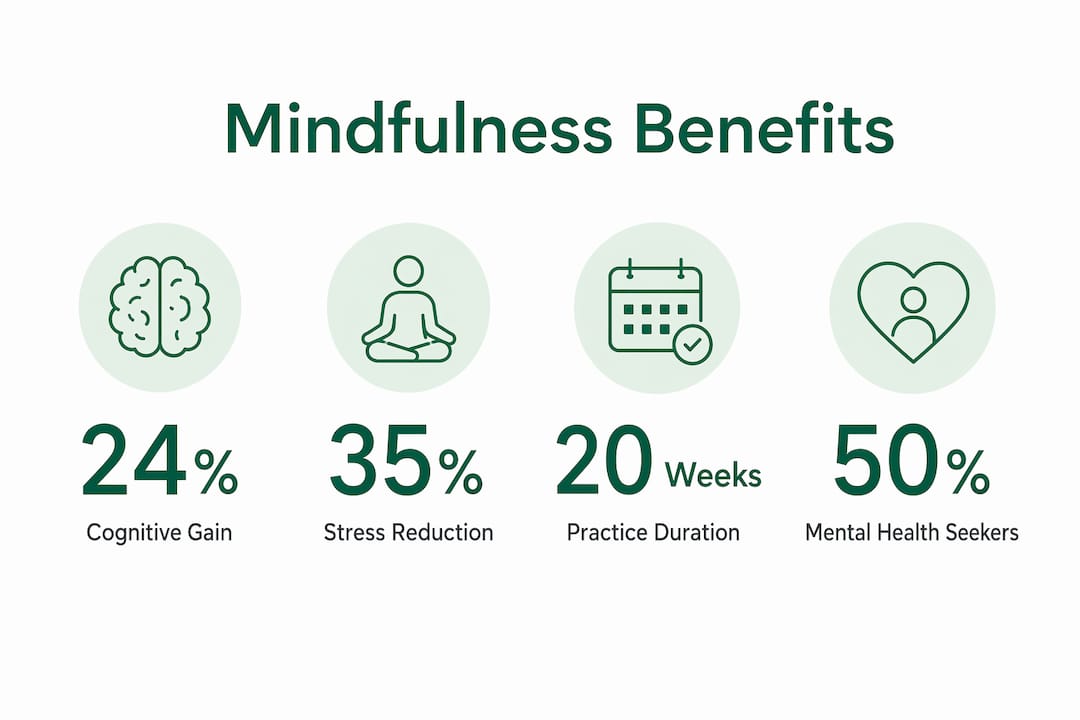
Mindfulness produces measurable changes in the brain, not just in mood. A 2024 meta-analysis of 111 randomized controlled trials found that meditation significantly improves executive function, sustained attention, and working memory. That means faster processing, better recall under stress, and stronger impulse control during high-stakes decisions.
The mechanism works like physical training. Attention is a neural pathway. Repeated focus and redirection physically strengthens the circuits responsible for concentration and cognitive control. A man who trains his attention daily builds the same kind of compound advantage a man who trains his body does.
The practical stakes are real. Executives and founders make hundreds of judgment calls each week. Fatigue, cortisol spikes, and distracted attention degrade those calls invisibly. Mindfulness addresses the root cause rather than the symptom.
| Cognitive benefit | What it means in practice |
|---|---|
| Improved sustained attention | Fewer errors during long meetings or complex analysis |
| Stronger working memory | Better retention of details without notes or reminders |
| Reduced mental fatigue | Consistent output later in the day, not just in the morning |
| Lower cortisol response | Calmer decision-making under deadline pressure |
A 2025 study on professional male fencers using a 20-week mindfulness intervention showed measurable gains in attention span, reduced cortisol, and lower mental fatigue. Fencing demands split-second reads of an opponent's intent. The cognitive demands mirror those of a high-pressure boardroom or negotiation.
Pro Tip: Start with five minutes of focused breathing before your first meeting of the day. The goal is not to clear your mind but to notice where it goes and bring it back. That return is the training.
Why men struggle emotionally and how mindfulness helps
Men seek professional mental health support at roughly half the rate of women. The gap is not primarily about stigma. It is about vocabulary. Many men genuinely cannot name what they are feeling, which makes it nearly impossible to address.
Mindfulness and emotional wellness are directly connected through a simple neurological mechanism. Naming an emotion engages the prefrontal cortex and creates a regulatory gap between the stimulus and the stress response. That gap is where intentional behavior lives. Without it, men operate on autopilot, driven by cortisol and habit rather than values and judgment.
The pattern shows up in a specific way. Men often describe emotional states in productivity terms: "I'm off today," "I can't focus," or "I'm running low." These are accurate observations but incomplete diagnoses. Mindfulness creates space for more accurate emotional recognition, which is the first step toward regulation.
"Mindfulness is a mental maintenance routine that helps men process complex emotional states accurately. Without it, emotional confusion accumulates quietly and surfaces as reactive behavior, poor decisions, or physical tension."
— Psychology Today, Practical Mindfulness, 2026
The practical benefits for men who build this skill are significant:
- Reduced reactivity in high-pressure conversations and negotiations
- Clearer self-assessment when evaluating personal performance or team dynamics
- Better stress recognition before it compounds into burnout or physical symptoms
- Stronger emotional presence in personal relationships, which builds trust over time
The stress management process for high-performing professionals often stalls because men address symptoms rather than the underlying emotional state. Mindfulness addresses the source.
Common misconceptions men have about mindfulness practice
The biggest barrier is a category error. Most men who dismiss mindfulness picture passivity: sitting still, emptying the mind, doing nothing. That is not what mindfulness is. Mindfulness trains the nervous system to be less reactive under pressure, enabling action based on values and intentionality rather than stress reaction. It is a form of active conditioning.
The second misconception is about technique. Many men who try meditation attempt to force their mind to stay still, what researchers call "white-knuckling." Growth in mindfulness occurs during the return-to-focus phase after distraction, not in forced stillness. Every time attention wanders and a man brings it back, that is a repetition. That is the training.
Practical mindfulness for busy men does not require a retreat or an hour of silence. The following approaches work within a demanding schedule:
- Two-minute breath focus before any high-stakes call or meeting
- Single-task blocks of 25–45 minutes with all notifications off
- End-of-day review of three decisions made and the emotional state behind each
- Body scan during commutes to identify where tension is held before it becomes chronic
- Deliberate pauses of three to five seconds before responding in tense conversations
The mental sharpness routine for high-performing executives integrates several of these practices into a structured daily framework. The key is consistency over intensity.
Pro Tip: Protect one 20-minute block each morning before checking email or messages. Use it for reflection, breath work, or journaling. Treat it with the same discipline you apply to a board meeting. That boundary signals to your nervous system that clarity is a priority.
How mindfulness shapes leadership, relationships, and daily resilience
The benefits of mindfulness extend well beyond the individual. Men who practice consistently become noticeably different to the people around them, even when those people cannot explain why.
Quietly mindful men maintain mental boundaries and prioritize meaningful engagement. They do not react to every provocation. They do not fill silence with noise. They ask better questions because they are actually listening rather than preparing their next point. That quality builds trust faster than any leadership training program.
The impact on leadership under pressure is direct. A man who has trained his attention can hold multiple competing priorities without losing composure. He reads the room accurately because he is not filtering it through his own anxiety. His responses are calibrated rather than reflexive.
The following sequence describes how mindfulness compounds into leadership presence over time:
- Daily practice builds a lower baseline cortisol level. The nervous system becomes less trigger-sensitive over weeks of consistent work.
- Lower reactivity improves listening quality. Men who are not flooded with stress hormones hear more of what is actually being said.
- Better listening produces more accurate responses. Teams and partners experience this as being understood, which builds loyalty.
- Accumulated trust creates psychological safety. Teams perform better when they are not managing their leader's emotional state.
- The leader's calm becomes a cultural signal. Subtle daily mindfulness practices lead to a baseline calm that others perceive but cannot readily explain.
The same dynamic applies in personal relationships. A man who can name his emotional state and regulate his response is a fundamentally different partner, father, and friend. Presence is the rarest resource in most households. Mindfulness makes it available.
The vitality optimization guide for high-performing men addresses how attention training fits within a broader performance framework for men in the 40–65 range.
Key Takeaways
Mindfulness is not a soft skill. It is a trainable cognitive and physiological system that directly improves decision quality, emotional regulation, and leadership presence in men who practice it consistently.
| Point | Details |
|---|---|
| Cognitive performance | A 2024 meta-analysis confirms mindfulness improves executive function, attention, and working memory. |
| Emotional regulation | Naming emotions engages the prefrontal cortex and creates a gap between stimulus and reactive behavior. |
| Correct technique | Growth comes from returning focus after distraction, not from forcing the mind to stay still. |
| Leadership impact | Consistent practice lowers baseline cortisol and produces a calm that builds trust in teams and relationships. |
| Daily integration | Short, structured practices protect mental space and compound into measurable performance gains over time. |
Mindfulness as mental fitness: a perspective worth adopting
I have watched a lot of high-performing men approach mindfulness the same way they approach everything else: with force. They set a 30-day challenge, download an app, and try to meditate perfectly. Within two weeks, most have quit. The practice felt unproductive. Nothing seemed to happen.
The reframe that actually works is this: mindfulness is not meditation as a task. It is mental fitness as a discipline. A man who lifts weights does not expect to feel stronger after one session. He builds a program, tracks progress, and trusts the compound effect. Mindfulness works the same way. The gains are invisible for weeks and then suddenly obvious.
The men I respect most in demanding roles share a common quality. They are not the loudest in the room. They are the most present. They do not perform calm. They have built it. That is not a personality trait. It is a trained capacity.
The practical entry point is smaller than most men expect. Five minutes of focused breath work in the morning, a deliberate pause before responding in a tense conversation, a brief written reflection at the end of the day. These are not spiritual practices. They are healthy lifestyle routines that produce a measurable return on attention.
The importance of mindfulness in men's lives is not about becoming more sensitive. It is about becoming more accurate: about your emotional state, your decisions, and the effect you have on the people around you. That accuracy is a competitive advantage. Treat it like one.
— Joakim
The Viridos Performance Journal and daily mindfulness
Sustained mindfulness requires a structure that holds the practice in place, especially during high-pressure periods when the habit is most likely to slip.

The Viridos Performance Journal is designed for exactly this purpose. It gives disciplined men a daily framework to track attention, emotional state, and decision quality without adding complexity to an already demanding schedule. The format is direct and structured, built for men who want results from their routines, not rituals for their own sake. Journaling combined with breath work and reflection creates the feedback loop that makes mindfulness stick. Viridos builds tools for men who take their performance seriously over the long term.
FAQ
What is mindfulness and why does it matter for men?
Mindfulness is intentional, present-moment awareness that trains attention and emotional regulation. It matters for men because it directly improves decision quality, reduces cortisol, and builds the kind of calm that sustains performance under pressure.
How does mindfulness improve men's mental health?
Mindfulness builds emotional vocabulary and regulation by engaging the prefrontal cortex, the brain's executive center. Men who practice consistently show lower reactivity, better stress recognition, and stronger emotional clarity in both professional and personal contexts.
How long does it take to see benefits from mindfulness practice?
Cognitive and physiological benefits from mindfulness typically become measurable after several weeks of consistent daily practice. A 20-week study on professional male athletes showed significant gains in attention and cortisol reduction with structured mindfulness training.
What are the best mindfulness techniques for busy men?
The most effective techniques for men with demanding schedules include two-minute breath focus before high-stakes meetings, single-task work blocks of 25–45 minutes, and a brief end-of-day written reflection on decisions and emotional state.
Does mindfulness make men less decisive or assertive?
Mindfulness does not reduce decisiveness. It improves it. Training the nervous system to respond rather than react produces faster, more accurate decisions under pressure, not slower or more passive ones.