
TL;DR:
- Elite performance is about maintaining consistent excellence relative to a specific peer group or cohort. Small differences in performance levels can lead to large disparities in recognition and outcomes, especially over time. Effective environmental support and disciplined recovery are essential for sustaining high achievement in any field.
Elite performance is the sustained demonstration of excellence relative to a competitive cohort, defined not by a single peak moment but by consistent output at the highest levels of a given field. The term is used formally in sports science and organizational psychology, where researchers measure it through objective criteria: national or international competition status, global rankings, or institutional funding. For executives, founders, and high-agency professionals, understanding elite performance means recognizing that the same principles governing world-class athletes govern sustained cognitive output, decision quality, and career longevity. The science is transferable, and the standards are higher than most people assume.
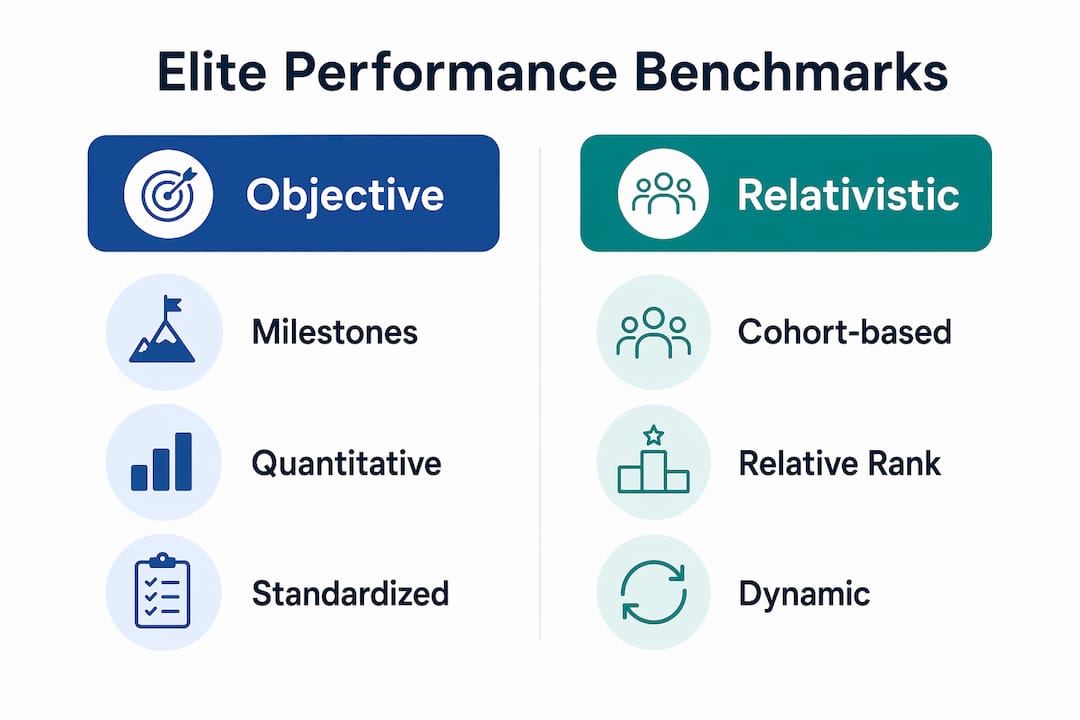
What defines elite performance: objective and relativistic benchmarks
Elite performance has no single universal definition, but researchers consistently apply objective milestones to identify it. These include competing at events like the Olympics, holding rankings among the top 4–300 performers globally, or receiving institutional funding reserved for high-level athletes. These criteria exist because "high performance" without a reference point is meaningless.
The more important insight is that elite status is always relative. Your ranking depends on your comparison cohort and the time frame being measured. A performer who dominates a national field may be average at the international level. A founder who outperforms peers in a startup cohort may fall short of the standard set by a different peer group five years later. Context shapes recognition entirely.
This relativistic framework has a practical implication: small absolute performance differences can create massive disparities in outcomes, recognition, and reward. The gap between first and fifth place in an Olympic final is often fractions of a second. In business, the gap between a market leader and the second-best competitor can be equally narrow yet produce dramatically different results.
Researchers also distinguish between talent development and sustained high-performance environments. Talent development focuses on junior-to-senior transitions, while high-performance environments address maintaining and extending peak career output. This distinction matters for executives: the skills that got you to a senior role are not the same skills that keep you performing at the top of that role for a decade.
- Elite status requires a defined comparison cohort, not just personal bests
- Rankings shift as the cohort changes, making continuous recalibration necessary
- Talent development and sustained performance are separate disciplines with different demands
- Institutional support and funding are recognized markers of elite classification in sports science
Pro Tip: Define your own comparison cohort explicitly. Vague ambitions like "performing at a high level" produce vague results. Identify the specific peer group you are measured against and track your position within it quarterly.
What are the physiological and psychological hallmarks of elite performers?
Elite performers differ from high performers in two compounding ways: their bodies adapt more efficiently, and their minds govern those bodies more effectively. Neither advantage operates in isolation.

On the physiological side, elite athletes display superior cardiovascular efficiency, metabolic flexibility, and neuromuscular coordination. These adaptations come from years of periodized training, not raw genetics alone. Optimizing elite performance requires individualized training, nutritional periodization, and rigorous recovery protocols. Managing low energy availability is particularly critical. Chronic energy deficits impair hormonal function, bone density, and cognitive output, often before the performer notices any decline.
The psychological dimension is where most high achievers underestimate the gap. The mind acts as the governor that restricts or enables physical and cognitive potential. Championship-level consistency, not isolated peaks, defines elite status. This means emotional regulation, stress tolerance, and decision quality under pressure are as trainable as cardiovascular fitness.
Elite performers possess superior perceptual-cognitive skills that allow faster, more efficient processing of complex information. In high-pressure situations, this cognitive efficiency reduces mental fatigue and preserves decision quality when it matters most. For an executive running a board meeting or a founder managing a crisis, this is the same mechanism at work.
- Train recovery as deliberately as output. Sleep, structured rest, and deload periods are not optional. They are the mechanism through which adaptation occurs.
- Manage energy availability. Adjusting macronutrients 24–36 hours before high-demand periods reduces physiological stress and preserves peak output. This applies to a major presentation as much as a competition.
- Build cognitive efficiency through deliberate practice. Repeated exposure to high-pressure decision scenarios trains faster, more accurate responses over time.
- Monitor allostatic load. Improper recovery increases allostatic load, the cumulative burden of stress on the body and mind, leading to burnout rather than growth.
- Integrate mental and physical training. Mindset and cognitive control are the primary governors of physical potential. Treating them as separate disciplines leaves performance on the table.
Pro Tip: Track your decision quality, not just your output volume. Elite performers notice when cognitive efficiency drops before their results do. A weekly review of your three most consequential decisions reveals patterns that output metrics miss entirely.
How does environment shape elite performance?
No performer operates in isolation. Environmental factors including coaching quality, communication, family support, team dynamics, and socio-economic policy all significantly influence elite development and performance sustainability. The environment either accelerates or limits what individual talent can produce.
High-performance sport environments (HPSEs) operate across three levels simultaneously. The micro level covers daily interactions: coaching conversations, training quality, and peer relationships. The meso level covers organizational culture: how institutions structure support, accountability, and development. The macro level covers policy and funding: the broader social and economic conditions that make sustained performance possible or impossible.
Environments that integrate wellbeing support alongside performance objectives achieve better sustainability and better mental health outcomes. The shift from "win at all costs" cultures to athlete-centered approaches produces longer careers and higher morale. This finding translates directly to corporate environments, where cultures that treat people as assets to develop rather than resources to extract consistently outperform over long time horizons.
| Environment type | Primary focus | Sustainability outcome |
|---|---|---|
| Win-at-all-costs culture | Short-term results | High burnout, shorter peak duration |
| Athlete-centered culture | Performance and wellbeing | Longer careers, higher consistency |
| Facilitative coaching model | Individual development | Greater adaptability under pressure |
| Institutional support systems | Funding and policy alignment | Broader talent pipeline and retention |
A caring coaching philosophy combined with a facilitative organizational culture is as important as physical training for long-term elite success. For executives, this means the quality of your advisors, your board relationships, and your immediate team culture are not soft factors. They are performance infrastructure.
How do elite performance principles apply to executives and high achievers?
The principles that define elite athletic performance map directly onto executive effectiveness. The mechanisms are identical. The application requires translation.
Performance longevity requires disciplined recovery, structured nutrition, and a trained mindset. Executives who treat sleep as negotiable and nutrition as an afterthought are operating with a degraded physiological base. The cognitive penalties compound over months and years, not days.
Cognitive efficiency under stress is the executive equivalent of athletic decision-making under pressure. The same perceptual-cognitive training that separates elite athletes from competent ones applies to high-stakes negotiations, capital allocation decisions, and crisis management. Deliberate practice in high-pressure scenarios builds the neural pathways that make faster, cleaner decisions possible.
Environment matters as much in business as in sport. The quality of your peer group, your advisors, and your organizational culture either raises or lowers your performance ceiling. Choosing your comparison cohort deliberately, as the relativistic framework suggests, is itself a performance decision.
- Nutritional periodization for executives means aligning food intake with cognitive demand cycles, not just caloric targets
- Recovery protocols should be scheduled with the same discipline as meetings
- Peer group selection determines the standard you are measured against and the ceiling you aim for
- Tracking vitality markers (sleep quality, energy consistency, decision clarity) provides early warning of declining performance before output metrics drop
Key takeaways
Elite performance is a sustained, relative standard of excellence requiring cognitive, physiological, and environmental alignment, not a single peak moment or innate talent.
| Point | Details |
|---|---|
| Elite status is relative | Your ranking depends on your cohort and time frame; recalibrate both regularly. |
| Mind governs body | Cognitive efficiency and emotional regulation are the primary limiters of physical and executive output. |
| Recovery is performance | Managing allostatic load through structured rest and nutrition periodization prevents burnout and sustains peak output. |
| Environment is infrastructure | Coaching quality, peer culture, and organizational support directly determine performance ceiling and career longevity. |
| Consistency beats peaks | Championship-level output over time, not isolated brilliant moments, defines elite status in any field. |
What I have learned about elite performance that most articles miss
The most common mistake I see among high-achieving men in demanding roles is treating elite performance as a destination rather than a dynamic position. They reach a level, stop recalibrating their comparison cohort, and mistake stability for sustained excellence. The relativistic framework is uncomfortable precisely because it removes the finish line.
The second mistake is undervaluing the environment. Men in executive roles often believe they can outperform a poor culture through sheer will. The research does not support this. A facilitative environment is not a luxury. It is a multiplier on everything else you do. Choosing your board, your advisors, and your inner circle with the same rigor you apply to capital allocation is one of the highest-leverage decisions available to you.
The third thing I have found is that the physiological base gets neglected longest and costs the most. Cognitive decline from chronic sleep debt, poor energy availability, and unmanaged allostatic load is gradual and easy to rationalize. By the time it shows up in results, the deficit has been accumulating for months. The executives I respect most treat their physiology as a primary asset, not a background condition. They track it, periodize it, and protect it with the same discipline they apply to their portfolios.
Elite performance at 50 looks different from elite performance at 35. The principles are the same. The application requires more precision, more recovery, and a clearer understanding of what your specific cohort demands. That is not a limitation. It is an advantage for anyone willing to do the work.
— Joakim
Viridos and the discipline of sustained performance

Viridos was built for men who take their performance seriously over the long term. The Viridos approach aligns directly with what the research shows: sustained output requires disciplined recovery, precise nutrition, and consistent tracking of the variables that matter. Small-batch Swedish production and sublingual delivery reflect a commitment to absorption quality and consistency that shortcuts cannot replicate. For executives who want to track and protect their vitality with the same rigor they apply to their work, the Viridos Performance Journal provides a structured framework for monitoring the physiological and cognitive markers that predict performance before results reflect them. Precision over time is the standard.
FAQ
What is elite performance in simple terms?
Elite performance is the consistent demonstration of excellence relative to a defined competitive group. It is measured by objective criteria like international rankings, competition level, or institutional recognition, not by personal bests alone.
How is elite performance different from high performance?
High performance describes strong output in general terms. Elite performance requires sustained consistency at the top of a specific, measurable cohort, where small differences in output produce large differences in outcomes and recognition.
What are the key characteristics of elite performers?
Elite performers combine superior physiological efficiency, perceptual-cognitive speed, emotional regulation, and disciplined recovery. The mind acts as the primary governor of physical potential, making mental training as critical as physical conditioning.
Can executives apply elite performance principles without an athletic background?
Yes. The core principles, including cognitive efficiency under pressure, nutritional periodization, recovery discipline, and environment selection, transfer directly to executive roles. The mechanisms are identical; only the context changes.
How does environment affect elite performance?
Coaching quality, peer culture, organizational support, and socio-economic factors all directly shape performance development and sustainability. Environments that balance performance demands with wellbeing produce longer careers and more consistent output than cultures focused solely on short-term results.