
TL;DR:
- Personal energy management involves optimizing physical, mental, emotional, and spiritual energy to improve performance and resilience. It emphasizes treating energy as a finite, trainable resource rather than just managing time, with strategies like baseline audits, ultradian cycle-aligned work, and quality recovery breaks. Sustained long-term success depends on daily reflection, structural discipline, and understanding one's unique energy patterns to prevent burnout and maintain peak output.
Personal energy management is the disciplined practice of optimizing your physical, mental, emotional, and spiritual energy to maximize output and resilience across demanding professional days. Unlike time management, which treats hours as the primary resource, energy management recognizes that a depleted executive with 12 free hours produces less than a sharp one with four. The science is clear: energy is renewable but finite, and how you manage it determines the quality of every decision, conversation, and creative effort you make. This guide delivers a precise, executive-focused framework built on 2026 research standards to help you sustain peak performance over the long term.
What is a personal energy management guide and why does it matter?
Personal energy management, formally studied within performance psychology and organizational behavior, treats human energy as a system with four distinct dimensions: physical, mental, emotional, and spiritual. Each dimension feeds the others. A physically exhausted executive makes emotionally reactive decisions. A spiritually disengaged one loses the motivation that drives initiative. Managing all four is not a wellness trend. It is a performance discipline.
The core insight is this: managing energy, not time is the primary lever for sustained executive output. Time is fixed at 24 hours. Energy is variable and trainable. Professionals who treat energy as their primary resource consistently outperform those who simply work longer hours.
Biological chronotypes are largely genetic and immutable. Aligning work to natural energy peaks improves task completion quality by 30–50%. That figure alone reframes how you should think about your calendar.
How do you perform an energy baseline audit?
The first step in any effective energy management strategy is a one-week baseline audit. You cannot manage what you have not measured. The audit maps your unique energy patterns across all four dimensions before you change a single habit.
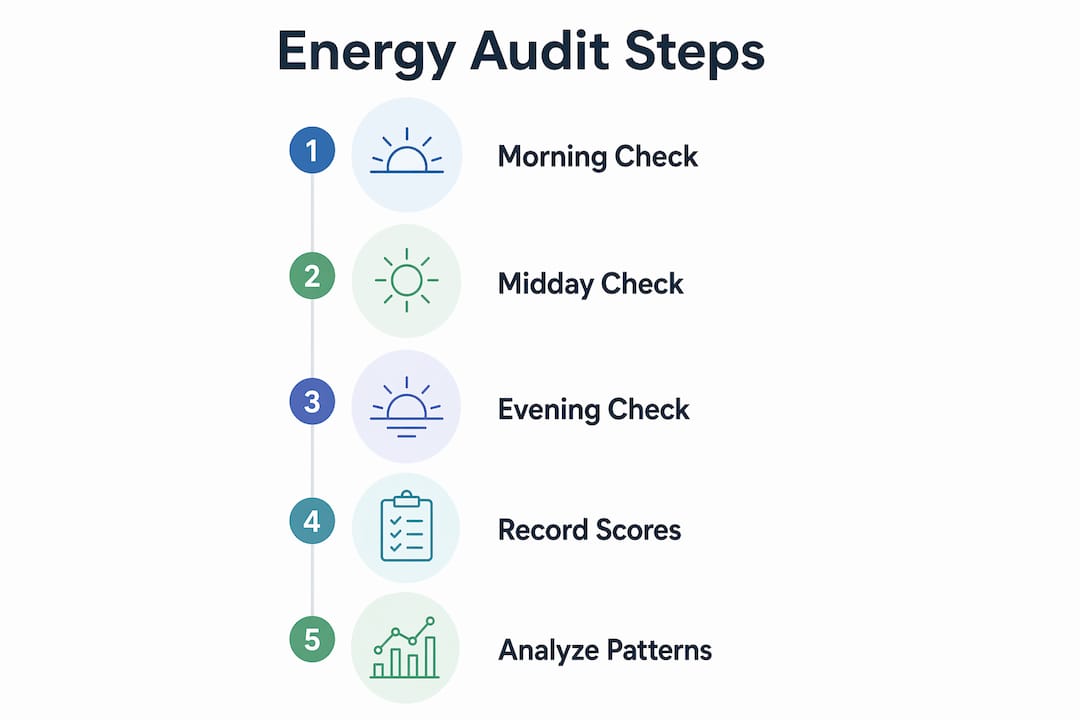
Track your energy at three fixed daily points: morning (within one hour of waking), midday (around noon), and late afternoon (around 3–4 PM). At each point, rate yourself on a 1–10 scale across physical energy, mental clarity, emotional stability, and sense of purpose. Seven days of data reveals patterns that feel invisible when you are inside them.
| Time | Physical (1–10) | Mental (1–10) | Emotional (1–10) | Spiritual (1–10) |
|---|---|---|---|---|
| Morning | ||||
| Midday | ||||
| Late afternoon |
A 1-week energy audit using this structure reveals unique peak performance windows that no generic productivity system can replicate. Your peaks are yours. An intermediate chronotype may find their sharpest mental window runs from 10 AM to 1 PM, while a morning type peaks between 7 AM and 10 AM. Scheduling against your actual pattern, rather than a borrowed one, is where the gains begin.
Pro Tip: During your audit week, avoid digital content during breaks. Scrolling social media masks true recovery signals and distorts your energy readings. A genuine rest period feels different from a stimulated one. Learn to tell the difference.
How do you structure your workday around ultradian cycles?
The ultradian rhythm is a 90–120 minute biological cycle that governs cognitive performance. Your brain moves through phases of high alertness and lower alertness throughout the day, independent of your chronotype. Working with this cycle, rather than against it, is the structural foundation of effective energy management for professionals.
Working in 90–120 minute focused blocks matched to ultradian cycles, followed by 15–20 minute genuine recovery breaks, sustains cognitive output and prevents burnout. Most executives can sustain 3–4 such cycles per day before diminishing returns set in. That is 4.5–8 hours of genuine deep work, which exceeds what most professionals actually produce in a 10-hour day of fragmented attention.
The structure works only when you protect peak blocks for high-impact work. Reserving peak cognitive windows exclusively for strategic tasks preserves mental energy and improves results. Administrative work, routine emails, and low-stakes meetings belong in energy troughs, not in your sharpest hours.
Recovery breaks are where most executives fail. The quality of a break determines whether the next block performs at full capacity. Activities like browsing digital content do not restore cognitive energy effectively. Physical movement, natural scenery, or genuine social connection best facilitate restoration.
Effective break activities, ranked by restoration quality:
- A 10-minute walk outside, preferably with natural scenery
- Light physical movement such as stretching or bodyweight exercises
- A brief, genuine conversation with someone you enjoy
- Controlled breathing or a short mindfulness reset
- Eating a small, protein-focused snack away from your desk
Common break mistakes include checking email, reading news, or staying seated. Each of these keeps the prefrontal cortex engaged and prevents the neural recovery that makes the next block sharp.
Pro Tip: Set a physical cue to end each work block, such as standing up or closing your laptop. The physical act signals your nervous system that recovery has begun. Without a clear boundary, the brain stays in work mode even when you stop working.
What are the key energy management strategies for sustained vitality?
Three foundational strategies determine daily energy quality for executives: sleep architecture, nutrition timing, and emotional regulation. Each operates on a different timescale, but all three compound over weeks and months.

Sleep as the non-negotiable foundation
Sleep is the primary foundational strategy for energy optimization. Poor sleep architecture compounds daily, leading to chronic decision fatigue that no supplement or productivity system can offset. Leaders often treat sleep as downtime. It is not. It is the critical foundation for decision-making capacity, and cumulative sleep debt impairs performance disproportionately compared to other deficits.
Practical sleep discipline for executives means consistent sleep and wake times, a room temperature below 68°F, and no screens within 60 minutes of sleep. These are not suggestions. They are the structural conditions for restorative slow-wave and REM sleep.
Nutrition timing for stable energy
Nutrition timing affects energy more than most executives realize. Large meals spike blood glucose and trigger the energy crashes that kill afternoon productivity. Smaller, protein-anchored meals every 3–4 hours maintain stable glucose and support sustained mental clarity. Caffeine works best when timed to your cortisol curve, typically 90–120 minutes after waking, rather than immediately upon rising.
Emotional regulation with the 4R Method
Emotional energy is the most overlooked dimension in executive performance. The 4R Method, Recognize, Regulate, Release, Refocus, gives you a real-time protocol for managing nervous system states during high-pressure moments. Stress cannot be eliminated from an executive role. It can be managed intentionally to preserve energy flow rather than drain it.
Many professionals neglect nervous system regulation entirely. Intentional resets enable better stress management rather than futile attempts to eliminate stress. A two-minute physiological sigh or a brief walk between difficult meetings applies the 4R Method in practice.
Foundational habits across all three energy dimensions:
- Physical: 7–9 hours of consistent sleep, protein-anchored meals every 3–4 hours, daily movement of at least 20 minutes
- Mental: Single-task focus during peak blocks, no notifications during deep work, weekly review of priorities
- Emotional: Daily application of the 4R Method, clear boundaries on after-hours communication, scheduled recovery time treated as non-negotiable
Pro Tip: Small, deliberate changes in sleep and nutrition habits generate measurable impact within two weeks. You do not need a complete lifestyle overhaul. Pick one habit from each dimension and execute it consistently for 14 days before adding more.
How do you sustain energy management as a long-term practice?
Energy management is a continuous maintenance routine, not a one-time setup. Daily 7-minute energy audits combined with 5-minute end-of-day reflections enable practitioners to identify energy leaks and build long-term resilience. The audit takes less time than most executives spend checking email before breakfast.
Energy functions as a system, akin to an industrial power grid, with sources, distribution channels, and recovery periods. Focusing on only one dimension creates inefficiencies across the others. An executive who sleeps well but ignores emotional regulation will still experience fragmented attention and reactive decision-making.
The daily reflection practice is simple. At the end of each day, answer three questions: What drained my energy today? What restored it? What will I adjust tomorrow? Over weeks, the patterns become clear and the adjustments become precise.
| Routine element | Impact on daily energy |
|---|---|
| Morning energy rating (3 min) | Identifies starting state and informs task scheduling |
| Ultradian work blocks (90 min) | Sustains cognitive output across 3–4 high-quality sessions |
| Quality recovery breaks (15–20 min) | Restores prefrontal function between blocks |
| End-of-day reflection (5 min) | Surfaces energy leaks and reinforces positive patterns |
| Consistent sleep schedule | Compounds recovery quality over days and weeks |
Common pitfalls in sustained energy management:
- Skipping recovery breaks when under deadline pressure, which accelerates the fatigue that causes missed deadlines
- Treating weekends as full recovery from a week of poor energy habits, rather than maintaining baseline discipline
- Ignoring emotional energy until a crisis forces attention to it
- Measuring only physical energy and neglecting mental and spiritual dimensions
The mismatch of tasks and energy type reduces efficiency and creates fragmentation. Iterative practice, rather than a one-time effort, is what distinguishes sustainable energy management from a temporary productivity experiment.
Key Takeaways
Effective personal energy management requires auditing all four energy dimensions, aligning tasks to natural biological rhythms, and treating daily reflection as a non-negotiable performance practice.
| Point | Details |
|---|---|
| Audit before you adjust | Track energy across physical, mental, emotional, and spiritual dimensions for 7 days before changing any habit. |
| Match tasks to energy peaks | Reserve your sharpest cognitive windows for high-impact work and move shallow tasks to energy troughs. |
| Protect break quality | Physical movement and nature exposure restore cognitive function. Digital browsing does not. |
| Sleep is the foundation | No productivity system compensates for inadequate restorative sleep. Protect it with structural discipline. |
| Reflect daily | A 5-minute end-of-day review surfaces energy leaks faster than any weekly or monthly audit. |
Energy management is a discipline, not a hack
I have worked with enough executives to know the pattern. The ones who burn out are rarely the ones who work the hardest. They are the ones who treat energy as an infinite resource and attention as something to be pushed through rather than managed. They confuse busyness with output and exhaustion with commitment.
What I have found, both personally and in observing high-performing men over 40, is that the shift from time management to energy management is not a productivity upgrade. It is a values realignment. When you start asking "what does this cost me in energy?" rather than "how long will this take?", your calendar changes. Your meetings change. Your mornings change.
The executives I respect most are not the ones with the most packed schedules. They are the ones who show up consistently sharp, who make clear decisions under pressure, and who still have something left for the people and pursuits that matter outside the office. That consistency is not accidental. It is the result of treating energy as a managed executive resource, with the same discipline applied to a financial portfolio or a training program.
The uncomfortable truth is that most energy problems are not physiological. They are structural. Fragmented attention, poor task sequencing, and neglected recovery are choices, even when they do not feel like it. Recognizing that is the first step. Building a system around it is the work.
— Joakim
Viridos membership and executive performance support

Viridos is built for men who take their performance seriously enough to be precise about it. The Viridos Membership gives controlled access to a premium Swedish performance formulation developed for disciplined executives who want sustained vitality, not short-term stimulation. Small-batch production, sublingual delivery for direct absorption, and a membership model designed around consistency rather than convenience reflect the same principles that underpin serious energy management. For executives who have done the work of understanding their energy and want a formulation that matches that standard, Viridos is the next step.
FAQ
What is personal energy management?
Personal energy management is the practice of tracking and optimizing physical, mental, emotional, and spiritual energy to sustain high performance. It treats energy, not time, as the primary professional resource.
How do ultradian cycles improve work performance?
Ultradian cycles are 90–120 minute biological rhythms that govern cognitive alertness. Working in focused blocks aligned to these cycles, followed by genuine recovery breaks, sustains output and prevents the fatigue that fragments attention.
How long does it take to see results from energy management?
Measurable improvements in clarity and stamina typically appear within two weeks of consistent changes to sleep timing, nutrition habits, and structured work blocks. The gains compound significantly over 30–60 days.
What is the 4R Method for emotional energy?
The 4R Method, Recognize, Regulate, Release, Refocus, is a nervous system regulation protocol for managing stress in real time. It gives executives a structured way to reset between high-pressure situations rather than carrying accumulated tension through the day.
Why do recovery breaks matter so much?
The quality of a recovery break determines whether the next work block performs at full capacity. Physical movement and nature exposure restore prefrontal function. Digital browsing keeps the brain in a low-grade active state that prevents true recovery.