
TL;DR:
- Executive vitality is sustainable energy and resilience across physical, emotional, mental, and spiritual layers.
- Rituals and oscillation between stress and recovery are key to maintaining long-term high performance.
- Prioritizing fundamentals like sleep and movement provides greater benefits than overinvesting in advanced biohacking tools.
Most high-achieving leaders spend years optimizing their calendars, hiring strategies, and quarterly targets while completely overlooking the one variable that governs all of it: their own vitality. Grit gets you far, but it has a ceiling. The executives who sustain elite output across decades are not simply tougher than their peers. They operate on a different system entirely, one built on layered energy management, disciplined recovery, and a clear understanding of what actually drives sustained performance. This guide breaks down what executive vitality really means, how its four core pillars work, what to measure, and how to avoid the trap that derails even the most accomplished leaders.
Table of Contents
- Defining executive vitality: More than just energy
- The four pillars: How vitality powers high performance
- Tracking and enhancing executive vitality: What to measure and why
- Personal versus organizational vitality: Avoiding the achievement trap
- Why rituals beat willpower: The overlooked key to sustainable executive vitality
- Take executive vitality further with the VIRIDOS approach
- Frequently asked questions
Key Takeaways
| Point | Details |
|---|---|
| Vitality is multi-layered | True executive vitality requires care for physical, emotional, mental, and spiritual domains. |
| Rituals outperform willpower | Sustainable performance comes from daily rituals and strategic stress-recovery cycles—not sheer discipline. |
| Measure the right metrics | Tracking core biomarkers and lifestyle habits yields better long-term results than focusing on short-lived trends. |
| Balance achievement and fulfillment | Optimizing both personal vitality and organizational health prevents burnout and drives meaningful success. |
Defining executive vitality: More than just energy
Executive vitality is not a synonym for feeling good or having enough caffeine to get through a board meeting. It is a state of multi-layered, sustainable energy and resilience that enables you to perform at your highest level across every domain of leadership, consistently, over years and decades.
The distinction matters. Most executives chase short-term energy: another espresso, another productivity hack, another early morning. These are stimulants, not systems. Real vitality compounds. It builds on itself when managed correctly and erodes silently when ignored. The executives who mistake short-term energy spikes for long-term vitality are the ones who burn out at 52 wondering what went wrong.
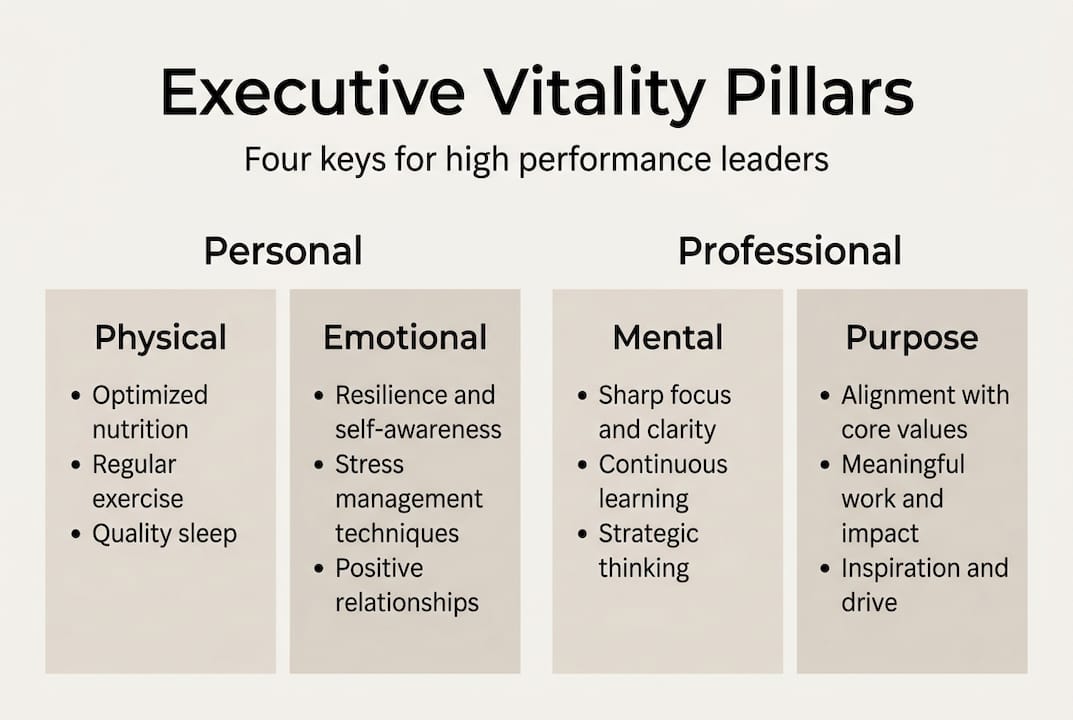
The Corporate Athlete Framework offers the most precise model for understanding this. It identifies four energy layers that are interdependent and equally critical:
- Physical: The biological foundation. Sleep, nutrition, movement, and recovery.
- Emotional: Psychological resilience and the ability to regulate your stress response under pressure.
- Mental: Sustained focus, cognitive clarity, and disciplined attention management.
- Spiritual: Alignment with your core values and a sense of purpose that transcends quarterly results.
Critically, the framework also establishes that rituals outperform willpower for sustained energy. Willpower is a finite resource. Rituals are automated. When you ritualize recovery, movement, or reflection, you stop relying on motivation and start building infrastructure.
"Energy, not time, is the fundamental currency of high performance." This reframe is the starting point for every serious conversation about executive vitality.
This connects directly to the concept of oscillation: the deliberate alternation between stress and recovery. Elite athletes train hard and recover hard. Executives rarely do the second part. The result is a slow, invisible drain on all four energy layers simultaneously.
The payoff for getting this right is not just feeling better. Executives who operate with genuine vitality make sharper decisions, lead with more emotional authority, and sustain performance over longer time horizons. It compounds, much like high-performance living as a practice, rather than a one-time optimization. Building this foundation also reinforces the habits that define serious executive fitness at every level.
The four pillars: How vitality powers high performance
Understanding the conceptual framework is powerful, but how do these pillars translate into real action and measurable results? Each layer has a distinct function and a specific failure mode when neglected.
| Pillar | Core function | Common failure mode | Tactical ritual |
|---|---|---|---|
| Physical | Energy generation and recovery | Chronic sleep debt, sedentary work | 7-hour sleep floor, daily walk |
| Emotional | Stress regulation and resilience | Reactive decision-making, irritability | End-of-day debrief, breathwork |
| Mental | Focus and cognitive clarity | Distraction, shallow thinking | Time-blocked deep work, no-meeting mornings |
| Spiritual | Purpose and values alignment | Drift, disengagement, success void | Weekly reflection, mission review |
The physical base supports emotional, mental, and spiritual layers. When sleep is compromised, emotional regulation degrades first. When emotional regulation fails, mental focus collapses. When focus collapses, purpose feels abstract. One neglected pillar cascades through all the others.
Here is how to build tactical rituals for each layer that actually fit into a demanding schedule:
- Physical: Commit to a non-negotiable sleep window. Even 30 minutes of daily movement, taken seriously, outperforms sporadic intense workouts for sustained energy output.
- Emotional: Build a brief end-of-day transition ritual. Five minutes of structured reflection separates the work state from the recovery state and prevents emotional carryover.
- Mental: Protect your first 90 minutes. No email, no Slack, no meetings. Use this window for your highest-leverage cognitive work before the day's noise erodes your focus.
- Spiritual: Schedule a weekly 20-minute review of your core priorities. Ask whether your calendar reflects your values. If it does not, it is a signal, not a scheduling problem.
Pro Tip: Do not try to optimize all four pillars simultaneously. Pick the one that is most depleted, install one ritual, and hold it for 30 days before adding another. Compounding works in vitality the same way it works in finance.
These holistic frameworks for vitality are not abstract wellness concepts. They are operational tools. And for practical, daily application, the right energy management tips can make the difference between a system that holds under pressure and one that collapses when it matters most.
Tracking and enhancing executive vitality: What to measure and why
Once you grasp how to assess and enhance your personal vitality, it is crucial to recognize the broader context and potential traps of focusing only on metrics. Measurement without fundamentals is just expensive data collection.

The most effective approach starts with biomarkers that actually predict performance longevity. Longevity strategies for high performers consistently prioritize VO2 max, insulin sensitivity, hormones, heart rate variability, and inflammation markers before recommending advanced interventions. These are not vanity metrics. They are early warning systems.
| Biomarker | What it signals | Review frequency |
|---|---|---|
| VO2 max | Cardiovascular fitness and longevity | Quarterly |
| Insulin sensitivity | Metabolic health and energy stability | Quarterly |
| Testosterone and cortisol | Hormonal balance and stress load | Quarterly |
| HRV (heart rate variability) | Recovery status and nervous system health | Daily via wearable |
| Inflammation markers (CRP) | Systemic stress and recovery quality | Twice yearly |
Here is what to prioritize in practice:
- Start with the fundamentals. Sleep quality, daily movement, and nutrition consistency provide the highest return before any advanced tool adds value.
- Use a wearable for daily HRV tracking. It gives you real-time feedback on whether your nervous system is recovered enough to push hard or needs a lighter day.
- Run a quarterly blood panel. Work with a physician who understands performance optimization, not just disease prevention.
- Consider a continuous glucose monitor (CGM) for 30 days. The data on how specific meals affect your energy and focus is often surprising and immediately actionable.
Pro Tip: Most executives over-invest in biohacking tools before mastering the basics. A consistent sleep schedule and 8,000 steps per day will move your long-term health metrics more than any supplement stack. Build the foundation first.
For targeted nutritional support, understanding the top vitamins for male executives can help you fill gaps that diet alone does not always cover, particularly after 40 when absorption and hormonal dynamics shift.
Personal versus organizational vitality: Avoiding the achievement trap
Now that you have seen the layering of vitality from both a personal and organizational perspective, let us finish with how to apply these ideas for lasting transformation. The most dangerous trap for high achievers is conflating corporate success with personal vitality.
They are related but not the same. Corporate vitality covers strategy, technology, people, and culture and it drives shareholder value. Personal vitality covers biology, fulfillment, and daily lived experience. Companies with high vitality grow faster. But executives who optimize only for the corporate side while neglecting the personal dimension often find themselves successful and empty simultaneously.
| Dimension | Focus | Risk when neglected |
|---|---|---|
| Personal vitality | Biology, fulfillment, energy, purpose | Burnout, health decline, loss of meaning |
| Corporate vitality | Strategy, systems, culture, growth | Stagnation, talent loss, competitive decline |
The longevity optimization risk is real: chasing performance metrics without purpose leads to biological fatigue first, then psychological burnout. Burnout rarely announces itself loudly. It shows up as blunted motivation, reduced empathy, and a creeping sense that the results no longer feel worth it.
Here is how to balance both and avoid the most common traps:
- Audit your calendar quarterly for alignment between your stated values and your actual time allocation.
- Define what success feels like personally, not just professionally, before your next planning cycle.
- Recognize that high-performing teams are built by leaders who model vitality, not just output.
- Build recovery into your schedule with the same rigor you apply to revenue targets.
The executives who sustain peak performance into their 60s are not the ones who worked hardest. They are the ones who treated their own energy as a strategic asset.
This is why learning to build a longevity strategy is not a wellness indulgence. It is a leadership decision. And sustaining elite performance over decades requires integrating both dimensions deliberately.
Why rituals beat willpower: The overlooked key to sustainable executive vitality
Here is the uncomfortable truth most leadership content will not tell you: discipline is overrated as a long-term strategy. The executives we most admire for their consistency are not running on superior willpower. They have designed environments and rituals that make the right behaviors nearly automatic.
The Corporate Athlete Framework is explicit on this: leaders who master stress and recovery oscillation multiply their capacity over time, while those who rely on force of will eventually hit a wall, usually at the worst possible moment.
Consider a simple example. A nightly wind-down routine, 20 minutes of no screens, light reading, and a consistent sleep time, is not a luxury. It is a performance asset that compounds across hundreds of nights. The executive who treats it as optional will always be at the mercy of their stress load. The one who protects it builds a recovery system that runs regardless of how hard the day was.
Micro-recoveries matter just as much. A five-minute walk between back-to-back calls, a brief breathing reset before a high-stakes meeting, these are not soft habits. They are wellness optimization strategies that prevent the slow accumulation of stress that eventually breaks even the most capable leaders.
Pro Tip: Pick one vital behavior, whether it is your sleep window, your morning movement, or your end-of-day debrief, and ritualize it completely for 60 days. The compounding effect on your overall vitality will be measurable.
Take executive vitality further with the VIRIDOS approach
The frameworks in this guide are not theoretical. They are the operating principles behind how VIRIDOS supports high-performing men who refuse to treat their vitality as an afterthought.
If you are ready to move from awareness to a structured system, the VIRIDOS Methodology translates these principles into a precise, personalized approach built for executives. The VIRIDOS Membership gives you access to the tools, protocols, and community that make sustained performance a practice rather than a goal. And the Performance Journal is where daily tracking becomes a discipline that compounds over time. The next level of your performance starts with the decision to treat your vitality as your most valuable asset.
Frequently asked questions
What is the difference between executive vitality and general wellness?
Executive vitality integrates physical, emotional, mental, and spiritual layers to support high-level performance, while general wellness often focuses on baseline health only. The four-layer model makes vitality a performance system, not just a health metric.
How do I know if my executive vitality is declining?
Early signs include persistent fatigue, increased stress response, poor decision-making, and loss of motivation, often before visible drop-offs in productivity. Burnout signals biological fatigue first, which means the warning signs appear well before performance visibly suffers.
Which biomarkers should executives track for optimal vitality?
Key biomarkers include VO2 max, insulin sensitivity, hormones, heart rate variability, and inflammation markers. These specific biomarkers are prioritized by performance longevity methodologies for their predictive accuracy.
Can focusing on personal vitality benefit my business?
Yes. Executives with high vitality make sharper decisions, model performance culture, and sustain company growth more effectively. High-vitality firms grow faster and generate more shareholder value over time.
What is the quickest way to start improving executive vitality?
Start by reliably prioritizing quality sleep, daily movement, and consistent nutrition. Fundamentals like these deliver the highest return on investment before any advanced strategy or supplement adds meaningful value.