
TL;DR:
- Moderate stress enhances executive focus and decision-making according to the Yerkes-Dodson law.
- Successful stress optimization involves calibrating stress levels to stay within the eustress zone.
- Continuous monitoring and personalized protocols help executives build resilience and sustain high performance.
Every high-performing executive has been told to reduce stress. Cut the pressure, protect your calm, and performance will follow. That advice is wrong, or at least dangerously incomplete. The Yerkes-Dodson law's inverted U-curve shows that moderate stress sharpens focus and drives peak output. The real problem is not stress itself. It is unmanaged, misdirected stress that erodes performance over time. This guide gives you a framework to stop fighting stress and start using it as a precision tool for sustained executive performance.
Table of Contents
- Understanding stress optimization: The science and myth
- Identifying your stress signature: Personal patterns and control
- Executive methodology: Tools and protocols to optimize stress
- Edge cases and advanced applications: Customizing stress optimization
- The uncomfortable truth: Why most executives misunderstand stress
- Take your performance further with Viridos
- Frequently asked questions
Key Takeaways
| Point | Details |
|---|---|
| Harness stress for performance | Moderate stress boosts focus and energy when strategically managed, rather than avoided. |
| Identify your stress signature | Knowing your personal stress patterns helps tailor effective resilience protocols. |
| Balance challenge and recovery | Combining deliberate stress exposure with solid recovery habits prevents burnout and enhances productivity. |
| Customize by task and proficiency | Optimal stress levels differ for strategic vs. routine tasks and must suit your individual strengths. |
| Track, adjust, and iterate | Regular tracking and adjustment of stress and recovery indicators are essential for sustained high performance. |
Understanding stress optimization: The science and myth
Stress optimization is not about pushing harder until something breaks. It is the deliberate practice of calibrating your stress load to sit in the performance-enhancing zone, not below it where you coast, and not above it where you crash. Think of it as tuning an engine rather than flooring the accelerator.
The scientific foundation rests on the Yerkes-Dodson law, which maps the relationship between arousal and performance as an inverted U-curve. Too little stress produces boredom and disengagement. Too much produces anxiety and cognitive breakdown. The sweet spot in the middle is where executives make their best decisions, lead with clarity, and sustain output across long seasons of pressure.
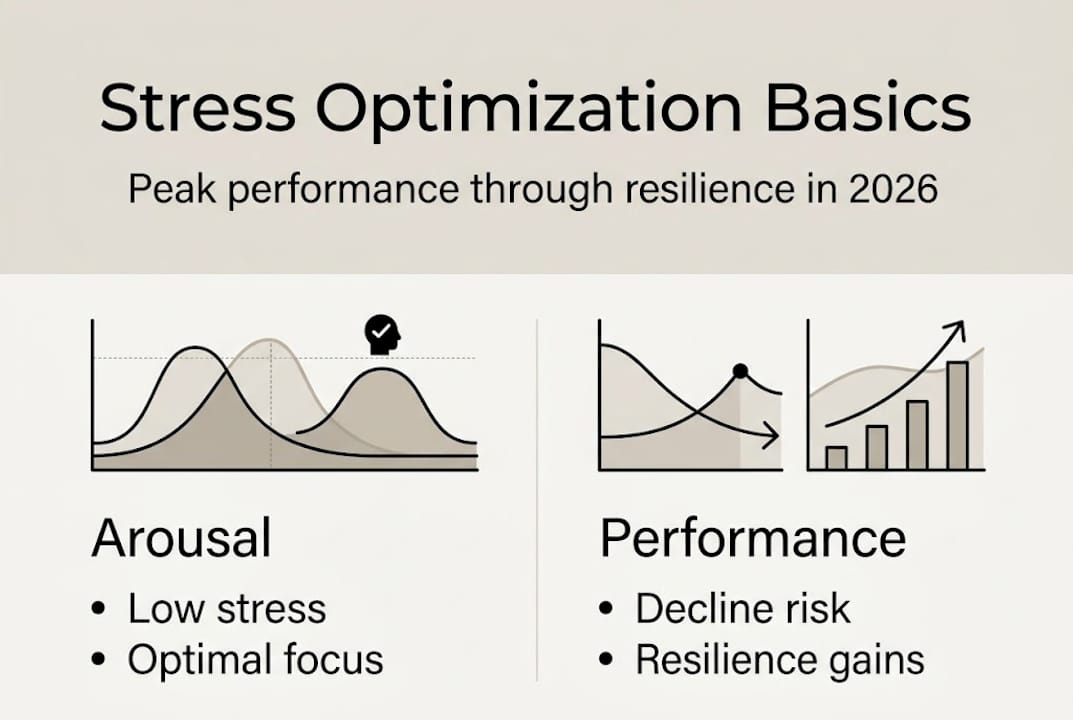
The critical distinction most people miss is the difference between eustress and distress. Eustress is productive stress. It is the tension before a high-stakes presentation, the focus that comes with a tight deadline, the edge you feel walking into a board room. Distress is the chronic, unrelenting pressure that degrades sleep, impairs judgment, and accelerates burnout. Optimizing stress means maximizing eustress while keeping distress in check.
| Type | Characteristics | Executive impact |
|---|---|---|
| Eustress | Short-term, goal-directed, energizing | Sharpens focus, drives motivation |
| Distress | Chronic, uncontrolled, depleting | Impairs cognition, accelerates burnout |
| Understress | Low arousal, minimal challenge | Reduces engagement, slows performance |
Common myths worth dismantling:
- Myth: All stress is harmful and should be eliminated.
- Myth: High performers feel less stress than others.
- Myth: Relaxation is always the right response to pressure.
- Myth: Stress tolerance is fixed and cannot be trained.
The mainstream view treats stress as an enemy to minimize. Stress optimization flips that. It treats stress as a performance tool, one that requires skill to wield but rewards those who master it. For stress management for executives, the shift from avoidance to optimization is not semantic. It is a fundamentally different operating model.
"The goal is not a stress-free life. The goal is a life where stress serves your performance rather than sabotages it."
Identifying your stress signature: Personal patterns and control
Once you grasp the science, the next step is identifying how stress uniquely shows up for you. Your stress signature is the specific pattern of cognitive, emotional, and physiological responses you produce under pressure. No two executives have the same one.
Some leaders go quiet and analytical under stress. Others become decisive and directive. Some experience jaw clenching, disrupted sleep, or a narrowing of peripheral thinking. Others feel a surge of energy and clarity. Knowing your signature is not a self-awareness exercise. It is operational intelligence.

Emotionally intelligent stress optimization involves identifying these patterns and modulating your arousal through self-awareness, emotional intelligence, and physiological regulation. The executives who perform consistently across years of high-stakes work are not the ones with the lowest stress. They are the ones who know their signature and can adjust their response in real time.
Practical methods to map your stress signature:
- Daily tracking: Note energy, focus, and decision quality at different stress levels across a two-week period.
- Feedback loops: Ask trusted colleagues how your behavior shifts under pressure. The gap between self-perception and external observation is revealing.
- HRV monitoring: Heart rate variability gives you a physiological read on your stress load and recovery status.
- Journaling: Brief end-of-day entries on what triggered stress, how you responded, and what the outcome was.
Pro Tip: Track your peak cognitive performance window each day for two weeks. Most executives discover a 90-minute to 3-hour window where their stress levels sit in the eustress zone naturally. Protect that window for your highest-leverage decisions.
| Stress indicator | Low arousal signal | High arousal signal |
|---|---|---|
| Cognitive | Slow thinking, low initiative | Racing thoughts, poor filtering |
| Emotional | Disengaged, flat | Reactive, irritable |
| Physical | Fatigue, low energy | Tension, disrupted sleep |
| Behavioral | Avoidance, procrastination | Impulsive decisions, over-control |
The role of control is significant here. Executives who perceive higher control over their environment show lower cortisol responses to the same stressors. Building that sense of control through clear priorities, strong delegation, and reliable routines is itself a stress optimization strategy. Explore executive wellness strategies to build the structural conditions that support optimal arousal.
Executive methodology: Tools and protocols to optimize stress
Understanding your stress patterns unlocks the ability to use executive tools that transform pressure from a liability into an asset. The methodology breaks into three layers: hormetic stressors, recovery protocols, and biohacking tools.
Hormetic stressors are controlled doses of physical or cognitive discomfort that train your system to become more resilient. Cold exposure, intermittent fasting, and high-intensity training all qualify. The principle is simple: a small, deliberate stressor forces adaptation, and that adaptation carries over into how you handle professional pressure. Hormesis reduces mortality by 15 to 30 percent and improves cognition, and resilient leaders are 25 percent more productive and make 30 percent fewer errors than their peers.
Key executive protocols to implement:
- 90-minute deep work blocks: Schedule your most cognitively demanding work during your peak arousal window. No meetings, no interruptions.
- Cold exposure (2 to 4 minutes daily): Cold showers or ice baths activate the sympathetic nervous system in a controlled way, building stress tolerance.
- Physiological sighs: A double inhale through the nose followed by a long exhale is the fastest known method to reduce acute stress in real time.
- HRV tracking: Monitor heart rate variability each morning. A declining trend over several days signals you are accumulating more stress than you are recovering from.
- Structured delegation: Offloading low-leverage decisions reduces cognitive load and preserves your stress budget for high-stakes work.
Pro Tip: Set a weekly HRV baseline. If your morning HRV drops more than 10 percent below your personal average for three consecutive days, treat it as a hard signal to reduce training intensity and increase sleep duration before performance suffers visibly.
The executive resilience habits that separate long-tenure CEOs from burnout casualties are not glamorous. They are consistent recovery disciplines: seven to eight hours of sleep, deliberate downtime, and boundaries around reactive communication. Pair these with executive fitness performance tips and performance longevity strategies to build a system that compounds over years, not just quarters.
Edge cases and advanced applications: Customizing stress optimization
With foundational protocols in place, it is vital to understand when and how stress needs to be customized, especially for complex roles. The inverted U-curve is not a fixed shape. It shifts based on task complexity, individual skill level, and personal risk tolerance.
For routine, well-practiced tasks, you can perform well at higher arousal levels. For complex strategic decisions, the optimal stress zone is narrower and lower. Pushing into high arousal during a nuanced negotiation or a multivariable resource allocation decision will degrade your output, even if the same arousal level would sharpen your performance in a physical challenge.
Optimal stress varies by task complexity and individual factors, and the risk of overtraining is real for high-achievers who default to more intensity as their solution to every performance gap.
Key customization factors to consider:
- Chronotype: Morning-type executives should schedule high-stakes stress exposure earlier in the day. Evening types need to protect their peak window accordingly.
- Skill level: As proficiency increases, you can handle higher arousal without performance degradation. New challenges require lower arousal to maintain quality.
- Risk tolerance: Executives with lower baseline risk tolerance need smaller hormetic doses to achieve adaptation without triggering chronic distress.
- Recovery capacity: Age, sleep quality, and accumulated stress history all affect how quickly you return to baseline after a stress event.
It is worth noting that some research suggests a U-shaped rather than inverted-U relationship between workload and wellbeing in certain populations. For executives in leadership roles, the inverted-U model holds, but this nuance reinforces the need for individual calibration rather than blanket protocols.
"The executive who applies the same stress protocol to every situation is as misguided as the surgeon who uses the same instrument for every procedure."
Avoid the comfort trap. High-achievers often mistake the absence of discomfort for optimization. They build routines that feel productive but no longer challenge adaptation. Explore performance tips for executives over 40 and self-optimization for resilience to keep your protocols calibrated as your role and physiology evolve.
The uncomfortable truth: Why most executives misunderstand stress
Here is what years of working with high-performing leaders reveals: the majority of executive stress advice is designed for the general population, not for you. It tells you to breathe, meditate, and reduce your load. For someone running a $200 million portfolio or leading a team through a market disruption, that advice is not just inadequate. It is counterproductive.
The executives who sustain performance across decades do not minimize stress. They develop antifragility, a system that gets stronger under pressure rather than merely surviving it. That requires daily discipline, not occasional retreats.
The real differentiator is monitoring. Not once a quarter during a wellness check. Every day. HRV in the morning, decision quality in the afternoon, sleep data at night. Stress optimization becomes a leadership edge when it is treated with the same rigor as financial performance. Explore holistic executive vitality frameworks to build the infrastructure that makes this sustainable long-term.
Take your performance further with Viridos
Stress optimization is not a concept you read once and apply passively. It is a discipline that requires consistent tracking, honest reflection, and the right tools to stay calibrated over time.
At VIRIDOS, we build resources specifically for executives who want to operate at this level of precision. The Performance Journal gives you a structured daily framework to track stress indicators, recovery quality, and decision performance in one place. The VIRIDOS Methodology integrates the science of stress optimization with practical executive protocols, designed for men who treat performance as a long-term investment, not a short-term sprint.
Frequently asked questions
How does stress optimization differ from stress management?
Stress optimization uses the Yerkes-Dodson law to leverage moderate stress for performance gains, while stress management aims primarily to reduce or control stress levels. The first treats stress as a tool; the second treats it as a threat.
What practical benchmarks can executives use to optimize stress?
Aim for seven to eight hours of sleep, a rising HRV trend, and net energy gain after stress events. Practical benchmarks also include monitoring decision fatigue, jaw clenching, and morning mood as early warning signals.
How can executives avoid overtraining or burnout while optimizing stress?
Balance deliberate discomfort with structured recovery, and customize protocols based on task complexity, current skill level, and physiological recovery signals. Warning signs include declining HRV, persistent irritability, and reduced motivation for previously engaging work.
Are there quick strategies executives can use to optimize stress during a workday?
Use 90-minute deep work blocks, physiological sighs between high-pressure tasks, and brief mindfulness breaks to modulate arousal and sustain focus across a full executive day.