
TL;DR:
- Unmanaged stress impairs decision-making, focus, and emotional regulation in executives.
- Chronic stress damages health and organizational performance, while acute stress can build resilience.
- Consistent stress management routines, grounded in science, are essential for sustainable executive vitality.
Stress wears many masks in executive life. It shows up as late-night email chains, back-to-back board meetings, and the quiet pride of being the last one standing. But 89% less effective strategic decisions result from unmanaged stress, and most leaders never connect the dots. The cost is not just personal. It bleeds into team culture, deal quality, and long-term organizational health. This guide breaks down the biology, separates productive from destructive stress, and gives you evidence-backed techniques to stay sharp when the pressure is highest.
Table of Contents
- The science: How stress impacts executive performance
- Chronic vs. acute stress: Resilience, liability and myths
- Evidence-backed methods: What really works for managing stress
- Integrating stress management for sustainable executive vitality
- Executive reality: What most leaders miss about stress management
- Next steps: Unlock your executive performance with VIRIDOS
- Frequently asked questions
Key Takeaways
| Point | Details |
|---|---|
| Stress management boosts decision-making | Managing stress preserves executive cognitive function and strategic clarity. |
| Chronic vs. acute stress | Acute stress helps resilience, but chronic stress erodes performance and health. |
| Training yields lasting effects | Structured programs and evidence-based routines improve mental health and outcomes. |
| Integration drives sustained vitality | Daily stress management ensures productivity, resilience, and long-term vitality. |
The science: How stress impacts executive performance
Your prefrontal cortex is the engine behind every high-stakes call you make. It governs strategic thinking, impulse control, emotional regulation, and complex problem-solving. When chronic stress floods your system with cortisol, that engine starts misfiring. Stress impairs prefrontal cortex function, reducing your capacity for creative thinking, focused attention, and sound decisions at exactly the moments they matter most.
Sleep is the first casualty. Most executives running on five or six hours believe they are performing at capacity, but sleep deprivation compounds cortisol's damage, accelerating cognitive decline. The brain needs deep sleep to clear metabolic waste and consolidate the learning from each demanding day. Without it, you are essentially making million-dollar decisions with a degraded processor.
The downstream effects span every domain of leadership. Consider what actually gets compromised:
- Focus: Sustained attention collapses under chronic stress, making deep work nearly impossible
- Creativity: Novel thinking requires a calm prefrontal cortex; stress narrows your cognitive aperture
- Memory: Stress hormones interfere with memory consolidation, making it harder to retain and apply critical information
- Emotional regulation: Reactive leadership, poor listening, and short fuses are stress symptoms, not personality traits
"The prefrontal cortex, the brain's CEO, is the first region compromised by stress. When it goes offline, so does your strategic edge."
This is why executive wellness strategies are not a luxury add-on but a core performance variable. Leaders who treat stress management as optional are essentially accepting a self-imposed performance ceiling. Integrating holistic performance frameworks into your routine is how you protect the cognitive assets your role demands.
Chronic vs. acute stress: Resilience, liability and myths
Not all stress is the enemy. This distinction matters enormously for how you manage your energy and your team.
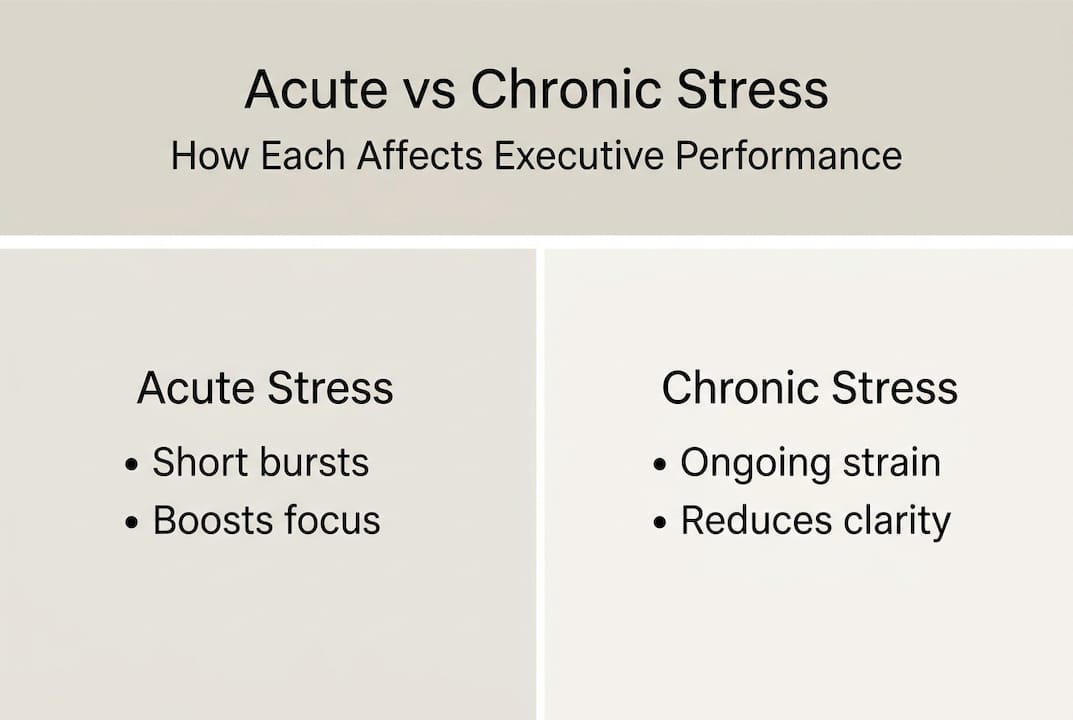
Acute stress, the kind you feel before a major pitch or during a high-stakes negotiation, can actually sharpen focus and heighten performance. This is called eustress. It triggers a short-term hormonal response that increases alertness, motivation, and even memory encoding. When the event passes, your system recovers. That recovery is where resilience is built.
Chronic stress is a different animal entirely. It is acute stress builds resilience that strengthens you, while sustained, unresolved pressure erodes your biology from the inside. Chronic stress is linked to cardiovascular disease, immune suppression, hormonal dysregulation, and burnout. There is no recovery window. The system stays in overdrive until it breaks.
| Eustress (acute) | Chronic stress |
|---|---|
| Short duration | Persistent, ongoing |
| Sharpens focus | Degrades cognition |
| Motivates action | Causes paralysis or reactivity |
| Builds resilience | Leads to burnout |
| Recoverable | Accumulates over time |
| Healthy hormonal response | Hormonal dysregulation |
The biggest myth in executive culture is that suppressing stress signals is a sign of strength. Many founders and senior leaders equate stoicism with toughness. Biologically, that equation is wrong. Suppression does not eliminate stress; it internalizes it. The cortisol still circulates. The inflammation still builds. You just lose the awareness that would allow you to intervene.
Pro Tip: Track recurring stress signals, such as jaw tension, disrupted sleep, or shortened patience, as early warning data. Catching patterns early is the difference between a course correction and a forced recovery.
Protecting your performance longevity means treating stress recognition as a skill, not a weakness. Building a longevity strategy that accounts for stress cycles gives you a structural advantage most of your peers are ignoring.
Evidence-backed methods: What really works for managing stress
Opinion is cheap. What do controlled studies actually show about stress management for leaders?
Stress management training reduces psychological strain in managers, with meta-analyses confirming that leader-focused stress management interventions (SMIs) improve mental health at a standardized effect size of g=0.38. That is a meaningful, measurable shift. Randomized controlled trials also show these benefits persist beyond six months when the interventions are structured and consistently applied.
| Intervention type | Mental health improvement | Work performance improvement |
|---|---|---|
| Mindfulness-based training | High | Moderate |
| Cognitive behavioral techniques | High | High |
| Physical exercise protocols | Moderate | High |
| Structured recovery routines | Moderate | High |
| Biofeedback and HRV training | Moderate | Moderate |
Building a stress management routine does not require a wellness retreat. Here is a practical framework:
- Anchor your morning: Fifteen minutes of breathwork, light movement, or journaling before screens sets your nervous system baseline for the day
- Schedule recovery blocks: Treat 20-minute recovery windows between high-demand meetings as non-negotiable calendar items
- Track your physiological signals: Resting heart rate, HRV, and sleep quality are objective stress indicators, not subjective feelings
- Apply cognitive reframing: Identify whether a stressor is within your control before allocating mental energy to it
- Review weekly: A brief weekly reflection on stress patterns lets you adjust before accumulation becomes a liability
Pro Tip: AI tools and wearables can surface useful data, but they are inputs, not solutions. Self-awareness and consistent practice are what convert that data into actual performance gains.
For executives focused on sustaining elite performance, these methods are not soft skills. They are operational levers. Pairing structured routines with smart energy management tips compounds the benefit over time.
Integrating stress management for sustainable executive vitality
Knowing the techniques is one thing. Building them into a demanding executive schedule is where most leaders stall. The goal is not a separate wellness practice bolted onto your week. It is stress management woven into the fabric of how you already operate.
Stress management improves executive work outcomes and long-term resilience, but only when it is consistent, not episodic. Crisis-driven stress management, where you only intervene when you are already depleted, is like servicing your car engine only after it has seized. The maintenance model is far more effective.
Here are practical integration points that fit naturally into executive life:
- Before high-stakes meetings: Two minutes of box breathing resets your nervous system and sharpens focus before you walk in
- During travel: Use flight time for structured reflection or breathwork rather than defaulting to email
- After difficult conversations: A five-minute walk or brief reset prevents emotional residue from carrying into your next interaction
- End-of-day review: A ten-minute wind-down routine signals your brain to shift from performance mode to recovery mode
- Weekly planning: Build stress awareness into your weekly review, noting what drained you and what energized you
The payoff extends well beyond mood. Executives who manage stress proactively report stronger relationships with their leadership teams, better physical health markers, and sharper long-term decision-making. Vitality is not just about living longer. It is about operating at a high level consistently, without the boom-and-bust cycles that wear down both leaders and the organizations they run.
Building performance resilience tactics into your daily structure, combined with attention to long-term health tips, creates the compounding effect that separates good executives from genuinely durable ones.
Executive reality: What most leaders miss about stress management
Here is the uncomfortable truth most leadership content will not say directly: the executives who most need stress management are the ones most likely to dismiss it.
There is a cultural script in high-performance environments that equates relentlessness with commitment. Grinding through stress is framed as character. Slowing down is framed as weakness. But suppression and stoicism are liabilities, not strengths. Biology does not reward the leader who ignores distress signals. It punishes them, quietly and consistently, until the bill comes due.
The leaders who sustain genuine edge over decades are not the ones who work hardest. They are the ones who recover best. They treat introspection as a competitive advantage, not a personality preference. They understand that managing their internal state is as strategic as managing their P&L.
The high-performance living guide makes this point clearly: performance longevity is built on recovery, not just output. The men who figure this out early protect their clarity, their relationships, and their organizations. The ones who figure it out late usually do so after a health event or a leadership failure that could have been avoided.
Stop treating stress management as self-care. Start treating it as operational discipline.
Next steps: Unlock your executive performance with VIRIDOS
If this article shifted how you think about stress and performance, the next move is building a system that keeps you accountable to it. Insight without structure fades fast.

VIRIDOS is built for exactly this. Our Performance Journal gives you a structured daily tool to track stress signals, recovery quality, and performance patterns over time. The Membership connects you to a framework designed for men in demanding roles who want sustained edge, not just short-term fixes. Everything we build is grounded in science-backed methodology that respects both your intelligence and your time. The work you do on stress management today is the performance advantage you carry into every decision you make tomorrow.
Frequently asked questions
How does unmanaged stress affect decision-making in executives?
Unmanaged stress degrades prefrontal cortex function, resulting in less creative, less focused, and less effective decisions precisely when high-pressure situations demand your best thinking.
Is any stress actually good for elite performance?
Yes. Acute stress builds resilience and can sharpen focus in the short term, but chronic, unresolved stress systematically undermines health, clarity, and leadership effectiveness over time.
What interventions show the greatest impact for executive stress management?
Structured stress management training yields lasting improvements in both mental health and work performance, with meta-analyses and randomized controlled trials confirming measurable benefits that persist beyond six months.
Are digital tools and AI effective for managing executive stress?
AI tools and wearables provide useful data on stress indicators, but personal awareness and proactive practice are what convert that data into real, lasting performance improvements.