
TL;DR:
- A sustainable workflow for executives involves structured time auditing, delegation, and fixed rhythms to protect cognitive capacity. Properly designed systems reduce burnout risk by maintaining agency, clarity, and leveraging AI for decision routing with human oversight. Consistent reviews and documentation ensure long-term organizational resilience and high performance.
A sustainable workflow for executives is a structured system of time management, delegation, decision-making, and process documentation that preserves cognitive capacity and organizational resilience over the long term. Most executives operate at high output for years before realizing their calendar, not their capability, is the limiting factor. Frameworks like Prialto's 6-step productivity loop, the Spry Executive OS, and AI-assisted decision routing now give leaders concrete tools to build workflows that hold up under sustained pressure. The core principle is simple: protect high-leverage work, systematize everything else, and design rhythms that prevent collapse.
What tools do executives need for a sustainable workflow?
The right tools are not productivity apps. They are systems that reduce the number of decisions you make about how to work. A sustainable workflow for executives begins with a time audit, a delegation framework, and a fixed operating rhythm. Without these three foundations, every other tool becomes noise.

Time auditing methods that actually work
Time auditing in 30-minute increments across a full week reveals which activities require your unique executive authority and which can be delegated or systematized. Most executives discover that 40–60% of their calendar contains work that does not require their judgment. That finding is the starting point for every delegation decision you make next.
Delegation and documentation tools
Standard operating procedure (SOP) software such as Notion, Tettra, or Confluence turns institutional knowledge into transferable process. A knowledge base is not a bureaucratic exercise. It is the infrastructure that allows your team to execute without pulling you into low-leverage decisions. Pair SOP documentation with a delegation list that maps each recurring task to a named owner and a documented process.
Operating systems for executive rhythm
| Tool Category | Example Tools | Primary Function |
|---|---|---|
| Time auditing | Toggl Track, Clockify | Identify delegation candidates |
| SOP and knowledge base | Notion, Tettra, Confluence | Document and transfer processes |
| Calendar management | Calendly, Reclaim.ai | Protect high-leverage time blocks |
| AI decision routing | Doe.so, custom GPT workflows | Triage and draft with human review |
| Weekly review systems | Spry Executive OS, portfolio reviews | Align calendar to current priorities |
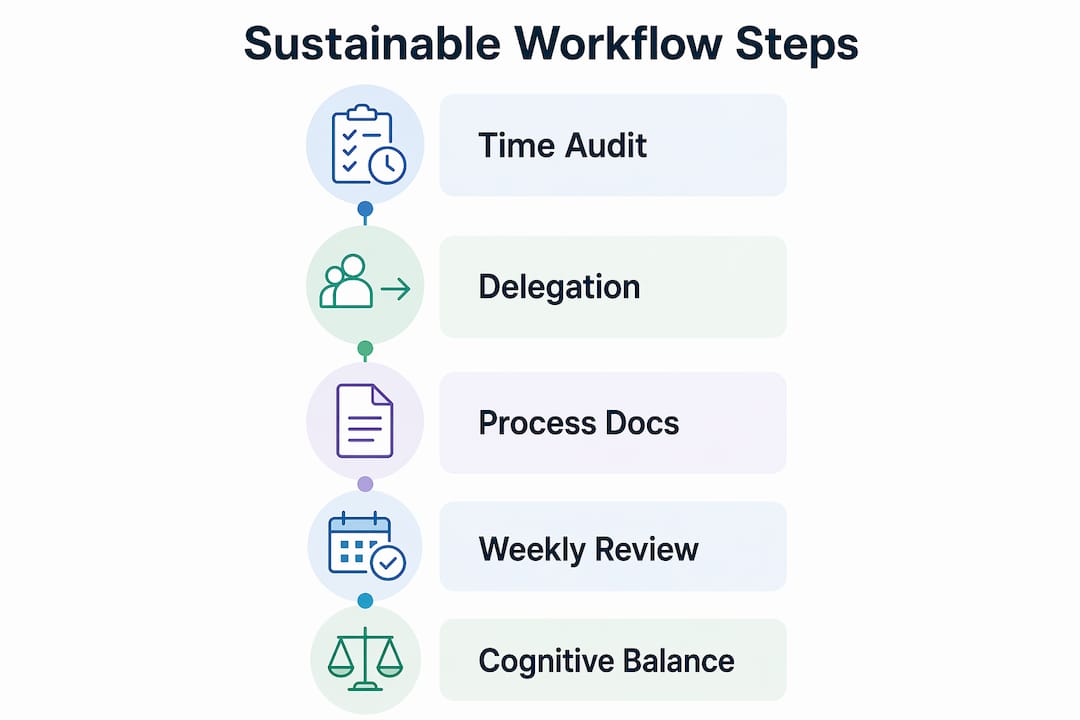
A weekly portfolio review prepares and prioritizes engagements and aligns your calendar with current high-leverage activities. This is not a status meeting. It is a structured decision about where your attention goes next week.
Pro Tip: Build your weekly review into a fixed 60-minute block on Friday afternoon. Treat it as non-negotiable. Executives who skip this review consistently report calendar drift within two weeks.
How to build your sustainable executive workflow step by step
The following process draws from Prialto's 6-step productivity framework and the Spry Executive OS. Each step builds on the last. Skipping steps does not save time. It creates the gaps that cause workflow collapse six months later.
-
Conduct a full time audit. Track every activity in 30-minute increments for one complete week. Categorize each block as high-leverage (requires your authority), delegable (can be owned by a team member with documentation), or eliminable (adds no value to current priorities). This audit is the foundation of your delegation design.
-
Define your high-leverage work explicitly. Write a one-page document listing the five to seven activities that only you can perform. These are your protected categories. Every other recurring activity is a delegation candidate. Be specific. "Strategic decisions" is not a category. "Final approval on contracts above $500,000" is.
-
Build and maintain a delegation list. For each delegable task, assign a named owner, document the process in an SOP, and set a review cadence. The list is a living document. Review it quarterly and update it as your role evolves.
-
Implement support layers. Virtual assistants, executive assistants, and cross-functional team members are not luxuries. They are the operational layer that executes your documented processes. AI tools draft and triage but require human final approval to prevent silent workflow failures. Use AI as a routing and drafting aid, not as a replacement for judgment.
-
Establish fixed operating rhythms. A weekly portfolio review, a monthly priority reset, and a quarterly workflow audit form the backbone of a durable executive operating system. The executive calendar must reflect evolving priorities and exclude catch-up tasks to avoid collapse by cadence reset. Open loops and deferred decisions accumulate into cognitive drag. Closure rituals and no-catch-up rules preserve continuity.
-
Integrate AI with accountability. AI integration in executive workflows is most effective when designed as decision routing with human review, not as a chat or summary replacement. Assign a named person to review AI outputs before they influence decisions. This prevents the quiet erosion of workflow quality that comes from unreviewed automation.
Pro Tip: After your first time audit, identify the single highest-volume delegable task and document its SOP within 48 hours. Momentum matters more than perfection at this stage.
How do you prevent executive burnout through workflow design?
Burnout in executives is rarely caused by workload intensity alone. Burnout and poor performance often stem from loss of agency and unclear commitment economics. When you lose conscious control over your calendar and commitments, autonomy becomes a liability rather than a strength.
"Autonomy is protective only if exercised with awareness. Calendar and workload unpredictability reduce resilience over time." — Executive Burnout and the Psychology of Autonomy
This distinction matters. Executives often believe they are in control because they set their own schedules. Unreflected autonomy, where you accept every commitment without conscious evaluation, produces the same cognitive overload as having no control at all.
The organizational dimension of burnout prevention
Individual resilience practices are necessary but not sufficient. A review of 11 studies covering 1,669 participants found that organizational-level interventions combining psychoeducation and training reduce burnout more effectively than individual efforts alone. The effects are real but limited in duration without sustained cultural reinforcement. This means workflow design must be embedded at the organizational level, not left to individual discipline.
Leadership behaviors around employee development, communication, and sustainable work efficiency correlate positively with both employee well-being and financial performance. Four years of company data showed feedback loops where employee well-being influences subsequent leadership behavior ratings. Your workflow design does not just protect you. It sets the standard your organization follows.
Key organizational practices that reduce burnout risk:
- Predictable meeting cadences that eliminate interpersonal unpredictability
- Explicit no-catch-up rules that prevent calendar collapse
- Ethical leadership and rhythm design that reduces chronic resource loss
- Documented escalation paths that prevent low-leverage decisions from reaching executive level
- Quarterly workflow audits that catch drift before it becomes structural
Pro Tip: Schedule a 20-minute "commitment audit" at the end of each month. Review every standing meeting and recurring obligation. Cancel or delegate anything that no longer aligns with your current high-leverage priorities.
Cognitive load and decision quality
Cognitive overload in executives diminishes decision quality and performance. Behavioral neuroscience shows that overload raises error rates. AI combined with well-designed team structures reduces cognitive load and enables better workflow decisions. The goal is not to think less. It is to protect the cognitive capacity you need for the decisions that matter most.
Traditional vs. sustainable executive workflows: what changes?
The difference between a traditional executive workflow and a sustainable one is not effort. It is architecture.
| Dimension | Traditional Workflow | Sustainable Workflow |
|---|---|---|
| Calendar management | Reactive, filled by requests | Protected, aligned to high-leverage priorities |
| Delegation | Ad hoc, based on trust | Systematic, documented with SOPs |
| Decision-making | Centralized, executive-dependent | Distributed, with clear escalation paths |
| Burnout risk | High, driven by volume and unpredictability | Reduced, through rhythm and autonomy design |
| AI use | Minimal or unstructured | Structured routing with human review |
| Review cadence | Irregular or absent | Fixed weekly, monthly, and quarterly rhythms |
| Long-term performance | Degrades under sustained pressure | Maintained through deliberate design |
Traditional workflows place the executive at the center of every decision. That model works in the short term and fails over years. Sustainable management strategies distribute execution while concentrating strategic authority. The result is an organization that performs consistently, not just when the leader is at peak capacity.
For executives focused on long-term performance, the comparison above is not theoretical. It describes the difference between a career that compounds and one that burns out at its most productive phase.
Key takeaways
A sustainable workflow for executives requires deliberate architecture across time auditing, delegation, operating rhythms, and cognitive load management to maintain performance over the long term.
| Point | Details |
|---|---|
| Start with a time audit | Track work in 30-minute increments to identify what requires your authority versus what can be delegated. |
| Document every delegation | Assign named owners and write SOPs for all recurring delegable tasks to maintain reliability under pressure. |
| Protect your calendar | Align your calendar only with current high-leverage priorities and eliminate catch-up tasks that cause cadence collapse. |
| Design organizational rhythms | Fixed weekly reviews, monthly resets, and quarterly audits prevent drift and reduce burnout risk at the structural level. |
| Use AI with accountability | Deploy AI as a routing and drafting tool with mandatory human review to prevent silent workflow failures. |
The architecture nobody talks about
Most conversations about executive productivity focus on habits. Wake up earlier. Block deep work time. Meditate. These are not wrong, but they address the symptoms of a poorly designed workflow, not the cause.
What I have observed, working with and alongside executives in demanding roles, is that the ones who sustain high performance over a decade are not the ones with the best habits. They are the ones who have built systems that do not depend on willpower. Their calendar is protected by design, not by discipline. Their delegation works because it is documented, not because their team is exceptional.
The concept of conscious autonomy is the piece most executives miss. You can have complete control over your schedule and still lose agency if you are accepting commitments without evaluating their cost. The psychology of executive burnout points directly at this: it is not the volume of work that breaks leaders. It is the accumulation of commitments made without a clear accounting of what they displace.
AI is genuinely useful here, but not in the way most people use it. A chat interface that summarizes emails is not a workflow tool. AI designed as a decision-routing layer, with named accountability and human review at every output, is a different category entirely. That distinction is worth building into your operating system before you automate anything.
The executives I respect most treat their workflow the same way they treat their physical conditioning. It requires regular assessment, deliberate adjustment, and the discipline to protect what works. The daily executive routine is not separate from the workflow. It is the workflow made visible.
— Joakim
How Viridos supports your executive performance system
Building a sustainable workflow requires more than strategy. It requires the physical and cognitive foundation to execute that strategy consistently, day after day.

Viridos is designed for exactly this. The Viridos Performance Journal gives you a structured tool to log weekly priorities, track review rhythms, and maintain the accountability cadence that prevents drift. It is not a diary. It is an operating instrument for disciplined leaders. For executives who want continuous support at the formulation level, the Viridos Membership provides controlled access to premium performance compounds, small-batch Swedish production, and a precision approach to vitality that matches the standard you hold in every other area of your work. Sustained performance is not accidental. It is built.
FAQ
What is a sustainable workflow for executives?
A sustainable workflow for executives is a structured system of time auditing, delegation, process documentation, and fixed operating rhythms designed to protect cognitive capacity and maintain high performance over the long term. It prioritizes high-leverage work and systematizes everything else.
How do i start building a sustainable executive workflow?
Begin with a one-week time audit in 30-minute increments to identify which activities require your unique authority and which can be delegated or documented. This audit forms the foundation of every delegation and rhythm decision that follows.
How does workflow design prevent executive burnout?
Burnout in executives often stems from loss of agency and unclear commitment economics, not just workload volume. Designing predictable rhythms, applying no-catch-up rules, and exercising conscious autonomy over calendar commitments reduces the resource loss that accumulates into burnout.
What role does AI play in a sustainable executive workflow?
AI is most effective as a decision-routing and drafting tool with mandatory human review at every output stage. It reduces cognitive load on routine decisions but should never replace executive judgment on high-stakes matters.
How often should executives review and update their workflow?
A weekly portfolio review, a monthly commitment audit, and a quarterly workflow assessment form the minimum review cadence for a durable executive operating system. Regular review prevents calendar drift and keeps delegation structures aligned with current priorities.