TL;DR:
- Reclaim vitality by consistently optimizing sleep, physical activity, and nutrition for a 64% lower mortality risk.
- Incorporate stress management programs like SMART to significantly reduce burnout and improve resilience.
- Use physical strength metrics and structured workday design aligned with biological rhythms to sustain energy and performance.
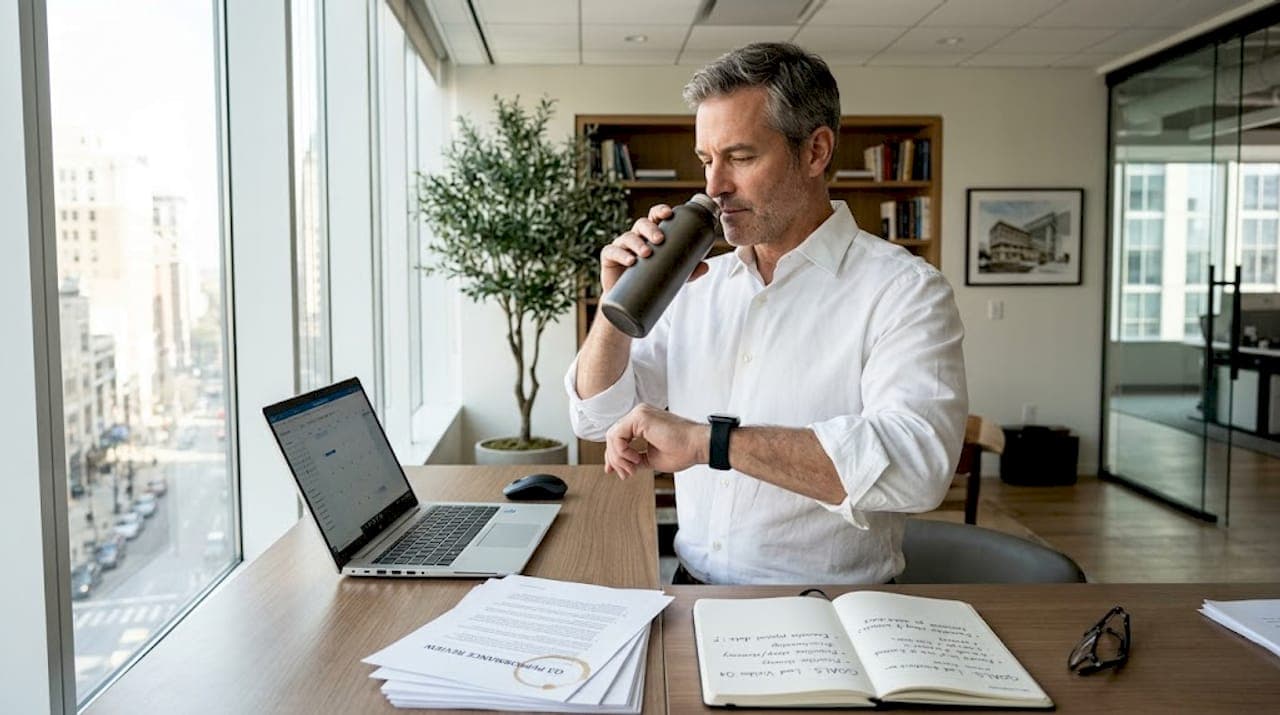
Most professionals assume reclaiming their edge requires a complete life overhaul. New research says otherwise. A 64% lower mortality risk is achievable simply by optimizing sleep, physical activity, and diet together. Not perfectly. Just consistently. The gap between where you are and where your physiology could be is smaller than you think. This guide translates elite-level research into practical, immediately usable strategies for sleep, stress, strength, and workday design. If you run a business, lead a team, or carry significant responsibility, this is the performance framework your calendar has been missing.
Table of Contents
- The vitality equation: Sleep, activity, and nutrition synergy
- Stress management and resilient minds: MBIs and SMART programs
- Muscle, fitness, and measurement: Physical strength as a vitality signal
- Designing your workday for sustained energy and leadership
- What most professionals miss about vitality: Beyond physical measures
- Next steps: Tools to put vitality into practice
- Frequently asked questions
Key Takeaways
| Point | Details |
|---|---|
| Synergy matters | Modest, combined improvements in sleep, movement, and nutrition deliver substantial vitality and longevity benefits. |
| Measure what counts | Grip strength and focused work patterns are practical, science-backed markers for professional resilience. |
| Resilience through routine | Integrating mindfulness and stress training into daily habits builds lasting capacity and guards against burnout. |
| Protect your peaks | Designing workday structure around ultradian rhythm cycles preserves energy and leadership performance. |
| Purpose fuels power | Fulfillment and contribution—beyond physical health—form the foundation for sustainable professional vitality. |
The vitality equation: Sleep, activity, and nutrition synergy
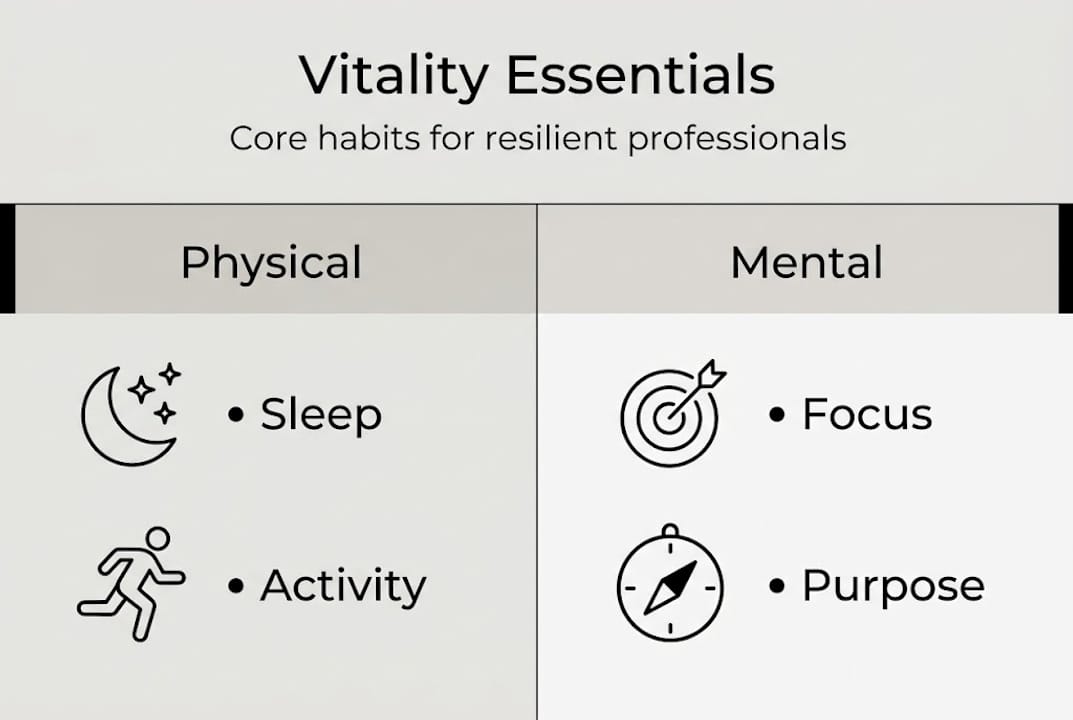
You already know sleep, exercise, and diet matter. What the research now confirms is that their combined effect is far greater than any one factor alone. Scientists call this the SPAN model: Sleep, Physical Activity, and Nutrition. When you improve all three even modestly, the benefits compound in ways that individual changes simply cannot match.
The optimal lifestyle combo reduces all-cause mortality risk by 64%, not through extreme protocols, but through hitting practical thresholds in each category simultaneously. Here is what those thresholds look like in practice:
| SPAN Factor | Minimum Effective Range | Optimal Target |
|---|---|---|
| Sleep | 7.2 hours/night | 8.0 hours/night |
| MVPA (moderate to vigorous activity) | 42 min/day | 103 min/day |
| Diet Quality Score (DQS) | 57.5 | 72.5 |
Notice the minimums. You do not need to become an athlete or eat like a nutritionist. You need to clear a baseline in each lane, consistently.
Pro Tip: Stack new habits onto existing work routines. Take calls walking. Eat a structured lunch at the same time daily. Keep sleep timing fixed even when travel shifts your schedule. Compounding only works if the habits are consistent enough to stick.
Here are the highest-leverage shifts for professionals starting from a demanding baseline:
- Fix your sleep schedule first. A consistent wake time anchors your circadian rhythm more powerfully than any supplement.
- Prioritize meal timing. Eating within a 10-hour window reduces metabolic load and supports recovery without requiring dietary overhaul.
- Add movement hacks to existing transitions. Stairs, standing desks, and short walks between meetings accumulate fast.
- Track one metric at a time. Overloading inputs creates friction. Pick sleep first, then layer.
For a broader view of longevity strategies and how to structure them around a demanding schedule, the research is increasingly clear: small, sustained improvements beat periodic heroics every time. If you are serious about balancing work and health, this is the science-backed foundation to build from.
With the power of small but coordinated lifestyle shifts in mind, let's explore how focused training in stress management and resilience sets the foundation for thriving in demanding roles.
Stress management and resilient minds: MBIs and SMART programs
Stress is not the enemy. Chronic, unmanaged stress is. For executives and founders, the cognitive and emotional load of high-stakes decision-making creates a form of physiological wear that, over time, erodes both performance and health. The question is not how to eliminate stress, but how to metabolize it effectively.
Mindfulness-based interventions, commonly called MBIs, are structured practices that train attention, emotional regulation, and present-moment awareness. They range from brief daily breathing protocols to intensive multi-week programs. One of the most rigorously studied is the SMART program, which stands for Stress Management and Resiliency Training.
| Feature | SMART Program | General MBIs |
|---|---|---|
| Duration | 8+ weeks, structured | Variable (often 4-6 weeks) |
| Effect size | Moderate to large | Small to moderate |
| Sustainability | High with structured follow-up | Moderate |
| Best for | High-stress professionals | Broad populations |
The evidence is direct. SMART Program delivers moderate to large improvements in well-being, resilience, and stress reduction in clinical settings, with benefits that persist beyond the intervention itself. For professionals, that means the investment in a structured program pays dividends long after the course ends.
"MBIs significantly reduce burnout and improve sleep quality for individuals in high-stress roles, with longer intervention periods producing the most durable effects."
The practical implications are significant. Longer is better. Eight weeks outperforms four. Daily practice outperforms weekly check-ins. Consistency, again, is the operative variable.
Here is a simple framework for integrating stress reduction into a working professional's day:
- Start with two minutes. A structured breathing protocol at the top of the morning requires no equipment and sets a physiological baseline before cognitive demands begin.
- Build a midday reset. A five-minute walk or breathing pause between morning and afternoon sessions interrupts cortisol accumulation.
- Audit your calendar for recovery gaps. Back-to-back meetings without buffer time is a design flaw, not a badge of productivity.
- Use transitions as cues. The space between tasks is a natural intervention point for a single mindful breath cycle.
- Commit to an 8-week practice. Choose one MBI format and run it long enough to generate durable results.
For deeper guidance, explore stress management for executives and the broader landscape of executive wellness strategies that integrate these principles into a full performance system.
Equipped with strategies for managing stress and building resilience, let's turn to the physical dimension and how fitness, especially strength and cardiorespiratory health, serve as simple, powerful biomarkers for sustaining vitality.
Muscle, fitness, and measurement: Physical strength as a vitality signal
Here is something most productivity frameworks overlook: your body is a performance instrument, and it has measurable indicators that tell you how well it is tuned. Two of the most powerful are cardiorespiratory fitness (CRF) and grip strength. Neither requires a lab. Both carry significant predictive value for how well you will perform and how long you will sustain it.
CRF is essentially how efficiently your heart and lungs deliver oxygen to working muscles. Grip strength is exactly what it sounds like, and it turns out to be one of the most reliable proxies for overall muscular health, neuromuscular function, and systemic resilience.
| Metric | Minimum Threshold | Optimal Target | Health Impact | |---|---|---| |---| | Grip strength | 31 kg | 36 kg | Reduced all-cause mortality | | CRF | Moderate fitness | High fitness | 10-13% lower healthspan risk |
The numbers matter. High CRF and strength cut healthspan termination risk by 10 to 13%, and grip strength below median increases all-cause mortality risk meaningfully. These are not abstract statistics. They are levers you can pull.
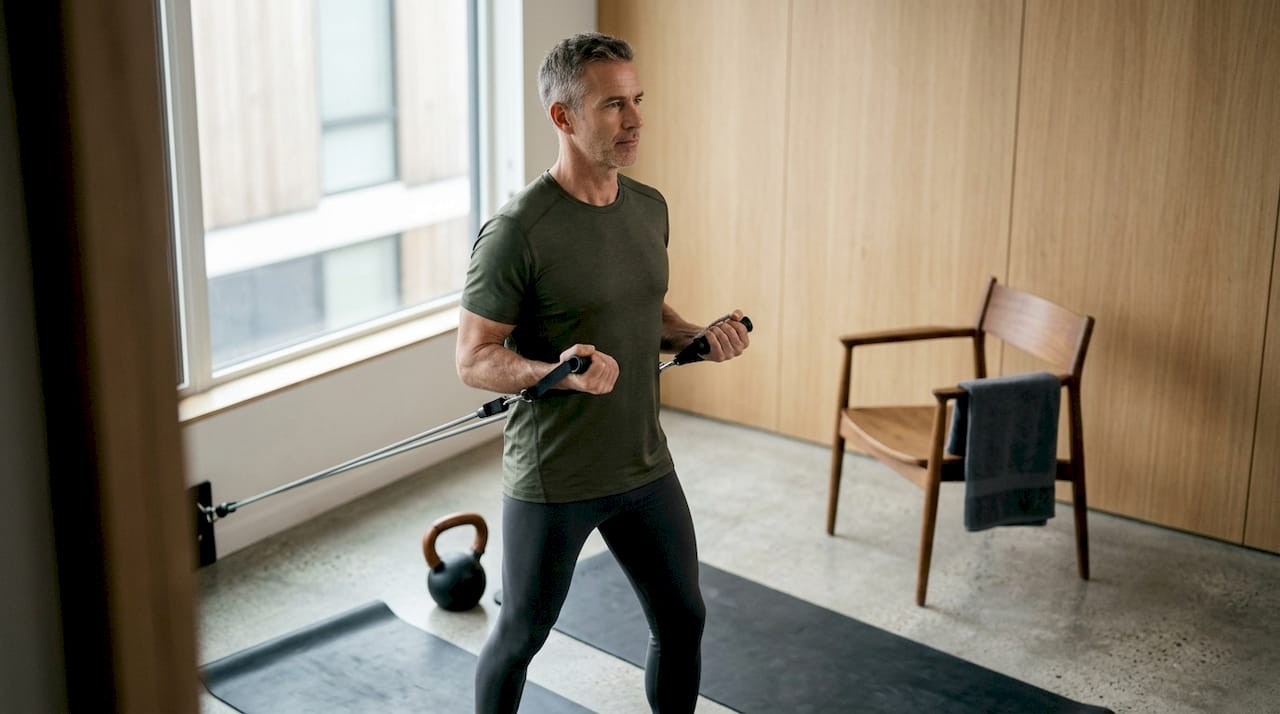
From 40 onward, resistance training becomes non-negotiable. Muscle mass declines at roughly 1% per year after 40 without deliberate intervention. That decline is not a fate. It is a default that training overrides.
Pro Tip: Test your grip strength right now with a bathroom scale. Grip it on the sides and squeeze as hard as you can. It will not give you kilograms, but tracking your consistent effort over weeks tells you if you are moving in the right direction. For a formal test, most physio clinics can provide a baseline in minutes.
Here are the most effective strength activities for professionals with limited time:
- Push-ups: Full range, three sets to technical failure, three times per week
- Bodyweight squats and lunges: Load-bearing lower body work protects metabolic health
- Dead hangs: Grip-specific training that also decompresses the spine
- Kettlebell swings: Posterior chain activation in minimal time
- Farmer carries: Simple grip and core load you can do anywhere
For a structured approach, see executive fitness and performance tips for execs over 40 for programming designed around demanding schedules.
Physical metrics are powerful yet actionable, but maximizing professional output also depends on managing time and focus, designing the workday to align with biological and cognitive rhythms.
Designing your workday for sustained energy and leadership
Your brain does not operate at a flat line of cognitive capacity across a 10-hour day. It cycles. Roughly every 90 minutes, your nervous system moves through a peak-to-trough cycle called the ultradian rhythm. Ignoring this cycle means working against your own biology. Aligning with it means you get more done with less fatigue.
90-minute focused blocks during peak windows elevate leadership performance. Task switching, by contrast, creates what researchers call attention residue, meaning part of your cognitive bandwidth stays stuck on the previous task even after you move on. The productivity cost is real and cumulative.
One striking data point: meetings scheduled after 8pm have increased by 16% globally, pulling recovery time out of schedules that already have too little of it. Protecting your cognitive architecture is a leadership decision, not a luxury.
For professionals looking to apply a focused work training workflow to their executive context, the principle transfers directly: structure, recovery, and repetition build output over time.
- Identify your peak window. Most professionals find peak cognitive performance between 8am and noon. Protect this block fiercely.
- Set 90-minute work units. Begin with a clear objective, close all unrelated tabs, and commit to single-task focus.
- Build in a deliberate break. A 10-to-20-minute recovery between blocks, whether a walk, a meal, or simply stepping away from a screen, restores attention.
- Batch low-cognitive tasks. Email, admin, and routine decisions belong in afternoon valleys, not morning peaks.
- End each block with a brief capture. Write down where you stopped and what is next. This reduces attention residue before you switch.
Pro Tip: Treat your peak cognitive window like a board meeting. Block it in your calendar, notify your team, and guard it with the same firmness you would a high-stakes external commitment.
For more on optimizing personal energy and aligning daily structure with performance goals, the framework above is a starting point, not a ceiling.
With science-based routines and physical cues mastered, next is connecting everyday work with meaning and long-term fulfillment.
What most professionals miss about vitality: Beyond physical measures
Here is the uncomfortable truth that most executive performance content sidesteps: you can optimize your sleep, hit your grip strength targets, and structure your workday perfectly, and still feel empty. Vitality is not just a physical state. It is a psychological and even spiritual one.
The Worker Vitality Scale, developed through rigorous research, includes psychological, emotional, and spiritual domains alongside physical ones. When professionals chase only output metrics or biometric benchmarks, they are optimizing an incomplete equation.
"Spiritual and psychological vitality add fulfillment, meaning, and sustained energy, contributing to professional endurance in ways that physical metrics alone cannot explain."
Contribution matters. Purpose matters. Men who feel that their work serves something beyond their own advancement consistently report higher vitality, more sustained motivation, and greater resilience under pressure. This is not soft language. It is measurable and reproducible in the research.
The practical reflection here is simple: build a 10-minute weekly review into your schedule that asks not just what you produced, but what you contributed. Who benefited from your decisions this week? What are you building that extends beyond the next quarter? These questions are not indulgent. They are performance inputs.
For a complete view of this dimension, explore the guide to self-optimization that integrates purpose-driven thinking with the physical and cognitive strategies covered throughout this article.
Next steps: Tools to put vitality into practice
Reading about vitality creates awareness. Applying it builds the edge you are here for. The frameworks in this article work best when tracked consistently over time, which is exactly what the VIRIDOS Performance Journal is designed for. Built for high-achieving professionals, it gives you a structured space to monitor your sleep, track your strength metrics, log your focused work blocks, and reflect on progress weekly.
At VIRIDOS, every tool and resource is built around one principle: sustained performance requires a system, not a series of isolated efforts. Start with what resonated most in this article, integrate it for 30 days, and return for the next layer of strategy. The edge is built incrementally.
Frequently asked questions
How much sleep do professionals really need for optimal vitality?
Aiming for 7.2 to 8.0 hours of quality sleep per night is strongly associated with reduced health risks and sharper daily performance for busy professionals.
Which physical metric best signals vitality for executives over 40?
Grip strength is one of the most practical and predictive markers available. A minimum of 31kg, with 36kg as an optimal target, correlates directly with reduced all-cause mortality risk.
What's the most effective routine to reduce work stress and prevent burnout?
Participating in a structured mindfulness program such as SMART or a comparable MBI, especially for eight weeks or longer, has proven to dramatically reduce burnout and improve resilience.
How can I improve my energy across a demanding workday?
Schedule 90-minute focused blocks during your biological peak periods and protect them from interruptions. Recovery between blocks is not optional. It is what makes the next block possible.
Recommended
- Longevity strategies: Why professionals thrive on healthspan
- Executive vitality: The complete guide for high achievers
- Long-term health tips for high-performing executives
- Vitality optimization guide for high-performing men 40–65
- Mastering Time Management for Coaches: Boost Efficiency – Hoop Mentality