If your total testosterone result is 400 ng/dL (13.9 nmol/L), that places you within the typical range for men in their 40s, though it sits in the lower half of what harmonized cohort data show for healthy men in that decade. Context matters as much as the number itself.
Here is a quick placement guide by decade, using commonly cited bounds:
- Below typical for your age: under 300 ng/dL (10.4 nmol/L) for men 20–39; under 250 ng/dL (8.7 nmol/L) for men 50+
- Within typical range: 300–900 ng/dL (10.4–31.2 nmol/L) for men under 40; 250–750 ng/dL (8.7–26.0 nmol/L) for men 40–65
- Above typical: values exceeding commonly observed upper reference bounds in most adult age groups
Unit conversion reference: multiply ng/dL by 0.0347 to get nmol/L. Divide nmol/L by 0.0347 to return to ng/dL. Most U.S. labs report in ng/dL; European and many hospital labs report in nmol/L.
This article is for general informational purposes only and does not constitute medical advice or a diagnosis. If your results are consistently low or you have symptoms, consult a licensed clinician before drawing conclusions or making changes.
Key Takeaways
Total testosterone must be interpreted against age-specific reference ranges, confirmed with two early-morning draws, and evaluated alongside symptoms before any clinical or lifestyle intervention is warranted.
| Point | Details |
|---|---|
| Age-stratified ranges matter | A single 300 ng/dL cutoff misclassifies many men; use decade-specific bounds from harmonized cohort data. |
| Two morning draws required | Confirm any low result with a second early-morning, fasting test before drawing conclusions or consulting a clinician. |
| Free testosterone and SHBG add context | When total levels and symptoms conflict, calculated free testosterone and SHBG clarify the bioavailable fraction. |
| Lifestyle drives the floor | Sleep quality, body composition, and metabolic health modulate where you land within the ~1%/year population-average decline. |
| Viridos membership | For men past the foundational steps, Viridos offers precision-grade performance support via controlled-access Swedish membership. |
Table of Contents
- What does the testosterone levels in men chart show by decade?
- How do total and free testosterone differ, and why does it matter?
- How does testosterone change as men age?
- How should you test and interpret your testosterone results?
- What do harmonized percentile data actually show?
- Why disciplined men should read their chart differently
- Viridos membership supports disciplined, sustained performance
- Sources
What does the testosterone levels in men chart show by decade?
The table below draws on harmonized cohort data from pooled U.S. and European studies alongside MedlinePlus clinical reference ranges. Values apply to healthy, nonobese men and represent total testosterone.
Note: MedlinePlus reports a commonly cited lab range of 249–836 ng/dL for men aged 17–50 and 193–740 ng/dL for men over 50. Individual lab reference ranges vary depending on the assay platform used.
Two practical points before you interpret your result:
- Assay variation is real. The same blood sample can produce readings that differ by 10–15% across different laboratory platforms. A result near a boundary deserves a repeat test, not an immediate conclusion.
- Morning, fasting samples are the standard. Testosterone peaks in the early morning. A draw taken at 2:00 PM can read 20–25% lower than one taken at 7:00 AM from the same man on the same day.
A single number from a single draw tells you less than you think. Two early-morning results, taken on separate days, give you something worth acting on.
How do total and free testosterone differ, and why does it matter?
Total testosterone is the sum of all testosterone in your bloodstream, including the fraction bound to proteins. The distinction matters clinically because a man can have a normal total level while his biologically active fraction is suppressed.
The binding protein at the center of this is sex hormone-binding globulin (SHBG). SHBG rises with age, with liver disease, and with hyperthyroidism. As SHBG increases, it captures more testosterone, lowering the free fraction even when total levels look adequate. Bioavailable testosterone adds the albumin-bound fraction back in, since albumin binds testosterone loosely and releases it to tissues more readily than SHBG does.
Your lab report may include several values:
- Total testosterone: the standard screening measure; most reference ranges are built around this
- Free testosterone (direct): measured by equilibrium dialysis; the most accurate method but expensive and not universally available
- Calculated free testosterone: derived from total testosterone, SHBG, and albumin; a reliable estimate when direct measurement is unavailable
- SHBG: ordered when total testosterone and symptoms conflict, or when obesity, aging, or medications complicate interpretation
StatPearls' testosterone physiology review confirms that testosterone supports muscle mass, bone density, mood, energy, and libido. Declines in any of these domains, when paired with a low lab result, give a clinician a clearer picture than the number alone.
Pro Tip: Schedule your blood draw before 10:00 AM, ideally between 7:00 and 9:00 AM, after an overnight fast. Testosterone follows a diurnal rhythm that peaks in the morning and drops through the afternoon. A draw outside this window can understate your true level by a clinically meaningful margin.
How does testosterone change as men age?
Total testosterone declines at roughly 1% per year after age 30–40 in population-average data. The critical word is average: individual trajectories vary widely, and the decline is not inevitable destiny.
~1% per year is the population-average decline in total testosterone after age 30–40. It is a statistical trend, not a biological ceiling. Lifestyle, body composition, and sleep quality all modulate where any individual lands within that distribution.
Several factors accelerate decline independent of calendar age:
- Obesity and metabolic syndrome: adipose tissue converts testosterone to estradiol via aromatase, directly suppressing androgen levels
- Sleep apnea and poor sleep quality: most testosterone is secreted during sleep; fragmented sleep reduces pulsatile LH release and suppresses testicular output
- Chronic stress and elevated cortisol: cortisol competes with testosterone at the receptor level and suppresses the hypothalamic-pituitary-gonadal axis
- Certain medications: opioids, corticosteroids, and some antidepressants can suppress testosterone meaningfully
- Sedentary behavior and low muscle mass: resistance training is one of the most consistent lifestyle levers for maintaining androgen signaling
Because SHBG rises with age, free testosterone can decline more steeply than total testosterone. A man whose total testosterone holds at 450 ng/dL at age 60 may have a free testosterone fraction closer to what a 400 ng/dL total would imply at age 35. This is why age alone does not tell the full story, and why SHBG measurement adds interpretive value in older men.
How should you test and interpret your testosterone results?
Reliable testosterone data requires deliberate preparation. A single casual draw is not a clinical baseline.
Before your test:
- Schedule the draw between 7:00 and 10:00 AM, when testosterone is at its daily peak
- Fast overnight (water is fine); avoid heavy alcohol the night before
- Avoid intense exercise for 24 hours prior, as acute exertion can transiently suppress levels
- Disclose all medications and supplements to your ordering clinician
- Do not use exogenous androgens, DHEA, or testosterone-containing products in the weeks before testing
What clinicians look for:
MedlinePlus clinical guidance specifies that a low result must be confirmed with at least two separate early-morning measurements before a diagnosis of deficiency is established. Biological variability and diurnal rhythm mean a single low draw is insufficient evidence on its own.
When both tests return low, clinicians typically order free testosterone and SHBG to clarify the bioavailable fraction. LH and FSH levels help distinguish primary testicular failure from secondary (pituitary or hypothalamic) causes. A Journal of Urology analysis reinforces that applying a single 300 ng/dL cutoff across all ages misclassifies many younger men as deficient and many older men as normal. Age-stratified reference ranges are clinically more precise.
What to bring to your appointment:
- Both lab reports (dates, times of draw, assay platform if listed)
- A symptom log: libido changes, fatigue pattern, sleep quality, mood, strength, and body composition shifts
- Current medications and supplements
- Fertility plans, if relevant, since testosterone therapy suppresses sperm production
Mayo Clinic's guidance on testosterone therapy is explicit: therapy is indicated for documented hypogonadism with symptoms, not for healthy aging alone. A man with a 380 ng/dL result and no symptoms does not meet the clinical threshold for treatment under current guidelines. A man with a 420 ng/dL result and significant symptoms warrants further evaluation. The number and the clinical picture work together.
If fertility is a concern, reviewing fertility hormone interpretation alongside testosterone data gives a more complete picture of reproductive endocrine function.
What do harmonized percentile data actually show?
The most rigorous population reference data come from a harmonized analysis of four cohort studies conducted across the United States and Europe. By applying CDC-standardized calibration methods, the researchers reduced intercohort assay variation and produced model-based percentiles that are more comparable across labs than any single-cohort reference range.
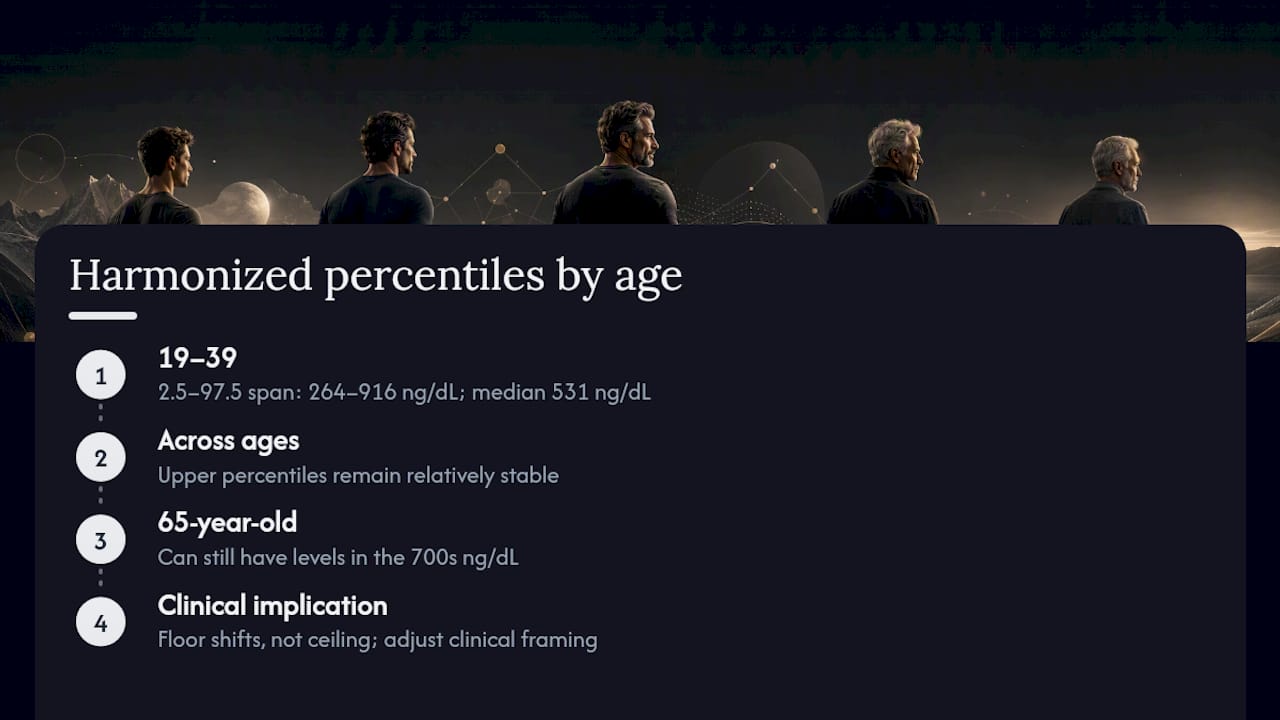
For healthy nonobese men aged 19–39, the harmonized 2.5th–97.5th percentile span runs approximately 264–916 ng/dL, with a median near 531 ng/dL.
One of the more clinically significant findings from this harmonized dataset: upper percentiles remain relatively stable across age groups, while lower percentiles decline. A 65-year-old man can still have a testosterone level in the 700s ng/dL. What shifts with age is the floor, not the ceiling. This has direct implications for how clinicians should frame "normal aging" versus pathological decline.
These percentiles apply specifically to healthy, nonobese men. Obesity, chronic illness, and medications that suppress the hypothalamic-pituitary-gonadal axis all shift an individual's distribution downward. Clinicians must adjust interpretation accordingly.
Why disciplined men should read their chart differently
The number on your lab report is a data point, not a verdict. That distinction matters more for high-responsibility men than for anyone else, because the temptation to optimize a single metric can lead to decisions that undermine the broader physiology you are trying to protect.
Most men who come to testosterone testing with a performance mindset focus on where their total level sits relative to the median. That is a reasonable starting point. What they underestimate is how much the trajectory matters relative to the absolute value. A man at 480 ng/dL who was at 620 ng/dL two years ago, with worsening sleep and a 15-pound increase in visceral fat, has a more actionable clinical picture than a man sitting at 380 ng/dL with stable labs, excellent sleep, and no symptoms.

The Annual Reviews clinical trial evidence on testosterone treatment in older men is instructive here. Benefits for sexual function and bone density are documented. Long-term cardiovascular and prostate safety remain uncertain. Guidelines recommend individualized decisions, not population-level protocols. That means the conversation belongs between you and a clinician who knows your full picture, not between you and a reference range.
Three priorities for men who want to maintain androgen signaling without pharmacological intervention:
- Optimize sleep architecture first. Seven to nine hours of quality sleep, with sleep apnea ruled out, is the single highest-leverage non-pharmacological lever for testosterone maintenance. The self-optimization guide for resilience and performance covers this in practical detail.
- Manage body composition with precision. Visceral adiposity is a direct suppressor of testosterone through aromatase activity. Resistance training three to four times per week and controlled caloric intake address this more reliably than any supplement.
- Confirm your labs before drawing conclusions. Two morning draws, SHBG included, give you a defensible baseline. Bring that data to a clinician alongside a symptom log. The longevity checklist for men offers a structured framework for tracking these variables over time.
Chasing a specific ng/dL target without addressing the systemic drivers is the wrong frame. Sustainable androgen signaling is a product of metabolic health, sleep quality, and body composition, not a number you optimize in isolation.
Viridos membership supports disciplined, sustained performance
Men who have confirmed their baseline labs and addressed the foundational lifestyle variables sometimes want a precision-grade next step, one that matches the rigor they bring to everything else.

Viridos is a controlled-access Swedish performance membership for founders, executives, and high-agency men who want sustained vitality without mass-market shortcuts. The formulation uses proprietary phytoandrogen-related compounds delivered via precision oral spray, produced in small batches in Sweden with exacting quality standards. Membership includes access to performance-focused resources and structured monitoring support, not a prescription and not a replacement for clinical care.
Viridos does not treat hypogonadism and is not a substitute for clinician evaluation. If your labs indicate documented deficiency with symptoms, that conversation belongs with your physician. For men who have addressed the fundamentals and want a premium, precision-grade support layer, Viridos membership is a disciplined next step. You can also explore the Viridos Performance Journal to track vitality trends and lab data over time.
Sources
The following sources underpin the data and clinical guidance in this article. Each is worth reading directly if you want to go deeper.
- Harmonized Reference Ranges for Circulating Testosterone Levels in Men of Four Cohort Studies in the United States and Europe - PMC
- Testosterone therapy — Mayo Clinic
- Testosterone: MedlinePlus Medical Encyclopedia
- What Is a Normal Testosterone Level for Young Men? Rethinking the 300 ng/dL Cutoff for Testosterone Deficiency in Men 20-44 Years Old | Journal of Urology
- Physiology, Testosterone - StatPearls - NCBI Bookshelf
- CDC Clinical Standardization Programs — Hormones
This article provides general health information for educational purposes. It is not a substitute for professional medical advice, diagnosis, or treatment. Consult a qualified clinician to interpret your personal lab results and determine appropriate next steps.