TL;DR:
- Most busy professionals should prioritize fixing their wake time first to improve sleep quality and circadian rhythm.
- Controlling bedroom temperature and limiting behavioral changes to one at a time enhance sleep consistency and long-term health.
Sleep hygiene is defined as the set of behavioral habits and environmental conditions that promote consistent, high-quality sleep essential for cognitive function, metabolic health, and sustained productivity. Professional guidelines from sleep medicine organizations recommend 7–9 hours of quality nightly sleep for adults to maintain cognition, mood, and immune health. That standard is not aspirational. It is a physiological requirement. For executives and founders managing high-stakes decisions daily, the role of sleep hygiene extends beyond rest. It determines how well you think, regulate emotion, and perform under pressure over the long term.
Which sleep hygiene practices most impact executive function?
Sleep timing consistency is the single behavior linked to all key sleep outcomes, including duration, efficiency, and latency. Other habits may shift one parameter, but your bed and wake times govern the whole system. That makes a fixed schedule the highest-return investment in your sleep quality.
Bedroom environment
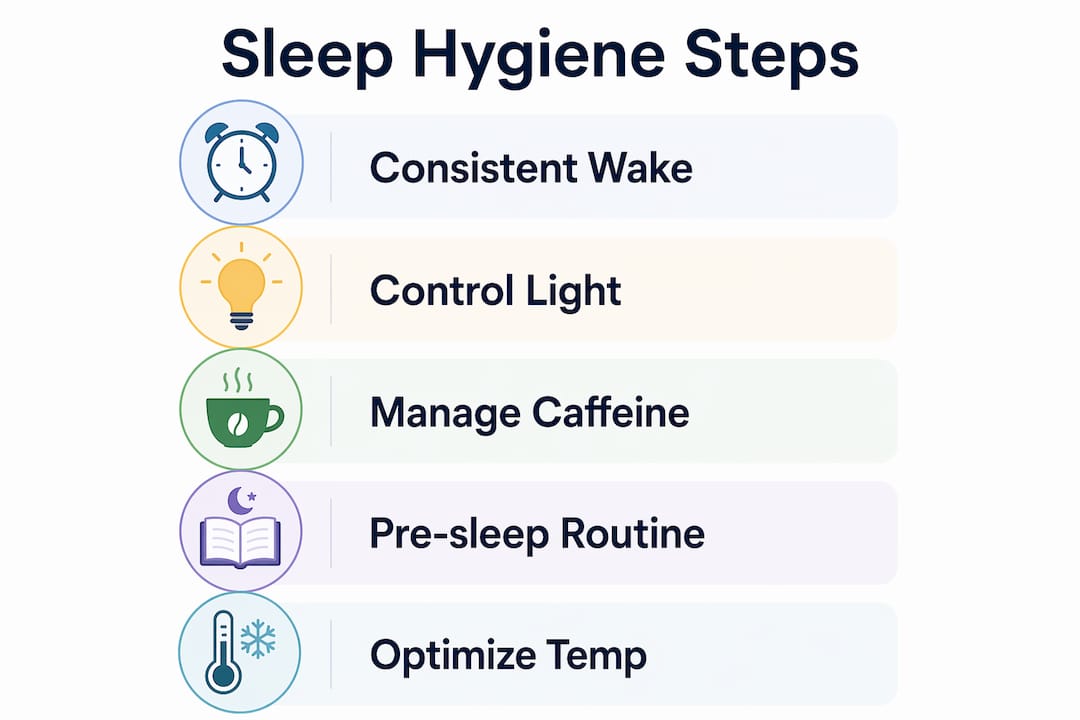
The bedroom environment shapes sleep onset more than most professionals realize. Core body temperature must drop to trigger sleep. A room temperature near 68°F, combined with a warm shower 1–2 hours before bed, accelerates that temperature drop and shortens the time it takes to fall asleep. Blackout curtains and noise control remove the two most common environmental disruptions.

Light exposure follows a precise logic. Morning sunlight anchors your circadian rhythm early in the day. Evening darkness, including limiting blue light from screens, prevents melatonin suppression and allows natural sleepiness to build. Dim lamps after 9:00 PM are not a comfort preference. They are a biological signal.
Stimulants and behavioral timing
Caffeine has a half-life of roughly five to six hours in most adults. A 3:00 PM espresso still has significant presence in your bloodstream at 9:00 PM. Alcohol compounds the problem differently. It may accelerate sleep onset but fragments the second half of the night, reducing restorative slow-wave sleep. Both require timing discipline, not elimination.
Evening screen use raises alertness at the exact moment your system needs to wind down. The content matters as much as the light. Work email, financial news, and high-stakes communication all activate the stress response. A hard stop on work-related screen use 60 minutes before bed is a behavioral boundary worth enforcing.
Pro Tip: Set a phone alarm labeled "wind-down" for 60 minutes before your target sleep time. Treat it with the same discipline you apply to a morning meeting.
Calming pre-sleep routines
A consistent pre-sleep routine signals the nervous system that performance mode is ending. The routine does not need to be elaborate. Dimming lights, light stretching, and reading non-work material for 20 minutes are sufficient. The consistency of the sequence matters more than its content. Your brain learns the pattern and begins releasing melatonin in anticipation.
How can busy professionals tailor sleep hygiene to their schedules?
Personalization separates effective sleep improvement from generic advice that fails in demanding schedules. Attempting too many behavior changes at once reduces effectiveness and adherence. The research is clear: target your individual deficit first, then add practices incrementally.
The following sequence works for most high-performing professionals dealing with fragmented or insufficient sleep:
- Fix your wake time first. Choose a consistent wake time and hold it seven days a week, regardless of the previous night's quality. This is the anchor for your entire circadian rhythm.
- Compress your time in bed. If you spend eight hours in bed but sleep only six, match your time in bed to your actual sleep time plus 30 minutes. Consolidating sleep builds pressure and improves efficiency before extending duration.
- Exit the bed if awake beyond 30 minutes. Lying awake in bed trains your brain to associate the bed with wakefulness. Get up, do something calm in dim light, and return when sleepy.
- Add one environmental change at a time. Once your schedule is stable, address temperature, then light, then noise. Sequential changes are easier to sustain than simultaneous overhauls.
- Track your patterns for two weeks. A written log of sleep and wake times, energy levels, and notable disruptions reveals your actual deficit more accurately than any generic recommendation.
Pro Tip: The sleep compression technique works fastest when you resist the urge to "catch up" on weekends. A single late morning resets your circadian anchor and costs you three to four nights of progress.
Professionals who build recovery and discipline into their weekly structure consistently outperform those who treat sleep as a variable they manage reactively. Sleep is not a recovery tool you deploy when exhausted. It is a performance input you protect proactively.
What are the broader health benefits of good sleep hygiene?
Sleep is an active biological process, not passive downtime. During deep sleep, the glymphatic system clears metabolic waste from the brain, including proteins associated with cognitive decline. Memory consolidation also occurs during this phase, transferring information from short-term to long-term storage. Both processes require uninterrupted, sufficient sleep to complete.
The systemic benefits of sustained good sleep practices extend well beyond the brain. Quality sleep supports immune regulation, cardiovascular function, and hormonal balance. Poor sleep hygiene, sustained over months or years, is linked to heart disease, diabetes, weight gain, depression, and anxiety. These are not distant risks. They are the compounding cost of treating sleep as optional.
| Health domain | Effect of quality sleep | Risk of chronic poor sleep |
|---|---|---|
| Cognitive performance | Faster recall, sharper decision-making | Impaired judgment, slower reaction time |
| Emotional regulation | Stable mood, higher stress tolerance | Irritability, anxiety, depression risk |
| Metabolic health | Balanced insulin response, healthy weight | Increased diabetes and obesity risk |
| Cardiovascular health | Lower resting heart rate, blood pressure | Elevated hypertension and heart disease risk |
| Immune function | Stronger pathogen response | Increased susceptibility to illness |
Daytime performance reflects the night before with precision. Executives who optimize sleep for professionals report measurable gains in decision speed, emotional composure under pressure, and sustained energy across long workdays. These are not soft benefits. They are the functional outputs of a system running on adequate recovery.
What practical steps build lasting sleep hygiene routines?
Sustainable sleep habits require structure, not willpower. The following practices address the most common failure points for professionals with demanding, irregular schedules.
- Hold your wake time constant. Even after a poor night, rise at the same time. Sleep pressure builds through the day and improves the following night. Sleeping in disrupts the cycle and compounds the problem.
- Take a warm shower 60–90 minutes before bed. The subsequent body temperature drop signals sleep onset more effectively than most supplements or relaxation techniques.
- Set a caffeine cutoff at 1:00 PM. This accounts for individual variation in caffeine metabolism and removes the compound effect of late-day stimulant use.
- Dim all lights by 9:00 PM. Use warm-toned bulbs or lamps in the evening. Overhead lighting in the 5,000–6,500 Kelvin range suppresses melatonin aggressively.
- Reserve the bed for sleep and intimacy only. Using the bed only for sleep strengthens the mental association between the bed and rest, reducing the time it takes to fall asleep.
- Journal before bed. Writing down tomorrow's priorities or unresolved concerns reduces nighttime rumination and clears mental load before sleep. Five minutes is sufficient.
- Keep the bedroom at 65–68°F. This range supports the core temperature drop required for deep sleep onset and maintenance.
Recovery nutrition also plays a role in sleep quality. Research on sport supplements and recovery shows that nutrient timing and composition affect overnight repair processes, which interact directly with sleep depth and duration.
Key Takeaways
Sleep timing consistency is the highest-return sleep hygiene habit for busy professionals, and every other practice compounds its effect only when a fixed schedule is already in place.
| Point | Details |
|---|---|
| Fix your wake time first | A consistent wake time anchors circadian rhythm and governs all other sleep outcomes. |
| Use sleep compression | Match time in bed to actual sleep time plus 30 minutes to consolidate fragmented sleep. |
| Control temperature | A room near 68°F and a pre-bed warm shower accelerate sleep onset more reliably than most interventions. |
| Limit behavior changes | Targeting one or two deficits at a time produces better adherence than overhauling all habits at once. |
| Sleep is preventive medicine | Sustained good sleep hygiene reduces long-term risk of heart disease, diabetes, and depression. |
Sleep hygiene as a performance discipline, not a wellness trend
I have worked with and around high-performing men long enough to know that sleep is the last thing most of them protect and the first thing they sacrifice. The logic sounds reasonable: there is always more to do, and sleep feels passive. That framing is wrong, and the cost compounds quietly.
What I have found is that the professionals who perform at the highest level over decades are not the ones who sleep the most. They are the ones who sleep the most consistently. A fixed wake time, held even after a difficult night, is worth more than any supplement, any biohack, or any productivity system. It is the foundation everything else sits on.
The mistake I see most often is trying to fix everything at once. Temperature, light, caffeine, journaling, no screens, meditation. All of it, starting Monday. That approach fails within two weeks because it requires too much cognitive overhead on top of an already demanding schedule. Pick the one habit with the highest personal deficit and hold it for 21 days before adding anything else.
Temperature management is the most underused tool I know. A warm shower before bed followed by a cool room is not a comfort ritual. It is a physiological trigger. Most men I know have never tried it deliberately. Those who do notice the difference within three nights.
Sleep hygiene is not remedial. It is not something you address when performance breaks down. It is the proactive infrastructure of a long career. Treat it accordingly.
— Joakim
Viridos and the discipline of recovery
Sustained performance requires more than ambition. It requires systems that support recovery with the same rigor you apply to your work.

Viridos is built for men who understand that distinction. The Viridos Performance Journal gives you a structured framework for tracking sleep, wake times, energy levels, and recovery patterns across weeks, making it easier to identify what is working and where your deficit actually lies. For professionals who want ongoing guidance, the Viridos membership provides expert support and a community of high-responsibility men committed to long-term vitality. The Viridos performance spray, delivered sublingually for rapid absorption, is designed to support the relaxation and wind-down routines that make consistent sleep possible.
FAQ
What is sleep hygiene?
Sleep hygiene is the set of behavioral habits and environmental conditions that support consistent, high-quality sleep. It includes sleep scheduling, bedroom environment, stimulant timing, and pre-sleep routines.
How many hours of sleep do professionals need?
Adults need 7–9 hours of quality nightly sleep to maintain cognitive performance, mood stability, and metabolic health. Consistently sleeping below this range compounds health and performance deficits over time.
What is the most important sleep hygiene habit?
Sleep timing consistency is the single behavior linked to all key sleep outcomes, including duration, efficiency, and latency. Fixing your wake time is the highest-return starting point.
What is sleep compression and when should I use it?
Sleep compression matches your time in bed to your actual sleep time plus 30 minutes, then extends in 30-minute increments as efficiency improves. It is the most effective approach for consolidating fragmented or inefficient sleep.
Does bedroom temperature really affect sleep quality?
A room near 68°F supports the core body temperature drop required for sleep onset and deep sleep maintenance. A warm shower 60–90 minutes before bed accelerates that drop and shortens the time it takes to fall asleep.