
TL;DR:
- Executive performance enhancement involves applying mindfulness, cognitive training, goal setting, and decision rituals to sustain judgment under pressure. Mindfulness reduces burnout and improves decision quality, with brief practices providing measurable benefits prior to important meetings. Tailoring interventions to specific cognitive deficits and implementing structured meeting and decision protocols are essential for long-term executive effectiveness.
Executive performance enhancement is defined as the deliberate application of mindfulness, cognitive fitness, goal architecture, and decision rituals to sustain high-quality judgment and output under sustained organizational pressure. If you are a founder, investor, or senior leader in a demanding role, the question is not whether to improve your performance. The question is which interventions actually work and in what order to apply them. This guide draws on peer-reviewed research from Microsoft Research, Bradford Journals, Springer, and MDPI to give you a precise, multi-modal framework for sustained executive effectiveness without stimulants or shortcuts.
How to boost executive performance through mindfulness
Mindfulness is not a wellness trend for executives. It is a measurable intervention that directly reduces burnout and improves decision quality. A 2026 Bradford Journal study found that mindfulness-based managerial interventions reduce burnout by 30% and significantly improve decision-making quality. The mechanism matters: burnout degrades judgment first, and mindfulness interrupts that degradation before cognitive output collapses.

The critical insight from that research is that mindfulness works by treating burnout as the causal driver of poor decisions, not by accelerating cognitive speed. This reframes the practice entirely. You are not meditating to think faster. You are meditating to protect the quality of the thinking you already do.
Mindfulness-Based Strategic Awareness Training, known as MBSAT, extends this further. A 2025 Springer validation study confirmed that MBSAT's two-block program improves interoception and executive function in working adults, enhancing both well-being and strategic decision skills. Interoception, the ability to read your own internal physiological signals, is what allows an executive to recognize when a decision is being driven by stress rather than analysis.
Even brief practice produces measurable gains. A 2024 MDPI Applied Sciences study showed that a 10-minute mindfulness session improved performance on the Tower of Hanoi cognitive test and raised self-efficacy before complex tasks. Ten minutes before a high-stakes meeting or negotiation is a legitimate performance input, not a luxury.
Practical integration for busy schedules:
- Use a 10-minute guided session before board meetings or major decisions, not as a general daily habit
- Track specific mediators over 4 to 8 weeks: burnout scores, sleep quality, and decision confidence, not just subjective calmness
- Consider MBSAT if you want structured training that builds interoceptive accuracy alongside strategic awareness
- Apps like Calm, Waking Up, or Ten Percent Happier provide structured protocols that fit executive schedules
Pro Tip: Do not measure mindfulness success by how calm you feel. Measure it by whether your burnout markers and decision confidence scores improve over a defined 6-week window. Subjective calmness is not a performance metric.
What does physical and cognitive training actually do for executives?
Physical fitness for executives is not about aesthetics. It is about maintaining the neurological substrate that executive function runs on. A 2025 MDPI study on multimodal psychophysiological training found significant gains in inhibitory control, psychological hardiness, and mood in corporate professionals following a structured program. Inhibitory control, the ability to suppress reactive impulses and irrelevant information, is one of the most trainable and most valuable executive functions.
The same study found no working memory improvements from the same training. This is a critical distinction. Not all cognitive skills respond equally to the same intervention. Executives who design training programs assuming uniform cognitive gains will misallocate time and effort.
| Cognitive skill | Responds to multimodal training | Best intervention type |
|---|---|---|
| Inhibitory control | Yes, significant gains | Physical exercise + breath regulation |
| Psychological hardiness | Yes, significant gains | Multimodal fitness + attentional training |
| Mood and emotional regulation | Yes, significant gains | Physical activity + nutrition integration |
| Working memory | No significant gains in this protocol | Targeted cognitive training required |
The CF2 cognitive fitness framework integrates physical exercise, attentional control, breath regulation, and nutrition as a single system. This is not a gym program with a meditation add-on. It is a coordinated protocol where each element modifies a different physiological lever. Executives over 40 who want sustained executive vitality should treat this as infrastructure, not supplementation.
Pro Tip: Before starting any fitness protocol, identify which executive function you most need to improve: inhibition, resilience, or mood regulation. Then select training that targets that specific outcome. Generic "get fit" programs produce generic results.
How can meeting habits improve executive productivity?
Meeting performance is a direct measure of executive productivity, and most executives manage it poorly. A 2026 Microsoft preregistered field experiment with 361 employees demonstrated that lightweight goal reflection nudges before meetings increased meeting intent awareness and improved self-reported behavior. The finding is counterintuitive: the problem with most meetings is not the agenda or the duration. It is the absence of controlled attention at the start.
Goal architecture before meetings follows a specific structure that separates high-performing executives from average ones. The framework from ChiefExecutive.net recommends defining breakthrough goals as one metric, one sentence, one deadline. This narrows execution clarity and removes the ambiguity that causes teams to leave meetings without committed next steps.
Here is a practical pre-meeting protocol built from that research:
- Write your single meeting goal in one sentence before the meeting starts, not during it
- Identify the one metric that will confirm the goal was achieved
- Assign a specific deadline to every commitment made in the meeting, not a general timeframe
- Distinguish between status updates and commitment updates. Status updates inform. Commitment updates create accountability.
- Close each meeting with a 90-second verbal recap of commitments, owners, and deadlines
Weekly review structures reinforce this. A Monday morning 20-minute solo review of the prior week's commitments versus outcomes is more valuable than any productivity app. It surfaces the gap between what you intended and what you executed, which is where most executive performance loss actually occurs.
- Replace recurring status meetings with asynchronous updates where possible
- Reserve live meeting time for decisions and commitments only
- Limit attendees to those with a direct commitment in the meeting outcome
What are the best decision-making rituals under pressure?
Decision fatigue and reactive bias are the two most common causes of poor executive judgment under pressure. The R.E.S.E.T. protocol, outlined in a 2026 Forbes article, addresses both in two minutes. The protocol has two steps: externalize the true decision in one written sentence, then complete a controlled breathing cycle before engaging.
The rationale is precise. Executives routinely mistake busy thinking for quality decision-making. When a decision is externalized in a single sentence, it separates the actual choice from the surrounding noise, politics, and emotional pressure. The controlled breathing cycle then reduces physiological arousal to a level where capacity-based judgment, rather than reactive judgment, becomes accessible.
"Executives often mistake busy thinking for quality decision-making. Externalizing the decision in a sentence plus breath control resets capacity for better choices." — Forbes, 2026
Deploying R.E.S.E.T. in practice looks like this:
- Before any high-stakes decision, write one sentence: "The decision I am actually making is..."
- Complete four cycles of box breathing: four counts in, four counts hold, four counts out, four counts hold
- Re-read the sentence and proceed with the decision
Common pitfalls include skipping the writing step when time pressure is high, which is precisely when it matters most. The second pitfall is using the breathing cycle as a delay tactic rather than a genuine physiological reset. The distinction is intent. One is avoidance. The other is preparation.
Pro Tip: Keep a small notebook or open a notes app before any meeting where a significant decision is likely. Writing the decision sentence takes 20 seconds. It is the highest-return 20 seconds in your executive day.
How do you tailor performance strategies to your specific needs?
The most common mistake executives make when improving their performance is applying generic interventions to specific deficits. Executive cognitive flexibility is positively linked to firm performance through strategic behaviors, but the path to improving it differs by individual. Inhibition and stress regulation respond to different training inputs than working memory, and assuming otherwise wastes months of effort.
A self-assessment framework for personalized performance improvement:
- Burnout and judgment quality: Start with mindfulness-based intervention. Track burnout scores and decision confidence at weeks 4 and 8.
- Inhibitory control and reactive bias: Prioritize multimodal physical training with breath regulation. Measure impulse control in high-pressure scenarios.
- Working memory and information processing: Targeted cognitive training programs are required. General fitness protocols will not move this metric.
- Mood and psychological hardiness: Integrate physical exercise, nutrition, and sleep quality as a combined protocol. These three variables interact.
- Meeting and execution clarity: Apply the goal architecture and pre-meeting reflection framework. Measure commitment follow-through rates weekly.
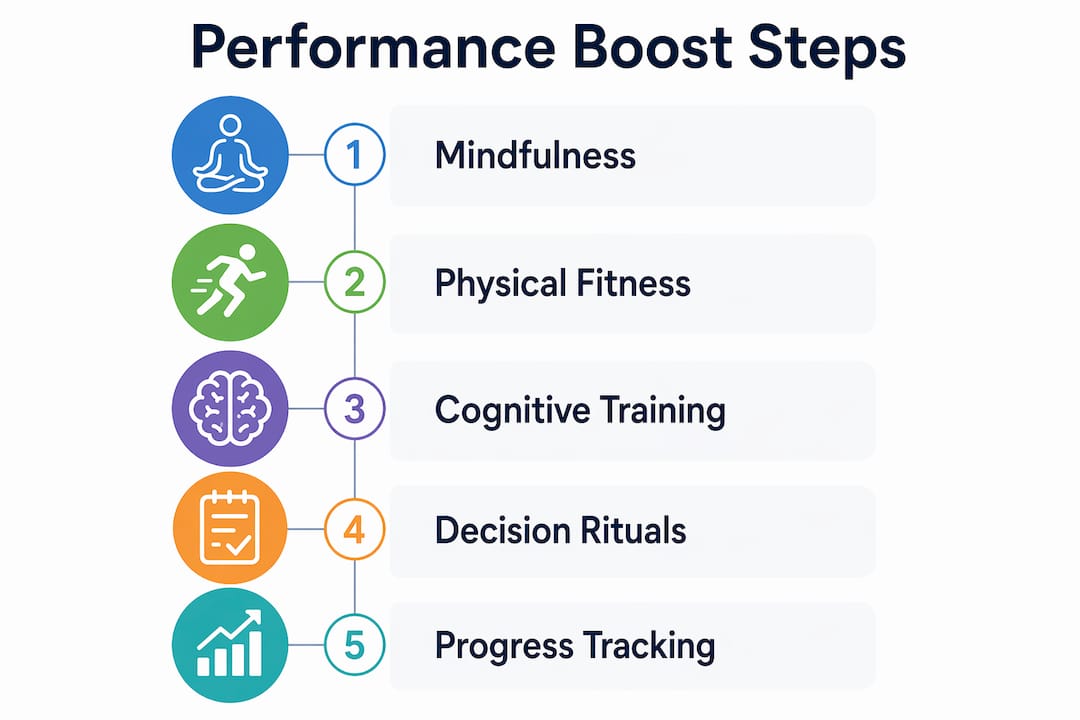
Combining physical, cognitive, and mindfulness strategies produces the strongest overall effect. No single track is sufficient for executives operating at the highest levels of organizational complexity. The holistic performance frameworks that integrate all three consistently outperform single-domain approaches in both research and practice.
Tracking mediators, not just outcomes, is what separates executives who improve from those who plateau. Measure sleep quality, burnout scores, and decision confidence weekly. Adjust the protocol at week 6 based on which mediators have moved and which have not. This is performance management applied to yourself.
Key takeaways
Sustained executive performance requires targeting burnout, inhibitory control, decision architecture, and meeting discipline as distinct, measurable levers rather than treating performance as a single undifferentiated output.
| Point | Details |
|---|---|
| Mindfulness reduces burnout first | A 30% burnout reduction precedes decision quality gains. Track mediators, not just mood. |
| Physical training targets specific functions | Multimodal training improves inhibition and hardiness but not working memory. Match training to your deficit. |
| Pre-meeting goal reflection works | One sentence, one metric, one deadline before every meeting converts intent into execution. |
| R.E.S.E.T. protects judgment under pressure | Writing the decision plus box breathing takes two minutes and reduces reactive bias measurably. |
| Personalize your intervention stack | Identify your primary cognitive deficit first, then select matched interventions and track mediators weekly. |
What I have learned about sustainable executive performance
The executives I have observed who sustain high performance over decades share one characteristic that rarely appears in productivity literature: they treat burnout as a structural threat, not a temporary inconvenience. They do not push through it. They build systems that prevent it from accumulating in the first place.
The mindfulness research confirms what disciplined practitioners already know. The value is not in the meditation session itself. It is in the 30% reduction in burnout that protects the quality of every decision made in the following 48 hours. That is a compounding return, not a one-time benefit.
What I find most underused among senior executives is the decision externalization habit. Writing one sentence before a high-stakes choice sounds almost embarrassingly simple. But the act of committing the actual decision to paper separates it from the surrounding noise in a way that no amount of mental rehearsal replicates. The Forbes R.E.S.E.T. framework formalizes something that experienced operators have done intuitively for years.
The physical training data also deserves more attention than it typically receives. The finding that inhibitory control improves significantly while working memory does not is not a failure of the research. It is a precise signal about where to invest training time. Executives who want to stop making reactive decisions under pressure should prioritize inhibition training, not memory drills.
Performance longevity is the real goal. Not a strong quarter. Not a productive week. A decade of high-quality judgment, sustained energy, and clear execution. That requires a multi-track approach, measured over months, adjusted based on data, and built into daily structure rather than reserved for retreats and off-sites.
— Joakim
Build your performance edge with Viridos
The strategies in this article work best when paired with a disciplined tracking system and premium nutritional support designed for the demands of executive life.
Viridos is a premium Swedish men's performance brand built specifically for founders, executives, and high-agency professionals who want sustained edge and consistency. The Viridos Performance Journal is designed as a structured tool for tracking goals, habits, burnout markers, and decision quality across weeks, giving you the measurement infrastructure that makes every intervention in this article more effective. For executives who take performance longevity seriously, Viridos offers premium vitality solutions crafted in small-batch Swedish production with precision and restraint. No shortcuts. No noise. Just the tools that disciplined men actually use.
FAQ
What is the fastest way to improve executive decision-making?
The R.E.S.E.T. protocol takes two minutes: write the actual decision in one sentence, then complete a box breathing cycle before engaging. This reduces reactive bias and restores capacity-based judgment under pressure.
How does mindfulness improve executive performance?
Mindfulness reduces burnout by up to 30%, and burnout is the primary driver of degraded judgment in executives. The performance gain comes from protecting decision quality, not from accelerating cognitive speed.
Does physical fitness actually improve cognitive performance for executives?
Multimodal physical training significantly improves inhibitory control and psychological hardiness in corporate professionals, but does not improve working memory. Match your training protocol to the specific cognitive function you need to develop.
How can executives make meetings more productive?
Pre-meeting goal reflection, as validated by a 2026 Microsoft study with 361 employees, measurably improves meeting intent and behavior. Define one goal, one metric, and one deadline before every meeting to convert discussion into committed execution.
How long does it take to see results from executive performance interventions?
Track mediators like burnout scores, sleep quality, and decision confidence at weeks 4 and 8. Mindfulness and physical training protocols require 4 to 8 weeks of consistent application before measurable improvements in performance mediators become visible.