
TL;DR:
- Sleep optimization involves targeted adjustments to improve sleep quality by focusing on timing, environment, and behavior. It is essential for high performers to prioritize consistent routines and sleep architecture to maintain cognitive and metabolic health. Success depends on gradual implementation, measurement, and long-term discipline rather than quick fixes.
Sleep optimization is defined as a systematic, evidence-based approach to improving both the quality and restorative power of sleep by targeting physiological, environmental, and behavioral factors. The goal is not simply to sleep longer. Optimized 7-hour sleep often outperforms unoptimized 9-hour sleep across cognitive performance, mood, and metabolic markers. One in three adults fails to meet the recommended 7–9 hours of quality rest, and the consequences compound over time: impaired cognition, metabolic disruption, and reduced immune resilience. For professionals in demanding roles, understanding how to improve sleep quality is not a wellness luxury. It is a performance requirement.
What is sleep optimization and why does it matter for professionals?
Sleep optimization is best understood through the lens of sleep medicine, where the recognized framework is sleep hygiene and circadian science. The informal phrase "sleep optimization" describes the same evidence-based practice: deliberately adjusting the conditions that govern sleep to maximize its restorative output.
The stakes are concrete. Inadequate sleep produces measurable declines in mood, cognition, and metabolic health. For an executive running a company or an investor making high-stakes decisions, those declines are not abstract. They show up in judgment, reaction time, and emotional regulation, the exact capacities that define professional performance.
Sleep optimization treats sleep as a complex biological system. It requires sequential, prioritized interventions rather than a checklist of generic tips. That distinction separates professionals who see lasting results from those who try a few habits and abandon them within a week.
What are the core pillars of sleep optimization and why do they matter?
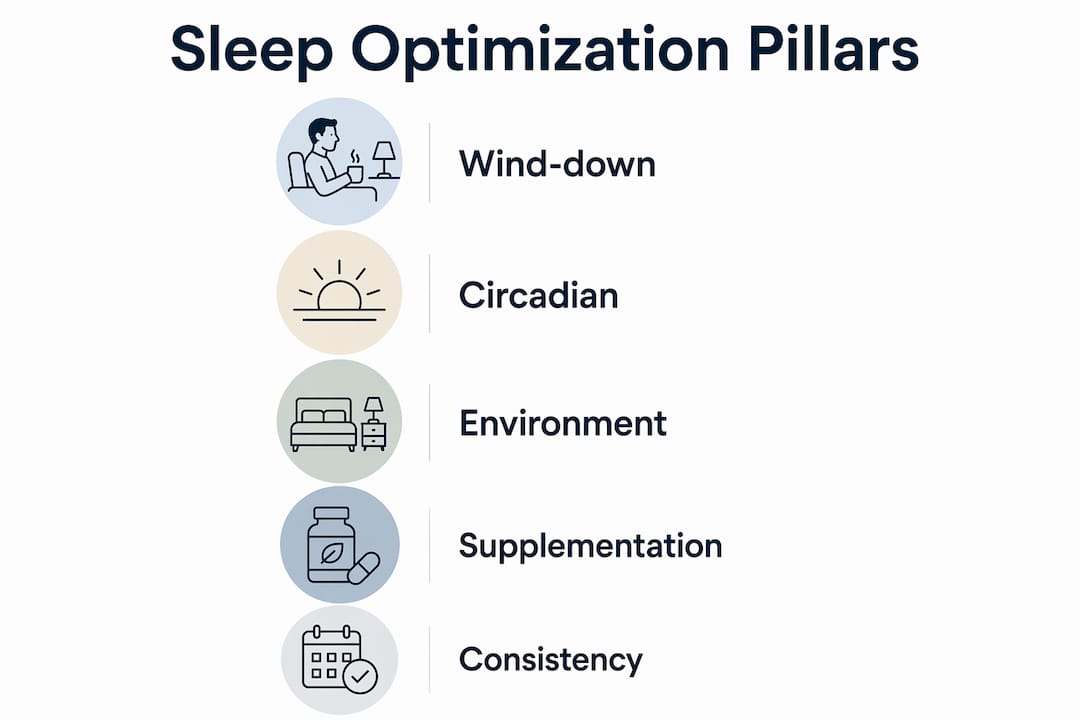
Five foundational pillars govern sleep quality. Each one builds on the last, which is why the order of implementation matters as much as the interventions themselves.
- Timing. Circadian rhythm alignment is the primary driver of sleep efficiency. Consistent bed and wake times calibrate the body's master internal clock, reducing how long it takes to fall asleep and improving overall sleep efficiency. This applies on weekends too.
- Environment. The ideal bedroom temperature sits between 60–67°F. Darkness and noise control are equally non-negotiable. A room that is too warm or too bright suppresses the physiological drop in core body temperature that triggers deep sleep.
- Hygiene. Consistent pre-sleep routines and stimulant management form the behavioral foundation. Caffeine consumed in the afternoon delays sleep onset by blocking adenosine receptors for hours after consumption.
- Behavioral techniques. Cognitive Behavioral Therapy for Insomnia, known as CBT-i, is the clinical gold standard when foundational hygiene alone falls short. Relaxation methods such as progressive muscle relaxation and diaphragmatic breathing also reduce pre-sleep arousal.
- Targeted supplementation. Supplementation functions as a supporting pillar, not a foundation. It works best when the first four pillars are already in place.
Pro Tip: A wind-down routine should begin at least 60 minutes before your target sleep time. Measurable improvements in sleep quality typically appear within 2–3 weeks of consistent practice.
The most common mistake professionals make is treating these pillars as interchangeable. Supplementation without circadian alignment produces marginal results. Environment without consistent timing produces inconsistent results. The progressive, layered approach starts with timing and environment, then adds hygiene, behavioral techniques, and supplementation in sequence.
How does sleep architecture affect performance and health?
Sleep architecture is the structural pattern of sleep stages across a night. A full night consists of 4–6 cycles, each approximately 90 minutes long. Each cycle moves through four stages: N1 (light sleep), N2 (consolidated light sleep), N3 (slow-wave deep sleep), and REM sleep.
| Stage | Name | Primary function |
|---|---|---|
| N1 | Light sleep | Transition from wakefulness |
| N2 | Consolidated light sleep | Memory consolidation begins |
| N3 | Slow-wave deep sleep | Physical restoration, immune repair |
| REM | Rapid Eye Movement | Emotional regulation, learning, memory |
Slow-wave sleep, or N3, is where physical restoration occurs. Growth hormone is released, tissue repairs, and immune function consolidates. REM sleep handles the cognitive and emotional workload: memory integration, pattern recognition, and emotional processing. Both stages are non-negotiable for sustained high performance.
The critical insight for professionals is this: total sleep time is a poor proxy for sleep quality. A night with frequent awakenings or poor sleep architecture can deliver eight hours of low-value rest. Maximizing slow-wave and REM stages is the actual target of any serious sleep enhancement program.
Pro Tip: If you wake feeling unrefreshed despite adequate hours, disrupted sleep architecture is the likely cause. Alcohol, late meals, and irregular schedules are the three most common architectural disruptors.
What practical steps can professionals take to improve sleep quality?
Concrete implementation separates theory from results. The following steps are ordered by impact, starting with the highest-leverage changes.
- Set rigid sleep and wake times. Choose a wake time and hold it every day, including weekends. This single habit does more to calibrate circadian rhythm than any supplement or device.
- Manage light exposure deliberately. Morning bright light of 1,000 lux or more within 30–60 minutes of waking is the most powerful circadian signal available. Ten to twenty minutes of outdoor light produces measurable benefits. In the evening, reduce blue light exposure (415–495nm wavelengths) at least 90 minutes before bed.
- Control your sleep environment. Set the bedroom to 60–67°F. Use blackout curtains or a sleep mask. Address noise with earplugs or a white noise source. These are not comfort preferences. They are physiological requirements for deep sleep.
- Time your stimulant intake. Avoid caffeine after 2:00 PM. Nicotine is a stimulant and disrupts sleep architecture regardless of timing. Avoid large meals within two hours of bedtime, as digestion elevates core body temperature.
- Build a consistent wind-down routine. Forty-five to sixty minutes of low-stimulation activity before bed signals the nervous system to downshift. Reading, light stretching, or breathing exercises work. Screens and work emails do not.
Beyond these five steps, two additional habits protect sleep architecture over the long term:
- Avoid vigorous exercise within two hours of bedtime. Exercise raises core body temperature and cortisol, both of which delay sleep onset.
- Limit daytime naps to 20 minutes and avoid napping after 3:00 PM. Longer or later naps reduce sleep pressure and fragment nighttime sleep.
Professionals who build an executive health routine around these habits consistently report faster sleep onset, fewer nighttime awakenings, and sharper morning cognition within two to three weeks.
What are common pitfalls and how do you sustain sleep optimization?
The most reliable predictor of failure in sleep optimization is attempting too many changes at once. Changing all factors simultaneously leads to poor adherence and unsustainable results. The brain resists wholesale behavioral overhaul. It responds to incremental, consistent change.
The right sequence is to stabilize timing and environment first. Once those are consistent for two weeks, add hygiene adjustments. After another two weeks, introduce behavioral techniques if needed. Supplementation comes last. This progression mirrors how sleep medicine practitioners approach chronic sleep complaints.
- Track before you change. Tracking sleep patterns over 2–3 weeks identifies the specific limiting factors in your sleep architecture. Without measurement, you are guessing. Consumer wearables and sleep journals both provide usable data.
- Recognize clinical thresholds. Persistent insomnia lasting more than three weeks, or symptoms consistent with sleep apnea (loud snoring, gasping, excessive daytime fatigue), require clinical evaluation. CBT-i and clinical intervention are the appropriate next steps when hygiene alone fails.
- Protect consistency above all else. One late night does not derail a well-established sleep schedule. Two or three in a row do. Treat your wake time as a non-negotiable commitment, even after poor nights.
Pro Tip: Do not compensate for a bad night by sleeping in. Sleeping in delays your next night's sleep onset and fragments the following cycle. Hold your wake time and let sleep pressure rebuild naturally.
The professionals who sustain sleep improvements over months and years are those who treat sleep as a performance longevity variable, not a recovery afterthought. Patience is not optional here. Measurable gains in mood, cognition, and metabolic markers require consistent practice across weeks, not days.
Key Takeaways
Sleep optimization delivers measurable gains in cognitive performance, metabolic health, and resilience only when timing, environment, and behavioral consistency are treated as non-negotiable foundations.
| Point | Details |
|---|---|
| Quality over duration | Optimized 7-hour sleep outperforms unoptimized 9-hour sleep on cognitive and metabolic markers. |
| Five pillars in sequence | Implement timing and environment first, then hygiene, behavioral techniques, and supplementation. |
| Architecture is the real target | Maximizing slow-wave (N3) and REM stages matters more than total hours in bed. |
| Progressive implementation | Changing one or two habits at a time produces better long-term adherence than overhauling everything at once. |
| Consistency is the foundation | A rigid wake time, even after poor nights, is the single highest-leverage sleep habit available. |
Why most executives get sleep wrong
I have worked with and observed a lot of high-performing men who treat sleep as the variable they compress when the schedule gets tight. The logic sounds reasonable: cut an hour here, catch up on the weekend, push through. The problem is that sleep debt does not work like financial debt. You cannot repay it in a lump sum on Saturday morning.
What I have seen consistently is that the executives who perform best over decades are not the ones who sleep the most. They are the ones who sleep the most consistently. Same wake time, same wind-down, same environment. The discipline they apply to their work calendar, they apply to their sleep schedule. That is not coincidence.
The other pattern worth naming: most professionals reach for supplements or devices before they have stabilized their schedule and environment. That is the wrong order. A magnesium supplement will not compensate for a bedroom that is 72°F and a wake time that shifts by two hours on weekends. Fix the foundation first. The supporting tools become genuinely useful once the foundation holds.
Sleep is not passive recovery. It is active biological maintenance. The men who understand that and act on it consistently are the ones still performing at a high level at 55 and 60, not just at 35. That long arc is what recovery and discipline actually look like in practice.
— Joakim
How Viridos supports disciplined sleep and performance habits

Building better sleep is a discipline, and discipline requires structure. The Viridos Performance Journal gives professionals a dedicated tool for tracking sleep times, wind-down routines, and morning readiness scores across weeks. That kind of structured, written accountability is what separates men who intend to improve their sleep from those who actually do. Viridos is a premium Swedish men's performance brand built for founders, executives, and investors who take their long-term health as seriously as their work. The journal reflects that same standard: precise, purposeful, and built for consistent use.
FAQ
What is sleep optimization in simple terms?
Sleep optimization is the practice of improving the quality and restorative power of sleep through targeted adjustments to timing, environment, and behavior. The goal is to maximize slow-wave and REM sleep stages, not simply to increase total hours.
How long does it take to see results from sleep optimization?
Measurable improvements in mood, cognition, and sleep efficiency typically appear within 2–3 weeks of consistent practice. Circadian alignment and environment changes produce the fastest results.
What affects sleep performance the most?
Inconsistent sleep and wake times are the primary disruptor of sleep performance. Evening blue light exposure is the second most common factor, as it suppresses melatonin and delays sleep onset.
When should a professional seek clinical help for sleep issues?
Persistent insomnia lasting more than three weeks, or symptoms of sleep apnea such as loud snoring and excessive daytime fatigue, require clinical evaluation. CBT-i is the evidence-based clinical standard for chronic insomnia.
Does a fitness routine support sleep optimization?
Structured physical activity improves sleep quality and deepens slow-wave sleep, but timing matters. Understanding the role of a fitness coach in structuring exercise timing can help professionals avoid workouts that interfere with sleep onset.