Yes, training supports natural testosterone, but the mechanism matters more than the workout. Resistance training and a workout produce a temporary hormonal spike within minutes, while the changes that actually hold, a healthier baseline, come from months of consistent training, sufficient sleep, and eating enough to fuel recovery. Start with a few resistance sessions per week, protect your sleep, and stop under-eating. The rest is refinement.
TL;DR:
- Short-term testosterone spikes from resistance training do not lead to lasting increases in baseline levels; long-term benefits come from muscle preservation and fat reduction.
- Training focused on heavy compound lifts two to four times weekly supports hormonal health more effectively than high-volume endurance or cardio workouts.
- Adequate sleep, managing stress, and proper nutrition, especially controlling energy balance and correcting micronutrient deficiencies, are key to maintaining optimal testosterone levels.
- Overtraining, poor recovery, and chronically insufficient sleep can suppress testosterone, making deloads and rest periods essential for hormonal balance.
- Regular testing should be timed in the morning, and interpretation benefits from considering symptoms and lifestyle alongside lab results.
Table of Contents
- How Training and Testosterone Interact: Acute Spikes vs. Long-Term Change
- Which Training Methods Actually Influence Testosterone?
- How Should You Structure Training to Support Testosterone?
- Why Recovery, Sleep, and Stress Determine Whether Training Helps
- Nutrition and Micronutrients: What Actually Moves Testosterone
- Overtraining: When Exercise Starts Working Against You
- When to Test Testosterone and How to Read the Results
- What the Evidence Actually Supports and Where It Runs Out
- The Discipline Behind Long-Term Hormonal Health
- Viridos as a Disciplined Adjunct
- Sources
How Training and Testosterone Interact: Acute Spikes vs. Long-Term Change
Two different processes influence the relationship between training and testosterone, and conflating them is a common misunderstanding.
The first is acute. Heavy resistance training, particularly compound lifts like squats, deadlifts, and presses, triggers a temporary rise in circulating testosterone that shows up in blood work 15 to 30 minutes after the session ends. This spike is a temporary, acute stress response to heavy loading and does not indicate a lasting change in baseline hormone production.
The second process is structural, and it is the one that matters for long-term vitality. Consistent resistance training builds and preserves muscle mass, which improves body composition over months and years. Reduced visceral fat lowers the activity of aromatase, the enzyme that converts testosterone into estrogen, which means less of your existing testosterone gets diverted away from androgen signaling. A long-term review of exercise and hormonal adaptation points to this body composition pathway, rather than repeated acute spikes, as the primary route by which training supports a healthier baseline.
This distinction explains a common frustration. A man trains hard for six weeks, feels stronger, and expects his resting testosterone to have jumped accordingly. It usually has not, at least not by much. The acute spikes from individual sessions do not stack into permanent elevation. What they do is signal to the body, repeatedly, that muscle tissue is in demand and worth maintaining. Over time, that signal, combined with fat loss and better sleep, shifts the hormonal environment in a favorable direction.
Individual variation is significant here. Baseline fitness, age, training history, and recovery capacity all influence how strongly someone responds to a given training stimulus, and the hormonal response to resistance exercise varies considerably between individuals. A 45 year old returning to lifting after a decade away will see a different hormonal trajectory than a 45 year old who has trained consistently since his twenties. Neither is doing it wrong. They are simply starting from different physiological positions, and that context should shape expectations, not undermine confidence in the process.
Which Training Methods Actually Influence Testosterone?
Not all training carries equal hormonal weight, and the differences are large enough to change how you should structure your week.
Resistance training has the clearest and most consistent evidence base. Compound, multi-joint lifts, performed with sufficient load and volume, produce the strongest acute hormonal response and the most reliable long-term body composition benefits. This is the modality to build a program around, not the one to treat as optional.
High-intensity interval training occupies a middle position. Short, intense intervals can produce some acute hormonal response, and HIIT is genuinely useful for cardiovascular health and fat loss, but the size of its effect on testosterone is inconsistent across studies and generally smaller than what resistance training delivers. Treat HIIT as a complement to lifting, not a substitute for it.
High-volume endurance training is where the relationship flips. Long-duration, high-frequency endurance work, marathon training blocks, extended cycling volume, back-to-back distance sessions, can suppress testosterone when recovery and caloric intake do not keep pace with the training load. This is not a reason to avoid running or cycling. It is a reason to treat volume and fueling as variables you manage deliberately rather than push past without a plan.
For a training week aimed at supporting hormonal health, prioritize in this order:
- Heavy compound lifts two to four times per week: squats, deadlifts, bench press, overhead press, rows, and pull-ups, using working sets in the 3 to 8 rep range.
- Moderate accessory volume targeting major muscle groups that the compound lifts do not fully cover, kept to a sustainable weekly total.
- One to two conditioning sessions, mixing short intervals with lower-intensity cardio rather than defaulting to long steady-state work every time.
- Deliberate volume caps on endurance work if you also compete in or train for distance events, with extra attention to caloric intake during heavy weeks.
The practical takeaway is simple. If your week is dominated by long runs and little else, and you are also under-eating, you are working against your own hormonal interests. If your week is built around heavy lifting with conditioning layered in in moderation, you are working with them.
How Should You Structure Training to Support Testosterone?
Programming for hormonal health does not require complexity. It requires consistency, sufficient intensity, and respect for recovery, three things that are simple to state and easy to neglect under executive schedules.
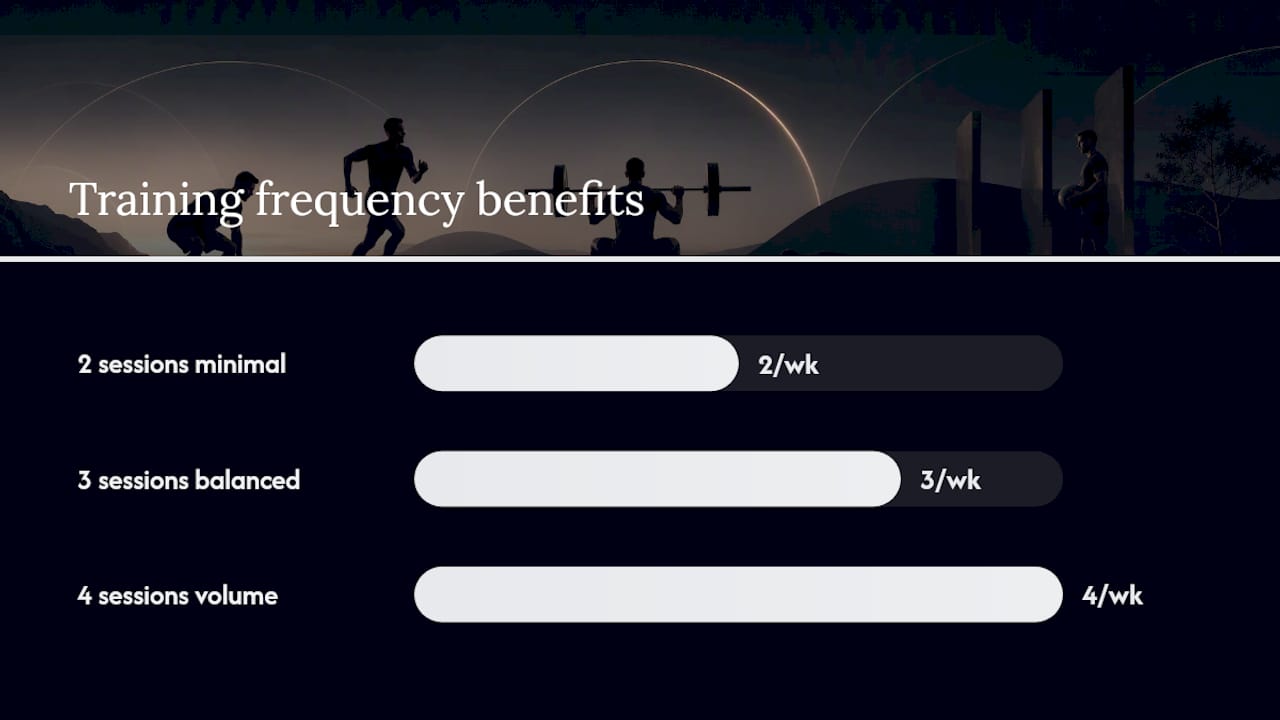
The minimal effective dose for most men is two to four resistance training sessions per week. Two sessions, done well, are enough to produce meaningful adaptation for someone who is otherwise sedentary or new to structured lifting. Three to four sessions allow for more specialization and volume, which benefits men with more training experience or specific strength and physique goals.
Within each session, structure matters. Compound lifts come first, while you are fresh and can apply the most force and intent. Accessory and isolation work comes after. This is not arbitrary sequencing. It ensures the exercises that carry the greatest hormonal and strength stimulus get your best effort, not your leftover energy after twenty minutes of curls.
For loading, a working range of 3 to 8 reps at 75 to 90 percent of your one-rep max builds strength and drives a strong acute hormonal response. A range of 8 to 15 reps at 65 to 80 percent builds hypertrophy and supports the body composition changes that matter for long-term hormonal balance. A well-designed program uses both across a training week rather than committing entirely to one style.
Here is a practical microcycle for a three-day week:
- Day one, lower body and posterior chain: squats or deadlifts as the primary lift, followed by lunges, hip hinges, and core work.
- Day two, upper body push and pull: bench press and overhead press paired with rows and pull-ups, followed by accessory shoulder and arm work.
- Day three, full-body integration: a second lower-body pattern (front squat or trap bar deadlift), overhead pressing, and 15 to 20 minutes of interval conditioning.
For a four-day week, split lower and upper body across two days each, which allows more volume per muscle group without extending any single session past 60 to 75 minutes.
Progression should follow a simple principle: add small increments of weight or reps regularly, and plan lighter deload periods periodically to allow recovery from fatigue.
Pro Tip: Track your top set weight for your three or four main lifts every week in a simple spreadsheet. If that number stalls or drops for two consecutive weeks with no change in sleep or diet, that is your earliest signal to deload before fatigue compounds further.
Why Recovery, Sleep, and Stress Determine Whether Training Helps
Training is the stimulus. Recovery is where the adaptation, hormonal and otherwise, actually happens. Skip this part and the training itself becomes close to irrelevant.
Sleep duration and timing directly affect testosterone. Most testosterone release follows a circadian rhythm, peaking in the early morning hours during sleep, which is precisely why clinical guidance points to morning blood draws as the standard for accurate measurement. Disrupted sleep, whether from short duration, irregular timing, or shift work, blunts this peak independent of anything happening in the gym.
Chronic stress compounds the problem through cortisol. Cortisol and testosterone operate in a competitive relationship: sustained elevation in one tends to suppress the other. A man training hard, sleeping five hours a night, and running a company under constant deadline pressure is stacking three separate sources of cortisol elevation. The training itself, in that scenario, is not the problem. It is one more input into a system that is already overloaded.
Practical recovery tactics worth building into a disciplined week:
- Protect a consistent sleep window of seven to eight hours, prioritizing this over an extra 30 minutes of training or work.
- Schedule a deload week every four to six weeks rather than waiting for a stall or an injury to force one.
- Track subjective signs, morning energy, motivation to train, resting heart rate, as early indicators before performance itself declines.
- Consider heart rate variability tracking if you already use a wearable, since a sustained downward trend often precedes a performance dip by one to two weeks.
Pro Tip: If you train hard and still feel flat after a full night's sleep for more than a week, treat that as data, not weakness. It usually means your recovery capacity has fallen behind your training load, and the fix is a deload, not more willpower.
Men in demanding roles often treat sleep as the most negotiable part of the day. Hormonally, it is the least negotiable. A missed lifting session costs you a day. A pattern of five-hour nights costs you the adaptation from every session that week.
Nutrition and Micronutrients: What Actually Moves Testosterone
Energy balance is the single largest nutritional lever for testosterone in men carrying excess body fat, and it outweighs almost everything else on this list.
Weight loss, specifically the reduction of visceral fat, is recommended by clinicians as a primary, evidence-backed strategy for men with overweight or obesity looking to support natural testosterone. This is not a call to crash diet. Rapid, extreme caloric restriction can suppress testosterone just as effectively as excess fat does, since the body reads severe energy deficit as a signal to conserve resources rather than invest in reproductive and muscular systems. A moderate, sustained deficit paired with resistance training to preserve muscle mass is the more reliable path.
Protein and dietary fat both matter for hormonal support. Testosterone synthesis depends on adequate dietary fat intake, and chronically low-fat diets have been associated with lower testosterone in some populations. Sufficient protein, generally in the range most resistance-trained men already target for muscle maintenance, supports the body composition changes that drive the long-term hormonal benefit described earlier.
Micronutrient deficiencies are worth checking, but they are a correction, not a boost:
- Vitamin D deficiency is common, particularly in men who spend most daylight hours indoors, and correcting a true deficiency has a documented association with hormonal improvement, though supplementing beyond adequate levels shows no added benefit.
- Zinc plays a role in testosterone synthesis, and deficiency, more common in men with restrictive diets, can suppress levels; correction restores function rather than enhancing it beyond normal.
- Magnesium deficiency is linked to broader metabolic and sleep disruption that indirectly affects hormonal health.
This is where most commercial "testosterone booster" products fall apart under scrutiny. The evidence for over-the-counter boosters reliably increasing testosterone in men without an underlying deficiency is thin. What actually works is identifying and correcting a real deficiency, not layering a proprietary blend on top of an already-adequate diet. A supplement guide aimed at men over 50 reflects the same conclusion most credible sources land on: lifestyle first, targeted correction second, and skepticism toward anything promising outsized results from a bottle.
Overtraining: When Exercise Starts Working Against You
More training is not always better training, and the point where volume becomes counterproductive is easier to miss than most men expect.
Persistent fatigue that does not resolve with a normal night's sleep is the earliest broad signal. Loss of morning erections, a specific and often underdiscussed marker, tends to appear before other symptoms and is worth treating as an early flag rather than dismissing. A declining interest in training itself, decreased libido, and unexplained drops in strength or lifting performance round out the common symptom picture. Excessive training volume without adequate recovery is a documented and reported cause of measurable testosterone suppression, not a fringe concern limited to elite athletes.
The causes are rarely mysterious once you look at them honestly. Training volume that has crept up faster than recovery capacity, a sustained caloric deficit run for too long, chronic sleep debt, and unmanaged work stress are the usual combination. Any one of these alone is often manageable. Stacked together, they compound.
Recovery is possible, but it requires patience most disciplined men find uncomfortable. Reducing training volume by 40 to 50 percent for two to four weeks, restoring adequate caloric intake, and prioritizing sleep typically produces improvement within that window for moderate cases. Severe, prolonged suppression can take considerably longer, sometimes months, and staged return to full training load with continued attention to nutrition and sleep gives the best odds of a full recovery. A physical therapy approach to athletic recovery can help structure that return in a way that avoids re-triggering the same overload.
The uncomfortable truth for high-achieving men is that pushing through these signals rarely works. Reducing load when the body is asking for it is not weakness. It is the faster route back to full performance.
When to Test Testosterone and How to Read the Results
Timing determines whether a testosterone test tells you anything useful at all.
Testosterone follows a circadian pattern, peaking in the early morning and declining through the day, which is why clinical guidance specifies morning, fasting blood draws as the standard protocol. A test drawn at 4pm after a poor night's sleep and a large lunch will read lower than the same man's true baseline, and comparing that number against a morning reference range invites a false conclusion.
Request both total testosterone and free testosterone where possible. Total testosterone measures everything circulating, bound and unbound. Free testosterone measures the fraction that is biologically active and available to bind receptors, which matters because two men can share an identical total testosterone number and differ meaningfully in how much of it their bodies can actually use.
A single number rarely tells the full story on its own. Symptoms, energy, libido, recovery capacity, sleep quality, provide the clinical context that turns a lab value into an actionable picture. This is where a conversation with a clinician earns its place. Lifestyle changes, training, sleep, weight management, are appropriately the first-line approach for most men with borderline or mildly low readings, and a clinician can help distinguish that population from men whose numbers warrant a different level of intervention. Testing once, adjusting a handful of habits, and retesting in three to six months is a more reliable approach than reacting to a single number in isolation.
What the Evidence Actually Supports and Where It Runs Out
The evidence base on training and testosterone is stronger than most fitness content suggests, and also more limited than most supplement marketing implies.
What holds up: resistance training reliably produces acute hormonal spikes, and sustained resistance training combined with fat loss produces a more favorable long-term hormonal environment through improved body composition. Sleep and stress management are not secondary considerations. They are load-bearing parts of the same system. Weight loss in men carrying excess body fat is one of the most consistently supported interventions available outside of clinical treatment. None of this requires exotic protocols. It requires consistency applied over months, not weeks.
What the evidence does not support is the idea that any single exercise, supplement, or biohack produces a dramatic, isolated hormonal transformation. Overtraining is a real and documented risk, not a myth invoked to justify laziness. Individual variation in response to training is substantial enough that comparing your numbers to a friend's, or to an average cited in a magazine, is rarely useful.
Viridos approaches this evidence base from a position of restraint rather than promise. Men in demanding executive roles do not need more noise about quick fixes. They need a clear framework: train with intent, protect recovery, correct real deficiencies, and treat testing as a tool for tracking trends rather than chasing a single number. Readers who want a deeper technical grounding in how serum measures work can review this guide to serum testosterone, and men focused specifically on midlife performance may find this practical vitality guide for men 40 to 65 useful for building out the surrounding lifestyle framework.
The Discipline Behind Long-Term Hormonal Health
Most men chase a peak. The ones who sustain performance into their fifties and sixties chase stability instead, and that distinction shapes everything else in this piece.
Testosterone is not a number you optimize once and forget. It is a downstream reflection of how you train, sleep, eat, and manage stress, compounded over years rather than weeks. The men who get this right are not the ones doing the most extreme version of any single habit. They are the ones who show up for resistance training two or three times a week for a decade, who treat a deload as a strategic decision rather than a failure, and who involve a clinician when the data calls for it instead of self-diagnosing from a forum thread.
That last point deserves emphasis. Lifestyle change is genuinely the first-line approach for most men, but it is not a substitute for professional partnership when symptoms are significant or persistent. A clinician who can order the right panel, interpret it against your history, and rule out other causes is not an admission that lifestyle failed. It is part of a disciplined approach, not a departure from one.
Resilience, in this context, is not about tolerating more. It is about building a foundation stable enough that a bad week, a missed session, a stretch of poor sleep, does not undo months of progress. That is the standard worth building toward.
— Joakim
Viridos as a Disciplined Adjunct
Everything in this article describes what training, sleep, and nutrition can do on their own, and that foundation comes first. For men who have already built that foundation and want a considered, plant-derived addition to their routine, Viridos offers a precision oral spray formulated with phytoandrogen-related compounds, delivered through a controlled, small-batch membership produced in Sweden.
Viridos is not a substitute for the training principles outlined above, and it makes no claim to treat or reverse anything. It is positioned as an adjunct for disciplined men who have already addressed sleep, training volume, and body composition, and who want a premium, precisely formulated option layered on top of that groundwork. Membership access is limited by design, reflecting the brand's focus on small-batch production over mass availability. Men managing androgen-related concerns as part of a broader lifestyle framework may also find this natural support plan for androgen deficiency a useful companion resource.
If your training, sleep, and nutrition are already dialed in and you want to explore whether Viridos fits into that framework, review membership details and eligibility at Viridos.
Sources
- Acute hormonal responses to heavy resistance exercise
- Lifestyle changes that can increase testosterone levels in older men — University of Utah Health
- För mycket träning kan ge lägre testosteronnivå — Svenska Dagbladet