
TL;DR:
- CEO vitality includes physical fitness, mental clarity, and emotional resilience that sustain executive performance. Regular resistance training, quality sleep, balanced nutrition, and mental fitness are essential; neglecting these can lead to burnout and organizational decline. Companies now increasingly invest in benefits to support CEO health, framing vitality as a key business input rather than a reward.
CEO vitality is defined as the integrated state of physical fitness, mental clarity, and emotional resilience that enables executives to sustain high performance across demanding leadership roles. This is not a wellness trend. It is a measurable business variable. Over two-thirds of CEOs experience burnout symptoms, yet many continue working without addressing the root cause. The result is degraded judgment, slower decisions, and a leadership capacity that quietly erodes before the business feels it. For executives aged 40–65, understanding what is CEO vitality is the first step toward treating health as a core operating asset.
What are the core components of CEO vitality?
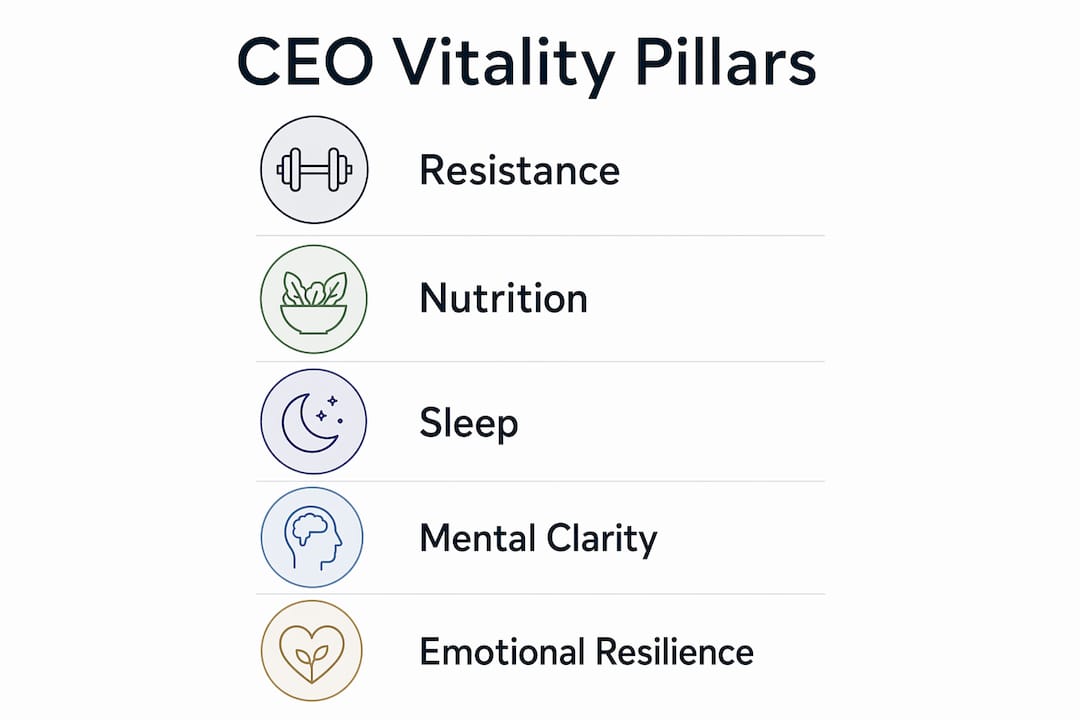
CEO vitality rests on three physical pillars: resistance training, quality nutrition, and restorative sleep. Each one is measurable, trainable, and directly tied to cognitive output. Miss one consistently, and the other two cannot compensate.

Physical fitness: the resistance training gap
Most executives default to cardio because it is time-efficient and familiar. That is a mistake. Resistance training is the most commonly missed pillar of executive health, despite its critical role in longevity and bone density. Experts recommend 90–120 minutes of resistance work weekly, achievable with resistance bands during travel or a short in-office session. Aerobic fitness supports cardiovascular health, but resistance training builds the physical reserve that sustains performance into your 60s and beyond.
Nutrition: protein and fiber as performance inputs
Nutrition for executives is not about restriction. It is about consistency and density. Adequate protein supports muscle retention during high-stress periods when cortisol accelerates breakdown. Fiber supports gut health, which research increasingly links to mood regulation and cognitive function. The practical standard is simple: prioritize whole-food protein sources at each meal and treat fiber as a daily minimum, not an afterthought.
Mental clarity and emotional resilience
Mental fitness follows the same logic as physical fitness. It requires deliberate practice. Meditation, even in short daily sessions, reduces cortisol and improves attentional control. Stress management techniques such as structured breathing and scheduled recovery time build emotional resilience over months, not days. These are not soft skills. They are performance inputs with measurable effects on decision quality.
Pro Tip: Treat energy management as a higher-order skill than time management. A CEO with eight hours and depleted energy produces worse decisions than one with six hours and full cognitive capacity. Schedule recovery the same way you schedule board meetings.
The importance of CEO vitality also includes preventative health measures. Annual executive physicals and targeted screenings catch metabolic and cardiovascular risks before they become performance liabilities. At 40, these screenings are optional. At 55, they are non-negotiable.
- Resistance training: 90–120 minutes weekly, using weights or bands
- Sleep: 7–8 hours, with behavioral protocols to address cognitive over-processing
- Nutrition: high-protein, high-fiber meals as a daily baseline
- Mental fitness: daily meditation or structured recovery practice
- Preventative care: annual executive physicals and metabolic screening
How does CEO vitality impact organizational performance?
CEO vitality is not a personal matter. It shapes the entire organization. CEO self-care leads to healthier leadership behaviors among line managers, reducing emotional exhaustion and improving organizational performance. The mechanism is social information processing: employees read leadership behavior as a signal of what the organization values. When a CEO models disciplined health habits, that signal travels down through management layers.
"The effect is strongest when the CEO's health values align with the organization's broader health culture. Person-organization health value alignment acts as a boundary condition that amplifies the positive impact of CEO vitality on employee well-being and team performance."
The data on burnout makes this concrete. When a CEO operates in a state of chronic fatigue, the cost is not just personal. Emotional exhaustion spreads. Managers mirror the stress they observe at the top. Teams lose psychological safety when leadership is reactive rather than grounded.
| CEO vitality factor | Organizational outcome |
|---|---|
| Consistent sleep and recovery | Improved decision quality and reduced reactive leadership |
| Resistance training and physical fitness | Higher sustained energy during long workdays and travel |
| Mental fitness practices | Reduced emotional contagion and calmer crisis response |
| Preventative health engagement | Lower risk of sudden leadership incapacity |
Executive fitness directly correlates with the quality of culture a CEO builds. A leader who cannot manage his own energy cannot credibly ask his organization to perform at a high level. The CEO health benefits that flow downstream are not incidental. They are structural.
What challenges do executives face in maintaining vitality?
The central paradox of executive health is this: the men who most need sustained vitality are the ones with the least structural support for maintaining it. The "always-on" leadership culture creates a gap between knowing rest is essential and actually implementing it. Executives intellectually accept the importance of recovery. They schedule it last.
The most common mistakes are predictable and avoidable:
- Insufficient sleep: The myth that five hours is enough persists in executive culture. Only 1–2% of the population carry the genetics to function on five hours or less. The rest accumulate cognitive debt that compounds across weeks.
- Skipping resistance training: Cardio feels productive. Resistance training feels slow. Most executives skip it and pay the price in lost muscle mass and declining metabolic health after 45.
- Unproven biohacking: Dr. Keith Klintworth warns specifically against non-FDA-approved peptides and self-medication protocols. Executive vitality plans must be individualized and evidence-based, not trend-driven.
- Inability to disconnect: 40% of CEOs struggle with sleep and 52% cannot fully disconnect off-duty. Both figures point to the same failure: the absence of a structured recovery protocol.
- Delayed intervention: Health decline often precedes visible business performance issues by months. Waiting for a visible signal is waiting too long.
Pro Tip: If you cannot fall asleep within 20 minutes, get up and do a low-stimulation activity until you feel sleepy. Lying in bed rehearsing tomorrow's agenda is the primary driver of executive insomnia. Break the association between bed and cognitive work.
The energy management strategies that separate high-performing executives from burned-out ones are rarely dramatic. They are consistent, boring, and non-negotiable.
Which practical strategies can CEOs use to improve vitality?
CEO wellness strategies work when they are built around the actual constraints of executive life: travel, unpredictable schedules, high cognitive load, and limited time. Generic wellness advice does not apply here. The following framework is built for men in demanding roles.
- Anchor resistance training to your calendar, not your energy. Schedule 90–120 minutes of resistance work weekly as a fixed appointment. Use resistance bands when traveling. Treat cancellation the same way you treat missing a board meeting.
- Build a sleep protocol, not just a bedtime. Address cognitive over-processing with behavioral techniques: a written shutdown ritual, no screens 45 minutes before sleep, and a consistent wake time regardless of when you fell asleep. Effective sleep hygiene for executives must specifically target night-time awakenings caused by work-related mental rehearsal.
- Standardize your nutrition baseline. Set a daily protein target based on body weight and hit it before adding complexity. Fiber follows the same logic. Consistency across 90% of meals matters more than perfection on any single day.
- Schedule executive health assessments annually. A comprehensive executive physical covers cardiovascular markers, metabolic panels, hormone levels, and sleep quality. These are the leading indicators of performance decline, not the lagging ones.
- Practice mental fitness daily. Ten minutes of structured meditation each morning reduces cortisol reactivity and improves attentional control. This is not a personality preference. It is a cognitive maintenance practice.
The comparison below shows how energy-managed executives approach their day differently from those who rely on time management alone.
| Approach | Time management focus | Energy management focus |
|---|---|---|
| Morning routine | Starts with email and calendar | Starts with movement and a structured shutdown of personal concerns |
| Meeting scheduling | Fills available slots | Protects peak cognitive hours for high-stakes decisions |
| Recovery | Treated as downtime | Scheduled as a performance input |
| Health appointments | Deferred when busy | Fixed in the calendar like client meetings |
BCG research on executive fitness frames the CEO career as an endurance event. Energy management is the discipline that determines who finishes strong and who burns out at mile 20.
How are companies evolving executive benefits to support CEO vitality?
The corporate response to CEO health risks is measurable and accelerating. 24% of companies added new executive benefits in 2025, a sharp rise from the 20-year average of 8%. That gap reflects a recognition that executive health is a retention and governance issue, not just a personal one.
The most common new benefits are extended executive physical exams and financial counseling. Both reduce the cognitive and logistical load that executives carry outside their core role. Financial stress is a documented driver of sleep disruption and decision fatigue. Removing it is a direct investment in leadership capacity.
| Executive benefit category | Trend direction |
|---|---|
| Extended physical exams | Increasing, now standard at large firms |
| Financial counseling | Added by majority of new benefit programs |
| Personal and home security | Home security at 27% prevalence, highest since 2003 |
| Cyber security benefits | Rising alongside personal security packages |
The security benefit expansion reflects a different kind of CEO health risk: personal safety. As executive visibility increases through social media and public-facing roles, personal and cyber security have become genuine well-being factors. Companies that ignore this create a background stressor that degrades executive performance over time.
The rebound in executive benefits to early 2000s levels signals a broader shift. Boards are beginning to treat CEO vitality as a governance variable, not a perk. The CEO health benefits conversation has moved from HR to the compensation committee.
Key Takeaways
CEO vitality is the single most underleveraged performance variable in executive leadership, and the executives who treat it as a business input consistently outperform those who treat it as a reward.
| Point | Details |
|---|---|
| Define vitality as a business input | CEO vitality is physical, mental, and emotional capacity that directly drives decision quality and leadership output. |
| Resistance training is non-negotiable | Most executives skip it, but 90–120 minutes weekly is the minimum for longevity and sustained physical capacity. |
| Sleep debt is cognitive debt | Only 1–2% of people function on five hours. Executives who believe otherwise are operating impaired. |
| CEO health shapes organizational culture | Research shows CEO self-care reduces emotional exhaustion in managers and improves team performance downstream. |
| Executive benefits are expanding | 24% of companies added new benefits in 2025, reflecting boards treating CEO health as a governance issue. |
Vitality is not a reward. It is the foundation.
I have watched capable executives delay addressing their health until the business forced the conversation. A missed quarter. A health scare. A moment where the judgment that built the company was no longer reliably available. Every time, the pattern is the same: the decline started months before anyone noticed.
The uncomfortable truth is that most executives treat vitality the way they treat insurance. They know it matters, but they fund it last. The health debt concept is real. Every month you defer resistance training, quality sleep, and preventative care, you accrue interest. That interest shows up as reduced patience in negotiations, slower recovery from stress, and a narrowing of the cognitive range you bring to complex decisions.
What I have found actually works is treating vitality as a non-negotiable operating cost, not a personal indulgence. The executives I respect most do not talk about work-life balance. They talk about performance longevity. They train because it makes them better at their job. They sleep because it protects their judgment. They get annual physicals because they understand that a CEO is a single point of failure, and that failure has a cost that extends far beyond the individual.
Reframe health as a core business input. Not a reward for a good quarter. Not something you will get to when things slow down. The discipline required to maintain vitality under pressure is the same discipline that makes a great executive. They are not separate skills.
— Joakim
Viridos: built for executives who take performance seriously
Viridos was designed for exactly this kind of executive. The men who understand that sustained performance requires deliberate inputs, not willpower alone.
Viridos produces premium, small-batch vitality supplements in Sweden, formulated for disciplined men in demanding roles. The focus is on quality, consistency, and long-term performance longevity. For executives who want a structured way to track and protect their daily energy and output, the Viridos Performance Journal provides a purpose-built framework for monitoring vitality across the metrics that matter most. This is not a generic wellness product. It is a precision tool for men who hold themselves to a higher standard.
FAQ
What is CEO vitality in simple terms?
CEO vitality is the integrated state of physical fitness, mental clarity, and emotional resilience that allows executives to lead effectively over the long term. It is treated as a business input, not a personal lifestyle choice.
How does poor CEO health affect a company?
Research shows that CEO burnout and low vitality reduce emotional exhaustion management in line managers and degrade organizational performance. Health decline in a CEO often precedes visible business performance issues by months.
How many hours of sleep do executives actually need?
Most executives need 7–8 hours of sleep. Only 1–2% of the population carry the genetics to function on five hours or less, making the "I sleep five hours" claim a performance liability for the vast majority of leaders.
What is the most overlooked component of executive health?
Resistance training is the most commonly neglected pillar of executive health. Despite its critical role in longevity and metabolic function, most executives favor cardio and skip the 90–120 minutes of weekly resistance work their bodies require.
Why are companies investing more in executive health benefits?
Boards increasingly treat CEO vitality as a governance and retention issue. In 2025, 24% of companies added new executive benefits, well above the 20-year average of 8%, reflecting a structural shift in how organizations value leadership capacity.