
TL;DR:
- Executive success relies on developing learnable leadership behaviors, strategic discipline, and energy management to drive sustained high performance. Key traits such as trust, purpose, energy, risk-taking, and persistence can be cultivated through deliberate practice and coaching, enhancing organizational results. Managing both immediate operations and future growth requires separate routines, metrics, and ownership to prevent strategic drift amid volatile markets.
Executive success foundations are defined as the learnable combination of leadership behaviors, strategic discipline, and personal energy management that enable sustained high performance across a career. This is not a soft framework. 70% of organizational performance variability links directly to the quality of leadership, including emotional intelligence, integrity, and resilience. That figure reframes the entire conversation: your personal development is your organization's most consequential investment. For executives and entrepreneurs aged 40 to 65, the foundations of executive leadership are not abstract ideals. They are specific, measurable, and trainable behaviors that compound over time.
What are the core leadership traits essential for executive success?
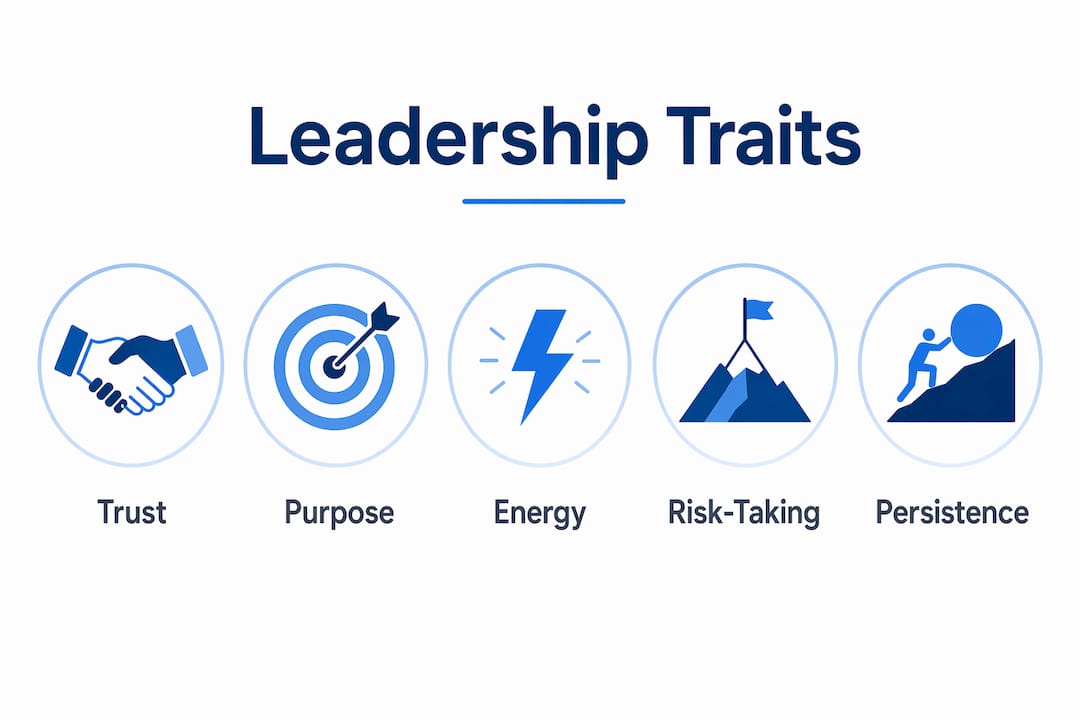
Leadership traits are behaviors, not fixed personality characteristics. Korn Ferry identifies five high-target traits that define effective leaders: trust, purpose, energy, risk-taking, and persistence. Each can be developed through deliberate practice and transformative behavior change. This matters because most executives plateau not from lack of intelligence or effort, but from an unexamined assumption that their current behavioral range is their permanent range.
Trust is the foundational trait. Without it, every other leadership behavior operates at a discount. Purpose gives direction to decisions under pressure, which is precisely when executives most need a clear internal compass. Energy, in this context, is not enthusiasm. It is the capacity to sustain focus, presence, and initiative across long cycles of demand. Risk-taking, calibrated correctly, is what separates executives who grow organizations from those who merely manage them. Persistence closes the gap between strategic intent and actual execution.
FranklinCovey's research confirms that leadership quality drives performance at the organizational level, meaning the return on developing these traits extends far beyond personal growth. An executive who improves their emotional intelligence by one measurable increment shifts the performance ceiling of every team they lead.
Developing these traits requires honest self-assessment. Tools like 360-degree feedback from firms such as Korn Ferry, structured reflection practices, and executive coaching programs from Columbia Business School or similar institutions provide the external mirror most leaders lack. Formal executive programs for senior leaders typically span eight to ten months, which signals the depth of investment required.
- Trust: Build it through consistent follow-through on small commitments before large ones
- Purpose: Articulate your leadership purpose in one sentence and test it against your calendar
- Energy: Treat physical and mental vitality as a performance input, not a personal luxury
- Risk-taking: Calibrate your risk tolerance by working with trusted advisors who can safely expand your range
- Persistence: Distinguish between productive persistence and sunk-cost stubbornness through quarterly reviews
Pro Tip: Work with a trusted executive coach or peer advisory group to safely expand your risk-taking range. Calibrated risk, tested in low-stakes environments, builds the conviction you need for high-stakes decisions.
How do executives balance delivering current results with building future growth?
High-performing CEOs operate on two simultaneous time horizons: immediate operational delivery and longer-term capability building. Most executives understand this intellectually. Far fewer execute it with discipline. Only 52% of CEOs believe they have the right routines to run and change the business at the same time. That gap is where most strategic ambitions stall.

The error is treating both agendas with the same tools, the same meetings, and the same success metrics. Operational delivery demands efficiency, speed, and accountability to quarterly targets. Long-term growth demands experimentation, patience, and tolerance for ambiguous early signals. Mixing these in the same weekly rhythm produces neither. Bain's research makes clear that distinct routines and metrics for each parallel agenda are what separate high-performing CEOs from the rest.
A practical framework for managing both agendas:
- Separate the calendars. Reserve specific blocks for transformation work that cannot be displaced by operational urgency. Treat these as board-level commitments.
- Define distinct success metrics. Operational health uses lagging indicators: revenue, margin, customer retention. Transformation uses leading indicators: experiments launched, capabilities built, talent developed.
- Assign dedicated owners. Do not ask the same leaders to run today's business and design tomorrow's. The cognitive and motivational demands are incompatible at high intensity.
- Review each agenda on its own cadence. Operational reviews can be weekly. Transformation reviews work better monthly or quarterly, with longer horizon checkpoints.
- Protect the transformation agenda from short-term pressure. When results disappoint, the instinct is to pull resources from future-building. This is the most common and most costly mistake in executive strategy.
The dual-agenda discipline is one of the clearest business executive strategies separating organizations that sustain growth from those that optimize themselves into irrelevance.
Why is personal energy management foundational to executive performance?
Personal energy is the infrastructure beneath every leadership behavior. Without it, emotional intelligence degrades, strategic thinking narrows, and resilience collapses under sustained pressure. Only 54% of CEOs agree they have routines to sustain personal performance over time. That means nearly half of the world's senior leaders are operating without a deliberate system for their most critical resource.
For executives over 40, this is not optional maintenance. Biological recovery slows, stress accumulates differently, and the cognitive demands of senior roles intensify rather than ease. The executives who sustain performance into their 50s and 60s share one visible pattern: they treat energy management for executives as a non-negotiable discipline, not a reward for when things slow down.
Effective energy management operates on two levels:
- Internal strategies: Sleep architecture, nutrition timing, deliberate recovery periods, and physical training calibrated to recovery capacity rather than volume
- External strategies: Professional coaching, structured peer networks, and vitality support systems that provide accountability and personalized guidance
Executives who optimize personal energy report measurably better decision quality in the afternoon, stronger presence in high-stakes conversations, and greater capacity to absorb organizational stress without transmitting it downward. These are not soft outcomes. They are competitive advantages.
Pro Tip: Model energy management visibly. When your team sees you protect recovery time, leave meetings on schedule, and speak openly about physical discipline, you give them permission to do the same. This is one of the highest-leverage leadership behaviors available to a senior executive.
How to navigate strategy in disruption with conviction and adaptability
Strategy in volatile markets is no longer a planning exercise. It is a portfolio of bets. Bain's framework, "From Plans to Bets," reframes strategy as the explicit articulation of your convictions about future outcomes, combined with the discipline to test those convictions continuously. Acting on the strength of your beliefs in outcomes is the new core of strategy. This shift has significant implications for how executives allocate attention, capital, and talent.
The key distinction is between high-conviction bets and low-conviction bets. Each demands a different posture:
| Conviction level | Strategic posture | Execution approach |
|---|---|---|
| High conviction | Speed and full commitment | Concentrate resources, move decisively, accept short-term risk |
| Low conviction | Experimentation and resilience | Run parallel tests, preserve optionality, learn from signals |
| Shifting conviction | Rapid reassessment | Establish clear trigger points for pivoting or doubling down |
Executives who combine strategic focus with disciplined agility outperform those who either commit rigidly to fixed plans or hedge everything into inaction. The practical tool for low-conviction bets is the Tiger Team: a small, cross-functional group tasked with rapidly testing an innovation hypothesis while the core business continues operating. High-performing organizations use Tiger Teams to test innovations without betting the enterprise on unproven assumptions.
The CEO's role in this model is to set the horizon point, define the conviction level for each major bet, and create the organizational permission for teams to move at the speed the market demands. Rapid strategy cycles, combined with data advantage from real-time market signals, are what separate organizations that adapt from those that react too late.
What organizational behaviors support effective executive success foundations?
Execution fails at the organizational level for four predictable reasons: weak routines, misaligned people, counterproductive behaviors, and governance processes that slow rather than enable speed. Only half of CEOs say their governance processes are simple enough to support agility. That is a structural drag on every strategy, regardless of its quality.
The behaviors that close these gaps are specific and learnable:
- Simplify decision rights. Ambiguous accountability is the single largest source of organizational friction. Define who decides, who advises, and who executes for every critical process.
- Encourage ownership at every level. Teams that feel genuine accountability for outcomes, not just tasks, move faster and recover from setbacks more effectively.
- Model curiosity from the top. CEOs who ask questions rather than deliver answers create organizations that surface problems early rather than hiding them until they become crises.
- Maintain frontline focus. The most important market intelligence in any organization lives closest to the customer. Senior leaders who lose that connection make increasingly abstract decisions.
MIT Sloan Management Review research confirms that inspiring leadership principles drive higher performance than transactional values alone. Principles tailored to an organization's specific character outperform generic slogans. This means the leadership principles worth investing in are the ones your people recognize as genuinely true about your organization, not aspirational statements that describe a different company.
Governance reform is often the hardest part of achieving executive excellence. It requires senior leaders to give up control mechanisms they have relied on for years. The executives who do it consistently report faster execution, higher team engagement, and more time for the strategic work only they can do.
Key takeaways
Executive success foundations require the deliberate integration of learnable leadership traits, dual-horizon strategic discipline, and personal energy management as a non-negotiable performance system.
| Point | Details |
|---|---|
| Leadership traits are learnable | Trust, purpose, energy, risk-taking, and persistence can be developed through deliberate practice and coaching. |
| Dual-horizon discipline is critical | Separate routines, metrics, and owners for operational delivery and long-term transformation to avoid strategic drift. |
| Energy management is infrastructure | Only 54% of CEOs have routines to sustain personal performance; building these routines is a competitive advantage. |
| Strategy requires conviction calibration | Frame strategy as a portfolio of bets, matching resource commitment to your actual conviction level for each initiative. |
| Governance enables or blocks execution | Simplify decision rights and model ownership behaviors to close the capability gaps that slow organizational agility. |
What I've learned about building these foundations over time
The executives I respect most share one quality that rarely appears in leadership frameworks: they are honest about their own energy. Not in a confessional way. In a precise, operational way. They know when they are sharp and when they are not, and they structure their most consequential work around that self-knowledge.
Most leadership development programs focus on behavior change in the abstract. What I have found more useful is the sequence: energy first, then behavior, then strategy. When your physical and mental vitality is managed with the same rigor you apply to a P&L, every other leadership behavior improves. Emotional regulation gets easier. Strategic patience becomes possible. Risk-taking feels calibrated rather than reckless.
The dual-agenda challenge from Bain's research resonates with me because the failure mode is so common and so invisible. Executives believe they are managing both horizons when they are actually just managing the urgent one. The tell is simple: if your transformation agenda has never displaced an operational meeting, it is not a real agenda. It is a wish.
On strategy, the shift from plans to bets is not just a reframing. It is a discipline. It forces you to state your actual conviction level, which is uncomfortable because it makes you accountable for being wrong. That discomfort is the point. Executives who can say "I was wrong about this bet, here is what I learned" build organizations that adapt. Those who cannot say it build organizations that rationalize.
The frameworks in this article are not new ideas. They are disciplines that compound. Start with one, apply it with precision, and add the next when the first is genuinely embedded.
— Joakim
How Viridos supports the vitality side of executive performance

The strategic and behavioral disciplines described in this article rest on a physical foundation. Viridos is built for exactly that foundation. Designed for disciplined men in demanding roles, Viridos combines premium small-batch Swedish production with a sublingual delivery philosophy that prioritizes absorption precision over convenience shortcuts. The result is a vitality system calibrated for executives who understand that sustained performance longevity requires the same quality standards they apply to every other high-stakes decision. If you are serious about the energy management discipline that underpins every leadership behavior discussed here, Viridos is where that work begins.
FAQ
What are executive success foundations?
Executive success foundations are the combination of learnable leadership behaviors, strategic discipline, and personal energy management that enable sustained high performance. Research links 70% of organizational performance variability to leadership quality, making these foundations a direct business priority.
Which leadership traits matter most for long-term executive performance?
Korn Ferry identifies trust, purpose, energy, risk-taking, and persistence as the five high-target traits for effective leaders. Each is a learnable behavior, not a fixed personality characteristic, and each can be developed through deliberate practice and executive coaching.
How do high-performing CEOs manage both short-term delivery and long-term growth?
High-performing CEOs maintain separate routines, metrics, and team ownership for operational delivery and transformation agendas. Only 52% of CEOs currently have the right routines to manage both simultaneously, according to Bain's 2026 research.
Why does personal energy management matter for executives over 40?
Personal energy is the infrastructure beneath every leadership behavior. Only 54% of CEOs have deliberate routines to sustain their personal performance over time, and for executives over 40, biological recovery demands make intentional energy management a non-negotiable discipline rather than a lifestyle preference.
What is the "bets" approach to executive strategy?
Bain's "From Plans to Bets" framework reframes strategy as a portfolio of explicit convictions about future outcomes, each matched to a resource commitment proportional to your actual confidence level. High-conviction bets receive concentrated resources and speed; low-conviction bets run as experiments with preserved optionality.