
TL;DR:
- Executive health focuses on preventive, personalized diagnostics to sustain peak performance over decades.
- Investing in tailored health programs yields high ROI through improved productivity and reduced absenteeism.
- Most executives fail to follow through with health plans, risking silent conditions and performance decline.
Most high-performing executives assume that sustained output is proof of good health. It is not. Silent coronary narrowing can exist in men who run companies, close deals, and train consistently. The gap between feeling functional and being biologically optimized is wider than most leaders want to admit. Executive health is not a luxury add-on or a corporate perk. It is a measurable performance lever with documented returns on productivity, cognition, and resilience. This guide breaks down what executive health actually includes, what the data says about its ROI, where the real risks lie, and how to build a strategy that works for your life and role.
Table of Contents
- What executive health really means (and why it matters))
- Evidence-backed benefits: Productivity, cognition, and ROI
- Costs and risks: What to consider before investing
- Practical steps: Building your executive health action plan
- Our perspective: What most executives miss about health investment
- How Viridos elevates your executive health journey
- Frequently asked questions
Key Takeaways
| Point | Details |
|---|---|
| Health equals performance | Investing in health directly boosts output, resilience, and leadership capability. |
| Data-backed ROI | Executive health programs yield a real-world return on investment of 3-6 times through productivity and reduced costs. |
| Awareness beats avoidance | Even the healthiest leaders risk missing silent threats—proactive screening uncovers hidden issues early. |
| Balance is key | Weigh program benefits against overtesting risks and focus on actionable, personalized strategies. |
What executive health really means (and why it matters)
Executive health is not a premium gym membership or an annual checkup with a better waiting room. It is an integrated, preventive system that combines advanced diagnostics, cognitive optimization, stress physiology, and personalized longevity protocols. The goal is not just to avoid illness. It is to sustain the mental and physical capacity required to lead at the highest level for decades.
Generic wellness programs are designed for population averages. Executive health is designed for the specific demands placed on founders, CEOs, and senior leaders: chronic high-stakes decision-making, irregular sleep, sustained cortisol exposure, and the kind of psychological load that does not show up on a standard blood panel.
The core components of a serious executive health program typically include:
- Advanced cardiovascular screening (coronary calcium scoring, VO2 max testing, arterial stiffness)
- Metabolic and hormonal profiling (testosterone, insulin sensitivity, thyroid, inflammatory markers)
- Cognitive performance assessment (executive function, processing speed, stress recovery)
- Sleep architecture analysis (not just duration, but quality and restorative depth)
- Mental health and resilience evaluation (burnout risk, HRV tracking, psychological load)
- Nutritional and gut health analysis (microbiome, deficiency screening)
The distinction matters because leaders face health challenges that are qualitatively different from the general population. Chronic stress rewires the hypothalamic-pituitary-adrenal axis. Decision fatigue is a real neurological phenomenon. Cardiovascular risk accumulates silently over years of compressed schedules and poor recovery.
"Executive health is not about living longer in retirement. It is about performing better today and avoiding the catastrophic health event that ends a career prematurely."
The long-term health tips that actually move the needle for executives are rarely the obvious ones. They are the ones that address the specific biology of sustained high performance.
The business case is equally clear. Research shows that executive health programs reduce absenteeism and presenteeism, delivering a 3.27:1 ROI from productivity increases alone. And there is growing evidence that fitness and executive function are directly linked, with physical conditioning improving working memory, cognitive flexibility, and sustained attention in ways that directly affect leadership quality.
This is not wellness for wellness's sake. It is a capital allocation decision with a measurable return.
Evidence-backed benefits: Productivity, cognition, and ROI
The numbers on executive health investment are no longer speculative. They are documented across multiple studies and program evaluations, and they are compelling enough to reframe how serious leaders think about health spending.
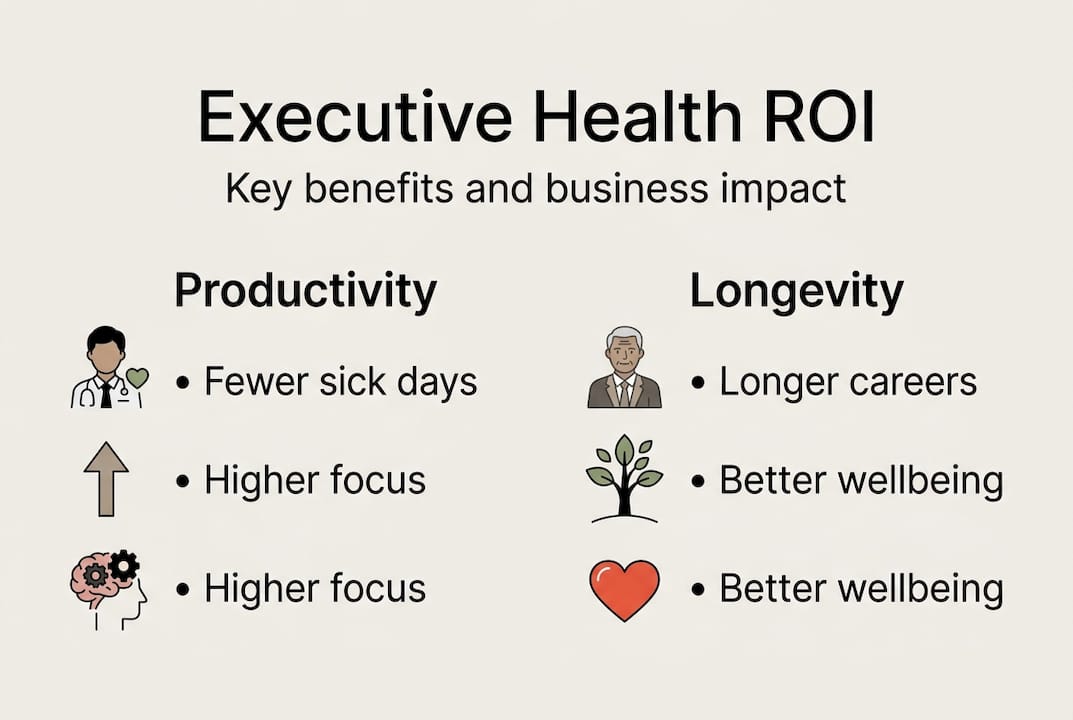
Start with absenteeism and presenteeism. Programs structured around executive-level health management produce a 22 to 35% reduction in absenteeism and a 30 to 45% reduction in presenteeism, which is the performance loss that occurs when you are physically present but cognitively compromised. For a founder or senior executive, even a 10% improvement in daily cognitive output compounds significantly over a year.
| Metric | Typical improvement | Business impact |
|---|---|---|
| Absenteeism | 22 to 35% reduction | Fewer lost leadership days |
| Presenteeism | 30 to 45% reduction | Higher-quality decisions |
| Healthcare costs | 20 to 30% reduction | Lower long-term spend |
| Productivity ROI | 3.27:1 average | Direct bottom-line return |
| Program ROI (top tier) | Up to 6:1 | Measurable business value |
The cognitive benefits deserve particular attention. Regular physical conditioning, stress management protocols, and sleep optimization improve decision-making speed, working memory, and emotional regulation. These are not soft benefits. They are the exact capacities that determine whether a leader performs well under pressure or makes costly errors when it matters most.

88% of CEOs report positive ROI from executive health programs, which is a remarkably high consensus for any investment category. The executives who do not see returns are typically those who treat the program as a one-time diagnostic event rather than an ongoing performance system.
A well-designed performance longevity strategy integrates health data into daily decision-making, not just annual reviews. The executive wellness strategies that deliver the highest returns combine physiological monitoring with behavioral coaching and structured recovery protocols.
For a detailed breakdown of costs and returns data across program tiers, the variance is significant, which brings us to the part most executives skip: the risks.
Costs and risks: What to consider before investing
Executive health programs are not uniformly valuable. The financial and medical landscape is more nuanced than most providers will tell you upfront, and informed executives need both sides of the ledger.
On the cost side, programs range from $2,500 to over $25,000 annually for standard executive physicals with advanced diagnostics. Comprehensive programs incorporating full-body MRI, genetic sequencing, and continuous biomarker monitoring can exceed $100,000 per year. The average reported ROI for top-tier programs sits at approximately 6:1, but that figure assumes the program is well-designed and the results are acted upon.
| Program tier | Annual cost | Key features |
|---|---|---|
| Standard executive physical | $2,500 to $5,000 | Blood panels, cardiac screening, basic imaging |
| Advanced diagnostic program | $5,000 to $25,000 | VO2 max, hormonal profiling, sleep analysis |
| Comprehensive longevity program | $25,000 to $100,000+ | Full-body MRI, genomics, continuous monitoring |
The medical risks are real and underreported. Comprehensive screenings yield approximately 16% false positives, which can trigger unnecessary follow-up procedures, invasive tests, and significant psychological stress. An executive who receives a false positive on a cardiac scan may spend weeks in diagnostic limbo, which is itself a performance and wellbeing cost.
The risks of overdiagnosis are particularly relevant for full-body imaging. MRI screening dilemmas frequently surface incidental findings, small abnormalities that would never cause symptoms but generate anxiety and further investigation. This is not an argument against screening. It is an argument for working with clinicians who can contextualize findings rather than simply report them.
Pro Tip: Before committing to any executive health program, ask the provider what percentage of their clients receive incidental findings and how they manage the follow-up process. A good program has a clear protocol for distinguishing actionable findings from noise.
The right health coaching for executives is what separates a program that produces clarity from one that produces anxiety. The clinician's ability to interpret data in the context of your specific risk profile and life demands is as important as the diagnostics themselves.
Practical steps: Building your executive health action plan
Knowing the benefits and risks is necessary but not sufficient. The executives who extract the most value from health investment are those who build a structured, evolving plan rather than responding reactively to symptoms or annual checkups.
Here is a practical framework for getting started:
- Define your baseline. Commission a thorough diagnostic workup that includes cardiovascular, metabolic, hormonal, and cognitive markers. You cannot optimize what you have not measured. High-performers who invest in structured health plans consistently detect silent risks before they become performance-limiting events.
- Choose providers with executive-specific expertise. Not all clinicians understand the demands of your role. Look for programs that specialize in high-responsibility professionals and can translate clinical findings into actionable performance guidance.
- Prioritize actionable outputs over diagnostic volume. More tests do not equal more value. Focus on screenings with clear intervention pathways. If a finding cannot be acted upon, question whether it belongs in your protocol.
- Build in continuous monitoring. Annual programs miss the dynamic nature of executive health. Wearable HRV tracking, quarterly biomarker reviews, and real-time sleep data give you a living picture of your physiological state.
- Integrate coaching and accountability. Data without interpretation is noise. A skilled health coach or physician who understands your goals converts findings into behavioral change.
- Review and update your strategy annually. Your risk profile changes with age, stress load, and life circumstances. A protocol that was appropriate at 45 may need significant revision at 55.
Pro Tip: Peer accountability among fellow executives is one of the most underused tools in health optimization. A small group of leaders who share health goals and check in quarterly creates social reinforcement that no app can replicate.
For deeper reading, explore longevity strategies for leaders, practical executive fitness approaches, and energy management for executives to build a complete performance ecosystem. The further ROI details behind top-tier programs are worth reviewing before you finalize your budget.
Our perspective: What most executives miss about health investment
Most executive health programs fail not because of bad diagnostics but because of bad follow-through. The annual physical becomes a checkbox. The results sit in a folder. Life resumes at the same pace with the same habits. That is not a health investment. That is expensive reassurance.
The executives who genuinely outperform over decades are not the ones with the most sophisticated testing protocols. They are the ones who have internalized health as a leadership practice, not a personal indulgence. They model recovery, protect sleep, and treat their physiology with the same rigor they apply to their balance sheet.
There is also a shadow cost that rarely gets discussed. Waiting for a wake-up call, a cardiac event, a burnout episode, a performance collapse, is the most expensive health strategy available. Why healthspan matters for high-performing executives is not an abstract question. It is the difference between leading at full capacity through your most valuable decades or managing decline.
Proactive leaders do not just live longer. They perform better, think more clearly, and build organizations that reflect their own sustained energy and judgment.
How Viridos elevates your executive health journey
Understanding the ROI of executive health is the first step. Applying it with precision and consistency is where most programs fall short.

VIRIDOS is built specifically for the demands you face as a high-performing leader. Our science behind Viridos draws on evidence-based protocols designed to support sustained cognitive performance, physical resilience, and long-term vitality. The Viridos methodology translates complex health data into daily practices that fit the reality of an executive schedule. And the Performance Journal gives you a structured tool for tracking the behavioral inputs that drive your most important health outcomes. This is not generic wellness. It is precision performance support for men who refuse to leave their edge to chance.
Frequently asked questions
What is the main ROI of executive health programs?
The primary return is increased productivity and reduced healthcare costs, with well-designed programs delivering 3 to 6 times the original investment through lower absenteeism and sharper daily performance.
Are executive health exams always worth it for healthy executives?
Not automatically. While they can surface silent risks, 16% false positive rates mean that comprehensive screenings should always be guided by experienced clinicians who can distinguish actionable findings from noise.
How much do top executive health programs typically cost?
Standard programs run $2,500 to $25,000 annually, while comprehensive longevity programs with full-body imaging and genomics can reach $100,000 or more per year.
What health risks are commonly found in symptom-free executives?
Silent conditions like coronary narrowing and metabolic syndrome are regularly detected in executives who feel and perform well, which is precisely why structured screening adds value beyond symptom management.