
TL;DR:
- Investing in performance creates compounding advantages in resilience, growth, and profitability that last over time.
- Executives should focus on a clear value driver, set success metrics upfront, and embed measurement and governance into every initiative.
Performance investment is defined as the deliberate allocation of resources toward improving execution, resilience, and measurable value creation to produce superior long-term outcomes. For executives and founders operating in high-stakes roles, this is not a discretionary choice. It is the operating principle that separates organizations that compound advantage from those that plateau. The case for why invest in performance has never been more data-supported: resilient companies grow revenues 6 percentage points faster and carry profit margins 8 points higher than their peers. That gap does not close on its own.
Why invest in performance: the evidence executives cannot ignore
The business case for performance investment rests on compounding returns, not one-time gains. Accenture's 2026 research demonstrates that organizations with the highest resilience scores do not just survive disruption. They outgrow competitors structurally, year over year. The mechanism is straightforward: resilience built across finance, technology, talent, and sustainability creates a portfolio of capabilities that reinforces itself.
The numbers sharpen the argument further. Balanced resilience investments across multiple dimensions quadruple the chances of sustaining high financial performance over a three-year horizon. This means that a CEO who invests narrowly, say, only in technology while neglecting talent development, captures a fraction of the available return. Breadth of investment is not a luxury. It is the multiplier.
"Resilience functions as a compounding portfolio of capabilities that fuel sustained growth and profitability when balanced across dimensions." — Accenture, 2026
The importance of investing in performance also shows up in workforce outcomes. CEOs who model disciplined performance habits and build execution systems around clear accountability directly shape how their organizations adapt. The benefits of performance investment are not abstract. They appear in revenue lines, retention rates, and the speed at which a team can pivot when market conditions shift.
Consider what this means for an executive managing a portfolio of initiatives. Every dollar allocated without a clear performance rationale is a dollar not compounding. The organizations that treat performance as an operating system, rather than a project, are the ones that show up in Accenture's top quartile.

How should executives approach performance investment to maximize ROI?
The most common failure in performance investment is not underinvestment. It is misdirected investment. IMD's 2026 AI ROI framework makes this precise: selecting one dominant value driver — whether productivity, market expansion, or customer experience — and aligning every execution decision to that driver is what separates initiatives that pay off from those that drain capital.
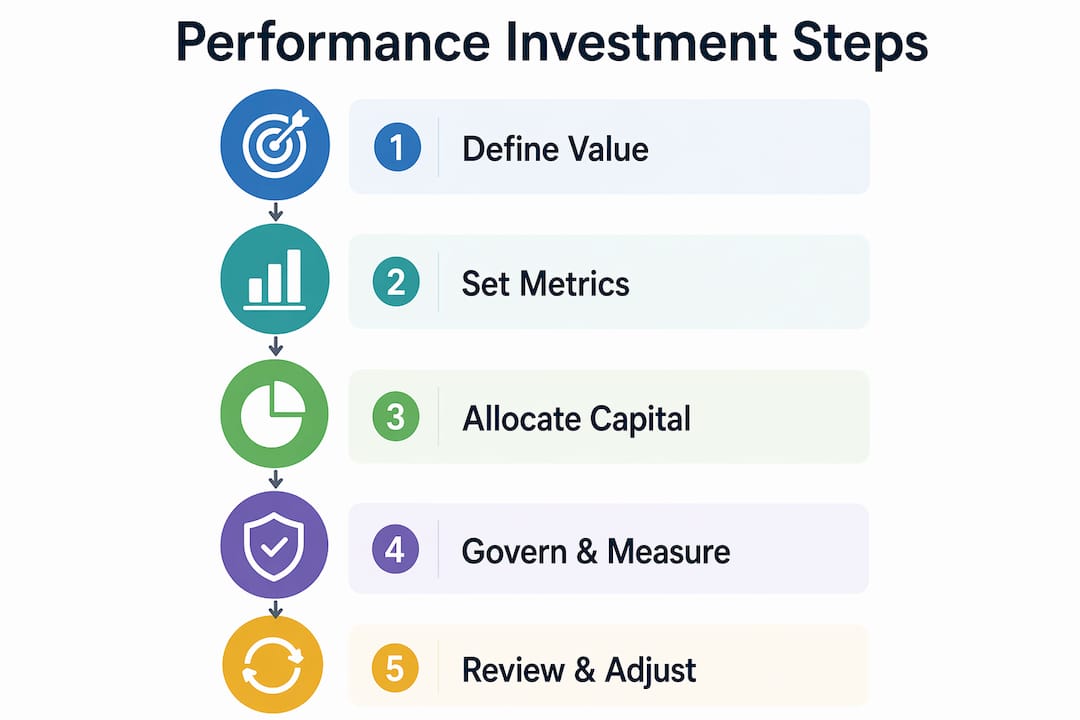
A disciplined approach to how to invest in performance follows a clear sequence:
- Define the primary value driver. Choose one: productivity, expansion, retention, or cost reduction. Trying to optimize for all four simultaneously produces mediocre results across all four.
- Set quantitative success metrics before launch. Revenue per employee, cycle time reduction, or customer acquisition cost are examples. These must be defined before any capital is committed.
- Establish kill criteria. Decide in advance what result, or absence of result, triggers termination of the initiative. IMD's research shows that explicit termination criteria prevent the sunk cost fallacy from consuming budgets that should be redeployed.
- Build a governance model. Assign a decision-maker with authority to pause, scale, or terminate. Governance without authority is theater.
- Separate technical success from business success. A system that works as designed but does not move the predefined metric is not a success. It is a distraction.
Pro Tip: Before approving any performance initiative, write a one-page document that states the value driver, the success metric, the kill criterion, and the decision-maker. If you cannot complete that document clearly, the initiative is not ready to fund.
The advantages of performance-based investing become visible when this discipline is applied consistently. Executives who govern their performance portfolios with the same rigor they apply to capital allocation decisions consistently outperform those who treat performance programs as cultural initiatives without financial accountability.
What are the common pitfalls in performance investment?
Execution gaps are the primary destroyer of performance investment value. Fewer than half of CEOs are confident their organizations can adapt and execute at market speed. That statistic reflects a structural problem: ambition routinely outpaces the systems needed to deliver on it.
The most damaging patterns Viridos observes among executives include the following:
- Treating AI as a productivity shortcut. Bain's 2026 CEO study found that over 80% of executives use AI primarily for cost reduction, not for building scalable execution systems. Cost reduction is a one-time gain. Execution systems compound.
- Measuring launch, not impact. A common executive mistake is treating the rollout of an initiative as the KPI. The initiative is not the outcome. The business result is the outcome.
- Neglecting the strategy-execution gap. Only about half of CEOs believe their organizations have the right routines to run and change the business simultaneously. This gap is where performance investment goes to die.
- Investing in one dimension only. Narrow investments in technology without corresponding investments in talent and governance produce fragile gains that erode when key people leave or market conditions shift.
Pro Tip: Audit your last three major performance initiatives. For each one, identify whether you measured business impact or project completion. If the answer is project completion, you have a measurement problem, not a performance problem.
The impact of performance investment is only visible when measurement is built into the initiative from day one, not retrofitted after the fact. Executives who embed continuous measurement into their performance improvement strategies avoid the most expensive failure mode: funding technically successful but commercially unproductive work.
How does measurement underpin successful performance investment?
Measurement is not a reporting function. It is the mechanism by which performance investment produces real returns. The performance loop framework from performance engineering makes this concrete: define targets, establish a baseline, identify bottlenecks, implement high-leverage fixes, benchmark, and re-measure. This cycle applies with equal force to organizational performance as it does to software systems.
The critical discipline within this loop is separating benchmarking from production impact. A benchmark tells you what is possible under controlled conditions. Production observation tells you what is actually happening in the real world. Executives who confuse the two fund initiatives that perform well in pilots and fail at scale. The measurement-first workflow used in performance engineering, which relies on Service Level Indicators and Service Level Objectives, translates directly into executive practice as predefined success thresholds that trigger action.
| Measurement stage | Executive application |
|---|---|
| Define targets | Set revenue, retention, or efficiency thresholds before launch |
| Baseline measurement | Quantify current state before any intervention |
| Identify bottlenecks | Locate the constraint limiting performance, not the most visible problem |
| Implement targeted fixes | Address the constraint directly, not symptoms |
| Re-measure and validate | Confirm business impact in production, not just in pilots |
"Stop guessing. The performance loop forces you to validate real-world impact rather than celebrate technical progress." — planetgeek.ch, 2026
Risk controls belong inside the measurement framework, not outside it. Kill criteria, rollback plans, and decision gates are not signs of pessimism. They are the governance structures that allow executives to sustain elite performance over multi-year horizons without accumulating dead-weight initiatives. The executives who build these controls into their performance improvement strategies are the ones who maintain capital discipline and organizational credibility simultaneously.
Key takeaways
Performance investment delivers compounding returns when it combines balanced resilience, disciplined governance, and measurement-first execution across all dimensions of the organization.
| Point | Details |
|---|---|
| Resilience drives financial outperformance | Companies with broad resilience investments grow revenues 6 points faster and margins 8 points higher than peers. |
| One value driver, not four | Selecting a single dominant value driver and aligning execution to it separates successful investments from wasted capital. |
| Kill criteria prevent sunk costs | Defining termination conditions before launch protects budgets and organizational credibility. |
| Measurement must precede intervention | Establishing a baseline before any initiative launches is the only way to validate real business impact. |
| Execution systems compound; productivity shortcuts do not | Building scalable execution routines produces lasting advantage; using AI only for cost reduction produces one-time gains. |
Performance as an operating system, not a project
I have watched capable executives invest heavily in performance programs and walk away with nothing to show for it. Not because the programs were poorly designed. Because they were treated as projects with end dates rather than as permanent operating infrastructure.
The shift in thinking that actually changes outcomes is treating performance the way you treat your balance sheet. You do not run a balance sheet review once and declare the work done. You maintain it, govern it, and adjust it continuously. Performance works the same way. The executives I have seen build resilient performance over a decade are not the ones who launched the most initiatives. They are the ones who built the fewest, measured them rigorously, and scaled what worked.
The uncomfortable truth is that most performance investment failures are governance failures. The initiative was sound. The measurement was absent. The kill criteria were never written. The decision-maker lacked authority. These are leadership problems, not strategy problems. And they are entirely within your control to fix.
What I find most clarifying from the 2026 research is the Accenture finding on balanced investment. Executives who invest across finance, technology, talent, and sustainability simultaneously are not spreading resources thin. They are building a system where each dimension reinforces the others. That is the definition of compounding. And compounding, applied to organizational capability, is the most durable competitive advantage available to any executive.
— Joakim
Build your performance investment strategy with Viridos

The frameworks in this article are the foundation. Applying them with consistency over years is where the real work begins. Viridos is built for executives who take that work seriously. The Viridos Performance Journal delivers disciplined, research-grounded content on executive vitality, resilience, and long-term performance longevity, written specifically for founders, investors, and high-responsibility professionals. For structured access to performance investment frameworks, governance models, and executive performance strategies, the Viridos Membership provides controlled, premium resources aligned with the demands of sustained leadership at the highest level.
FAQ
Why invest in performance rather than just cutting costs?
Cost reduction produces one-time gains. Performance investment builds execution systems that compound over time, producing structural advantages in revenue growth, margin, and organizational adaptability that cost reduction alone cannot generate.
What is the most important first step in performance investment?
Define a single dominant value driver and set quantitative success metrics before committing capital. IMD's 2026 research shows that initiatives without predefined business metrics routinely mistake technical success for commercial value.
How do resilience investments affect long-term financial performance?
Accenture's 2026 data shows that organizations investing broadly across finance, technology, talent, and sustainability quadruple their chances of sustaining high financial performance over a three-year period compared to those investing narrowly.
What separates successful performance initiatives from failures?
Strong governance with predefined business metrics, kill criteria, and a decision-maker with real authority separates successful performance investments from those that consume capital without producing measurable returns.
How should executives measure the impact of performance investment?
Establish a quantitative baseline before any initiative launches, then measure business outcomes in production rather than in controlled pilots. Service Level Indicators and iterative re-measurement validate whether real-world impact matches the original investment thesis.