
TL;DR:
- Burnout results from chronic workplace stress caused by a mismatch between job demands and available resources. Preventing burnout requires organizational leadership, workload restructuring, and individual strategies like cognitive behavioral training. Addressing systemic issues and fostering early detection help sustain performance and reduce long-term risks.
Burnout is defined by the World Health Organization as a syndrome of chronic workplace stress that has not been successfully managed. For professionals aged 30–55 in demanding roles, the question of why minimize burnout risk is not abstract. Burnout arises from a mismatch between job demands and available resources, affecting core psychological needs like control, fairness, and competence. The consequences reach beyond personal discomfort. Burnout degrades decision quality, erodes team trust, and drives turnover at a cost that organizations rarely account for until the damage is done. Preventing workplace burnout is not a wellness trend. It is a performance discipline.
Why minimize burnout risk before it becomes a crisis
Burnout is not simply exhaustion after a hard week. The clinical term, occupational burnout, describes a prolonged state of depletion that develops when job demands consistently outpace the resources available to meet them. Resources include time, autonomy, social support, and clarity of role. When those resources run short for months, the psychological foundation of performance erodes.
Three core psychological needs take the hardest hit:
- Autonomy. Professionals who lose control over how and when they work report sharply lower motivation and higher emotional exhaustion.
- Competence. When workload exceeds capacity, the sense of doing good work disappears. That loss is demoralizing in a way that simple tiredness is not.
- Belonging. Isolation, poor team cohesion, and absent leadership cut the social connection that buffers stress. Without it, pressure accumulates faster.
Burnout is also a lagging indicator. Visible signs appear only after months of developing stress and imbalance. By the time a professional recognizes the symptoms in themselves, the underlying damage is already significant. That delay is precisely why the importance of reducing burnout centers on early, structural action rather than reactive recovery.
What organizational factors drive burnout most?

The structural causes of burnout sit at the organizational level, not the individual one. 76% of HR professionals identify leadership gaps as a primary root cause of burnout. That figure points directly at manager development as the highest-leverage intervention available to any organization.
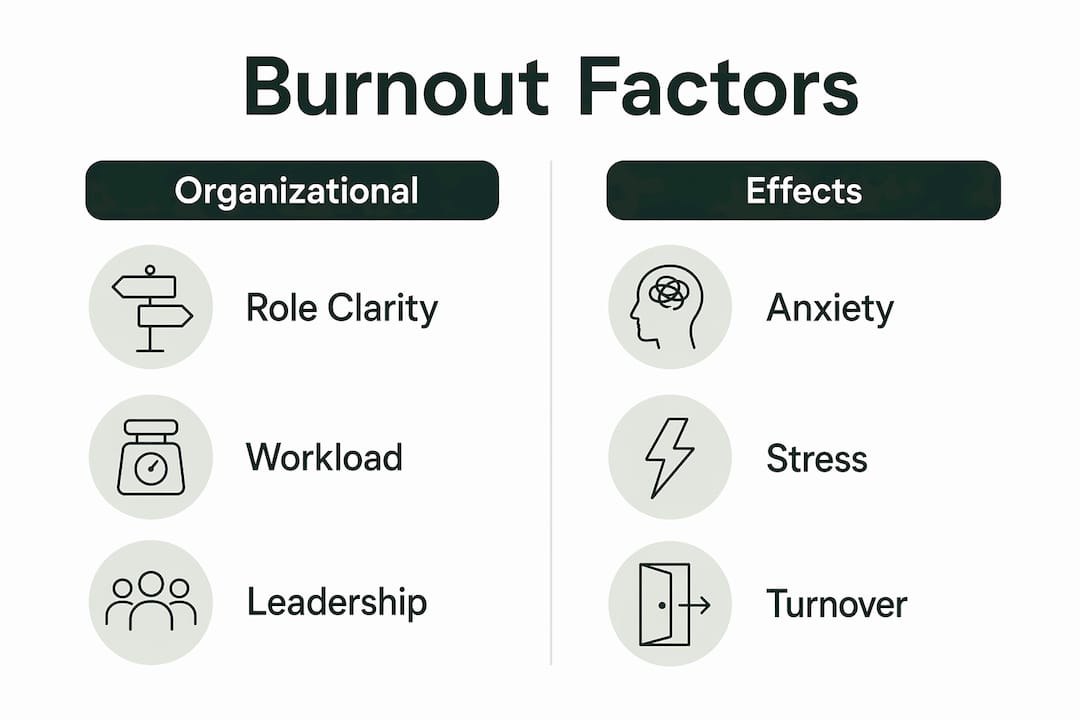
Poor leadership creates a cascade. Managers who lack training in workload distribution, role clarity, and psychological safety pass that deficit directly to their teams. The result is ambiguous expectations, uneven workloads, and a culture where raising concerns feels risky. Each of those conditions accelerates burnout independently. Combined, they make it nearly inevitable.
| Organizational factor | Effect on burnout risk |
|---|---|
| Unclear role expectations | Increases anxiety and decision fatigue |
| Excessive workload | Depletes cognitive and emotional reserves |
| Weak psychological safety | Suppresses early help-seeking behavior |
| Absent manager support | Removes the primary buffer against stress |
| No recovery periods built in | Prevents physiological and mental restoration |
The table above reflects a consistent pattern in occupational health research. Psychologically safe environments with clear roles, balanced workloads, and emotional support reduce burnout more durably than any self-care program. That finding reframes the conversation. Burnout prevention is a leadership responsibility, not a personal one.
Pro Tip: Audit your team's workload distribution quarterly. Uneven loads are rarely visible to managers until someone is already depleted. A 30-minute review of task volume per person can surface imbalance before it becomes a retention problem.
How do individual factors shape burnout vulnerability?
Organizational conditions set the stage, but individual behavioral patterns determine how quickly burnout takes hold. The professionals most at risk are often the highest performers. Overachievers face elevated burnout risk because they tie self-worth directly to productivity. That link makes boundary-setting feel threatening rather than rational.
The psychological barriers are specific:
- Fear of rejection. Saying no to a senior colleague or client feels like risking the relationship itself.
- Competence threat. Declining work signals, to the overachiever, that they are not capable of handling it.
- Identity erosion. For professionals whose identity is built around output, rest feels like failure.
These patterns are not character flaws. They are learned responses that served a purpose earlier in a career. The problem is that they become liabilities at senior levels, where the volume and complexity of demands never naturally decrease.
Cognitive behavioral training (CBT) reduces burnout with a strong effect size of d=0.93 in randomized controlled trials. That makes it the most evidence-supported individual intervention available. CBT works by restructuring the thought patterns that make overwork feel necessary and rest feel dangerous. It does not require months of therapy to produce results. Structured CBT programs of 6–8 weeks show measurable shifts in how professionals respond to pressure.
Pro Tip: Conduct a weekly self-assessment using three questions: What did I agree to this week that I should have declined? What did I avoid asking for that I needed? What recovery did I skip? Honest answers to those three questions reset behavioral patterns faster than any app.
What are the most effective strategies to lower burnout risk?
The most durable strategies for burnout prevention combine organizational change with individual support. Programs that address both levels produce lasting results at 12 months and beyond. Individual-only interventions, by contrast, show measurable decline within six months. That gap in longevity is the single most important finding in burnout prevention research.
A practical prevention framework operates on two tracks simultaneously:
- Restructure workloads. Cap weekly task volume per person. Build explicit recovery periods into project timelines. Treat recovery as a performance input, not a reward.
- Develop managers first. Train managers in workload distribution, role clarity, and how to create psychological safety. A well-trained manager prevents more burnout than any wellness benefit.
- Clarify roles and expectations. Ambiguity is a chronic stressor. Written role definitions and clear decision rights reduce the cognitive load of navigating unclear authority.
- Build early detection into the system. Use regular one-on-one check-ins and anonymous pulse surveys to catch stress accumulation before it becomes visible burnout.
- Provide CBT access. Offer structured cognitive behavioral training as a standard professional development resource, not a crisis intervention.
- Protect autonomy. Give professionals control over how they complete work, not just what they complete. Autonomy is a direct buffer against emotional exhaustion.
The comparison between hybrid and individual-only programs is not subtle. Organizations that invest only in meditation apps and wellness stipends without addressing workload or leadership see short-term engagement gains that fade. The underlying systemic problems remain intact and produce the same burnout cycle on a slightly delayed schedule.
For professionals managing their own executive stress responses, the individual track still matters. CBT, structured reflection, and peer support each contribute to resilience. The key is pairing those tools with honest conversations about workload and organizational support.
How can professionals apply these strategies day to day?
Translating prevention strategy into daily behavior requires specificity. General commitments to "work less" or "take breaks" do not hold under pressure. Concrete practices do.
- Set a weekly capacity ceiling. Decide in advance how many hours of deep work you can sustain without degrading quality. Treat that number as a hard constraint, not a target to exceed.
- Communicate workload proactively. Do not wait for a manager to notice overload. Name it directly and early. Proactive communication is a professional skill, not a complaint.
- Access mental health support before stress escalates. Confidential mental health care accessed early is a key protective factor against burnout progressing to leave or turnover. Waiting until crisis arrives costs far more time and performance than early intervention.
- Use CBT or structured reflection weekly. A 20-minute weekly review of thought patterns, decisions, and stress responses builds the self-awareness that prevents gradual drift into depletion.
- Build peer accountability. Share workload boundaries with a trusted colleague. External accountability makes it harder to quietly abandon limits under pressure.
Recovery is also a physical process. Professionals who maintain consistent sleep, movement, and nutrition alongside antioxidant-supported recovery report better stress tolerance and faster cognitive restoration. The body's capacity to buffer stress is not separate from mental resilience. It is the same system.
Key Takeaways
Minimizing burnout risk requires combining organizational structural change with individual behavioral discipline, because neither approach alone produces results that last beyond six months.
| Point | Details |
|---|---|
| Burnout is structural, not personal | It arises from resource-demand mismatch, not individual weakness or poor attitude. |
| Leadership gaps drive most burnout | 76% of HR professionals cite poor leadership as the primary cause, making manager training the top priority. |
| Hybrid programs last longer | Combining organizational and individual interventions sustains results at 12+ months; individual-only programs fade within six. |
| CBT is the strongest individual tool | Cognitive behavioral training shows an effect size of d=0.93, the highest of any individual burnout intervention. |
| Early access to support is protective | Confidential mental health care before stress escalates prevents burnout from progressing to leave or turnover. |
The discipline of protecting your performance capital
Most high-responsibility professionals I have spoken with treat burnout as something that happens to other people. They point to their track record, their discipline, their ability to push through. What they miss is that burnout does not discriminate by work ethic. It targets the people who push hardest without building the structural conditions to sustain that output.
The mistake I see most often is treating burnout prevention as a self-care problem. Meditation, cold plunges, and sleep tracking are not prevention. They are maintenance. Real prevention means having honest conversations about workload, demanding role clarity, and building recovery into the structure of work itself, not bolting it on afterward.
The identity piece is the hardest. Executives and founders often define themselves by their capacity to absorb pressure. Setting a limit feels like admitting a limit. But the professionals who sustain performance over a decade are not the ones who never set limits. They are the ones who protect their capacity with the same discipline they apply to their finances or their physical conditioning.
Burnout is not a sign of weakness. It is a sign that the system was running without adequate resources for too long. Recognizing that is not just reassuring. It is the first step toward building something that actually holds.
— Joakim
Viridos and the long game of executive performance
Sustained performance at the executive level demands more than ambition. It requires a system.

Viridos is built for disciplined professionals who take their mental and physical output seriously over the long term. The Viridos Performance Journal gives you a structured framework to track mental resilience, workload patterns, and recovery quality, the exact variables that determine whether burnout accumulates or stays contained. For professionals who want a more complete support structure, the Viridos Membership provides access to evidence-aligned executive wellness tools designed for men in high-responsibility roles. Both are built on the same principle: sustained edge comes from disciplined systems, not occasional effort.
FAQ
What is burnout and how is it defined clinically?
Burnout is an occupational syndrome caused by chronic workplace stress that has not been successfully managed. The World Health Organization classifies it by three dimensions: exhaustion, increased mental distance from one's work, and reduced professional effectiveness.
Why does minimizing burnout risk matter for productivity?
Burnout degrades decision quality, reduces output, and drives turnover. Because it is a lagging indicator, the productivity loss accumulates for months before it becomes visible, making early prevention far less costly than recovery.
What is the most effective individual intervention for burnout?
Cognitive behavioral training (CBT) is the most evidence-supported individual intervention, with an effect size of d=0.93 in randomized controlled trials. It works by restructuring the thought patterns that make overwork feel necessary.
How long do burnout prevention programs actually last?
Programs combining organizational change with individual support show durable results at 12 months and beyond. Individual-only programs show measurable decline within six months without structural organizational changes alongside them.
Are overachievers more vulnerable to burnout?
Overachievers face higher burnout risk because they link self-worth to productivity, making boundary-setting feel like a threat to identity, competence, and belonging. That psychological pattern increases vulnerability even when external workload is manageable.