
Burning out at the top isn't a badge of honor. It's an avoidable liability that quietly erodes your decision-making, shortens your runway, and compounds into serious health risk. The executives who sustain peak performance into their 50s and 60s aren't working harder than everyone else. They're working smarter on their biology. Sleep, movement, nutrition, and breathwork form the pillars of long-term health for leaders, and the men who treat these as non-negotiable investments consistently outperform those who don't. This guide gives you the protocols, frameworks, and metrics to build a wellness system that scales with your ambitions.
Table of Contents
- Understanding the burnout-performance trap
- Essentials for executive-level wellness optimization
- Step-by-step blueprint: Building your executive wellness protocol
- Common pitfalls and troubleshooting strategies
- How to verify results and sustain high performance
- Elevate your wellness journey with expert support
- Frequently asked questions
Key Takeaways
| Point | Details |
|---|---|
| Comprehensive approach wins | Combining sleep, movement, nutrition, and stress management delivers the highest, longest-lasting results. |
| Program ROI is proven | Executive health programs cut absenteeism and boost productivity, justified by early risk detection and tracking. |
| Track, adjust, repeat | Measuring and re-tuning protocols on a monthly basis is key to sustained executive performance. |
| Beware common pitfalls | Over-optimization and neglecting emotional health are common mistakes—adapt and prioritize essentials during high-pressure periods. |
Understanding the burnout-performance trap
Most executives know burnout is bad. Few realize how much it's already costing them before they feel it. There's a critical difference between absenteeism (missing work due to illness) and presenteeism (showing up while impaired). Presenteeism is the silent killer of executive output because it's invisible on a spreadsheet but devastating in the boardroom.
The numbers are stark. Executive health programs reduce absenteeism by 22-35% and presenteeism by 30-45%. That's not a wellness perk. That's a performance multiplier with a measurable return. For healthspan-focused executives, the goal isn't just living longer. It's staying sharp, decisive, and physically capable throughout your highest-value years.
The hidden threat most leaders overlook is silent cardiovascular risk. Comprehensive assessments catch silent risks like heart blockages early, before they become career-ending or life-threatening events. This is where proactive executive health tips separate the reactive from the strategic.
"Early detection isn't just a medical advantage. It's a leadership advantage. The executive who knows his numbers can act. The one who doesn't is operating blind."
Watch for these burnout warning signs before they compound:
- Persistent mental fog that doesn't clear after sleep
- Declining motivation for work you previously found energizing
- Increased irritability or emotional reactivity in high-stakes meetings
- Disrupted sleep despite physical exhaustion
- Relying on stimulants (caffeine, sugar) to sustain baseline function
Now that we've established the consequences of unchecked stress and poor health, the next section lays out what you need to take action.
Essentials for executive-level wellness optimization
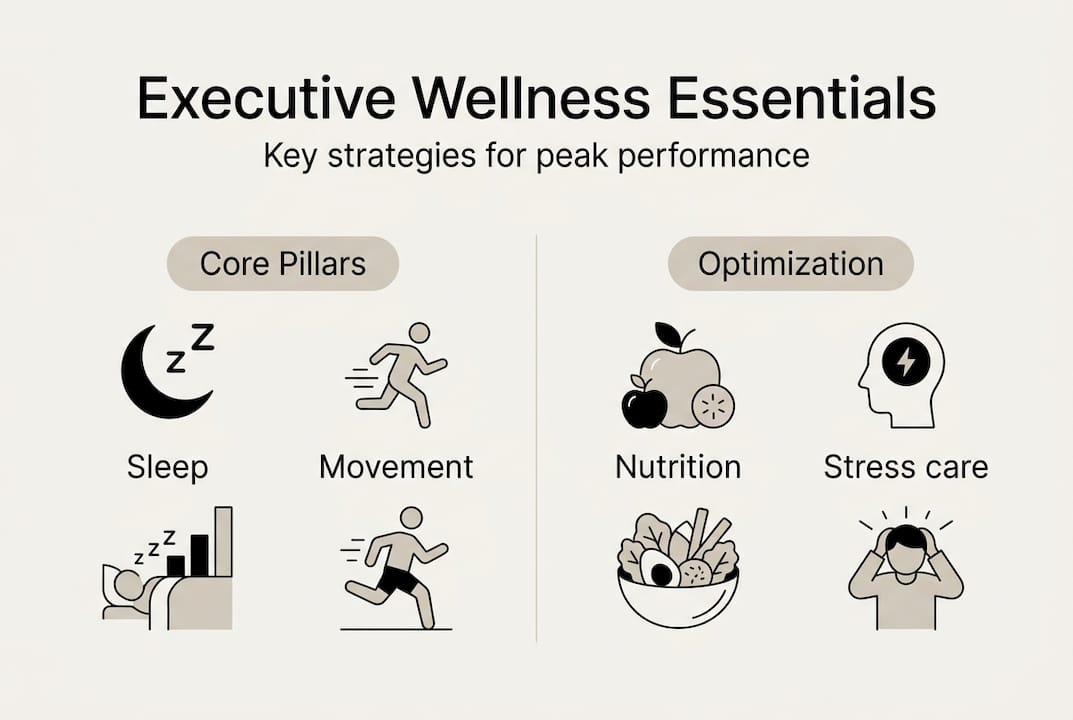
Building a sustainable wellness system starts with knowing which pillars actually move the needle. Effective longevity plans are built on movement, nutrition, and breathwork, but the full picture for executives includes four core domains:
- Sleep: 7+ hours of quality sleep is non-negotiable. Prioritize sleep architecture, not just duration.
- Movement: Strength training and cardiovascular work, structured around your travel and meeting schedule.
- Nutrition: Anti-inflammatory, protein-forward eating that sustains cognitive output without energy crashes.
- Stress and emotional health: Breathwork, mindfulness, and deliberate recovery to regulate your nervous system.
Here's how standard and advanced executive assessments compare:
| Assessment type | What's included | Typical cost | Key insight delivered |
|---|---|---|---|
| Standard executive physical | Blood panel, BP, BMI, basic cardiac | $500–$1,500 | Baseline health snapshot |
| Advanced executive program | Full imaging, VO2 max, hormone panel, cognitive testing | $3,000–$10,000+ | Silent risk detection, performance gaps |
| Ongoing coaching program | Quarterly reviews, protocol adjustments, accountability | $2,500–$4,500/year | Sustained optimization and ROI |
The investment looks significant until you calculate the cost of a missed diagnosis or six months of degraded executive performance. For a deeper look at building healthy routines for vitality, the framework matters as much as the individual habits.

Pro Tip: Insert two to three minutes of box breathing (inhale 4 counts, hold 4, exhale 4, hold 4) between back-to-back meetings. It resets your cortisol response and sharpens focus for the next conversation without requiring a schedule change.
With clarity on what successful wellness programs require, it's time to outline the step-by-step process to implement these pillars efficiently.
Step-by-step blueprint: Building your executive wellness protocol
A protocol without structure is just intention. Here's a seven-step framework built for the demands of executive life, drawing on sleep, movement, nutrition, and stress management as the core drivers of chief wellness outcomes.
- Get a baseline assessment. Schedule a comprehensive executive health evaluation. Know your VO2 max, hormone levels, inflammatory markers, and cardiovascular risk profile before building anything else.
- Define your performance KPIs. Choose three to five measurable targets: resting heart rate, sleep score, energy rating at 3pm, weekly training volume, and quarterly biomarker benchmarks.
- Optimize sleep first. Set a fixed sleep window. Control light exposure after 9pm. Keep your room cool. Sleep is the highest-leverage intervention available to you.
- Build a movement minimum. Three to four strength sessions per week plus two low-intensity cardio sessions. Protect these like board meetings. They are not optional.
- Systematize nutrition. Eliminate decision fatigue around food. Prep protein sources in advance, keep processed carbohydrates out of your workspace, and time meals to support your cognitive peak hours.
- Install a stress protocol. Daily breathwork, weekly decompression (sauna, nature, low-stimulation time), and a hard boundary on after-hours digital input.
- Build emotional resilience deliberately. Regular reflection, strong peer relationships, and professional support when needed. Emotional health is a performance variable, not a soft topic.
For a broader view of longevity strategies for leaders, the evidence consistently points to the same fundamentals.
| Intervention | Evidence strength | Time to results | Sustainability |
|---|---|---|---|
| Structured exercise | Very high (RCT-backed) | 4–8 weeks | High |
| Sleep optimization | Very high | 1–2 weeks | High |
| Targeted supplementation | Moderate (varies by compound) | Variable | Moderate |
| Advanced biohacking (cold, red light) | Emerging | Variable | Moderate |
Dr. Peter Attia's work on exercise and supplements reinforces what the data shows: the fundamentals outperform the exotic every time. Supplements can support a strong foundation, but they can't replace one. For a full breakdown of performance longevity, the hierarchy of interventions matters.
Pro Tip: Set a quarterly review date in your calendar now. Review your three to five KPIs, adjust your protocol based on what's working, and identify one area to upgrade. Treat it like a board review for your own biology.
Even with the best strategy, implementation stumbles are common. The next section covers how to stay on track.
Common pitfalls and troubleshooting strategies
The most disciplined executives often fall into the same traps. Knowing them in advance is the difference between a temporary setback and a complete derailment.
- Over-optimization: Stacking too many interventions at once creates complexity that collapses under pressure. Start with two or three high-leverage habits and build from there.
- Neglecting emotional wellness: Physical metrics improve while relationships deteriorate and stress compounds. Emotional health is not separate from performance health.
- Overreliance on supplements: Supplements are support tools, not solutions. Prioritizing a pill stack over sleep and movement is a losing trade.
- Underestimating recovery: High performers often treat rest as weakness. Recovery is where adaptation happens. Without it, you're just accumulating fatigue.
The most successful protocols adapt to changing stress loads and work demands. A Q4 board sprint or a major acquisition doesn't mean abandoning your wellness system. It means scaling it intelligently.
"When pressure spikes, the instinct is to drop wellness routines first. The smarter move is to compress them, not eliminate them. Ten minutes of movement beats zero. Five minutes of breathwork beats none."
Practical fixes when your schedule compresses:
- Shorten workouts to 20 minutes of high-intensity work rather than skipping entirely
- Shift focus to sleep and nutrition as the two highest-ROI pillars during crisis periods
- Use calendar automation to protect at least one recovery block per day
- Lean on accountability systems (a coach, a partner, a tracking app) to maintain minimum effective dose
For executives committed to sustaining elite performance across market cycles and high-pressure periods, adaptability is the skill that separates the consistent from the inconsistent.
Having covered how to troubleshoot and adapt, the final educational section outlines how executives can measure their own results for continuous improvement.
How to verify results and sustain high performance
What gets measured gets managed. For executive wellness, the metrics that matter most are the ones that connect directly to your output and longevity.
- Sleep quality score: Use a wearable to track sleep stages, HRV (heart rate variability), and resting heart rate. These are your recovery report card.
- Energy and focus levels: Rate your afternoon cognitive clarity on a 1-10 scale daily. Trends over weeks reveal more than any single data point.
- Biomarkers: Testosterone, cortisol, inflammatory markers (CRP, IL-6), and lipid panels tracked quarterly give you the biological picture behind the performance data.
- Absenteeism and productivity rates: Track days lost to illness and self-rated productivity weekly. These are your bottom-line wellness metrics.
- Body composition and VO2 max: Measured every six months, these reflect the cumulative impact of your movement and nutrition protocols.
Executive health programs provide clear ROI by tracking metrics and catching health risks early. The return isn't abstract. It shows up in fewer sick days, sharper decision-making, and lower long-term healthcare costs.
Refine your protocol on a monthly micro-review (adjust one variable based on data) and a quarterly macro-review (reassess all KPIs, update goals, consider new assessments). For targeted nutritional support, top vitamins for executives can fill specific gaps identified through your biomarker data. Pair this with a structured performance tracking journal to build the habit of data-driven self-management.
Elevate your wellness journey with expert support
You've built the framework. Now the question is execution at the level your ambitions demand. VIRIDOS exists precisely for this moment, when a high-performing man decides to treat his biology with the same rigor he applies to his business.
The VIRIDOS Membership gives you access to curated protocols, science-backed tools, and a premium support structure designed for men who operate at the highest level. Track your progress with precision using the VIRIDOS Performance Journal, built specifically for data-driven self-optimization. And when you want to go deeper on the research behind what works, the science behind VIRIDOS gives you the evidence without the noise. This is what sustained edge looks like in practice.
Frequently asked questions
What are the most important wellness pillars for executives?
The four key pillars are sleep, movement, nutrition, and stress and emotional health. Sleep, movement, and breathwork form the core of effective executive longevity plans, with recovery as the essential fifth element.
How much does an executive wellness program typically cost?
Basic risk-stratified assessments start at $1,500 to $3,000, with annual coaching programs ranging from $2,500 to $4,500 depending on depth and frequency of support.
Are supplements or biohacking strategies necessary for optimal performance?
Most evidence supports exercise, nutrition, and sleep as the fundamentals. RCT-backed exercise and nutrition consistently outperform unproven supplements for sustainable, long-term results.
How can executives measure if their wellness routine is working?
Track sleep quality, energy levels, physical markers, and productivity rates consistently. Executive programs succeed by monitoring health and performance outcomes over time, not by optimizing a single data point.