
TL;DR:
- Burnout prevention involves organizational redesign, leadership development, and personal behavioral strategies to maintain long-term professional energy. Combining these approaches produces lasting results beyond 12 months, especially when systemic changes address root causes. Self-care tools alone cannot prevent burnout without structural organizational support.
Burnout prevention is defined as the proactive combination of systemic workplace adjustments, leadership development, and individual behavioral change designed to sustain professional energy and engagement over the long term. For executives, founders, and high-responsibility professionals, this is not a wellness trend. It is a performance discipline. Research from Avidon Health confirms that combined organizational and individual approaches produce effects lasting 12 months or more, while individual-only programs fade within six months. The Cleveland Clinic identifies daily self-monitoring as a core early-warning tool. Cognitive behavioral therapy (CBT) remains the strongest evidence-based personal strategy. The importance of burnout prevention grows with the weight of your role.
What is burnout prevention, and why does it matter for professionals?
Burnout prevention is the structured practice of reducing chronic workplace stress before it becomes physical and psychological collapse. The World Health Organization classifies burnout as an occupational phenomenon, not a personal weakness. That distinction matters because it shifts responsibility from the individual alone to the system around them.
For professionals in demanding roles, the stakes are concrete. Burnout degrades decision quality, narrows strategic thinking, and erodes the relational trust that leadership depends on. A founder who cannot sustain energy past year three is not a resilience failure. He is operating inside a system that was never designed to support him.
Burnout is a systemic issue, not a personal failure. Focusing solely on individual coping misses root causes tied to job demands and depleted resources. This is why the importance of burnout prevention extends beyond personal health. It is a structural performance question.
The signs of burnout worth watching include persistent exhaustion that sleep does not resolve, growing cynicism toward work that once motivated you, and a measurable drop in output quality. Recognizing these early is the first condition for prevention.
What are the core components of effective burnout prevention?
Three components define a complete burnout prevention strategy: organizational redesign, leadership development, and individual behavioral change. No single component works alone. The evidence is clear that combined interventions produce lasting results beyond 12 months, while programs targeting only the individual fade within six months.
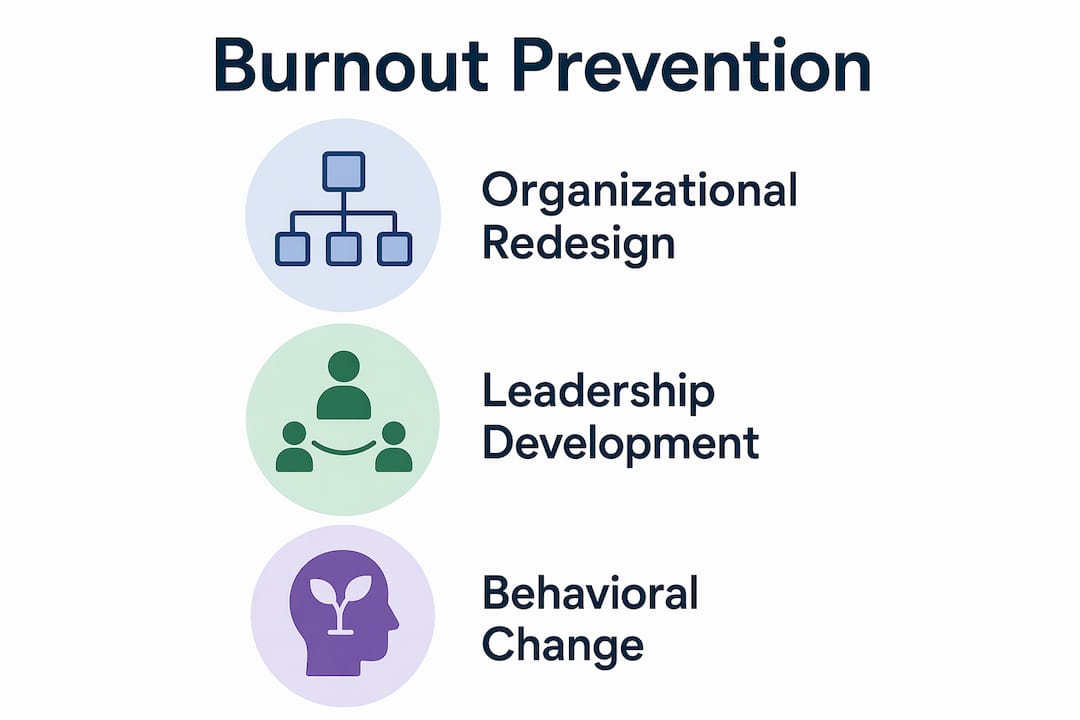
Organizational redesign
Organizational redesign addresses the structural causes of burnout: excessive workload, unclear roles, lack of autonomy, and cultures that reward overwork. These are the conditions that create burnout regardless of how disciplined an individual is. Fixing them requires decisions at the leadership level, not the employee level.

Leadership development
Manager training is the most underused lever in burnout prevention. Managers who communicate clearly, set realistic expectations, and model sustainable work behavior create a cascading effect on team well-being. One trained leader can shift the behavioral norms of an entire group.
Individual behavioral change
CBT-based individual interventions show the strongest evidence among personal strategies. CBT works by restructuring the thought patterns that drive overcommitment, perfectionism, and poor boundary-setting. It is not passive. It requires structured practice, ideally with professional support.
| Component | Scope | Duration of impact | Effectiveness alone |
|---|---|---|---|
| Organizational redesign | Team and company-wide | Long-term (12+ months) | High |
| Leadership development | Team level | Medium-term (6–12 months) | Moderate |
| Individual CBT-based change | Personal | Short-term without support | Low to moderate |
| Combined approach | All levels | Long-term (12+ months) | Highest |
Pro Tip: If your organization only offers an employee assistance program or a meditation app, push for structural changes alongside it. The app treats the symptom. The structural change removes the cause.
How does organizational culture and leadership influence burnout prevention?
Organizational culture is the single most powerful variable in whether burnout prevention strategies succeed or fail. A systematic review published in IJERPH confirms that structural workplace changes outperform individual coping methods in reducing burnout rates. Culture is not a soft concept here. It is a measurable driver of output and attrition.
Practical organizational strategies that reduce burnout risk include:
- Workload audits conducted quarterly to identify roles carrying disproportionate demand
- Clear role definitions that eliminate ambiguity about ownership and decision authority
- Flexible work structures that give professionals control over when and where they perform deep work
- Psychological safety norms that allow team members to flag overload without career risk
- Recognition systems that reward sustainable output, not just volume or hours logged
Leadership behavior is the delivery mechanism for all of these. A policy on paper means nothing if the executive team models 70-hour weeks and responds to messages at midnight.
Small, sustainable micro-shifts in leadership practices, like brief weekly check-ins and clearer communication about priorities, can disrupt the burnout cycle without requiring a full organizational overhaul. This matters for executives who want to act now without waiting for a company-wide initiative.
"Preventing burnout requires not a single solution but a daily routine of assessment and adjustment to maintain balance and avoid overload." — Cleveland Clinic
The most durable burnout prevention cultures share one trait: leadership that treats energy as a managed resource, not an infinite input.
What individual strategies support burnout prevention effectively?
Individual strategies are necessary but not sufficient. They work best as a complement to organizational change, not a substitute for it. The following practices have the strongest evidence base for professionals in high-demand roles.
-
Prioritize sleep consistency. Consistent sleep of 7–9 hours per night is the foundation of physical recovery. Bedtime consistency matters as much as total duration. Irregular sleep schedules disrupt cortisol regulation and impair the cognitive functions executives rely on most.
-
Build daily physical activity into your schedule. Twenty-minute walks or 5,000 steps daily are linked to measurable reductions in stress hormones and lower rates of depression. This is not a fitness goal. It is a neurological maintenance practice.
-
Develop structured self-awareness. Self-awareness is learned, not innate. Structured reflection about your energy levels, emotional state, and engagement quality each day creates the data you need to catch early burnout signs before they compound. Cynicism and detachment typically appear before exhaustion does.
-
Practice daily check-ins. Scheduled self-assessments help you recognize early warning signals and act before reaching overload. A two-minute morning and evening check-in on physical and emotional state is enough to build a meaningful pattern over weeks.
-
Engage CBT-based behavior change. CBT restructures the cognitive patterns that drive unsustainable work behavior. For executives, this often means addressing the belief that stopping equals falling behind. Working with a trained therapist or structured CBT program produces results that self-help reading alone does not.
Pro Tip: Track your energy, not just your output. A weekly log of your focus quality, sleep consistency, and emotional state gives you a leading indicator of burnout risk weeks before performance drops.
Relying solely on self-care apps without addressing systemic causes is the most common mistake high performers make. Apps can support habits. They cannot redesign a broken workload structure.
How do combined approaches create sustainable burnout prevention?
The gap between short-term relief and lasting prevention comes down to integration. Individual programs without organizational support show temporary effects fading within six months. The professional feels better, returns to the same conditions, and the cycle restarts.
Sustainable burnout prevention depends on clear role clarity, realistic workload expectations, autonomy, and a supportive environment. These are organizational conditions. Individual resilience cannot substitute for them indefinitely.
The most effective path for a senior professional is to work both sides simultaneously. Build personal habits that protect your energy. Then use your positional authority to push for structural changes in your team or organization. You are rarely without influence over your own conditions.
| Approach | Effect at 6 months | Effect at 12 months | Key limitation |
|---|---|---|---|
| Individual-only program | Moderate improvement | Fading benefit | No structural change |
| Organizational-only change | Moderate improvement | Sustained benefit | Ignores personal habits |
| Combined approach | Strong improvement | Durable benefit | Requires ongoing commitment |
Programs combining both levels require ongoing reinforcement for durable results. This means sustained measurement, regular adjustment, and leadership accountability. Prevention is not a one-time intervention. It is a performance system.
High-performing professionals often try to outpace burnout with harder work. Meaningful prevention comes from disciplined boundary-setting and systemic support, not from pushing through. The professionals who sustain performance over decades are not the ones who worked hardest. They are the ones who managed their conditions most intelligently.
For executives looking to build this into a daily practice, a structured executive health routine provides the framework to align personal habits with organizational demands.
Key takeaways
Burnout prevention requires combining organizational redesign, leadership development, and individual behavioral change. Individual-only approaches fade within six months without structural support.
| Point | Details |
|---|---|
| Combined approaches last longer | Organizational and individual strategies together produce results lasting 12 months or more. |
| Sleep consistency is non-negotiable | Maintaining 7–9 hours with a regular bedtime protects cognitive performance and reduces burnout risk. |
| CBT leads individual strategies | Cognitive behavioral therapy shows the strongest evidence among personal burnout prevention methods. |
| Organizational change outperforms self-care alone | Structural fixes to workload, role clarity, and leadership behavior reduce burnout more than coping tools. |
| Self-awareness is a learned skill | Daily check-ins and structured reflection help professionals catch early signs before exhaustion sets in. |
Why I think most burnout prevention advice misses the point
Most burnout content tells you to meditate, sleep more, and take breaks. That advice is not wrong. It is just incomplete in a way that costs people years of performance.
In my experience working with and observing executives in demanding roles, the ones who burn out hardest are not the ones who skipped their morning run. They are the ones who accepted a structurally broken workload and tried to manage it with better personal habits. The habits helped for a while. Then the conditions reasserted themselves.
The uncomfortable truth is that burnout recovery tips and self-care protocols are useful maintenance tools, but they are not prevention. Prevention requires you to look at the conditions you are operating in and make changes at that level. For a founder or executive, that means using your authority to redesign what you can, and being honest about what you cannot change.
The professionals I respect most treat their energy as a managed asset. They track it, protect it, and make deliberate decisions about where it goes. They also know when a role or organization has become structurally incompatible with sustained performance. That is not weakness. That is executive wellness optimization at its most disciplined.
Discipline is not about doing more. It is about doing the right things consistently, including saying no to the conditions that will eventually break you.
— Joakim
How Viridos supports executive performance and resilience
Burnout prevention is a daily practice, and the right tools make consistency easier to maintain.

The Viridos Performance Journal is built for exactly this purpose. It structures your daily self-assessment, tracks energy and focus quality over time, and gives you the data to catch early burnout signals before they become performance problems. It is not a diary. It is a performance instrument designed for men in demanding roles who take their output seriously.
For professionals who want structured support beyond journaling, Viridos Membership provides controlled access to executive health formulation developed with precision and small-batch Swedish production standards. Both tools are designed to complement the organizational and individual strategies covered in this article, not replace them.
FAQ
What is burnout prevention, exactly?
Burnout prevention is the proactive combination of organizational changes, leadership development, and individual behavioral strategies designed to sustain professional energy and engagement. It addresses both systemic causes and personal habits simultaneously.
What causes burnout in high-performing professionals?
Burnout is caused by chronic imbalance between job demands and available resources, including workload, autonomy, role clarity, and social support. High performers are especially vulnerable because they often absorb structural problems through personal effort rather than addressing root causes.
How long does it take for burnout prevention strategies to work?
Individual-only programs show benefits within weeks but fade within six months without structural support. Combined organizational and individual approaches produce durable results lasting 12 months or more, according to research from Avidon Health.
What are the earliest signs of burnout to watch for?
Cynicism and emotional detachment typically appear before physical exhaustion does. Structured daily check-ins on energy, focus quality, and emotional state help professionals identify these early signals before they compound into full burnout.
Can self-care apps prevent burnout on their own?
Self-care apps support habit formation but cannot address the structural causes of burnout such as excessive workload, unclear roles, or poor leadership. They are most effective as one component of a broader prevention strategy that includes organizational change.