Short answer: zinc supports androgen production when a real deficiency exists. It does not raise testosterone further once your zinc status is already adequate. Sweden's Livsmedelsverket sets daily intake at 9 mg for men and 7 mg for women, with an upper limit of 40 mg. Anything beyond correcting a genuine shortfall is speculative at best, and at high doses it competes with copper absorption.
TL;DR:
- Zinc supplementation benefits men with a confirmed deficiency, typically showing testosterone increases within 8 to 12 weeks.
- Men with adequate zinc levels do not see further testosterone gains from additional supplementation, making it ineffective as an enhancement.
- Excessive zinc intake above 25 mg daily can impair copper absorption, so supplementation should stay within recommended limits and include copper if needed.
- Iron and calcium supplements should be taken separately from zinc to avoid absorption competition, and testing is essential before starting supplementation.
- The most effective protocol involves diagnosis, targeted correction, using chelated forms, and regular lab monitoring, especially for performance-focused men.
Table of Contents
- What Clinical Trials and Reviews Show About Zinc and Androgens
- How Zinc Works in the Androgen Axis
- Who Actually Benefits From Zinc for Androgen Health
- Dosing, Forms, and Safety Guardrails
- How to Test Before You Supplement
- Practical Rules for Performance-Focused Men
- [Zinc supplementation should be considered primarily when laboratory tests indicate deficiency. A disciplined approach involves testing first, individualizing the plan, and focusing on quality production rather than blanket claims. Our natural androgen support resource goes deeper into a test-first framework for men managing vitality over the long term. If your labs point toward a genuine gap, talk to a clinician, and consider a tailored performance strategy built around your actual numbers, not a generic protocol.](#zinc-supplementation-should-be-considered-primarily-when-laboratory-tests-indicate-deficiency-a-disciplined-approach-involves-testing-first-individualizing-the-plan-and-focusing-on-quality-production-rather-than-blanket-claims-our-natural-androgen-support-resourcehttpsblogviridoscoblogandrogenbrist-naturligt-stod-goes-deeper-into-a-test-first-framework-for-men-managing-vitality-over-the-long-term-if-your-labs-point-toward-a-genuine-gap-talk-to-a-clinician-and-consider-a-tailored-performance-strategyhttpsviridoscolongevity-performance-strategy-built-around-your-actual-numbers-not-a-generic-protocol)
- Sources
What Clinical Trials and Reviews Show About Zinc and Androgens
The relationship between zink och androgener is conditional, not universal. That single word, conditional, separates the men who benefit from supplementation and the men who are simply diluting their own copper stores for no return.
A 2025 review of seminal plasma zinc and reproductive outcomes found that low baseline zinc correlated with lower testosterone across a range of studies, and that supplementation raised testosterone primarily in men who started deficient. Results across the literature are heterogeneous. Some trials used doses of zinc supplementation varying within a moderate range, and outcomes varied depending on baseline status, trial duration, and how zinc was measured.
Healthline's clinical synthesis lands on the same conclusion from a different angle: zinc deficiency can suppress testosterone, but supplementation only moves the number in men who were already short on zinc. Men with normal zinc levels who take additional zinc supplements do not gain increased testosterone levels. They are buying a nutrient they didn't need.
A handful of consistent findings emerge from the trial data:
- Deficient men in most trials showed measurable testosterone increases with correction, typically over 8 to 12 weeks.
- Men with adequate baseline zinc rarely showed further gains, regardless of dose.
- Trial dosages ranged widely (roughly 30 to 50 mg elemental zinc daily), which limits direct comparison across studies.
- Seminal zinc concentration tracked more consistently with sperm quality than serum zinc did with testosterone alone.
The number that matters most here isn't a percentage. It's a threshold. Benefit shows up almost exclusively on the deficient side of that threshold, which is precisely why blanket zinc supplementation for otherwise healthy men has such an inconsistent track record in the literature.
How Zinc Works in the Androgen Axis
Zinc is not a hormone. It is a structural and catalytic requirement for the machinery that makes hormones, which is a distinction worth sitting with if you're the kind of man who wants to understand mechanisms rather than just outcomes.
Inside the Leydig cells of the testes, zinc participates directly in steroidogenesis, the multi-step conversion process that produces testosterone from cholesterol precursors. A comprehensive review of zinc's role in male reproduction and androgen regulation describes zinc as essential to maintaining Leydig cell function, supporting the enzymatic activity of 5α-reductase, and preserving the structural integrity of androgen receptors, which depend on zinc finger protein domains to bind DNA and initiate gene transcription.
Two transporter families, ZIP and ZnT, manage how zinc moves into and out of testicular cells. When either system underperforms, intracellular zinc concentration drifts, and testicular tissue becomes more vulnerable to oxidative stress. That stress can trigger apoptosis in the cells responsible for both steroidogenesis and spermatogenesis.
The practical consequence:
- Adequate zinc protects the cellular environment where testosterone is made.
- Deficiency creates oxidative conditions that impair that environment.
- Correcting deficiency restores function; it does not enhance function beyond baseline.
This is why the mechanism supports a repair model, not an enhancement model. Zinc fixes a broken system. It does not supercharge a functioning system.
Who Actually Benefits From Zinc for Androgen Health
Not every man reading this needs to supplement. The men most likely to see a real shift are those with an identifiable, biological reason for low zinc in the first place.
Strict vegetarians and vegans tend to run lower on zinc because plant-based zinc sources come bound to phytates, which block absorption. Older men, people with malabsorption conditions such as Crohn's disease or celiac disease, and men who lose significant zinc through heavy sweating (frequent intense training, hot climates) also run higher deficiency risk.
In male fertility contexts, seminal zinc concentration has shown a consistent association with semen quality, and low seminal zinc has been linked to impaired spermatogenesis in a 2025 systematic review. Men working through a fertility evaluation are one of the clearer use cases for targeted zinc assessment.
Women with PCOS present a more complicated picture. Some studies associate zinc status with androgen markers in PCOS, but the evidence base is mixed and far less settled than the male fertility literature. This is not a case for self-directed supplementation. It calls for a conversation with a clinician who can interpret the full hormonal picture.
Pro Tip: If you train hard, sweat heavily, and eat mostly plant-based, you carry two zinc risk factors at once. That combination is worth a lab check before you assume supplementation is the answer.
Dosing, Forms, and Safety Guardrails
Livsmedelsverket's guidance is the anchor here: 9 mg per day for men, 7 mg for women, with a tolerable upper intake level of 40 mg daily for adults. That ceiling exists for a reason, and disciplined men respect ceilings.
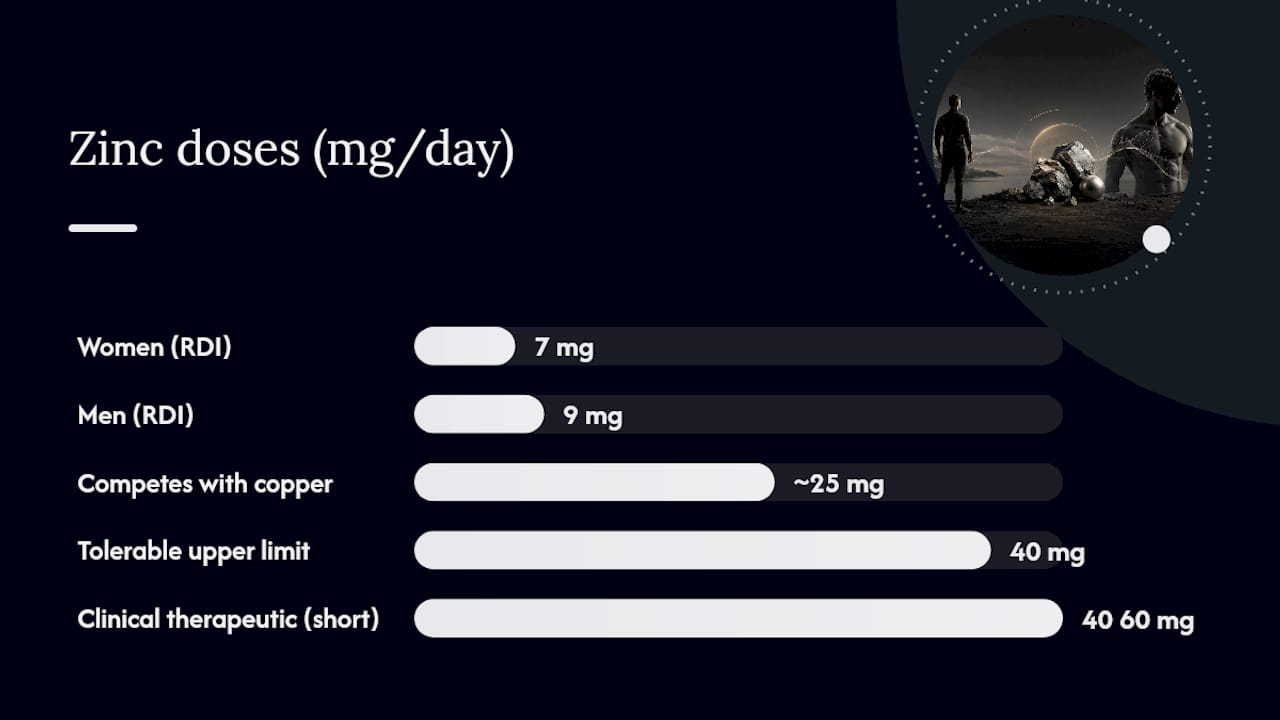
Clinical protocols in supervised settings have occasionally used higher short-term doses, roughly 40 to 50 mg of elemental zinc daily, to address hypogonadism or low sperm count. One study on medicinal zinc doses in male hypogonadism used 220 mg of zinc sulfate (about 50 mg elemental zinc) twice daily for one to four months under clinical supervision. That is a supervised therapeutic regimen, not a general recommendation, and it is not something to replicate on your own timeline.
A working safety framework:
- Choose chelated forms. Zinc bisglycinate and zinc picolinate absorb better and cause fewer GI side effects than zinc oxide, which is cheap but poorly bioavailable.
- Respect the copper relationship. Chronic zinc intake above roughly 25 mg per day competes with copper absorption; most clinical nutrition sources recommend adding around 2 mg of copper alongside sustained higher-dose zinc.
- Separate mineral doses. Avoid taking zinc simultaneously with iron or calcium supplements, since they compete for the same absorption pathways.
- Watch for excess signals. Nausea, altered immune response, and signs of copper deficiency (fatigue, anemia-like symptoms) indicate you have overshot your requirement.
The gap between a maintenance dose and a therapeutic dose is roughly fivefold, and that gap is exactly where unsupervised supplementation gets risky.
How to Test Before You Supplement
Test first. That is the entire premise of a precision approach to zink och androgener, and it separates men who make evidence-based decisions from men guessing based on a supplement label.
Order serum zinc alongside total and free testosterone, SHBG, and LH/FSH, understanding that serum zinc has real measurement limitations and should be read in context rather than in isolation. Men working through fertility questions should also discuss seminal zinc testing, since it has tracked more reliably with semen quality in the research than serum levels alone. For a fuller breakdown of what your free testosterone numbers actually mean, that's worth reading before you order labs.
Retest at 8 to 12 weeks. If numbers haven't moved and symptoms persist, escalate to a clinician rather than escalating the dose yourself.
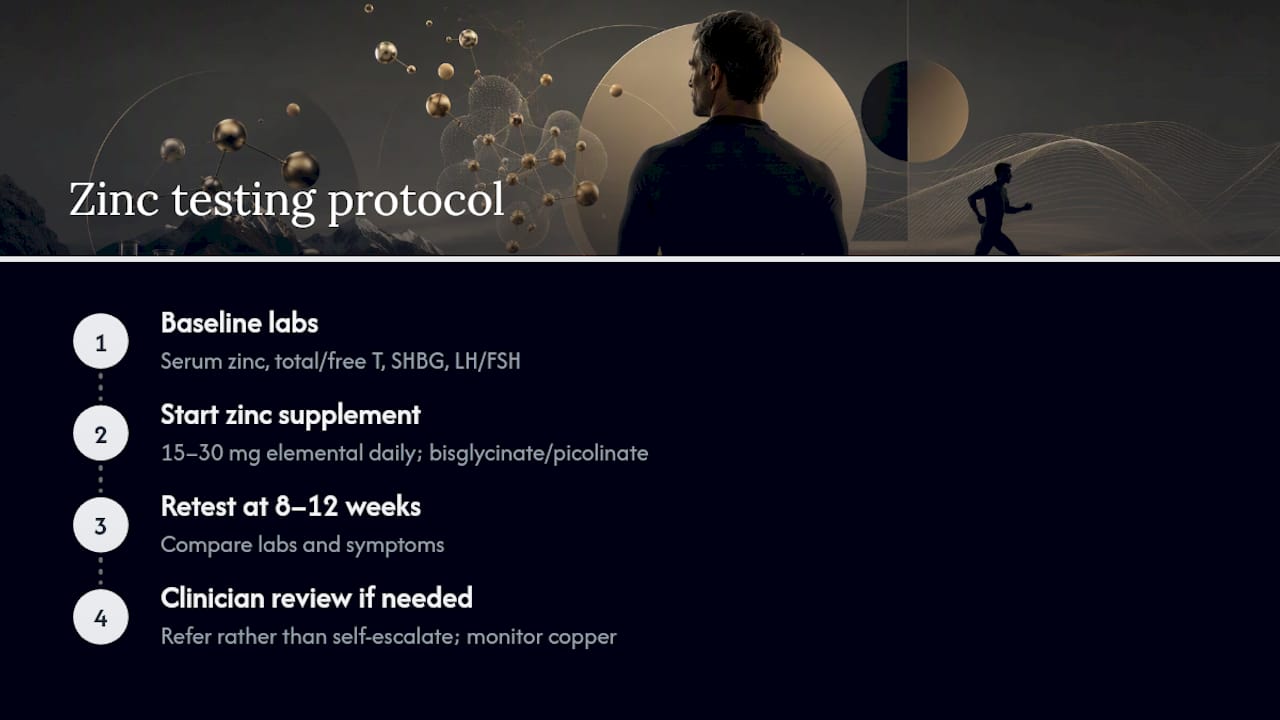
Pro Tip: A simple starting protocol looks like this: baseline labs, 15 to 30 mg elemental zinc daily in a bisglycinate or picolinate form, retest at 8 to 12 weeks, and add copper monitoring if you're on the higher end of that range for more than a few weeks.
Practical Rules for Performance-Focused Men
Discipline here means restraint, not aggression. The rules are simple:
- Test before you supplement. Guessing at deficiency wastes time and money.
- Correct deficiency deliberately. Do not chase a chronic megadose once labs normalize.
- Prefer chelated forms (bisglycinate, picolinate), respect the 40 mg UL, and add copper when your dose or duration calls for it.
- Treat zinc correction as one input in a broader vitality strategy, alongside training, sleep, and clinical assessment, not a standalone fix.
Zinc supplementation should be considered primarily when laboratory tests indicate deficiency. A disciplined approach involves testing first, individualizing the plan, and focusing on quality production rather than blanket claims. Our natural androgen support resource goes deeper into a test-first framework for men managing vitality over the long term. If your labs point toward a genuine gap, talk to a clinician, and consider a tailored performance strategy built around your actual numbers, not a generic protocol.
— Joakim
This article is general information, not a substitute for advice from a qualified doctor. Consult a qualified healthcare professional about your own circumstances before acting on anything here.
Sources
- Systematic review of seminal plasma zinc levels and reproductive outcomes (2025)
- Use of medicinal doses of zinc as a safe and efficient coadjutant in the treatment of male hypogonadism
- Can zinc treat low testosterone? — Healthline