Yes, alcohol can lower testosterone in men, and the effect scales with both dose and frequency. A single heavy drinking episode produces a measurable but temporary dip. Regular heavy drinking suppresses baseline production through liver, testicular, and brain pathways. For most disciplined men, occasional moderate drinking carries low hormonal risk. Regular heavy use is a different matter entirely, and much of the damage reverses once intake drops.
TL;DR:
- A single heavy drinking episode causes a temporary testosterone dip lasting 12 to 48 hours, but does not cause long-term effects in healthy men.
- Regular heavy drinking leads to persistent baseline testosterone suppression, disrupted hormone signaling, and testicular damage over time.
- Alcohol impairs testosterone production primarily by suppressing hypothalamic-pituitary signals and causing cellular damage to Leydig and Sertoli cells.
- Recovery of testosterone levels after heavy drinking varies, typically taking weeks after abstinence, with individual factors like age and health influencing the timeline.
- Monitoring hormone levels and timing alcohol consumption carefully can help mitigate the hormonal impacts, without requiring complete abstinence.
Table of Contents
- Alkohol Och Testosteron Män: What Acute and Chronic Drinking Actually Do
- How Alcohol Lowers Testosterone: The Biological Mechanisms
- How Much Alcohol and How Long Until Testosterone Recovers?
- The Real-World Cost: Libido, Fertility, and Training Recovery
- How to Check If Alcohol Is Affecting Your Testosterone
- Protecting Testosterone Without Giving Up Your Social Life
- What Performance-Minded Men Get Wrong About Alcohol and Hormones
- When an Adjunct Supplement Makes Sense
- Sources
Alkohol Och Testosteron Män: What Acute and Chronic Drinking Actually Do
The research on alkohol och testosteron män splits cleanly into two categories, and conflating them is where most casual reporting on this topic goes wrong.
Acute exposure studies, where subjects consume a large single dose of ethanol under controlled conditions, show transient reductions in serum testosterone. Some protocols report transient drops in serum testosterone lasting roughly 12 to 48 hours after intake, based on secondary reporting of controlled dosing studies. That's a real hormonal disruption, but it's also short-lived in men without underlying liver or endocrine issues.
Chronic heavy use tells a different story. Sustained alcohol exposure is linked to consistently lower baseline testosterone, disrupted LH and FSH signaling from the pituitary, and measurable testicular dysfunction over time, according to a comprehensive review of alcohol's effects on male reproductive function.
A few things worth remembering when you read headlines on this subject:
- Lab dosing protocols don't map perfectly onto habitual weekend drinking patterns, so treat acute-study percentages as directional, not diagnostic for your own body.
- Population differences matter. Age, baseline liver function, and body composition all shift how a given man responds to the same alcohol load.
- Most acute-study designs measure hours, not weeks, so they tell you little about what happens after years of regular heavy intake.
The honest takeaway: a single night of heavy drinking is not the same biological event as ten years of it. Your body treats them very differently.
How Alcohol Lowers Testosterone: The Biological Mechanisms
Alcohol doesn't attack testosterone directly. It disrupts the systems that produce and regulate it, and it does so on multiple fronts simultaneously.
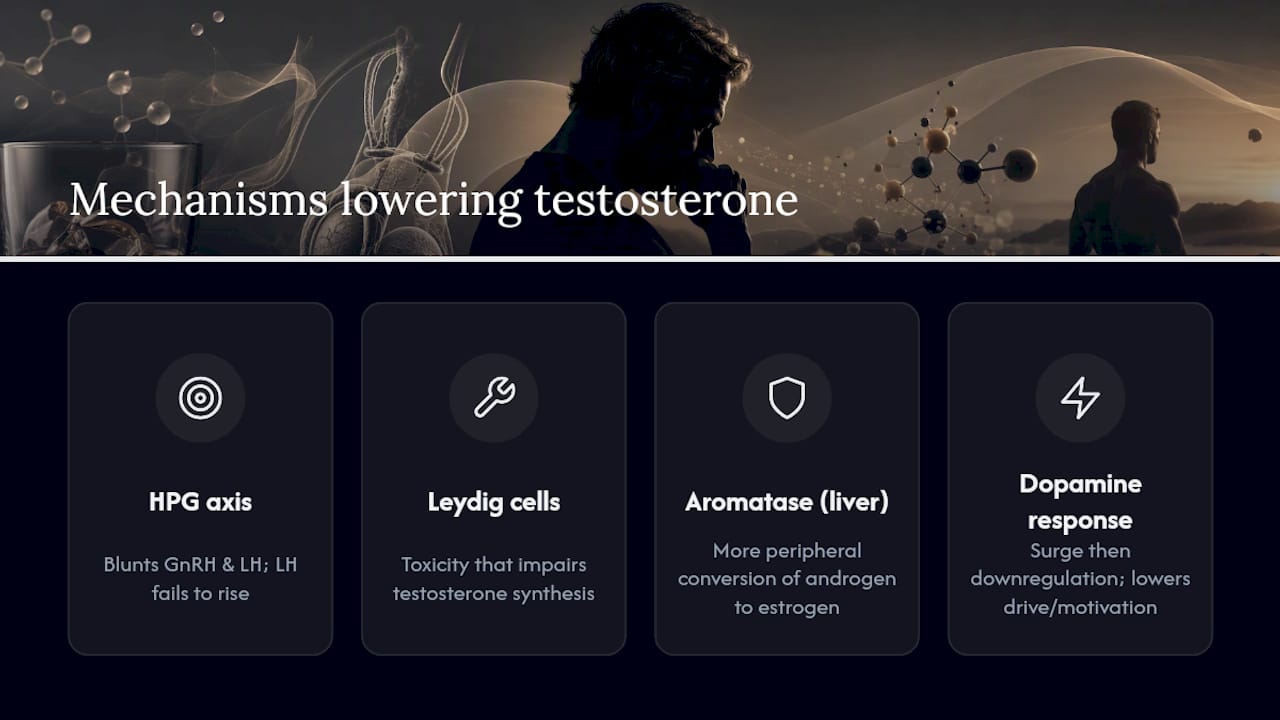
The first target is the hypothalamic-pituitary-gonadal (HPG) axis, the signaling chain that tells your testes to produce testosterone in the first place. Alcohol can blunt GnRH and LH secretion from the brain, which reduces the stimulation your testes receive. Some studies show a particularly telling pattern here: LH fails to rise in response to low testosterone the way it normally should, which points to central suppression at the pituitary or hypothalamic level rather than a purely testicular problem.
Direct cellular damage compounds the issue. Sustained heavy exposure is associated with Leydig cell toxicity, which impairs testosterone synthesis at the source, and Sertoli cell damage, which interferes with sperm maturation.
The liver's trade-off: Because your liver prioritizes ethanol metabolism above nearly everything else, peripheral aromatase activity rises, converting more androgen into estrogen and shifting your hormonal balance before any lab test would flag liver disease.
The neuroendocrine layer adds a final complication. Alcohol triggers a dopamine surge in reward circuits, producing short-term reinforcement that fades into dopaminergic downregulation, a shift linked to hangover-related low motivation and to longer-term changes in drive and behavior.
How Much Alcohol and How Long Until Testosterone Recovers?
Dose and timing determine whether alcohol's effect on your hormones is a footnote or a real problem. The distinction that matters isn't "do you drink," it's "how much, how often, and for how long."
- A single large dose (protocols equivalent to several standard drinks consumed in one sitting) has produced testosterone drops in controlled studies, recovering within roughly a day or two in healthy men.
- Regular moderate drinking, spread across the week with alcohol-free days built in, shows far less consistent hormonal disruption in the available evidence.
- Sustained heavy drinking, month after month, is where the picture changes: baseline suppression becomes persistent, and recovery timelines stretch out.
- Recovery from short-term abstinence often shows measurable hormone and fertility improvement within weeks, based on clinical reports on abstinence-linked hormone recovery, though severity and duration of prior use shift that timeline considerably.
Individual variation is real. Age, body composition, baseline liver health, and any medications you're on all change your sensitivity to the same alcohol load. A lean, healthy 42 year old and a 58 year old with early fatty liver changes will not respond identically to the same six drinks.
Pro Tip: If you're planning a morning testosterone test, treat the prior 48 hours as sacred. A single heavy session two nights before the draw can skew your result and send you chasing a problem that doesn't exist.
The Real-World Cost: Libido, Fertility, and Training Recovery
Hormone numbers matter because of what they translate to. This is where alcohol's effect on testosterone stops being a lab value and starts showing up in your life.
- Sexual function takes the first hit. Hangover physiology reduces blood flow and motivation simultaneously, and the dopaminergic downregulation described earlier compounds the effect on drive and erection quality the following day.
- Fertility markers decline with chronic heavy use. Lower sperm count and abnormal morphology are documented outcomes of sustained heavy drinking, tied to the Sertoli cell damage covered above.
- Training recovery suffers directly. Alcohol reduces muscle protein synthesis and interferes with recovery signaling pathways like mTOR, meaning a heavy drinking session near a hard training block works against the adaptation you're trying to build, a point sport-science reviews consistently make.
None of this requires abstinence to manage. It requires sequencing.
How to Check If Alcohol Is Affecting Your Testosterone
Symptoms alone won't give you an answer, because low libido, low energy, mood shifts, and lost muscle mass overlap with a dozen other causes, from poor sleep to thyroid issues to simple overtraining. Testing is the only way to know what's actually happening.
- Get a morning total testosterone reading on at least two separate occasions. A single blood draw, especially an afternoon one, is unreliable given normal circadian swings.
- Ask for free testosterone alongside total. SHBG levels can mask a real problem if you only look at the total number.
- Request LH and FSH. These values tell you whether the issue originates in the testes or further up the HPG axis, which changes the entire clinical picture.
- Include a liver panel. Given how central liver function is to androgen metabolism, this is not optional if alcohol is part of your history.
- Interpret every result in clinical context, not against a generic online chart. Age, medications, and comorbidities all shift what "normal" means for you specifically.
See a clinician if your labs are consistently abnormal across repeat testing, if symptoms are severe, or if you notice any of the following red flags: gynecomastia, testicular shrinkage, or a sudden, unexplained fertility problem. These warrant evaluation, not guesswork. For a deeper look at when supplementation is and isn't warranted, testosterone health and vitality is worth reading before you draw conclusions from a single number.
Pro Tip: Don't test the week after a business trip, a holiday, or a heavy social stretch. You'll get a real number, just not the one that reflects your baseline.
Protecting Testosterone Without Giving Up Your Social Life
You don't need to quit drinking to protect your hormones. You need rules that hold under pressure.
- Set a weekly limit and enforce genuine alcohol-free days, not just lighter ones.
- Avoid heavy drinking within 24 to 48 hours of a key training session or a scheduled testosterone test.
- Prioritize resistance training, adequate protein, and 7 to 9 hours of sleep, the same pillars covered in a broader resilience and performance strategy.
- Reduce body fat where it's elevated. Excess adipose tissue increases aromatization independent of alcohol intake.
- Run a focused 3 to 8 week reduction protocol, then retest. Most men see measurable movement in that window.
Pro Tip: Track the behavior, not just the outcome. Log drinks per week for a month before you touch your training or diet. Most men are surprised by the actual number.
What Performance-Minded Men Get Wrong About Alcohol and Hormones
Most men treat alcohol as a binary: either you drink or you're disciplined. That framing misses the point entirely. Testosterone isn't a switch alcohol flips; it's a system alcohol nudges, repeatedly, until the nudges compound into a trend. The men who protect their hormone profile longest aren't the ones who abstain out of fear. They're the ones who track the variable, the same way they'd track a KPI, and correct course before symptoms force the issue. A plant-based approach to serum testosterone support can complement that discipline, but it never replaces it. No supplement outworks a poor sleep pattern or a habit of heavy weekend drinking, and Stefan Arver's caution against treating testosterone therapy as a substitute for lifestyle correction applies just as much to over-the-counter products as it does to prescriptions.
— Joakim
When an Adjunct Supplement Makes Sense
If you've already tightened alcohol intake, fixed your sleep, and kept training consistent, and your numbers or your sense of drive still lag, that's the point where an adjunct earns consideration, not before. Viridos is built for exactly that stage: a plant-derived, precision oral spray delivered sublingually, formulated in small batches in Sweden, and made available through a controlled membership rather than mass retail. It's designed to support drive, clarity, and strength alongside the fundamentals, never in place of them.

Supplementation without the behavioral groundwork is a wasted spend. But once alcohol, sleep, and training are genuinely in order and you want additional support for sustained performance, the longevity and performance strategy behind Viridos is worth a closer look. Membership is limited by design, small-batch production out of Sweden, so review the criteria and apply when you're ready to see if it fits your situation.
Sources
For readers who want the primary sources: the PMC review on alcohol and male reproductive function, the dopamine and alcohol reinforcement literature, and Karolinska's commentary on testosterone myths form the clinical backbone of this article. For broader systemic context, bone health and alcohol is a useful companion read.
This article is general information, not a substitute for advice from a qualified doctor. Consult a qualified healthcare professional about your own circumstances before acting on anything here.
- Alcohol’s effects on male reproductive function (review) — PMC6761906
- Dopaminergic signaling and alcohol reinforcement — PMC6826820
- Karolinska commentary and reviews on testosterone myths — PubMed 19852166