
Androgen receptor sensitivity is the tissue-level throttle that determines how effectively your body uses testosterone and DHT. It often explains fatigue, poor recovery, or flat drive when a standard blood panel looks normal. Receptor responsiveness, not just hormone volume, governs how strength, energy, and clarity actually show up. Understanding it means knowing what to test, what you can influence, and when a clinician needs to get involved.
TL;DR:
- Receptor sensitivity varies with genetic factors like CAG repeat length and can significantly impact tissue response to testosterone, even with normal blood levels.
- Combining CAG repeat length with free and total testosterone ratios improves diagnosis of androgen-related symptoms beyond measurement of hormone levels alone.
- Metabolic health, sleep, and lifestyle choices influence receptor function by affecting downstream signaling pathways, offering modifiable targets for improving response.
- Genetic testing is a secondary tool, used alongside hormone panels and functional tests like the SHBG suppression test, with the latter indicating receptor responsiveness.
- Prioritize improving metabolic and recovery factors before considering genetic or molecular testing for receptor sensitivity issues.
Table of Contents
- What Androgen Receptor Sensitivity Actually Means
- Why a Normal Testosterone Number Doesn't Guarantee Normal Function
- How Clinicians Measure or Infer Receptor Responsiveness
- What Changes Receptor Sensitivity Over Time
- A Disciplined Protocol for Men Who Suspect a Receptor Problem
- The Overlooked Variable in Executive Performance
- Sources
- FAQ
What Androgen Receptor Sensitivity Actually Means
Testosterone and DHT do nothing on their own. They need to bind to the androgen receptor (AR), a protein inside your cells that acts as a switch for gene expression. Once testosterone or DHT locks onto the AR, the receptor moves into the cell nucleus and activates or suppresses specific genes, the ones governing muscle protein synthesis, fat distribution, red blood cell production, and mood regulation. This is the actual mechanism behind androgen signaling, and it explains why two men with identical testosterone levels can experience completely different results in the gym and in the boardroom.

The AR gene contains a stretch of repeated genetic code called the CAG repeat sequence. Shorter repeat counts generally produce a more responsive receptor; longer counts produce a less responsive one. Most men fall in a normal range, and small differences within that range rarely cause problems on their own.
At the far clinical extreme sits androgen insensitivity syndrome (AIS), where receptor mutations blunt or eliminate the AR's ability to respond to androgens at all, producing a defined clinical spectrum that requires molecular diagnosis, according to a comprehensive review of androgen physiology.
- AR sensitivity determines how much biological effect a given testosterone level produces
- CAG repeat length is one genetic driver of receptor responsiveness
- AIS represents the rare, severe end of a spectrum that otherwise varies continuously in the general population
Why a Normal Testosterone Number Doesn't Guarantee Normal Function
A man can post a "normal" total testosterone result and still feel the symptoms of low androgen signaling: flat energy, sluggish recovery, diminished drive. Receptor sensitivity is frequently the missing variable, and the diagnostic implications matter for anyone making decisions based on a single lab value.
Combining CAG repeat length with testosterone fractions, specifically free testosterone to CAG ratios (FT:CAG) and total testosterone to CAG ratios (TT:CAG), produces a stronger correlation with hypogonadal symptoms than testosterone measurements alone, according to a clinical review on refining hypogonadism diagnosis. An exploratory study behind that review found these combined ratios outperformed total testosterone or bioavailable testosterone on their own when predicting who actually had symptoms.
CAG repeat length links to more than symptoms. A long-term cohort study found each unit increase in CAG repeat count was associated with roughly 0.1% higher HbA1c at follow-up, along with a U-shaped relationship between CAG length and mortality in men with type 2 diabetes, according to research from the University of Manchester.
That U-shaped curve is worth sitting with. It means there is no simple "more sensitive is better" rule. Both extremes carry risk, and optimal function tends to sit in a mid-range rather than at either pole.
- Testosterone alone predicts symptoms poorly in isolation
- FT:CAG and TT:CAG ratios sharpen diagnostic accuracy
- Receptor sensitivity connects to metabolic outcomes, not just libido or muscle
A man with mid-normal testosterone and a long CAG repeat count may be functionally under-androgenized, even though his lab report looks unremarkable. That mismatch is exactly why executives with demanding physical and cognitive schedules should not treat a single testosterone number as the final word.
How Clinicians Measure or Infer Receptor Responsiveness
No single test fully captures AR sensitivity, so clinicians typically combine genetic, functional, and hormonal data.
- Genetic CAG repeat testing. A blood or saliva sample determines the number of CAG repeats in the AR gene. This gives a fixed, lifelong data point, but it does not by itself diagnose a problem. It is a modifier, not a verdict, and interpretation depends heavily on clinical context.
- The stanozolol SHBG-suppression test. A short course of the synthetic androgen stanozolol normally suppresses sex hormone-binding globulin (SHBG) by approximately 45 to 55% in men with normal AR function, according to historical clinical research. A blunted or absent drop signals impaired AR-mediated feedback, the kind seen in androgen insensitivity. This functional test requires specialist administration and monitoring.
- Standard hormone panels. Total testosterone, free testosterone, SHBG, and LH give the hormonal backdrop against which receptor data gets interpreted. None of these values means much without the other pieces.
Timing matters. Morning blood draws, consistent assay methods, and awareness of recent illness, sleep debt, or heavy training all affect the numbers, sometimes more than receptor variation itself.
Pro Tip: Genetic CAG testing is rarely a first step. Clinicians generally reserve it for men whose symptoms clearly conflict with their standard labs, such as clear fatigue or low libido paired with a mid-normal testosterone reading.
What Changes Receptor Sensitivity Over Time
Some influences on AR responsiveness are fixed at birth. Others respond directly to how you live.
Non-modifiable factors include your baseline CAG and GGN repeat lengths and any rare AR mutations along the androgen insensitivity spectrum. These are set by genetics and do not change with diet or training.
Metabolic and inflammatory conditions shift receptor function in ways that are very much within your control. Insulin resistance, visceral obesity, and chronic low-grade inflammation all interfere with the downstream signaling pathways, including the PI3K/AKT/mTOR axis, that determine whether androgen binding actually translates into a cellular response, according to a review of hormone receptor signaling. A receptor can bind testosterone perfectly well and still fail to produce the downstream effect if the metabolic environment around it is compromised.
Drugs and competing steroids matter too. Endocrine therapies, exogenous anabolic steroids, and some glucocorticoid medications alter receptor availability or the mix of circulating steroid intermediates that compete for AR binding. Research on AR mutations in prostate cancer has shown that specific receptor variants can even be activated by steroid intermediates that would normally have little effect, illustrating how dynamic this system is rather than fixed.
- CAG and GGN repeat length: genetic, not modifiable
- Insulin resistance and visceral fat: highly modifiable, directly affects downstream signaling
- Chronic sleep deprivation, smoking, and heavy alcohol use: degrade receptor environment over time
- Resistance training and metabolic control: among the most reliable levers available to improve the signaling environment
A Disciplined Protocol for Men Who Suspect a Receptor Problem
Start with sequence, not speculation. Before any genetic testing, get a morning total and free testosterone, SHBG, and LH panel, reviewed by a clinician who understands the difference between a hormone problem and a receptor problem. Genetic CAG testing is a second-line tool, useful when your symptoms and your labs disagree, not a first move.
While you wait on results, work the variables you actually control. Resistance training three to four times weekly, adequate protein distributed across the day, and seven or more hours of consistent sleep do more to support the AR signaling environment than any single supplement. Managing visceral fat and insulin sensitivity is not a side project. It is central to whether your receptors respond at all.
Plant-derived compounds, including phytoandrogens, are reasonable adjuncts to discuss with a clinician once the fundamentals are in place. Treat any supplement claim with appropriate skepticism, and never substitute it for the priority sequence above. For men who want a deeper technical grounding, Viridos maintains detailed guides on free testosterone interpretation and a zinc and androgen protocol worth reviewing before your next appointment.
- Test first: morning hormone panel, reviewed by a clinician, before genetic testing
- Fix the environment: training, protein, sleep, and metabolic control come before any adjunct
- Escalate deliberately: CAG testing and functional tests belong to specialists, not self-diagnosis
The Overlooked Variable in Executive Performance
Most performance advice for men fixates on raising testosterone, more injections, more supplements, more aggressive dosing. The research tells a different story. Receptor sensitivity, not raw hormone volume, decides whether that testosterone does anything useful at the tissue level. An executive chasing a higher number on a lab report while ignoring visceral fat, sleep debt, and chronic stress is optimizing the wrong variable.
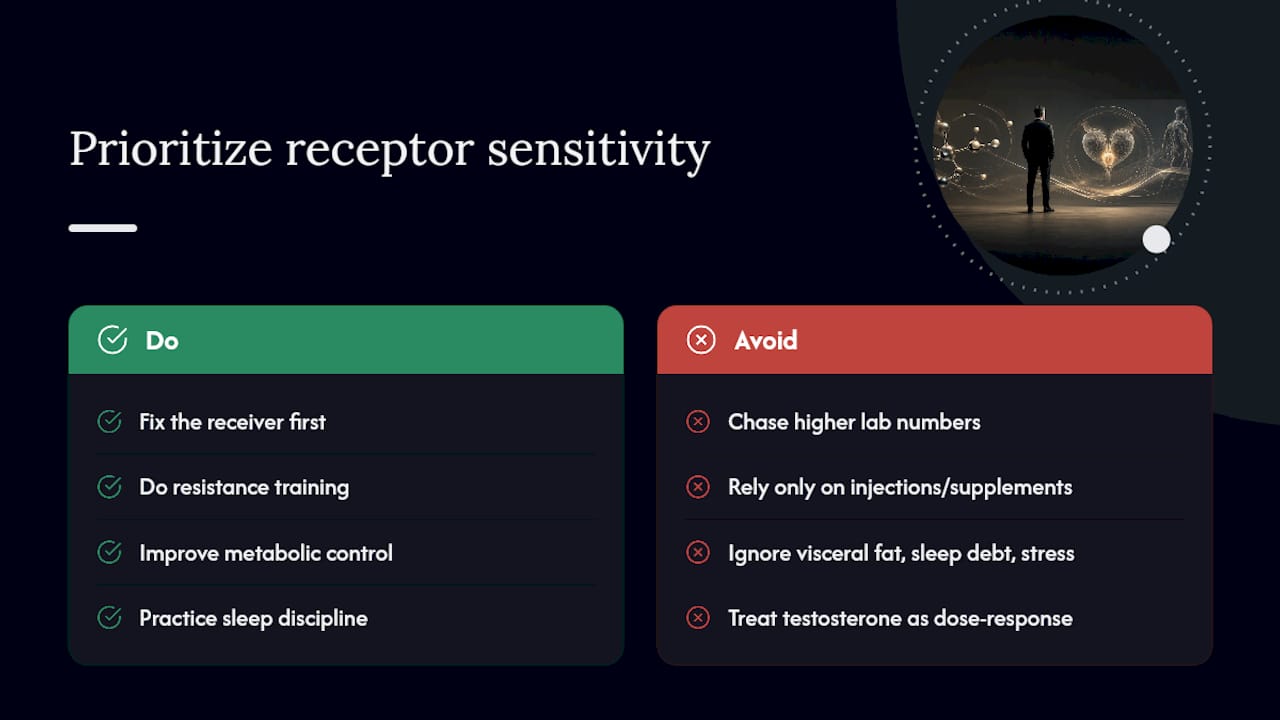
The conventional advice falls short because it treats testosterone as a dose-response drug rather than a signal that requires a functioning receiver. Fix the receiver first. Resistance training, metabolic control, and sleep discipline change the signaling environment in ways a prescription alone cannot. Genetic and functional testing have real value, but only after the fundamentals are addressed and only when a clinician is involved in the decision.
Prioritize the boring work: metabolic health, recovery discipline, and honest tracking of how you actually feel and perform, not just what a single number says. That is where the real leverage sits, and it is available starting today, without waiting on a lab result.
— Joakim
This article is general information, not a substitute for advice from a qualified doctor. Consult a qualified healthcare professional about your own circumstances before acting on anything here.
Sources
- Clinical use of the androgen receptor sensitivity CAG repeat polymorphism to refine and improve the diagnosis of male hypogonadism - PMC
- PubMed: Clinical assessment using stanozolol SHBG suppression (historical study)
- Androgen receptor-reduced sensitivity is associated with increased mortality and poorer glycaemia in men with type 2 diabetes mellitus - Research Explorer The University of Manchester
- Endotext: Androgen physiology: receptor and metabolic disorders
FAQ
What is androgen receptor sensitivity?
Androgen receptor sensitivity is how effectively your cells respond to testosterone and DHT once those hormones bind to the androgen receptor. It depends on genetic factors like CAG repeat length and on your metabolic and inflammatory state, according to a review of hormone receptor signaling.
Can you have normal testosterone but low receptor sensitivity?
Yes. Combining testosterone levels with CAG repeat data through ratios like FT:CAG improves symptom correlation compared with testosterone alone, according to a clinical review on hypogonadism diagnosis. This explains why some men feel symptomatic despite a normal lab report.
How do doctors test for androgen receptor sensitivity?
Clinicians typically use genetic CAG repeat testing alongside standard hormone panels, and sometimes a functional stanozolol SHBG-suppression test, which normally lowers SHBG by about 45 to 55% in men with typical receptor function, according to historical clinical research.
Can lifestyle changes improve receptor sensitivity?
Lifestyle changes cannot alter your genetic CAG repeat length, but they can improve the metabolic and inflammatory environment that determines whether receptor signaling functions well. Resistance training, sleep, and insulin sensitivity are among the most reliable levers available.
Is a longer CAG repeat count always bad?
Not necessarily. Research shows a U-shaped relationship between CAG repeat length and long-term outcomes like mortality, meaning both very short and very long repeat counts carry risk, according to cohort research from the University of Manchester. Mid-range sensitivity appears most favorable.