
An ergogenic aid is any substance, technique, or device used to enhance physical performance, endurance, or recovery — a definition spanning five distinct categories from nutrition to psychology. Of all the options studied in human trials, caffeine and creatine monohydrate have the most consistent, replicated evidence across multiple performance domains. β-alanine, dietary nitrates (beetroot juice), sodium bicarbonate, and glycerol each show meaningful ergogenic effects in specific contexts. Before trialing any of these, confirm the product carries third-party batch certification, and never debut a new protocol on competition day. WADA maintains a current prohibited-substance list; EFSA governs health-claim approvals in Europe. Check both before purchasing.
Key Takeaways
Caffeine and creatine monohydrate have the strongest, most replicated evidence of any legal ergogenic aids, and both are WADA-permitted and EFSA health-claim approved — making them the rational starting point for any disciplined performance protocol.
| Point | Details |
|---|---|
| Caffeine and creatine lead the evidence | Both have consistent human trial support across endurance, strength, and power; dose caffeine at 3–6 mg/kg, 30–60 min pre-exercise. |
| β-alanine, nitrates, NaHCO3, glycerol follow | Each shows positive effects in specific contexts; match the aid to your sport type and event duration before committing. |
| Third-party certification is non-negotiable | Use NSF Certified for Sport or Informed Sport products; keep batch records to protect against inadvertent doping. |
| Trial in training, measure objectively | Introduce one aid at a time during training, track objective performance metrics, and apply a clear stopping rule for adverse effects. |
| Viridos supports long-term performance | The Viridos plant-derived oral spray targets sustained drive and metabolic resilience — a complement to, not a replacement for, evidence-based acute aids. |
Table of Contents
- How ergogenic aids are classified
- The ergogenic aids with the strongest human evidence
- How these substances actually work in the body
- Safety, regulation, and anti-doping: what you need to know
- How to trial an ergogenic aid responsibly
- Supplements with limited or mixed evidence
- How Viridos evaluates ergogenic claims
- The discipline of evidence-first performance
- Viridos and the long-term performance equation
- Sources
How ergogenic aids are classified
Ergogenic aids fall into five categories, and understanding the taxonomy matters because evidence quality and regulatory risk differ sharply across them.
- Nutritional: Substances consumed to supply or augment a physiological substrate. Creatine monohydrate is the clearest example — a compound the body produces naturally, supplemented to expand phosphocreatine stores.
- Pharmacological: Drugs or drug-like compounds that alter physiology beyond normal dietary intake. Stimulants (amphetamines, certain β-agonists) belong here, as does erythropoietin (EPO). Regulatory and anti-doping risk is highest in this category.
- Physiological: Techniques that manipulate the body's own systems, such as blood doping, altitude training, or heat acclimatization. These carry medical risk and, in some forms, WADA prohibition.
- Mechanical: Equipment and biomechanical tools — carbon-fiber running plates, altitude tents, compression garments. Evidence is often device-specific and context-dependent; regulatory risk is generally low.
- Psychological: Mental performance techniques including visualization, arousal regulation, and attentional focus strategies. These are legal, carry no contamination risk, and are underused by most athletes.
The practical implication: nutritional and psychological aids offer the most accessible risk-to-benefit ratio for disciplined men who want measurable gains without anti-doping exposure. Pharmacological and physiological aids demand medical supervision and, in many cases, are simply off the table for competitive athletes.
The ergogenic aids with the strongest human evidence
Six substances have enough replicated human trial data to justify serious consideration. The NIH Office of Dietary Supplements and Harvard Health both identify creatine and caffeine as the supplements most likely to deliver real performance benefits. β-alanine, dietary nitrates, sodium bicarbonate, and glycerol follow with solid but more context-dependent evidence.
Caffeine
Caffeine works primarily through adenosine-receptor antagonism in the central nervous system, reducing perceived exertion and delaying fatigue onset. Population-level guidance places the effective pre-exercise dose at roughly 3–6 mg/kg body weight, consumed 30–60 minutes before activity. For a 90 kg man, that translates to approximately 270–540 mg. Benefits are documented across endurance events, high-intensity intermittent sport, and some strength tasks. Side effects at higher doses include tachycardia, anxiety, GI distress, and disrupted sleep — the last of which can erode the very recovery you are trying to protect. Caffeine is permitted by WADA.
Creatine monohydrate
Creatine is among the most thoroughly studied ergogenic substances in sports nutrition, with consistent positive effects in strength, power, and repeated-sprint contexts. It works by expanding the phosphocreatine pool, accelerating ATP resynthesis during high-intensity efforts. A standard loading protocol uses 20 g/day in four divided doses for 5–7 days, followed by a maintenance dose of 3–5 g/day. Loading is optional; a lower daily dose of 3–5 g achieves saturation over 3–4 weeks. Creatine also has documented benefits for bone health when combined with resistance loading. Minor weight gain from water retention is common; GI discomfort is reduced by splitting doses. WADA-permitted.

β-alanine
β-alanine raises muscle carnosine concentrations over several weeks, increasing the intracellular buffering capacity for hydrogen ions produced during high-intensity exercise. The result is a delay in the acidosis-related fatigue that limits efforts lasting roughly 1–4 minutes. Effective dosing in studies is 4–6 g/day, divided across the day to minimize paresthesia (a harmless but noticeable tingling sensation). Benefits are most pronounced in sports with sustained high-intensity intervals: rowing, swimming, cycling time trials, and combat sports. Position statements and systematic reviews confirm positive ergogenic effects in these specific contexts, while noting that evidence for longer endurance events is less consistent.
Dietary nitrates (beetroot juice)
Dietary nitrate, most commonly delivered via concentrated beetroot juice, follows an entero-salivary conversion pathway: nitrate → nitrite → nitric oxide. Nitric oxide mediates vasodilation and reduces the oxygen cost of submaximal exercise, meaning you can sustain a given power output with less metabolic strain. Research supports doses delivering at least 300 mg of nitrate equivalents, consumed 2–3 hours before exercise to allow peak nitrite conversion. Benefits are clearest in recreational-to-moderately-trained athletes performing endurance or intermittent exercise; highly trained athletes show smaller and less consistent effects. GI sensitivity is the main side effect; beeturia (pink urine) is harmless.
Sodium bicarbonate (NaHCO3)
Sodium bicarbonate acts as an extracellular buffer, raising blood pH and increasing the gradient for hydrogen-ion efflux from working muscle. The ergogenic window is similar to β-alanine: high-intensity efforts of 1–7 minutes. Acute dosing of 0.2–0.3 g/kg body weight, taken 60–90 minutes before exercise, is the most studied protocol. A split-dose approach (smaller doses over 2–3 hours) reduces the significant GI side effects — nausea, cramping, and diarrhea — that limit compliance. Sodium bicarbonate is WADA-permitted and inexpensive, but GI tolerance testing in training is non-negotiable before any competitive use.
Glycerol
Glycerol supports hyperhydration when co-ingested with a large fluid volume (typically 1.2 g/kg glycerol with 26 mL/kg water) before exercise in hot or humid conditions. It increases total body water retention, delaying dehydration-related performance decrements. The primary benefit is in prolonged endurance events where fluid access is limited. Glycerol was previously banned by WADA but was removed from the prohibited list in 2018 and is currently permitted. Note that some jurisdictions and sports organizations may have their own rules; always verify current status. Bloating and headache are reported side effects.
Evidence and dosing at a glance:
A 2025 systematic review confirms that caffeine and creatine have the strongest and most consistent evidence, while β-alanine, nitrates, sodium bicarbonate, and glycerol show positive effects in specific contexts, despite regulatory and labeling inconsistencies across markets.
How these substances actually work in the body
Understanding the mechanism tells you which sport scenario an aid fits and when to take it. The physiology is not complicated once you strip it to first principles.
- Creatine → ATP/phosphocreatine: Creatine phosphorylates ADP back to ATP during maximal efforts lasting under 10 seconds. Expanding the phosphocreatine pool means more high-intensity work before that system is depleted.
- Caffeine → CNS adenosine antagonism: Adenosine accumulates during exercise and signals fatigue to the brain. Caffeine blocks adenosine receptors, reducing perceived exertion and sustaining motor drive longer.
- Dietary nitrates → nitric oxide → vasodilation: The entero-salivary pathway converts ingested nitrate to nitrite via oral bacteria, then to nitric oxide in hypoxic muscle tissue. Nitric oxide dilates blood vessels and reduces the ATP cost of muscle contraction, improving exercise economy.
- β-alanine → carnosine → intracellular buffering: β-alanine is the rate-limiting precursor to carnosine synthesis in muscle. Elevated carnosine buffers hydrogen ions produced during anaerobic glycolysis, delaying the pH drop that impairs contractile function.
- Sodium bicarbonate → extracellular buffering: NaHCO3 raises blood bicarbonate, creating a steeper gradient for H+ to exit working muscle cells. The effect is complementary to β-alanine's intracellular action.
- Glycerol → osmotic fluid retention: Glycerol is an osmotically active molecule. When consumed with a large fluid load, it increases plasma volume and total body water, reducing cardiovascular strain during prolonged exercise in heat.
Placebo effects are real and measurable in performance research. Blinded trials consistently show that athletes who believe they have taken an ergogenic substance perform better, even on inert compounds. This does not invalidate the pharmacological evidence for caffeine or creatine, but it does mean that subjective performance logs alone cannot confirm an aid is working. Objective metrics — power output, time-trial results, force production — are the only reliable signal.
Pro Tip: Match the timing of an acute aid to its mechanism. Nitrate requires 2–3 hours for entero-salivary conversion to peak nitrite levels; caffeine peaks in plasma at roughly 30–60 minutes. Taking both at the same time means one of them will be mistimed.
Safety, regulation, and anti-doping: what you need to know
The Mayo Clinic is direct on this: many performance-enhancing substances carry significant health risks, and supplement markets in most countries lack the regulatory oversight applied to pharmaceuticals. That gap creates two distinct problems — health risk and inadvertent doping.
Health risk categories
- Cardiovascular: Stimulants at high doses raise heart rate and blood pressure. Men with pre-existing cardiac conditions should seek medical clearance before using caffeine at the upper end of the ergogenic range.
- GI: Sodium bicarbonate and high-dose creatine loading both carry GI side effects. Split dosing reduces but does not eliminate the risk.
- Hormonal: Pharmacological agents targeting androgen pathways carry serious endocrine disruption risk. This category is WADA-prohibited and medically supervised territory.
- Neuropsychiatric: High-dose caffeine and stimulant compounds can produce anxiety, insomnia, and dependency patterns that degrade long-term performance.
Contamination and inadvertent doping
Supplement contamination is not a theoretical concern. Undeclared anabolic agents, stimulants, and diuretics have been found in products marketed as legal sports nutrition. The Mayo Clinic guidance and broader clinical consensus recommend a structured approach to contamination risk:
- Choose third-party certified products. Certification programs such as NSF Certified for Sport, Informed Sport, and BSCG test for WADA-prohibited substances at the batch level. Certification does not guarantee purity, but it substantially reduces risk.
- Prefer single-ingredient formulations. Proprietary blends obscure individual ingredient doses and increase the surface area for undeclared additions.
- Keep batch records. Note the product name, lot number, and purchase date for every supplement you use. If a positive test occurs, batch records are the first line of defense.
- Verify WADA status before purchase. The WADA prohibited list is updated annually. An ingredient legal last year may not be legal today.
- Consult a sports medicine physician. Particularly for any substance with cardiovascular or hormonal implications.
Regulatory labeling: FDA vs. EFSA
In the United States, dietary supplements are regulated under DSHEA — manufacturers do not require pre-market approval, and health claims are the manufacturer's responsibility to substantiate. In the EU, EFSA evaluates health claims before they can appear on labels. Only caffeine and creatine currently hold EFSA-approved health claims relevant to physical performance. That regulatory asymmetry means a product sold legally in the US with bold performance claims may carry no approved claim in Europe — and vice versa. Read labels with that context in mind.
How to trial an ergogenic aid responsibly
The decision to add a performance-enhancing supplement to your protocol should follow the same logic you apply to any high-stakes decision: baseline first, hypothesis second, measure objectively, and have a stopping rule.
The decision sequence
- Optimize diet and training first. A well-balanced diet supplies the micronutrients most athletes need. Supplementation on top of a poor nutritional foundation produces marginal returns. Consult the role of nutrition in performance before adding any ergogenic substance.
- Identify the targeted outcome. Is the goal power output, endurance capacity, or recovery speed? Match the aid to the mechanism that addresses that specific gap.
- Check the evidence tier. Meta-analyses and replicated RCTs outweigh single studies and manufacturer-funded trials. Confirm the evidence applies to your training status and sport type.
- Screen for contraindications. Cardiovascular conditions, GI sensitivity, and medication interactions all require medical review before starting.
- Select a certified product. Third-party tested, single-ingredient, with a verifiable batch number.
- Plan the trial in training, not competition. Never introduce a new protocol on race day or during a high-stakes performance window.
Trial protocol
- Pre-trial baseline: Record relevant performance metrics (time-trial result, maximum reps, power output), body weight, resting blood pressure, and a subjective log of energy, mood, and GI status.
- Loading vs. acute aids: Creatine and β-alanine require multi-week loading before effects are measurable. Caffeine, nitrates, and sodium bicarbonate are acute; effects appear within hours of a single dose.
- Objective measurement: Repeat the same performance test under the same conditions at the end of the trial period. Subjective "feeling better" is not sufficient evidence.
- Stopping rules: Discontinue if you experience persistent GI distress, cardiovascular symptoms, sleep disruption lasting more than 3 nights, or any adverse effect that impairs daily function.
- Periodize supplement use. Align acute aids with high-priority training blocks and competitions. Continuous year-round use of every aid simultaneously makes it impossible to attribute effects to any single compound.
For pre/post-exercise nutrition timing that complements supplement use, a runner's guide to fueling offers practical macronutrient guidance applicable across endurance disciplines.
Supplements with limited or mixed evidence
These compounds appear frequently in sports nutrition discussions. The mechanistic rationale for most is sound; the human trial evidence is less so.
BCAAs (branched-chain amino acids): Proposed to reduce exercise-induced muscle protein breakdown and central fatigue. Human evidence shows modest benefit for muscle soreness in untrained individuals; effects in trained men meeting daily protein targets are minimal. Typical study doses: 5–20 g around training. The main caveat is that adequate total protein intake renders BCAA supplementation largely redundant.
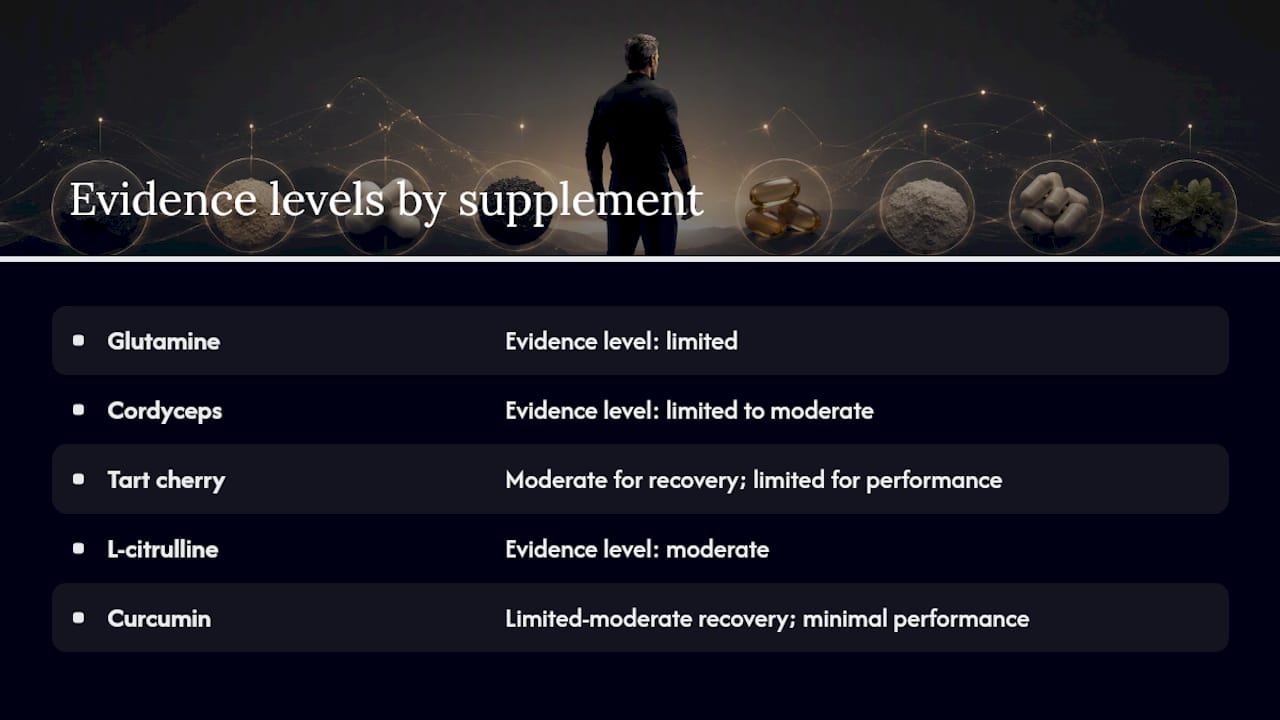
Glutamine: Marketed for immune support and gut integrity during heavy training. Evidence for performance enhancement is weak. Some data suggest reduced upper respiratory illness incidence during high training loads, but effect sizes are small and findings inconsistent. Evidence level: limited.
Cordyceps (Cordyceps sinensis / militaris): A fungal extract with proposed mitochondrial and oxygen-utilization benefits. Recent reviews identify promising mechanistic rationale but consistently note that human trials are small-sample and population-specific, with mixed results on VO2max and time-to-exhaustion. Standardization of active compounds (cordycepin, adenosine) varies widely between products. Evidence level: limited to moderate.
Tart cherry (Montmorency cherry): Rich in anthocyanins with anti-inflammatory and antioxidant properties. Human evidence supports reduced muscle soreness and faster recovery of strength after eccentric exercise. Effects on primary performance metrics (power, time-trial) are less consistent. Typical protocol: 30 mL concentrate twice daily for 4–5 days before and after a demanding event. Evidence level: moderate for recovery, limited for primary performance.
L-citrulline: A precursor to arginine and subsequently nitric oxide, with a more favorable oral bioavailability profile than arginine itself. Some trials show modest improvements in high-intensity exercise capacity and reduced muscle soreness. Effective doses in studies range from 6–8 g taken 60 minutes pre-exercise. Results are directionally positive but inconsistent across populations. Evidence level: moderate.
Curcumin: Anti-inflammatory compound from turmeric. Human evidence for recovery and reduced DOMS is growing but limited by poor bioavailability of standard curcumin formulations. Piperine-enhanced or liposomal formulations improve absorption. Evidence level: limited to moderate for recovery; minimal for acute performance.
A critical point across all botanical extracts: batch-to-batch variability in active compound concentration is a primary reason for inconsistent trial results.
How Viridos evaluates ergogenic claims
The framework below reflects the editorial standards applied to every recommendation on this site. You can use it to appraise any new ergogenic claim you encounter.
- Evidence hierarchy. Meta-analyses and systematic reviews of multiple RCTs carry the most weight. Single RCTs are informative but not definitive. Cohort studies and case reports generate hypotheses, not recommendations.
- Population relevance. A trial conducted in untrained university students may not transfer to a trained man in his 50s. Check whether the study population matches your training status, age, and sport type before applying its findings.
- Effect size, not just statistical significance. A statistically significant result with a trivial effect size (Cohen's d < 0.2) has limited practical value for a high-performing individual. Viridos weights practical effect size — the magnitude of change in a real performance metric — above p-values alone.
- Replication and ecological validity. A finding replicated across multiple independent labs in real-world sport settings carries more weight than a single well-designed lab study. Ecological validity matters: a treadmill VO2max test and a road race are not the same stimulus.
- Conflict of interest. Industry-funded trials are not automatically invalid, but undisclosed supplement provision, post-hoc outcome selection, and publication bias are documented problems in sports nutrition research. Prioritize trials with pre-registered protocols and independent funding where available.
This framework applies equally to the six well-supported aids covered above and to any new compound you encounter in the market. The question is never "does this have any evidence?" — almost everything does. The question is whether the evidence is strong enough, in the right population, with a meaningful effect size, replicated independently.
The discipline of evidence-first performance
Most men who ask about ergogenic aids are not asking the right question. The question is rarely "which supplement should I add?" It is almost always "what is the highest-leverage intervention available to me right now?" For the majority of disciplined, high-performing men, the answer is not a new supplement. It is sleep quality, training periodization, and nutritional precision — areas where the effect sizes dwarf anything a legal ergogenic aid can deliver.
That said, caffeine and creatine are genuinely useful tools for men who have those foundations in place. The evidence for both is not marginal or context-dependent. It is consistent, replicated, and applicable across a wide range of training ages and sport types. The mistake is treating them as shortcuts rather than as precision additions to an already-optimized protocol.
The other mistake is chasing the compounds in the "limited evidence" category before the established ones are dialed in. Cordyceps and tart cherry may have a role in a sophisticated protocol. They do not belong at the top of the list for a man who is not yet using creatine consistently. Sequence matters. The strategies that sustain high energy for professionals over 40 follow the same logic: foundational first, precision additions second.
One more thing worth stating plainly: the placebo effect in performance research is not a reason to dismiss supplements. It is a reason to measure objectively. If you feel better on a compound but your time-trial result does not change, you have learned something useful. If both improve, you have a stronger signal. Design your trials accordingly.
Viridos and the long-term performance equation
Acute ergogenic aids address a specific performance window. Caffeine sharpens a morning session; sodium bicarbonate buffers a hard interval set. What they do not address is the sustained hormonal and metabolic environment that determines how well you perform, recover, and adapt over years — not hours.

Viridos occupies a different position in that equation. Designed for disciplined men in demanding roles, the Viridos formulation is a plant-derived precision oral spray, produced in small batches in Sweden, targeting phytoandrogen-related pathways associated with drive, clarity, and metabolic resilience. It is not an acute ergogenic. It is a long-term support product for men who want to sustain their edge across decades, not just optimize a single training session. The membership model reflects that philosophy: controlled access, individual application, and a commitment to consistency over convenience.
Before starting any new pharmacological or drug-class agent, consult a sports medicine physician. For men ready to explore what long-term performance support looks like beyond the supplement aisle, the Viridos membership is the place to start.
Sources
The following primary sources and position statements informed the recommendations in this article. When seeking dosing clarity or policy guidance, prioritize systematic reviews and consensus statements over single-study findings or manufacturer literature.
- Exercise and Athletic Performance - Health Professional Fact Sheet | NIH ODS
- Can supplements boost my athletic performance? - Harvard Health
- Ergogenic aids | PubMed
This article is general information, not a substitute for advice from a qualified doctor. Consult a qualified healthcare professional about your own circumstances before acting on anything here.