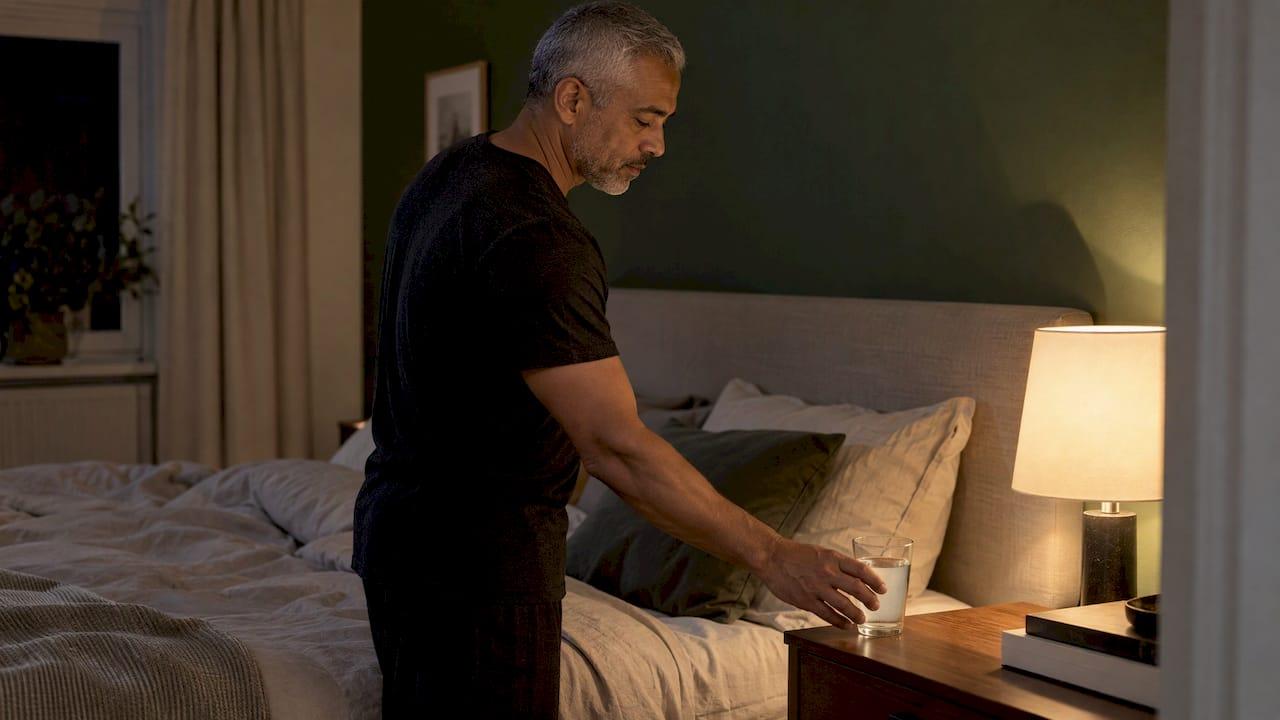
Glycine is an amino acid that your body makes and that you also get from protein-rich food. In small human trials, 3 g taken 30 to 60 minutes before bed was linked to better self-rated sleep and less next-day sleepiness. The studies are short and small, so the realistic expectation is a modest effect, tested with discipline rather than assumed. This guide sets out the dose that was studied, the timing, what the trials in men actually measured, and how a high-responsibility professional can run a fair, structured trial.
TL;DR
- The studied dose is 3 g of glycine, taken 30 to 60 minutes before bedtime.
- A 2023 systematic review reported better sleep quality and alertness and less fatigue and sleepiness, but the studies were small and carried a high risk of bias.
- The most relevant male data come from short sleep-restriction experiments lasting days, not months. Treat the effect as modest and personal.
- Doses far above 3 g have been studied for safety, yet more is not the goal. Speak to your physician first if you take medication or have a medical condition.
- Glycine is one input. Light, timing, alcohol and workload usually decide the night.
Table of Contents
- What glycine is and why it is linked to sleep
- The dose studied: 3 g, and why more is not the aim
- Timing: building it into an evening routine
- What the research shows, and how strong it is
- Glycine and sleep quality: what to expect
- Safety: who should be careful
- How to run a fair trial, executive style
- Glycine in the wider picture of executive recovery
- Where VIRIDOS fits
- Our perspective
- FAQ
- Sources
What glycine is and why it is linked to sleep
Glycine is the smallest amino acid. It serves as a building block for protein, including collagen, and it also acts as an inhibitory signal in the nervous system. That second role is why it attracted sleep researchers.
The proposed mechanism is physiological rather than sedative. A 2012 review by Bannai and Kawai explains that orally administered glycine acts on NMDA receptors (a type of signal receptor) in the suprachiasmatic nucleus, the brain's master clock region. Core body temperature then falls, and sleep quality improves. The 2024 review in PMC links the effect to peripheral vasodilation, meaning wider blood vessels in the skin that release heat, and to modulation of sleep-regulating neurons.
Why does temperature matter? Sleep onset normally coincides with a drop in core temperature. A supplement that helps that drop along is a plausible route to falling asleep more easily. Plausible is the key word: the same 2012 authors note that the brain regions involved have many connections, and that the temperature change is not simply a glycine-induced trait that explains the sleep benefit. The mechanism is still being mapped.
The dose studied: 3 g, and why more is not the aim
The figure you will see repeated is 3 g. The Sleep Foundation states that glycine supplements typically have a recommended dose of 3 g, taken 30 to 60 minutes before bedtime. The 2023 systematic review used the same dose and window: 3 g per day of oral glycine, 30 minutes to 1 hour before bed, in studies that ran for 2 to 4 days.
Two practical points follow.
- The dose is a gram count, not a capsule count. Products differ in how much glycine each serving contains. Read the label for grams of glycine per serving and do the arithmetic before you start.
- Higher is not a better protocol. Researchers have tested very large amounts for safety. The Sleep Foundation notes that amounts as high as 31 g and 0.8 g/kg have been studied, and that high doses may cause nausea. Those were safety investigations, not sleep protocols. There is no evidence in the material reviewed here that a larger dose improves sleep more than 3 g does.
If you search for "glycine dosage sleep", the answer therefore is simple: the evidence supports 3 g, once, shortly before bed.
Timing: building it into an evening routine
The studied window is 30 to 60 minutes before bed. For a man who finishes work at 9 p.m. and tries to sleep at 11, that places glycine at roughly 10 to 10:30 p.m., after the last screen-heavy task and ideally in the same slot as the rest of your wind-down.
A few ways to make the timing reliable:
- Anchor it to a fixed cue. Brushing your teeth or switching off your phone is more dependable than a clock alarm.
- Keep the same time on travel days. If you cross time zones, anchor to local bedtime, not to home time.
- Do not stack new variables. Start glycine on a week when you are not also changing your bedtime, alcohol intake and training schedule. Otherwise you cannot tell what worked.
Glycine has a mildly sweet taste, and it dissolves in water. Many people take it as a powder stirred into a glass of water. If you want a deeper look at how the surrounding routine affects the result, our guide to sleep hygiene in executive performance covers the habits that carry most of the weight.
What the research shows, and how strong it is
This is where a disciplined reader should slow down. The headline findings are encouraging, and the caveats are real.
The systematic review
The 2023 review in GeroScience by Soh and colleagues examined 18 studies in healthy populations. In three populations given 3 g per day before bed, sleep quality, alertness and cognition improved, while fatigue and sleepiness decreased. The authors also noted small sample sizes and a high risk of bias. Both statements belong together.
A scoping review published in September 2026 in the Journal of Dietary Supplements identified 22 unique trials in its field, of which 3 investigated supplemental glycine and sleep-related outcomes. All three reported a benefit on at least one sleep-related outcome. The authors concluded that larger mechanistic trials with standardized sleep outcomes are needed.
So the pattern is consistent in direction and thin in volume. Few trials exist, and they are small.
What the trials in men actually tested
If you are a man in your forties, fifties or sixties, the two studies that matter most deserve a plain description.
Sleep restriction in healthy men (2012). In a study published in Frontiers in Neurology, ten healthy men aged 30 to 61 (average 41.4 years) had their sleep cut to 25% less than usual for three consecutive nights. Seven were included in the analysis. Those given 3 g of glycine before bed showed significantly reduced fatigue on day 1 (p = 0.022) and improved psychomotor vigilance, a reaction-time measure of sustained attention, on days 1 and 3. Sleepiness showed a trend that did not reach significance (p = 0.098).
Notice what this does and does not tell you. It describes how men coped with a deliberately short-slept stretch. It does not describe how glycine behaves over months in a man whose sleep is merely uneven because of travel and deadlines. Still, for an executive who regularly runs a sleep debt, the design is not far from daily reality.

Glycine-rich collagen peptides in active men (2023). A European Journal of Nutrition study gave 13 physically active men with sleep complaints, average age 24, 15 g per day of collagen peptides containing about 3.5 g of glycine, one hour before bed for 7 nights. Polysomnography (the lab measurement of sleep stages) found fewer awakenings than with placebo (21.3 vs. 29.3 counts; P = 0.028), and the proportion of correct Stroop test responses was higher the next morning (P = 0.009). The men were much younger than most readers of this article, and the product was collagen rather than pure glycine, so treat it as supportive rather than directly comparable.
Reading the strength of evidence honestly
| Question | What the studies suggest | How firm it is |
|---|---|---|
| Does 3 g before bed improve self-rated sleep quality? | Improvement reported in several small trials | Small samples, high risk of bias |
| Does it reduce next-day sleepiness and fatigue? | Reduced in sleep-restricted adults | Short trials of 2 to 4 days |
| Does it help men in their forties and fifties specifically? | One small male study with average age 41.4 | Very limited |
| Is long-term nightly use studied? | Not in healthy people over months | A gap in the evidence |
The last row matters. Short trials say little about what happens after six months of nightly use, and no guidance should pretend otherwise.
Glycine and sleep quality: what to expect
For the reader who asks whether glycine improves sleep quality, the calibrated answer is this. In the trials, the benefits showed up mostly in how people rated their sleep and in how they felt the next day. A faster fall into sleep and fewer awakenings appeared in some lab recordings. None of this adds up to a dramatic change, and the reviewers stop well short of promising one.
A sensible expectation is a small, personal effect that you can notice or not. If you notice nothing after a fair trial, that is useful data and costs you nothing further. If you notice an easier evening and a clearer morning, you have a data point worth keeping.
Safety: who should be careful
At 3 g, the Sleep Foundation reports that glycine caused no side effects in human sleep research. A 2012 review reports that no serious side effects were observed at 31 g per day. That margin is reassuring, but it is not permission to scale up. Nausea can occur at high doses, and more is not part of any sleep protocol studied.
Practical safety points:
- Stay at the studied dose. 3 g is the reference point.
- Speak to your physician first if you take prescription medication, have a kidney or liver condition, or have a diagnosed sleep disorder. The Sleep Foundation advises checking with a healthcare provider before starting any supplement.
- Persistent sleep trouble deserves an assessment. Loud snoring, gasping, or waking unrefreshed night after night are reasons to see your doctor, because they can point to conditions that no supplement addresses.
- Watch for the paradox. Some people report falling asleep faster yet waking after a few hours feeling alert. If that happens, stop and reassess rather than raising the dose.
How to run a fair trial, executive style
You already evaluate decisions by recording the inputs and checking the outcome. Do the same here.
- Establish a baseline. For seven nights, log bedtime, wake time, how long you think it took to fall asleep, awakenings, and a 1 to 5 rating for morning alertness. A wearable can add data, but a simple note works.
- Fix the variables. Keep caffeine cutoff, alcohol, training time and bedtime within a consistent range.
- Introduce 3 g, 30 to 60 minutes before bed. One change, nothing else.
- Run it for two weeks. The published trials were short, so two weeks is already longer than most of the evidence.
- Compare with baseline. Look at morning alertness and awakenings first. If the ratings are no better, you have your answer.
- Reassess periodically. Because long-term studies in healthy people are missing, avoid treating a nightly supplement as a permanent fixture without checking in on it.
This structure also protects you from the most common error in sleep optimization: changing five things at once and crediting the wrong one.
Glycine in the wider picture of executive recovery
Glycine does not replace the foundations. Chronic short sleep affects judgment, mood and decision quality, and our article on what sleep deprivation costs a leader lays out why. A glycine trial is worth running only once light exposure, a consistent wake time, a caffeine cutoff and a cool bedroom are in place. For the full framework, see sleep optimization for professionals.
Recovery also extends beyond the night. How you structure training, nutrition and workload decides how much sleep pressure you carry into bed. Our guide to building recovery and discipline covers that daytime side, and our overview of natural cognitive sharpness after 40 looks at what supports clear thinking over the long run.
Where VIRIDOS fits
VIRIDOS is a Swedish men's performance brand built around vitality, executive performance and long-term performance longevity. It offers a plant-derived oral spray, produced in small batches in Sweden, through an application-based membership. Access is controlled and cohort-limited, and there are two plans: Member at $99 per month and Professional at $299 per month. You can review both on the pricing page, read how the membership works, or see how the product is made on the Swedish production page.

What we offer is a precision formulation and a disciplined framework for men who treat their performance as a long-term project. It is not a sleep aid, and this article does not suggest otherwise. If you want a broader plan for vitality at your stage of life, our practical guide to vitality for men 40 to 65 is the place to start.
Our perspective
We approach sleep the way we approach everything at VIRIDOS: evidence first, uncertainty stated, decisions recorded.
The glycine literature is a good example of why that discipline matters. The direction of the findings is consistent, and the studies are small. A man with a demanding role does not need a promise. He needs a clear dose, a clear window and a way to judge the result for himself. Three grams, thirty to sixty minutes before bed, two weeks, a simple log. That is a protocol he can own.
The same principle guides our formulation work. We favor precision, small-batch Swedish production and traceable decisions, because performance longevity is built on consistency rather than on intensity for a week. Sleep is the base layer of that consistency. Protect it first, then add the rest deliberately.
Men still in the arena do not chase every new input. They choose a few, measure them, and keep what earns its place.
Joakim
FAQ
How much glycine should I take for sleep?
The amount studied in sleep research is 3 g, taken 30 to 60 minutes before bed. Check the label of your product for grams of glycine per serving. Larger amounts have been tested for safety only, and they have not been shown to improve sleep further.
Does glycine help men sleep differently from women?
The published evidence does not allow a firm comparison. One small 2012 experiment in healthy men, average age 41.4, found less fatigue and better vigilance after short sleep with 3 g of glycine. Larger trials that compare sexes and age groups are still needed.
Can glycine cause side effects or make sleep worse?
At 3 g, human sleep research reported no side effects, and nausea is the main concern at high doses. A few people report waking early feeling alert. If that happens, stop, keep your log, and speak to your physician if sleep problems persist or if you take regular medication.
How long does it take to notice an effect?
The trials in the 2023 review ran for 2 to 4 days, and effects were measured the following morning. A two-week trial with a baseline week gives you enough information to decide. If you notice no change in morning alertness or awakenings, glycine is probably not a meaningful lever for you.
Sources
- Glycine for Sleep: Benefits, Dosage, and Side Effects, Sleep Foundation
- The effect of glycine administration on the characteristics of physiological systems in human adults: a systematic review, GeroScience, 2023
- Glycine bioavailability and sleep-related outcomes, Journal of Dietary Supplements, 2026
- An update of the promise of glycine supplementation, PMC, 2024
- New therapeutic strategy for amino acid medicine: glycine improves the quality of sleep, PubMed, 2012
- The effects of glycine on subjective daytime performance in partially sleep-restricted healthy volunteers, Frontiers in Neurology, 2012
- Collagen peptide supplementation before bedtime reduces sleep fragmentation, European Journal of Nutrition, 2023