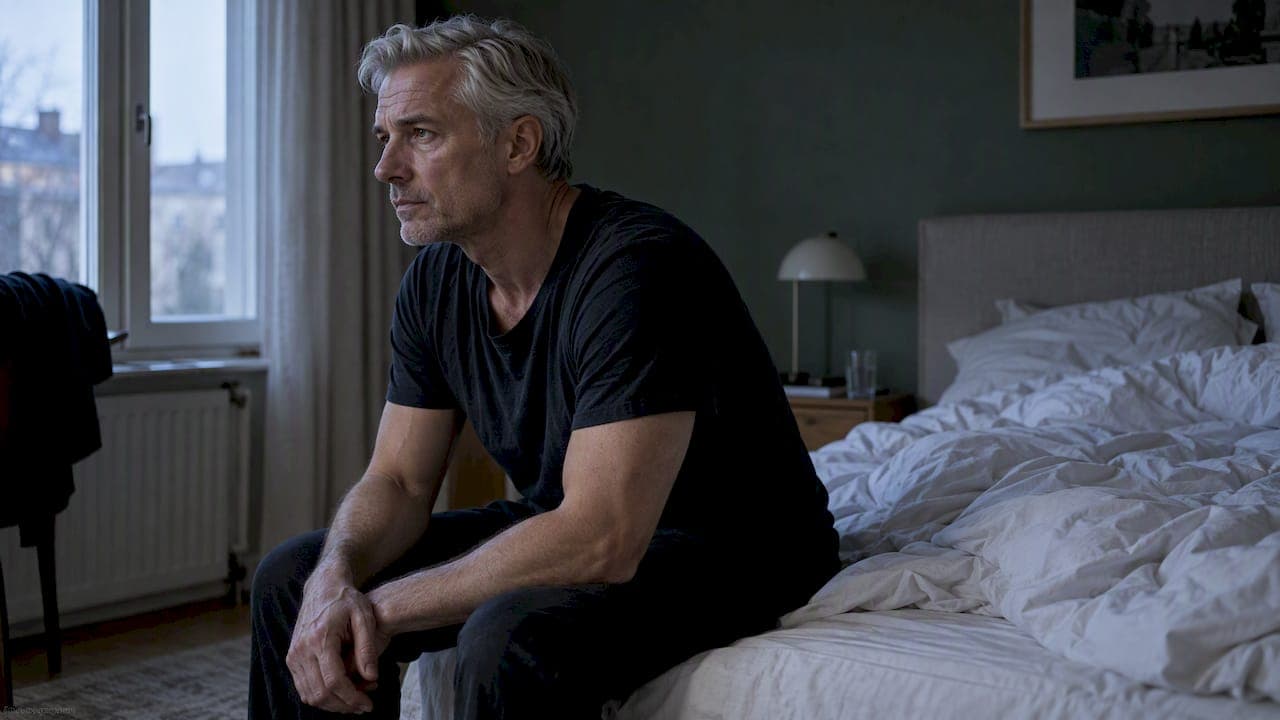
Sleep deprivation does not stay private. In a leader it shows up as slower judgment, shorter patience and a team that adjusts its behavior around your mood. Research links short sleep to weaker concentration, poorer handling of the unexpected and lower engagement among the people who report to you. The good news: sleep is among the most controllable variables in a demanding role, and a disciplined approach to it pays back within weeks of consistent practice.
This article covers what the evidence says about executives and sleep loss, what drives it in Swedish management culture, and how to build a routine that protects performance over decades, not just through the next quarter.
TL;DR
- Sleep loss commonly impairs decision-making, though the size of the effect depends on the task and on how long the deprivation lasts.
- A leader's poor sleep can spread: research connects it to harsher supervision and lower daily engagement in the team.
- In Sweden, long hours and constant availability are recognized work-environment risks, and many entrepreneurs report sleeping poorly because of work stress.
- The most reliable levers are fixed sleep and wake times, daylight, a screen-free hour before bed and a clear rule for nights when sleep does not come.
- Persistent sleep problems belong with a physician or your occupational health service, not with a productivity hack.
Table of Contents
- Why sleep is a leadership variable, not a lifestyle preference
- What sleep loss does to concentration, judgment and risk assessment
- How a tired leader changes the team
- What drives short sleep among Swedish managers and entrepreneurs
- What chronic sleep loss does to the body
- A disciplined sleep protocol for people in demanding roles
- Build the organization so it does not depend on your sleeplessness
- Our perspective
- Where VIRIDOS fits
- FAQ
- Sources
Why sleep is a leadership variable, not a lifestyle preference
Most executives treat sleep as the buffer that absorbs whatever the calendar does not. That is a trade, and it carries interest. Your job is judgment under uncertainty: allocating capital, reading people, deciding what not to do. Those are the executive functions that sleep loss degrades first.
A 2025 scoping review of 25 articles with 2,276 participants found that sleep deprivation commonly impairs decision-making, while noting that results vary by task and by how long people were deprived. That qualification matters. Short sleep does not make every decision worse. It tends to hurt most where the situation is new, ambiguous or emotionally loaded, which describes much of senior work.
The same body of research ties sleep loss to weaker memory, alertness and learning. For a founder or investor who relies on pattern recognition built over twenty years, the loss is rarely dramatic. It is a quiet narrowing: you still perform, but with less range.
What sleep loss does to concentration, judgment and risk assessment
Concentration and working memory
The first thing to go is sustained attention. Meetings that once felt routine require effort. You reread the same paragraph in a board pack. Because the decline is gradual, you adapt your expectations downward without noticing, which is why sleep-deprived people tend to rate themselves as more capable than their output suggests.
Rigidity when plans break
A review of sleep deprivation and decision making describes a pattern worth knowing: decision makers who are short on sleep often fixate on solutions that are not working when something unexpected happens, and they struggle to revise the plan or improvise. For a leader, the cost shows up in precisely the moment that matters, when the quarter, the deal or the launch goes off script.
Risk assessment
The evidence on risk is more mixed, and honesty requires saying so. Effects differ by task, by the length of deprivation and by the individual. The practical reading is cautious: do not assume your risk calibration is intact after a run of short nights, and avoid scheduling irreversible decisions at the end of one.
A simple rule
If you have slept under about five or six hours for several nights, treat large, hard-to-reverse decisions the way you would treat a decision made after a long flight: delay when you can, add a second reviewer when you cannot. That is a judgment call, not a clinical threshold, and it costs you very little.
How a tired leader changes the team
Sleep loss is often discussed as an individual problem. Leaders do not have that luxury, because their state is contagious.
A study in the Academy of Management Journal, "You Wouldn't Like Me When I'm Sleepy", found that poor leader sleep quality can lead, through depleted self-control and abusive supervision, to lower daily engagement in the leader's work unit. The mechanism is ordinary: a depleted person is shorter, less patient and quicker to criticize, and the team feels it that day.
There is an emotional component too. A review in Trends in Cognitive Sciences reports that sleep loss amplifies emotional reactivity, raises negative mood and impairs both recognizing and expressing emotion, and that it can weaken perceived charisma. Authority built on composure is exactly what erodes.
The Swedish press has noticed the same theme. Leadership publications regularly return to the idea that managers who sleep poorly lead worse, often without realizing it. The point is not that you should feel guilty. It is that sleep is part of the job's infrastructure, like a reliable chief of staff.

What drives short sleep among Swedish managers and entrepreneurs
Sweden has a reputation for work-life balance, but leaders and business owners often sit outside the protections that shape other people's days.
- Long hours and constant availability. The Swedish Work Environment Authority states that long shifts and workweeks, night or shift work, and expectations of being constantly reachable can be health risks, and that unplanned long hours may signal an imbalance between demands and resources. See its guidance on working time that leads to ill health.
- Owner pressure. A Timbro report on necessity entrepreneurs found that four in ten Swedish entrepreneurs feel they work so much that they cannot maintain their health, and nearly as many say they sleep poorly because of work-related stress.
- A reinforcing loop. Swedish research by Johanna Garefelt and colleagues describes work stress and insomnia feeding each other: stress disrupts sleep, and disrupted sleep makes demands feel heavier. Their conclusion points to structural factors such as excessive demands and limited decision authority, not only to personal habits.
That last point deserves attention from anyone who runs a company. If you are the person who sets the demands, you are also the person who can change them. Employers in Sweden are expected to prevent unhealthy workloads and to create conditions in which staff can flag excessive demands, under the organizational and social work environment regulations (AFS 2015:4). A leader who sleeps four hours and emails at midnight sets an availability norm for everyone else, whether intended or not.
What chronic sleep loss does to the body
Beyond the working day, the long-term picture is the reason to act now. Swedish heart and lung foundation Hjärt-Lungfonden notes that research shows a strong link between insufficient sleep and higher risk of cardiovascular disease, including high blood pressure, heart attack and stroke, and that most adults need 7 to 9 hours. The same page reports a study in which people sleeping under six hours were considerably more likely to catch a cold than those sleeping seven or more.
These are associations across populations, not predictions for any one person. They are still a sound reason to treat sleep as part of long-term performance planning. For men over 40, who already face rising demands on recovery, the margin for neglect narrows. We explore this in our guide to how professionals over 40 sustain high energy daily.

A disciplined sleep protocol for people in demanding roles
The official Swedish guidance is unglamorous, and that is its strength. 1177, Sweden's healthcare guide, recommends 7 to 9 hours for adults, regular sleep and wake times, daylight exposure and an hour without screens before bed. Here is how an executive can apply it.
- Fix the wake time first. Choose a wake time you can hold seven days a week, within reason. The anchor stabilizes everything after it.
- Get daylight early. Fifteen to thirty minutes outside in the morning, even in a Stockholm November, helps to set your rhythm. Walk part of the way to the office.
- Set a hard end to the digital day. One hour before bed, no screens. Move the last email check to early evening and tell your team that nothing urgent will wait for a reply after it.
- Separate the worry from the bed. Write tomorrow's three priorities and open questions on paper before you wind down. Unfinished loops are what keep many leaders awake.
- Apply stimulus control. If you have not fallen asleep after about 30 minutes, 1177 advises getting up and doing something calm before trying again, so the bed does not become associated with sleeplessness.
- Protect travel and time-zone weeks. Plan lighter mornings after late flights rather than pretending they cost nothing.
The same 1177 sleep school notes that sleep restriction has given the best results in research, and that people with exhaustion syndrome, bipolar disorder or psychosis should consult their care provider before trying it. This is a technique to discuss with a professional, not one to improvise during a hard quarter.
When to see a professional
If you have struggled with sleep for weeks, wake unrefreshed despite enough hours, snore heavily with daytime sleepiness, or feel persistently exhausted or low, book an appointment with your primary care center or your company's occupational health service. These patterns can have causes that discipline alone will not resolve, and a physician can assess them properly. Nothing in this article is a substitute for that.
Build the organization so it does not depend on your sleeplessness
Performance longevity is a system. A leader who sleeps well but runs a culture of permanent urgency still creates pressure at every level. Some practical structure:
- Agree on response-time norms. Not every message needs an answer within the hour.
- Keep decision authority close to the work, so fewer decisions funnel through you late in the day.
- Schedule the hardest thinking for your best cognitive hours, and protect them from meetings.
- Make sleep discussable. As one Swedish workplace publication has put it, poor sleep feels private, which makes it harder to raise with a manager. A leader who mentions their own routine makes it easier for others.
For deeper reading on the building blocks, see our pieces on the role of sleep hygiene in executive performance, sleep optimization for professionals and how to avoid executive fatigue. Because stress and sleep run in a loop, stress management for high-performing executives is the natural companion, and our guide to building recovery and discipline shows how to make the routine hold under pressure.
Our perspective
We build for men who are still in the arena: founders, executives and investors who carry responsibility and refuse to accept decline as a default. In our experience of that audience, the most common error is treating recovery as a reward for finishing the work, when it is the condition that makes the work possible.
We hold a clear line on what a supplement can and cannot do. VIRIDOS is a plant-derived, sublingual formulation, produced in small batches in Sweden, and it is built to support drive, clarity and executive performance. It is not a sleep aid, it does not replace sleep, and it makes no claim to address sleep disorders. Nothing in a bottle compensates for chronic short nights. The foundation is the protocol above: a fixed rhythm, daylight, a defined end to the day and honest attention to when something needs medical review.
What we ask of ourselves is the same discipline we ask of members: inspect the evidence, name the uncertainty, and support professional judgment rather than replace it. Sleep is where that discipline starts.
— Joakim
Where VIRIDOS fits
Once your sleep foundation is in place, the question becomes how to sustain drive and clarity across a long career. VIRIDOS is a controlled-access membership: approved applicants receive regular shipments of our precision oral spray, with small-batch Swedish production and a limited cohort. The Member plan is $99 per month and the Professional plan is $299 per month; both are detailed on the pricing page. You can read how access works on the membership page and the thinking behind the formulation in The VIRIDOS Methodology.
FAQ
How many hours of sleep should an executive get?
Swedish official guidance for adults is 7 to 9 hours per night, with the exact need varying between individuals, according to 1177. Leaders are not an exception to this range. The practical test is whether you wake reasonably refreshed and stay alert through the day without leaning on caffeine.
Does sleep deprivation really make leaders worse at their jobs?
The evidence points that way. Reviews find that sleep loss commonly impairs decision-making and flexibility when plans change, and a study of leaders linked poor sleep to lower daily team engagement. Effects vary by task and duration, so the honest claim is that the risk is real, not that every tired decision is a bad one.
Can you be signed off sick in Sweden for sleep problems?
It is possible when a physician judges that a health condition reduces your ability to work, but that is an individual medical assessment. Start with your primary care center or occupational health service, describe how the sleep problem affects your work and let them advise. Employees and the self-employed have different rules, so ask about your own situation.
What should I do when I cannot fall asleep?
Follow stimulus control: if you are still awake after about 30 minutes, get up, do something calm in low light, and return to bed when sleepy, as 1177 recommends. Avoid screens and work. If sleeplessness persists for weeks, speak with a physician.
Sources
- Examining the Effects of Sleep Deprivation on decision-making (PMC, 2025)
- The impact of sleep deprivation on decision making: a review (PubMed)
- "You Wouldn't Like Me When I'm Sleepy": Leaders' Sleep (Academy of Management Journal)
- Sleep Loss and the Socio-Emotional Brain (Trends in Cognitive Sciences)
- Arbetstid som leder till ohälsa (Arbetsmiljöverket)
- Organisatorisk och social arbetsmiljö, AFS 2015:4 (Arbetsmiljöverket)
- Nödvändighetsföretagarna (Timbro)
- Reciprocal relations between work stress and insomnia (PMC)
- Goda sömnvanor (Hjärt-Lungfonden)
- Sömnen är viktig för hälsan (1177)
- Sömnskola, råd för att sova bättre (1177)