
TL;DR:
- Executive fatigue results from sustained decision-making, calendar overload, and unmanaged stress, leading to cognitive, emotional, and physical depletion. Protecting focused work time, applying decision protocols, delegating effectively, and building stress intelligence help leaders maintain performance and prevent burnout. Tracking key indicators daily enables early intervention before fatigue severely impacts leadership capacity.
Executive fatigue is defined as the progressive depletion of cognitive, emotional, and physical capacity caused by sustained high-stakes decision-making, calendar overload, and unmanaged stress. It is not a character flaw or a sign of weakness. It is a predictable consequence of demanding leadership roles without deliberate recovery systems in place. Knowing how to avoid executive fatigue is the difference between a leader who sustains performance across decades and one who peaks early and burns out quietly. The core solution rests on three pillars: protecting focused work time, applying decision protocols, and building what the World Economic Forum now calls stress intelligence.
What are the main causes and symptoms of executive fatigue?
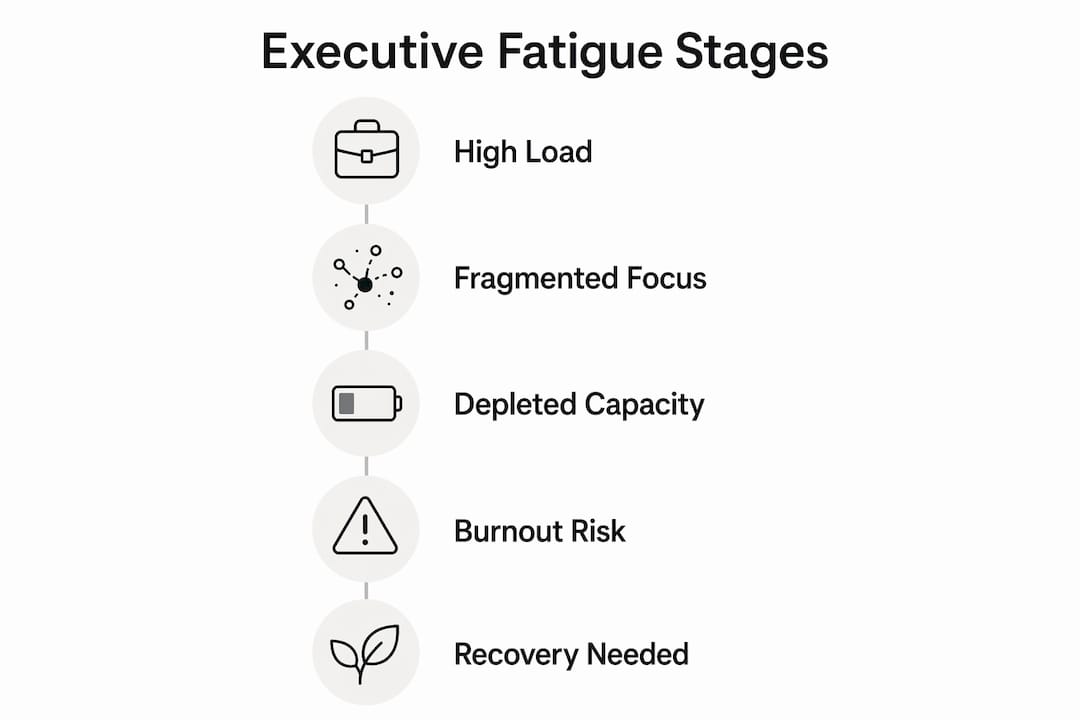
Executive fatigue follows a clear mechanical pattern. High calendar density fragments attention, decision volume depletes cognitive reserves, and chronic stress degrades the executive functions that leaders rely on most.
When a calendar exceeds 70% scheduled time, focus time collapses below 25%, which signals high burnout risk. That threshold matters because deep strategic thinking requires sustained, uninterrupted attention. Meetings and reactive tasks consume that window before it can be used.
Stress compounds the problem at the neurological level. Sustained cortisol exposure impairs working memory, narrows creative thinking, and degrades judgment quality. These are precisely the functions an executive uses most. The World Economic Forum reports that over 50% of C-suite leaders describe themselves as "very stressed" in the current environment. That is not a personal failing. It is a structural problem requiring a structural response.
The symptoms of executive fatigue are worth naming precisely:
- Mental fog: Difficulty processing complex information or holding multiple variables in mind simultaneously
- Decision avoidance: Postponing choices that would normally feel straightforward
- Irritability: Shortened patience with teams, partners, or family, often disproportionate to the trigger
- Motivation loss: Reduced engagement with work that previously felt meaningful
- Prolonged recovery: Needing more downtime than usual to feel functional after a demanding period
Executives often mask these signals by doubling down on output metrics. That pattern accelerates burnout rather than resolving it. Recognizing the symptoms early is the first act of self-leadership.
How can executives protect and optimize their focus time?
The Focus Fortress concept treats protected focus time as a non-negotiable operational boundary, not a scheduling preference. The standard is clear: at least 25% of work hours must be reserved for high-value, uninterrupted strategic work. Anything below that threshold creates the conditions for chronic fatigue.
A calendar audit is the starting point. Block every recurring meeting, standing call, and reactive task for one week. Then ask which items require your specific judgment and which do not. Most executives discover that a significant portion of their calendar consumes cognitive energy without producing decisions only they can make.
Practical steps for protecting focus time:
- Reserve the first 90–120 minutes of each day for critical thinking, writing, or high-stakes analysis. Morning hours are the most cognitively productive and should not be spent in status meetings.
- Avoid pivot-level decisions after 4 PM. Cognitive depletion accumulates across the day. Late-afternoon decisions carry a measurably higher error rate.
- Batch communications. Check email and messages at two or three fixed windows rather than responding reactively throughout the day.
- Consolidate meetings into blocks. Cluster meetings in the afternoon to preserve morning depth work.
Pro Tip: Set a recurring calendar block labeled "Strategic Work" every morning before any other meeting is scheduled. Treat it with the same protection you would give a board call.
Calendar design is one of the most underused tools in executive stress management. The executives who sustain performance longest are not the ones who work the most hours. They are the ones who protect their highest-quality hours most deliberately.
What decision-making protocols help reduce cognitive overload?
Decision fatigue is the cumulative cost of making too many choices without adequate recovery between them. The solution is not fewer decisions. It is a system that allocates cognitive resources to decisions by their actual importance.
Four protocols reduce this load effectively:
-
Apply the 70% Rule. Decide when you have 70% of the data and 70% confidence. Waiting for certainty creates mental looping and analysis paralysis. Most executive decisions are reversible enough to tolerate a 30% information gap.
-
Use Decision Sprints. Set a fixed time limit, typically 20–30 minutes, for any decision below a defined impact threshold. When the sprint ends, commit to the best available option. This prevents low-stakes choices from consuming the same energy as high-stakes ones.
-
Segment decisions by impact and reversibility. High-impact, irreversible decisions deserve full cognitive investment. Low-impact, reversible decisions should be delegated or resolved quickly. Treating all decisions equally is one of the fastest routes to overload.
-
Normalize delayed finalization. Not every decision needs to be made the moment it arrives. A structured pause, returning to a decision after sleep or a physical break, consistently improves quality on complex choices. This is not procrastination. It is cognitive resource management.
Shifting your team from waiting for instructions to owning outcomes directly removes a large category of decisions from your plate entirely. That structural shift reduces decision fatigue more reliably than any individual technique.
How does delegation and boundary setting prevent burnout?
Delegation is the single most effective tool for preventing leadership burnout. Effective delegation reduces stress by 80% and is five times more impactful than other burnout-reduction strategies, according to the 2025 DDI Global Leadership Forecast analyzing 10,796 leaders. That is not a marginal gain. It is a structural transformation of your cognitive load.
Most executives underdelegate for one of two reasons: they believe no one else can do the work to their standard, or they have not invested in developing team autonomy. Both are solvable problems.
Effective delegation and boundary practices include:
- Train for outcome ownership. Define what success looks like, assign accountability, and step back. Teams that own outcomes rather than tasks require far fewer check-ins and escalations.
- Set communication windows. Specify when you are available for non-urgent input. An open-door policy feels generous but creates constant interruption that fragments your focus.
- Conduct weekly delegation audits. Review which tasks you handled that week and ask honestly which ones required your specific judgment. Reassign the rest.
- Protect recovery periods. Evenings, weekends, and vacations are not optional. They are the maintenance intervals that prevent system failure.
Pro Tip: Build a "delegation register" in a simple spreadsheet. List every recurring task you own, rate its strategic necessity from 1 to 5, and identify one person who could own each item rated 3 or below.
The burnout prevention guide from Viridos covers schedule auditing and boundary-setting in depth for executives who want a structured framework to apply immediately.
What role does stress intelligence play in overcoming leadership fatigue?
Stress intelligence is the capacity to recognize your own stress patterns in real time and respond in ways that protect cognitive function rather than suppress the stress signal. It is distinct from conventional stress management, which typically focuses on reducing stress after it has already impaired performance.

Stress intelligence requires accepting stress as normal in leadership and building systems that safeguard decision quality under pressure. That reframe is significant. The goal is not a stress-free leadership life. The goal is a leadership life where stress does not degrade your judgment.
Self-leadership is the broader framework. It means managing your energy, emotions, and priorities with the same rigor you apply to your organization. Small consistent self-leadership shifts rebuild clarity and presence well before major burnout appears. The key word is consistent. One recovery weekend does not offset six months of structural overload.
Self-care as a strategic investment means treating exercise, sleep, and meaningful breaks as inputs to leadership capacity, not rewards for completing work. Intense physical training, in particular, has a well-documented effect on stress hormone regulation and cognitive recovery.
Early-warning dashboards give stress intelligence a practical form. Tracking four indicators daily takes less than two minutes and provides an objective signal before fatigue becomes severe.
| Indicator | What to track | Warning signal |
|---|---|---|
| Sleep quality | Hours and subjective depth | Below 6.5 hours or consistently poor |
| Energy levels | Morning and afternoon rating (1–10) | Consistent score below 6 |
| Irritability | Frequency of disproportionate reactions | More than twice in a day |
| Decision clarity | Confidence in choices made | Frequent second-guessing or avoidance |
Monitoring these indicators weekly prevents the pattern where executives skip maintenance after an initial recovery and relapse into the same overload cycle. The professional energy support framework from Viridos addresses this recovery and monitoring approach in practical terms.
Key takeaways
Avoiding executive fatigue requires protecting focused work time, applying decision filters, delegating with intent, and building stress intelligence as a daily practice.
| Point | Details |
|---|---|
| Protect focus time | Reserve at least 25% of work hours for uninterrupted strategic work every day. |
| Apply the 70% Rule | Decide at 70% data confidence to prevent analysis paralysis and mental looping. |
| Delegate for stress reduction | Effective delegation reduces burnout risk by 80%, making it the highest-leverage prevention tool. |
| Build stress intelligence | Recognize stress patterns in real time to protect decision quality under sustained pressure. |
| Use early-warning dashboards | Track sleep, energy, irritability, and clarity daily to detect fatigue before it becomes severe. |
What I've learned about sustaining performance over the long run
The executives I respect most are not the ones who never feel tired. They are the ones who have built systems that catch fatigue early and correct it before it compounds.
The Focus Fortress concept sounds simple until you try to defend it against a full calendar and a team that expects immediate access. The discipline required is real. Protecting that 25% of focused time is a daily act of stewardship over your own cognitive capacity. It is not a luxury. It is the maintenance that keeps the engine running.
Delegation took me longer to trust than any other practice. The shift from "I'll handle it" to "you own this outcome" feels like risk. It is actually the opposite. Every task you hold unnecessarily is a decision you are making to carry weight that someone else could carry better, with the right training and accountability.
Stress intelligence changed how I read my own performance. The goal stopped being "feel less stressed" and became "notice what the stress is telling me and respond with precision." That reframe is worth more than any single technique in this article.
Resilience is not built in one retreat or one recovery week. It is built in the small, consistent choices you make every day about where your attention goes, what you delegate, and when you stop.
— Joakim
Viridos and the executive performance edge
Sustained leadership performance requires more than discipline and good habits. It requires a foundation of physical vitality that supports cognitive clarity, stress resilience, and consistent output across years, not just quarters.
Viridos is a premium Swedish men's performance brand built for exactly this. Designed for founders, executives, and high-agency professionals aged 40–65, Viridos combines small-batch Swedish production with a precision approach to vitality and performance longevity. The brand's executive wellness philosophy aligns directly with the stress intelligence and self-leadership frameworks covered in this guide. If you are serious about sustaining your edge, Viridos is worth your attention.
FAQ
What is executive fatigue?
Executive fatigue is the progressive depletion of cognitive and emotional capacity caused by sustained decision-making, calendar overload, and unmanaged stress. It impairs memory, judgment, and leadership presence over time.
How do I know if I have executive fatigue?
Key signs include mental fog, decision avoidance, disproportionate irritability, loss of motivation, and needing more recovery time than usual after demanding periods.
How does delegation help prevent burnout?
Effective delegation reduces stress by 80% and is five times more impactful than other burnout-reduction strategies, according to the 2025 DDI Global Leadership Forecast.
What is the 70% Rule for decision-making?
The 70% Rule means committing to a decision once you have 70% of the data and 70% confidence. It prevents the mental looping and analysis paralysis that drain cognitive reserves.
What is stress intelligence?
Stress intelligence is the ability to recognize your own stress patterns in real time and respond in ways that protect decision quality, rather than simply trying to reduce or suppress stress.