
TL;DR:
- Executives are just as vulnerable to motivational decay as others, necessitating science-backed resilience strategies. Building structured thought management, defining ambiguity boundaries, and maintaining physical vitality are key to sustaining high-level performance long-term. Systemic support, external coaching, and deliberate architectural design prevent burnout and reinforce motivation beyond mere willpower.
The assumption that senior executives are fueled by an inexhaustible internal drive is flattering but dangerously wrong. High-performing professionals are just as susceptible to motivational decay as anyone else, and because the stakes are higher, the consequences are more severe. 85% of midlevel leaders report experiencing burnout on a weekly basis, a figure that should stop every founder and C-suite executive cold. This article delivers science-backed strategies for sustaining motivation, building genuine resilience, and protecting your capacity to perform at the highest level for years, not just quarters.
Table of Contents
- The science behind executive motivation
- Common pitfalls: Recognition, over-reliance, and burnout
- Practical strategies for sustaining motivation and resilience
- Optimizing performance longevity: Lessons for executives over 40
- Expert perspective: Why conventional motivation advice fails high performers
- Take your motivation and resilience to the next level
- Frequently asked questions
Key Takeaways
| Point | Details |
|---|---|
| Thought management is critical | Constructive thought management predicts sustained motivation and resilience. |
| Recognition can backfire | Public praise may erode intrinsic motivation unless paired with capacity protection. |
| Burnout rates are high | Weekly burnout affects 85% of midlevel leaders, requiring smarter boundaries and supports. |
| Multi-dimensional strategies work | Combining mental, physical, and social strategies best sustains executive motivation. |
| Resilience improves with age | Older executives tend to manage thoughts better, leading to stronger performance longevity. |
The science behind executive motivation
The popular view of executive motivation treats it like a fixed character trait: either you have the fire or you don't. That view is wrong, and the science is unambiguous about it.
A large-scale resilience study of 5,279 participants identified "Manages Thoughts Constructively" as the single strongest predictor of outcomes including happiness, success, and sustained resilience. What makes that finding striking is the accompanying data: the average score on that factor was just 59.5%, making it the lowest-scoring dimension across the entire study. In practical terms, the skill most responsible for keeping you motivated and resilient is also the one most executives are worst at.
Motivation at the executive level is multi-dimensional. It operates across psychological, biological, and environmental layers simultaneously. Psychological factors include self-efficacy, perceived control, and emotional regulation. Biological factors include testosterone levels, cortisol regulation, sleep quality, and neuroinflammation. Environmental factors include team dynamics, organizational culture, and the quality of your support infrastructure. Pull any one of these out of alignment and the whole system degrades.
The resilience study also found a meaningful positive correlation between age and constructive thought management, with a correlation coefficient of r=0.28. That is genuinely good news for executives over 40. It suggests that experience builds a specific kind of cognitive strength. The challenge is channeling that strength intentionally rather than coasting on it.
| Resilience factor | Average score | Correlation with age |
|---|---|---|
| Manages Thoughts Constructively | 59.5% (lowest) | r = 0.28 (positive) |
| Emotional regulation | 68.2% | r = 0.19 |
| Social support utilization | 72.4% | r = 0.14 |
| Physical self-care habits | 64.8% | r = 0.22 |
Tapping into resilient performance strategies built specifically for leaders gives you a framework that aligns all three motivational dimensions rather than optimizing one at the expense of the others. Combined with a serious approach to executive wellness optimization, the science begins to translate into daily operating advantage.
Common pitfalls: Recognition, over-reliance, and burnout
Understanding motivation drivers, let's examine what actually sabotages motivation in real-world executive roles. The traps are rarely obvious, and the most dangerous ones are often disguised as strengths.

The recognition trap. When organizations spotlight their top performers publicly, the intent is to motivate. The reality is more complicated. Recognizing top performers without providing multidimensional support can actively erode the intrinsic motivation that made them top performers in the first place. Public recognition signals that more is expected, and when that increase in demand is not matched by an equal increase in capacity, decision-making bandwidth, recovery time, or organizational protection, the recognized executive simply absorbs a heavier load. The internal reward of doing excellent work gets replaced by the external pressure of maintaining a reputation. That is a corrosive trade.
The over-reliance trap. Senior executives frequently become the organizational node that absorbs ambiguity. When a crisis hits, when a key decision is unclear, when the team needs direction, they default to the person at the top. Over time, this creates a pattern where high performers burn out not from their own work but from carrying the cognitive and emotional weight of everyone else's unresolved uncertainty. This is a subtle, cumulative drain. It doesn't announce itself like an acute crisis. It just hollows you out over months.
Burnout patterns in high performers. The signs of burnout in executives rarely match the textbook version. You are not likely to be lying on the floor unable to function. More commonly, you will notice:
- Declining quality of decision-making, especially under pressure
- Reduced tolerance for ambiguity that you previously handled with ease
- Emotional flatness, losing the engagement that used to come naturally
- Shorter recovery time between high-demand periods
- Increased reliance on reactive habits, late nights, caffeine, skipped workouts
"The executive who burns out from over-reliance is often the most conscientious one in the room. Their strength, absorbing uncertainty to protect others, becomes their greatest vulnerability without structured boundaries."
These patterns are well-documented in research on executive edge lifestyle management, and the path out requires deliberate restructuring rather than simply pushing harder. Revisiting your motivation strategies through a discipline-first lens rather than a willpower-first lens is where durable change begins.
| Motivation drain | Immediate symptom | Long-term consequence |
|---|---|---|
| Unstructured recognition | Increased demand, no capacity buffer | Intrinsic motivation erosion |
| Over-reliance by teams | Cognitive overload | Burnout, decision fatigue |
| Poor thought management | Reactive thinking patterns | Fragile resilience baseline |
| Missing support networks | Isolation, no peer feedback | Blind spots, poor calibration |
Practical strategies for sustaining motivation and resilience
Identifying pitfalls is just the start; here's how you can address them with proven strategies that hold up under real pressure.
1. Build a daily thought management practice. Given that constructive thought management is the top predictor of resilience but the lowest-scoring factor across thousands of executives, this is the highest-leverage place to start. A practical version of this involves structured reflection: ten to fifteen minutes each morning reviewing your active mental narratives. What are you telling yourself about the challenges on your plate? Are those narratives accurate and useful, or are they threat-amplifying and disempowering? A performance journal works well here. Write the thought, evaluate its accuracy, and reframe it toward a constructive action you control.
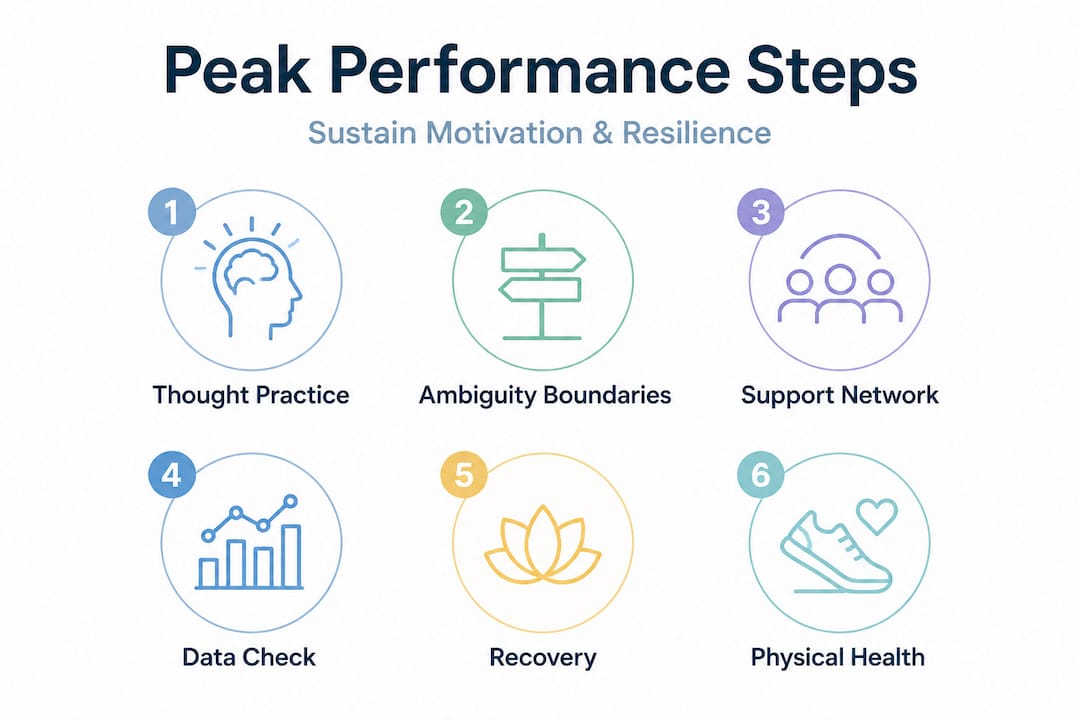
2. Set explicit ambiguity boundaries. Not every decision or open question needs to land on your desk. Define the categories of ambiguity your team is empowered to resolve independently, and hold the boundary consistently. This is structural protection for your cognitive bandwidth. It also builds your team's decision-making muscle, which reduces dependence over time.
3. Build a tiered support network. The HBR burnout data is specific about what leaders need: development opportunities for continued growth, access to peer collaboration, reliable data for informed decisions, and efficient technology that removes friction rather than adding it. Map your current situation against these four categories. Where are the gaps? A formal mentor relationship, a peer executive group, and a health coach covering physical performance are three concrete nodes in a support network that actually holds under pressure.
4. Use data for continuous recalibration. Subjective self-assessment degrades under stress. You think you are fine until you are not. Regular, objective data on your physical performance metrics, sleep, HRV (heart rate variability), cognitive test scores, and hormonal panels provides early warning signals before motivation collapses. This is where executive energy support systems earn their value: they remove the guesswork.
5. Systematize recovery as a performance input. Recovery is not downtime. It is the mechanism through which adaptation occurs. Block it with the same discipline you apply to strategic planning sessions. A well-structured approach to stress optimization treats recovery as an active protocol, not a passive absence of activity.
6. Align physical vitality with motivational goals. Testosterone, cortisol balance, inflammation markers, and sleep architecture all directly affect motivation and decision quality. Vitality strategies for executives that integrate nutritional, hormonal, and physical protocols are not optional add-ons for the serious performer; they are foundational infrastructure.
Pro Tip: Track your decision quality, not just your output volume. Keep a one-line daily log rating the quality of your three most consequential decisions on a scale of one to ten. After four weeks, you will see clear patterns tied to sleep, recovery, and thought management practices that output metrics alone will never reveal.
Optimizing performance longevity: Lessons for executives over 40
With tactics for sustaining motivation covered, let's focus specifically on performance longevity for experienced executives. The game changes after 40, not because you decline, but because the variables shift.
The age-resilience correlation at r=0.28 suggests something that most performance literature ignores: older executives have a structural cognitive advantage in constructive thought management. Years of navigating uncertainty, managing complex stakeholder dynamics, and recovering from setbacks builds what could be called "pattern resilience," the ability to contextualize current challenges against a rich library of past experience. This is a genuine competitive edge if you deploy it deliberately.
What shifts after 40:
- Biological recovery rates slow. Sleep architecture changes, testosterone production begins a gradual decline, and inflammatory responses take longer to resolve. These are manageable but need to be actively managed.
- Motivation becomes more values-driven. External rewards, title, compensation, status, carry less weight. Meaning, legacy, and autonomy matter more. Motivation strategies need to reflect that shift.
- Peer network quality matters more than size. A handful of high-caliber relationships with peers who challenge your thinking is more valuable than a broad professional network.
- Compounded strengths are real. Strategic pattern recognition, emotional calibration, long-term thinking, and tolerance for ambiguity all improve with experience. These are your performance multipliers.
Executive fitness at this stage is not about vanity metrics. It is about maintaining the physical infrastructure that supports cognitive performance, hormonal balance, and recovery speed. Compound movements, adequate protein, consistent sleep, and cardiovascular conditioning are not optional at 40 plus; they are operational requirements.
Performance optimization for executives over 40 also means being strategic about where you direct cognitive intensity. Not every challenge deserves your highest-level mental engagement. Conservation of your most focused states for genuinely high-leverage decisions is itself a performance strategy.
Pro Tip: Use your age-earned pattern recognition deliberately. When you face a new challenge, spend five minutes mapping it against similar situations you have navigated before. What worked? What failed? What was the key turning point? This structured retrospective activates the constructive thought management capability that research identifies as your primary resilience lever.
Expert perspective: Why conventional motivation advice fails high performers
Bringing all the strategies together, let's take a critical look at what actually works for high-performing executives, and why most mainstream motivation frameworks fall short.
Most motivation advice is built around the average employee profile: someone who needs to be energized, inspired, and connected to purpose. Executives at the top of demanding organizations already have purpose in abundance. What they lack is structural protection from the specific forces that erode motivation at high performance levels. Telling a high performer to "reconnect with their why" when they are burning out from absorbing ambiguity for their entire organization is like telling a marathon runner to "think positive thoughts" when their shoes are disintegrating at mile twenty.
The actual problem is almost always systemic, not psychological. Over-reliance is a structural issue that requires structural solutions: delegation frameworks, decision authority matrices, and explicit communication about what the organization can and cannot route through a single person. Recognition without capacity protection is a cultural design flaw, not a personal failing.
The hard-won lesson is that sustainable motivation at the executive level requires multi-dimensional architecture. Psychological habits like thought management matter. Physical vitality matters. Support networks matter. Environmental design matters. None of these alone is sufficient. An executive with excellent thought management practices but no peer accountability, poor sleep, and no ambiguity boundaries will still degrade over time. The system needs all its components.
The approach that works involves treating motivation as an infrastructure problem, something you engineer and maintain, not a feeling you wait to experience. This means regular audits of your motivational architecture, not just annual reviews. Where are the structural vulnerabilities? Where is ambiguity leaking in without resolution? Where is recognition creating pressure without protection? Those are the diagnostics that actually move performance longevity forward.
Health coaching for executives is underused partly because high performers resist admitting they need external input. But the research is clear: structured external support, whether peer collaboration, mentorship, or professional coaching, is one of the specific factors that differentiates executives who sustain performance from those who burn out. This is not a weakness. It is a design decision.
Take your motivation and resilience to the next level
The strategies in this article point toward a clear conclusion: sustained executive performance is built, not inherited. It requires the right tools, structured support, and consistent recalibration.

VIRIDOS is built specifically for this. Designed for disciplined men in demanding roles, our premium Swedish formulations support the biological foundation that makes everything else possible: energy, focus, hormonal resilience, and recovery. Alongside our performance resources and member community, VIRIDOS gives you the infrastructure to implement what you have read here with precision and consistency. Explore VIRIDOS performance support and see how structured vitality investment translates directly into sustained edge. Because the executives who last are not the ones who push hardest. They are the ones who build the best systems.
Frequently asked questions
What is the most effective way for executives to stay motivated long-term?
Consistently practicing constructive thought management alongside deliberate boundary-setting and structured peer support is what sustains motivation over years rather than just quarters, according to large-scale resilience research.
How can executives prevent burnout?
Balancing workload with structured recovery, delegating ambiguity to appropriate levels, and using data-driven support tools for growth, collaboration, and efficient decision-making are the core prevention mechanisms identified by burnout research.
Does public recognition boost executive motivation?
Recognition boosts motivation only when it's multi-dimensional; without capacity protection, public recognition can increase demand without increasing resources, which actively erodes intrinsic motivation over time.
Are older executives more resilient than younger ones?
Yes, resilience tends to strengthen with age: research shows a positive age correlation of r=0.28 specifically for constructive thought management, the most powerful predictor of resilience outcomes.
What practical daily habits support executive motivation?
Reflective journaling on decision quality, structured morning thought audits, consistent physical training, and regular peer interaction are daily habits supported by the same research that identifies collaboration and development as core leadership sustainers.