
TL;DR:
- Optimizing daily routines involves building biological stability, habit stacking, and timeboxing for sustained performance. Regular calibration and flexibility during tough days ensure routines remain effective under real-world pressures. Prioritizing sleep, hydration, movement, and structured adjustments yields the best long-term results.
Optimizing daily routines is defined as structuring your behaviors, environment, and time blocks to reliably produce peak cognitive output, physical energy, and sustainable work-life balance. For executives and founders operating under sustained pressure, this is not a self-help concept. It is a performance architecture problem. The most effective approach combines biological baselines, habit stacking, and timeboxing into a layered system that holds up under real-world demands, not just ideal conditions. Viridos builds its entire performance philosophy around this principle: sustainable output requires a designed system, not willpower.
How to optimize daily routines: start with biological foundations
The single most common mistake professionals make is adding complexity before establishing biological stability. Professionals who skip foundations and jump to advanced protocols collapse under cognitive overload within weeks. Sleep, hydration, and movement are not optional inputs. They are the operating system everything else runs on.
Sleep: the non-negotiable baseline
Sleep duration and quality set the ceiling for every other performance variable. Research confirms that 7–9 hours of consistent sleep, a bedroom temperature of 65–68°F (18–20°C), and a caffeine cutoff by 2:00 PM are the three levers that most reliably protect cognitive performance. That combination is not a preference. It is a biological requirement for sustained executive function.
Hydration and movement as system resets
Hydration and movement work as daily nervous system resets. A 10-minute walk before your first meeting shifts cortisol patterns and primes focus in a way that coffee alone cannot replicate. These inputs do not require a gym or a two-hour morning block. They require consistency.

Environment design reduces friction
Environment design that makes desired habits obvious, easy, and satisfying outperforms willpower every time. Willpower is finite. Laying out workout clothes the night before, keeping water visible on your desk, and blocking phone notifications during deep work periods are structural decisions, not motivational ones. The goal is to make the right behavior the path of least resistance.
Pro Tip: Spend five minutes each Sunday night setting up your physical environment for Monday. Remove friction before the week creates it.
Key actions for building your biological foundation:
- Set a fixed wake time seven days a week, including weekends
- Keep your bedroom at 65–68°F and use blackout curtains
- Stop caffeine intake by 2:00 PM to protect sleep architecture
- Drink 16 oz of water within 30 minutes of waking
- Add a 10-minute walk or movement block before your first commitment
How does habit stacking improve daily routine consistency?
Habit stacking is the practice of anchoring a new behavior to an existing automatic one. The structure is simple: "After I do X, I will do Y." This method reduces cognitive load because you are borrowing the neural pathway of an established habit to carry a new one. Habit stacking combined with a 2-minute starting version of the new behavior accelerates automaticity during the critical first 30-day formation window.
The 2-minute rule is not about doing two minutes of work. It is about forging the cue-response link. Once the link is automatic, expanding the behavior takes no additional willpower. A founder who stacks "review my three priorities" onto an existing morning coffee ritual will build that habit faster than one who schedules it as a standalone task.
Identity-based language accelerates this further. Treating each behavior as a vote for the person you are becoming shifts motivation from forced effort to natural expression. "I am someone who plans his day" is more durable than "I should plan my day." The distinction sounds subtle. The behavioral difference over 90 days is significant.
A practical habit stacking sequence for busy professionals:
- Anchor to coffee: After brewing your morning coffee, write your three non-negotiable priorities for the day.
- Anchor to commute: After sitting in your car or opening your laptop, review your calendar for the next 24 hours.
- Anchor to lunch: After finishing lunch, take a 5-minute walk before returning to work.
- Anchor to end of workday: After closing your last work application, write one sentence about what went well.
- Anchor to brushing teeth: After brushing at night, set your phone to Do Not Disturb and place it outside the bedroom.
Pro Tip: Start every new habit at two minutes or less. The goal in week one is not output. It is the cue-response link. Expand scope only after the behavior feels automatic.
For a deeper look at how executive habit design connects to sustained performance, the Viridos blog covers the structural principles in detail.
What role does timeboxing play in effective daily planning?
Timeboxing is the practice of assigning specific tasks to fixed calendar blocks rather than managing an open-ended to-do list. The difference is significant. A to-do list tells you what to do. A timebox tells you when and for how long. Blocking tasks directly onto your calendar and starting each day with a 15-minute self-planning meeting are the two moves that align your workload with your actual available time.
The 15-minute planning meeting is a meeting with yourself. You review your calendar, confirm your top three priorities, and adjust any blocks that no longer reflect reality. This single habit prevents the common failure of arriving at 4:00 PM with a full to-do list and no time left to execute it.
Tracking planned versus actual completion is the feedback mechanism that makes timeboxing improve over time. When you consistently overrun a 30-minute block, the data tells you to allocate 45 minutes next time. This is not failure. It is calibration.
| Timeboxing element | Purpose | Practical application |
|---|---|---|
| Fixed calendar blocks | Replace open to-do lists with time-bound commitments | Schedule tasks as meetings with yourself |
| 15-minute planning session | Align daily priorities with available time | Review and adjust blocks each morning |
| Planned vs. actual tracking | Identify where time estimates are wrong | Note overruns and adjust future blocks |
| Energy-peak alignment | Match high-focus tasks to peak cognitive hours | Schedule deep work in your chronobiological peak |
| Buffer blocks | Absorb overruns and unexpected demands | Add 15-minute buffers between major tasks |
Chronobiology adds another layer. Most executives have a 2–4 hour window of peak cognitive performance, typically in the late morning. Scheduling deep work, high-stakes decisions, and creative output during that window, and placing administrative tasks and meetings in lower-energy periods, produces measurably better output without adding hours to the day. For more on maximizing productivity routines through energy management, the Viridos performance blog offers a practical framework.
How to adapt routines when real-world pressure hits
The most common reason routines fail is that they are designed for ideal days. Routines built only around clear schedules collapse the first time a board meeting runs long, a flight is delayed, or a family obligation appears. Sustainable routine design requires stress-testing against worst-case days, not just best ones.
The fix is not a more disciplined version of the same routine. It is a scaled version built for hard days.
"A routine that survives your worst week is worth more than a perfect routine that only works on your best days. Build the floor, not just the ceiling. Consistency at 60% beats perfection at 100% attempted twice a month."
Weekly calibration is the mechanism that keeps routines alive. Reviewing your upcoming schedule each week to identify high-friction days, scaling down habit scope instead of abandoning it entirely, and adjusting timing and buffers prevents the all-or-nothing failure pattern that derails most professionals. A weekly calibration session does not need to be long. Fifteen minutes on Sunday evening is sufficient.
Common friction sources and their remedies:
- Travel days: Reduce morning routine to three non-negotiables. Sleep, hydration, and one priority review.
- Back-to-back meeting days: Protect one 30-minute block in the morning for planning. Treat it as immovable.
- Low-energy days: Scale habit scope down, not out. A 5-minute walk replaces a 30-minute workout. The cue-response link stays intact.
- Unexpected deadlines: Use your buffer blocks first. Do not sacrifice sleep to compensate for poor planning earlier in the day.
Routine resilience is a skill, not a personality trait. It is built through repeated calibration, not through willpower or motivation.
Key Takeaways
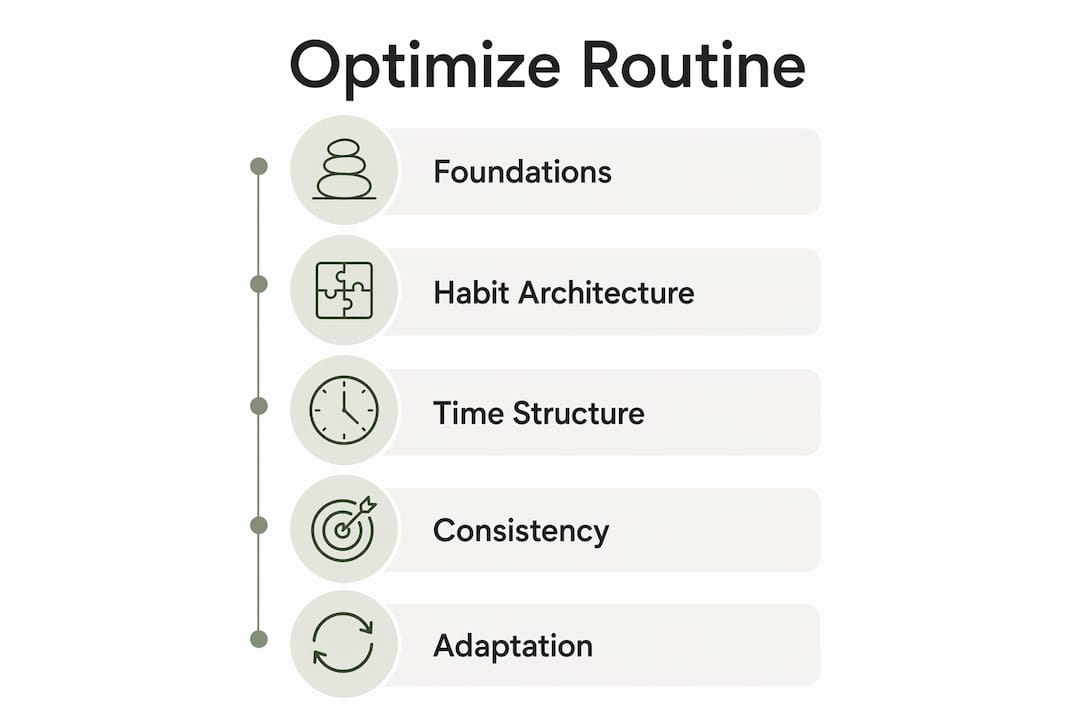
Sustainable daily routine design requires biological foundations first, then habit architecture, then time structure, with weekly calibration to maintain performance under real-world pressure.
| Point | Details |
|---|---|
| Foundations before complexity | Establish consistent sleep, hydration, and movement for at least 30 days before adding advanced protocols. |
| Habit stacking accelerates consistency | Anchor new behaviors to existing automatic habits using the 2-minute rule to build cue-response links faster. |
| Timeboxing replaces to-do lists | Assign tasks to fixed calendar blocks and run a 15-minute daily planning session to align workload with available time. |
| Stress-test against worst-case days | Design routines that hold at reduced scope during travel, overload, or low-energy days, not just ideal conditions. |
| Weekly calibration prevents abandonment | Review and adjust timing, scope, and buffers each week to keep routines realistic and sustainable. |
What I've learned coaching executives on routine design
The executives I've worked with who sustain high performance longest share one trait: they treat their routine as a system to maintain, not a standard to meet. The ones who burn out fastest are the ones chasing the perfect morning. They add cold plunges, journaling, meditation, and a 5K before 7:00 AM, then collapse by week three when one element fails and they abandon everything.
My honest position is that most professionals need less routine complexity, not more. The biological foundations, sleep quality, hydration, and 10 minutes of movement, deliver more cognitive return per minute than any advanced protocol layered on top of a broken sleep schedule. I've seen founders spend thousands on biohacking tools while sleeping six hours a night. The math does not work.
Identity-based habit language changed how I approach this with clients. When someone says "I am a person who plans his day," the behavior becomes self-reinforcing. When someone says "I'm trying to be more disciplined," it stays effortful. That shift in framing is free and it works faster than any supplement or system.
The final thing I'd tell any executive reading this: your routine does not need to be perfect. It needs to be calibrated. A routine you edit weekly and maintain at 70% capacity will outperform a perfect routine you restart every Monday for the rest of your career.
— Joakim
Viridos and the tools that support disciplined daily performance
Designing a high-performance routine is one thing. Tracking it with enough precision to improve it is another.

The Viridos Performance Journal is built for exactly this purpose. It connects your daily habits to your longer-term performance goals through a structured, premium journaling format produced in small batches in Sweden. The format reflects the same principles covered here: biological baselines, habit tracking, and weekly calibration built into a single daily practice. For executives who want structured support beyond the journal, Viridos Membership provides controlled access to evidence-based performance formulation and a community of high-agency professionals committed to long-term output. Both are designed for men who take their performance seriously and want tools that match that standard.
FAQ
What are the most important habits to build first in a daily routine?
Sleep, hydration, and movement form the biological foundation that all other habits depend on. Starting with these three for at least 30 days before adding complexity prevents cognitive overload and routine collapse.
What is habit stacking and why does it work?
Habit stacking anchors a new behavior to an existing automatic one, reducing the cognitive effort required to start. Beginning with a 2-minute version of the new habit builds the cue-response link faster during the critical formation window.
How does timeboxing differ from a standard to-do list?
Timeboxing assigns each task a fixed calendar block, which forces realistic scheduling and eliminates the open-ended nature of to-do lists. Tracking planned versus actual completion then refines your time estimates over weeks.
How do I keep my routine intact on difficult or unpredictable days?
Scale your habits down in scope rather than abandoning them entirely. Stress-testing your routine against worst-case days, heavy travel, back-to-back meetings, and low energy, ensures you have a viable minimum version ready when conditions are not ideal.
How often should I review and adjust my daily routine?
A weekly calibration session of 15 minutes is sufficient to adjust timing, reduce ambition, and add buffers before friction accumulates. Regular edits prevent the all-or-nothing failure pattern that causes most professionals to abandon their routines entirely.