
For most men, intermittent fasting does not meaningfully suppress androgen levels in a way that undermines strength, drive, or performance. Some trials show modest testosterone declines in lean, highly active men, while longer studies in men with obesity show no change at all in testosterone, DHEA, or SHBG. The priority is not the number on the lab report. It's whether energy intake, protein, and resistance training are dialed in enough to protect the function that androgens support.
TL;DR:
- Men with obesity on time-restricted eating see no significant change in testosterone, DHEA, or SHBG after 12 months, despite similar weight loss to calorie restriction.
- Lean, active men may experience modest testosterone declines during fasting protocols, but without losses in muscle mass or strength, due to differences in energy reserves and activity levels.
- Variability in fasting duration, individual body composition, training, and stress levels makes it difficult to isolate fasting as the direct cause of androgen shifts.
- Resistance training and sufficient protein intake (1.6 to 2.2 grams per kilogram of body weight) effectively preserve lean mass and performance during fasting.
- Regular blood testing should be timed carefully, after several weeks of stable fasting routines, and symptoms like fatigue or low libido merit prompt medical review.
Table of Contents
- Intermittent Fasting and Androgens: What the Human Trials Actually Show
- Why Androgen Markers Shift During Fasting: The Mechanisms
- Resistance Training and Protein: Your Buffer Against Hormonal Drift
- Building a Fasting Protocol That Protects Performance
- What to Test, When to Test, and When to See a Specialist
- A Note From Viridos on Fasting, Performance, and Longevity
- Treat Fasting as an Experiment, Not a Verdict
- Sources
- FAQ
Intermittent Fasting and Androgens: What the Human Trials Actually Show
The evidence on intermittent fasting and androgens is smaller and more fragmented than most fitness content implies. This isn't a settled science with a thousand replicated trials. It's a young field with a handful of well-designed studies pointing in a consistent if nuanced direction.
The most rigorous data point comes from a 12-month randomized controlled trial involving 90 adults with obesity. Researchers compared time-restricted eating (TRE) against daily calorie restriction and a control group. TRE produced significant weight loss, on par with calorie restriction, but total testosterone, DHEA, and SHBG did not shift in either direction. A 2024 medRxiv preprint analyzing a similar TRE versus calorie-restriction design reached the same conclusion: weight came off, androgen markers stayed put. That is a meaningful finding for the largest share of men considering fasting for body composition. If you carry excess fat mass, fasting appears to reshape your metabolism without touching your baseline hormone profile.
The picture shifts for a different population: lean, physically active young men. Studies in this cohort have observed measurable reductions in testosterone during fasting protocols. Notably, those reductions did not come paired with losses in muscle mass or strength. A 2022 review in Nutrients synthesizing this literature found the same divergence: androgen markers dipped in some lean, active male cohorts, while premenopausal women with obesity showed decreased androgens alongside rising SHBG, a distinctly different hormonal signature.
Key evidence patterns across trials:
- Men with obesity on time-restricted eating: no measurable change in total testosterone, DHEA, or SHBG over 12 months.
- Lean, active young men on fasting protocols: modest testosterone reductions observed, but strength and muscle mass held steady.
- Women, particularly premenopausal women with obesity: androgens tend to decrease while SHBG rises, a different pattern from most male responses.
- Sample sizes across this body of work remain small, and protocols vary widely in fasting window length and duration, which limits how confidently any single number can be generalized.
The evidence gap: No large, multi-year trial has isolated fasting-window length as the sole variable driving androgen changes in men. Most existing data comes from studies where fasting duration, calorie intake, and training status shift simultaneously, which makes it difficult to assign causation to any single factor.
A narrative review covering sex-specific responses to fasting reinforces this caution: the field lacks the scale and duration needed for firm conclusions, and what data exists points toward heterogeneity rather than a single universal effect. Men and women respond differently. Lean men and men with obesity respond differently. Even within a single trial, individual variation is substantial.
Why Androgen Markers Shift During Fasting: The Mechanisms
Testosterone doesn't operate in isolation. It responds to energy availability, the balance between calories consumed and calories burned relative to lean body mass. When that balance runs tight for extended periods, the hypothalamic-pituitary-gonadal axis, the signaling chain between your brain and your testes, can downregulate testosterone production as a conservation measure. This is not damage. It's an adaptive response to a perceived scarcity signal.
That mechanism explains the split in the trial data. Lean, active men training hard while fasting are more likely to run a genuine energy deficit relative to their output, which can trigger measurable testosterone declines. Men with obesity starting a fasting protocol typically have substantial energy reserves; the shift from constant eating to a restricted window represents less biological stress, since fat stores buffer the transition. Their axis rarely needs to signal scarcity in the same way.
What determines whether your androgens shift meaningfully:
- Your starting body composition and fat reserves relative to energy demands.
- The size of the caloric gap between what you burn and what you eat within your window.
- Training volume and intensity layered on top of the fasting protocol.
- How consistently you sleep and manage stress, both of which independently affect the HPG axis.
The clinical significance question matters more than the lab number itself. In the trials showing testosterone reductions among lean, active men, muscle mass and strength were preserved. That gap between a measured hormonal shift and an actual functional consequence is the detail most fasting content skips entirely.
Pro Tip: Don't panic over a single depressed testosterone reading if your training performance, recovery, and libido remain steady. A snapshot lab value taken during an adaptation period tells you less than three months of consistent strength numbers and how you feel walking into the gym.
Resistance Training and Protein: Your Buffer Against Hormonal Drift
The single most reliable lever for preserving lean mass and performance during fasting is not adjusting your eating window. It is what you do in the gym and what you eat when you do eat. A 2026 narrative review focused on men with obesity or metabolic dysfunction found that pairing intermittent fasting with resistance training and adequate protein preserved lean mass while still delivering fat loss, and that the metabolic upside consistently outweighed any transient hormonal shift.
Three practical rules follow directly from the trial evidence:
- Train against resistance, not just cardio, inside your fasting structure. Studies combining TRE with resistance training show lean mass preservation even when calorie intake drops. Cardio alone does not offer the same protective signal to muscle tissue.
- Target 1.6 to 2.2 grams of protein per kilogram of body weight, distributed across your eating window rather than crammed into one meal. Two to three protein-dense meals within an 8 to 10-hour window comfortably hits this range for most men.
- Treat energy deficit, not the fasting window itself, as the variable to control. A 2024 randomized trial makes this distinction directly: time-restricted eating without an aggressive calorie cut left androgen markers unchanged. It's the depth and duration of a deficit that drives risk, not simply compressing when you eat.
Pro Tip: If you train in the morning, break your fast with a protein-forward meal within an hour of finishing your session. This isn't about a mythical "anabolic window." It's about making sure your total daily protein target doesn't get squeezed out by a shorter eating period.
Building a Fasting Protocol That Protects Performance
Not every fasting window carries the same risk profile. For a performance-focused man balancing demanding work with serious training, protocol selection matters more than most guides admit.
Three protocol tiers, ordered by conservatism:
- Conservative TRE (12 to 14-hour fast): Minimal metabolic stress, easy to sustain indefinitely, and the least likely to touch energy availability enough to affect the HPG axis. A reasonable starting point for men over 45 or anyone with a demanding training load.
- Standard performance TRE (14 to 16-hour fast, the 16:8 structure): The most studied window and the one used in most of the trials cited above. Manageable for most men once adapted, though it requires more deliberate protein planning to hit intake targets in a shorter window.
- Early time-restricted eating (finishing meals earlier in the day): Some evidence suggests aligning the eating window with earlier hours supports circadian and metabolic function, though this comes at the cost of flexibility for men with late work dinners or evening training sessions.
Structuring the window itself matters as much as choosing one. Front-load your largest meal near your primary training session, keep peri-workout carbohydrate intake adequate if training intensity is high, and avoid stacking your entire protein target into a single sitting late in the window.
Signals that a protocol needs to be scaled back or stopped:
- Persistent fatigue that doesn't resolve after two to three weeks of adaptation.
- A noticeable, sustained drop in libido rather than a brief adjustment period.
- Declining strength numbers or stalled recovery across multiple training sessions.
- Abnormal lab results paired with any of the above symptoms, not in isolation.
Harvard Health's clinical overview of fasting side effects and the Mayo Clinic's fasting FAQ both recommend clinical consultation before starting extended fasting protocols if you carry existing metabolic conditions. That guidance holds regardless of which window you choose. If your energy, drive, or output for ways to boost vitality start trending the wrong direction, that's your signal to adjust before the lab work catches up.
What to Test, When to Test, and When to See a Specialist
A meaningful monitoring plan beats a single anxious lab order. Pull a panel that includes total testosterone, calculated free testosterone or SHBG and albumin (to calculate it), LH, and a straightforward symptom checklist covering energy, libido, mood, and sleep quality.
Timing changes what the numbers mean. Draw blood in the morning, when testosterone naturally peaks, and only after several weeks on a stable fasting routine rather than during the first adjustment period. A narrative review on sex-specific fasting responses notes that samples drawn immediately within or right after a fasting window can understate baseline testosterone, so schedule your draw on a normal eating day if your protocol allows it.
What warrants a call to a specialist:
- Total testosterone consistently below your lab's reference range across two separate draws.
- LH results that suggest a signaling issue between brain and testes rather than a peripheral one.
- Persistent symptoms (fatigue, low libido, mood decline) that don't track with training load or sleep debt.
For a deeper walkthrough of interpreting these numbers, Viridos's guide to free testosterone breaks down why calculated free testosterone often tells you more than the total figure alone.
A Note From Viridos on Fasting, Performance, and Longevity
I've spent years watching high-responsibility men chase performance metrics while ignoring the physiological baseline underneath them. Fasting sits at that intersection: a legitimate metabolic tool that gets misapplied when men treat a single lab number as a verdict rather than a data point.
This approach is built for men who want measured, disciplined approaches to performance longevity, not shortcuts dressed up as biohacks. If you're incorporating intermittent fasting into a broader performance strategy, pair it with structured tracking of training output, recovery, and drive, not just periodic bloodwork. Related reading on training's actual effect on testosterone and testosterone health and vitality will round out how fasting fits into the larger picture of hormonal resilience.
Treat Fasting as an Experiment, Not a Verdict
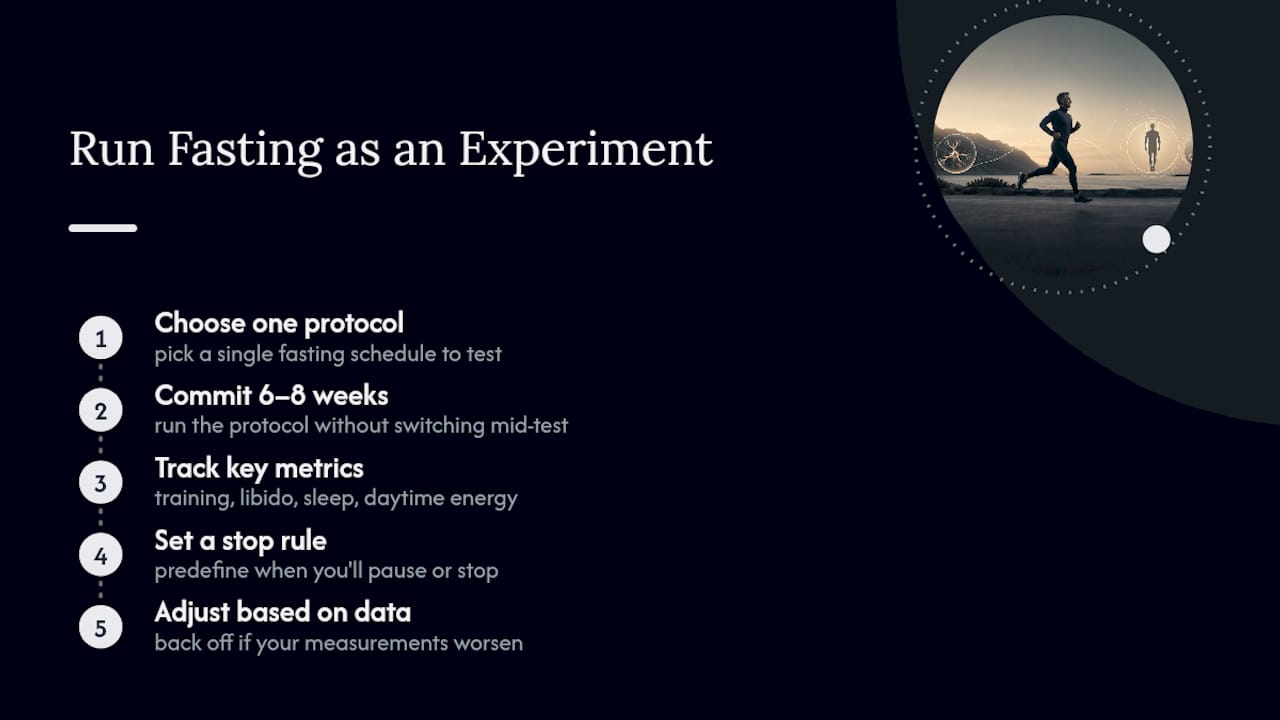
The men who get the most out of intermittent fasting run it like a small, disciplined trial. They pick one protocol, hold it for six to eight weeks, and track three or four metrics that actually matter: training numbers, libido, sleep quality, energy through the workday. They set a stop rule in advance rather than deciding mid-fatigue whether to push through.
Reversibility is the underrated advantage here. Nothing about a 14-hour eating window is permanent, and there's no cost to backing off if the data on your own body says otherwise. Start conservative, measure honestly, and let the results, not the trend, decide what stays in your routine.
— Joakim
This article is general information, not a substitute for advice from a qualified doctor. Consult a qualified healthcare professional about your own circumstances before acting on anything here.
Sources
- PubMed: Studies reporting reduced testosterone in lean active men during IF
- Time restricted eating vs daily calorie restriction RCT (2024)
- Narrative review (2026) on sex-specific responses and interaction with training/nutrition
- Time restricted eating versus daily calorie restriction on sex hormones (medRxiv, 2024)
FAQ
What happens in the body during a 16-hour fast?
After roughly 12 hours without food, glycogen stores deplete and the body shifts toward burning fat for fuel; by 16 hours, insulin levels drop further and growth hormone tends to rise, though androgen markers in most men remain stable unless a substantial calorie deficit is layered on top.
How does intermittent fasting affect cortisol levels?
Fasting can produce a modest, temporary rise in cortisol, particularly during the initial adaptation phase, but this typically normalizes as the body adjusts to a stable eating pattern within a few weeks.
Is intermittent fasting good for women?
Evidence suggests women, especially premenopausal women with obesity, show a different hormonal response than men, often with decreased androgens and increased SHBG, which is why protocols and recommendations should be sex-specific rather than copied directly from male-focused research.
Is intermittent fasting good for the body overall?
Short-term data points to benefits including weight loss, improved blood glucose control, and reduced inflammation, but long-term evidence remains limited, and the Mayo Clinic recommends clinical consultation for anyone with existing metabolic conditions before starting.