
Declining libido at 50 rarely traces to one cause. Gradual testosterone decline of roughly 1 to 1.5% a year combines with vascular health, poor sleep, medication side effects, and stress to blunt sexual desire. The natural levers with the strongest evidence behind them are resistance and aerobic exercise, weight management, better sleep with screening for sleep apnea, moderating alcohol, quitting smoking, and a review of current medications. Sudden or total loss of libido, signs of hypogonadism, or significant erectile dysfunction warrant a clinician's assessment, not a supplement aisle.
TL;DR:
- Testosterone decline of 1 to 1.5% annually results in a 20 to 30% reduction by late fifties, but free testosterone and vascular health play crucial roles.
- Sleep quality, vascular health, weight management, and moderation of alcohol and smoking have the strongest evidence for improving libido at age 50.
- Most men with low desire do not have true hypogonadism; symptoms often relate to sleep disturbances, medication effects, or vascular issues.
- Over-the-counter supplements lack robust evidence and can pose safety risks; focus on lifestyle changes first before considering unverified products.
- A structured, disciplined approach over six to eight weeks, beginning with sleep and exercise, yields measurable improvements in energy and libido.
Table of Contents
- What Changes With Age: Hormones, SHBG, and Libido män 50 naturligt
- What Else Lowers Libido: Sleep, Medications, and Stress
- The Natural Strategies With the Strongest Evidence Behind Them
- Diet, Nutrients, and the Supplement Aisle: What Holds Up
- What to Ask Your Doctor to Test
- A Disciplined Protocol for Men Who Take Performance Seriously
- Why the Testosterone Obsession Misses the Point
- Precision Support for Men Who Have Already Done the Work
- Sources
What Changes With Age: Hormones, SHBG, and Libido män 50 naturligt
Testosterone production falls by about 1 to 1.5% per year starting in a man's thirties, and by age 50 to 60 total production can run 20 to 30% lower than it was at 30. That number matters, but it is not the whole story, and men chasing a natural, evidence-grounded answer to libido decline at 50 need to understand what else moves alongside it.
Sex hormone-binding globulin, or SHBG, tends to climb with age. SHBG binds testosterone in the bloodstream, and only the unbound, or "free," fraction is biologically active. A man can have a total testosterone reading that looks perfectly normal on paper while his bioavailable testosterone, the portion his tissues can actually use, sits meaningfully lower. This is why a single total testosterone number rarely tells the full story, and why symptomatic men with normal-looking labs often need free or calculated bioavailable testosterone checked before anyone rules hormones out.
The 1 to 1.5% figure: Applied over two decades, that annual decline compounds into a 20 to 30% reduction in total testosterone production by a man's late fifties, according to Testmottagningen. It is gradual, not a cliff, and gradual declines respond well to gradual, disciplined intervention.
The pattern of desire itself often shifts too. Many men in their fifties notice they stop experiencing the spontaneous, out-of-nowhere desire common in their twenties and thirties, replaced by what is sometimes called responsive libido, desire that arises after physical intimacy or touch begins rather than before it. This is a normal recalibration, not a malfunction, and men who understand it tend to feel less anxious and adapt their approach with a partner more effectively than men who interpret it as failure. The refractory period, the recovery time between arousal cycles, typically lengthens as well.
Vascular health deserves equal billing with hormones. An erection is fundamentally a vascular event, dependent on healthy endothelial function and adequate blood flow. Men carrying metabolic syndrome, the cluster of elevated blood pressure, high blood sugar, excess abdominal fat, and abnormal cholesterol, face substantially higher risk of both erectile dysfunction and reduced libido, independent of testosterone levels.
What tends to get overlooked in casual conversation about "low T" is how uncommon clinically confirmed hypogonadism actually is relative to how often men suspect it. True hypogonadism requires a documented pattern:
- Low testosterone confirmed on two separate morning blood draws
- Consistent clinical symptoms (low libido, fatigue, reduced muscle mass)
- Ruled-out alternative explanations (sleep apnea, medication effects, thyroid dysfunction)
Most men who feel their drive has faded do not meet that bar. Their labs come back within normal range, and the real drivers sit elsewhere, in sleep architecture, in vascular fitness, in stress load, or in a medication they have been taking for years without connecting it to the bedroom.
What Else Lowers Libido: Sleep, Medications, and Stress
Hormones get the headline, but sleep quality may be doing more damage. Obstructive sleep apnea, a condition where breathing repeatedly stops and starts during sleep, suppresses testosterone production and wrecks the deep sleep stages where the body does its hormonal repair work. Men with untreated apnea report both lower libido and flatter daytime energy, a double penalty that no amount of gym discipline fully offsets.
Two screening signs are worth taking seriously: loud, frequent snoring reported by a partner, and daytime sleepiness that persists despite adequate hours in bed. Either one justifies asking a physician about a sleep study, since poor sleep and undiagnosed apnea measurably reduce testosterone and daytime energy.
Medications are the next place to look, and they are frequently overlooked because men rarely connect a prescription started years ago with a symptom that crept in gradually. Several common drug classes carry libido as a documented side effect:
- SSRIs and other antidepressants, which can blunt desire and delay orgasm
- Beta blockers, prescribed for blood pressure and heart conditions
- Finasteride and other 5-alpha reductase inhibitors, used for hair loss or prostate enlargement
- Opioid pain medications, which suppress the hypothalamic-pituitary-gonadal axis directly
- Some antihistamines and sedatives, taken regularly for sleep or allergies
Finasteride is FDA-indicated for men only. Women who are or may become pregnant must not handle crushed or broken finasteride tablets, due to the risk of harm to a male fetus. It can also cause sexual side effects (reduced libido, erectile dysfunction) in a minority of men, which usually resolve after stopping treatment. Discuss these risks with a physician before starting.
None of this means stopping a prescribed medication unilaterally. It means bringing the question directly to the prescriber: is there an alternative in this class with a better sexual side-effect profile, and is the dose still appropriately calibrated.
Psychological and relational factors round out the picture, and clinicians increasingly stress that many men attribute sexual difficulty solely to testosterone when stress, depression, anxiety, or relationship friction are doing the real damage. A demanding executive role, chronic sleep debt, and an under-maintained relationship compound each other in ways a blood test cannot capture.
Pro Tip: Run a two-week self-audit before assuming a hormonal cause. Track sleep hours and quality, alcohol intake, stress load, and any medication timing changes. Patterns that correlate with low-desire days often point straight at the fixable driver.
The Natural Strategies With the Strongest Evidence Behind Them
Lifestyle change is not the consolation prize before "real" treatment. It is the first-line intervention with the most consistent supporting evidence, and it is the intervention every clinician will ask about before considering anything pharmacological. Cohort data from the Health Professionals Follow-up Study found that men with higher physical activity levels and leaner body composition had substantially lower rates of erectile dysfunction than sedentary, heavier peers, even after adjusting for other health conditions.
Here is a prioritized sequence, ranked by the strength of evidence and the speed of expected returns:
-
Exercise, structured and consistent. Aim for resistance training two to three times weekly plus roughly 150 minutes of moderate aerobic activity. Resistance work supports lean mass and metabolic rate; aerobic work improves endothelial function directly, the same vascular mechanism responsible for erection quality. Expect measurable mood and energy shifts within three to four weeks, with libido and erectile improvements often trailing by six to eight weeks as cardiovascular fitness builds.
-
Weight management, targeting visceral fat specifically. Abdominal fat is metabolically active tissue that converts testosterone to estrogen via the aromatase enzyme, meaning excess visceral fat can actively work against a man's hormonal profile. Even a 5 to 10% reduction in body weight, concentrated through diet and training rather than crash dieting, tends to improve both metabolic markers and reported libido.
-
Sleep hygiene, treated as a discipline, not an afterthought. A consistent sleep window, a dark and cool bedroom, and a hard cutoff on screens 60 to 90 minutes before bed all support deeper sleep architecture. If snoring or daytime fatigue are present, a sleep study should come before any other intervention, since untreated apnea can quietly cancel out gains from exercise and diet.
-
Alcohol moderation. Alcohol is a vasodilator in the short term but a depressant on erectile function and testosterone production with regular heavy use. Cutting back to occasional, moderate intake rather than daily drinking shows up in erection quality within weeks for many men.
-
Smoking cessation. Smoking damages the endothelium directly, the vascular lining responsible for the blood flow response behind an erection. This is one of the more immediate wins available. Quitting improves vascular function measurably within months, and the benefit compounds over time.
-
Stress management, fitted to an executive schedule. This does not require an hour of meditation a day. A five-minute box-breathing protocol (four seconds in, four-second hold, four seconds out, four-second hold) before high-stakes meetings, combined with two or three short walk breaks during the workday, measurably lowers cortisol load without requiring a calendar overhaul.
-
Deliberate intimacy and communication work. Since responsive libido becomes the norm rather than spontaneous desire for many men past 50, initiating physical closeness without the pressure of a specific outcome, and talking openly with a partner about the shift, tends to reduce performance anxiety and rebuild consistency.
Pro Tip: Do not stack all seven changes simultaneously. Pick the two with the clearest personal relevance, sleep and exercise are the most common starting pair, run them for three weeks, then layer in the next.
Evidence consistently backs this sequencing. Lifestyle changes, exercise, weight loss, smoking cessation, and reduced alcohol intake are the interventions most consistently recommended for improving sexual function before anything pharmacological enters the conversation, and the same cohort data confirm modifiable behaviors like activity level and leanness correlate with lower erectile dysfunction rates even in men managing other health conditions.
For men who want a fuller breakdown of training cadence and recovery habits that fit a demanding schedule, Viridos has published a practical guide to sustained vitality covering exercise sequencing in more depth.
Diet, Nutrients, and the Supplement Aisle: What Holds Up
A Mediterranean-style diet, heavy on vegetables, fatty fish, olive oil, and nuts, and light on processed food and added sugar, supports the same vascular and metabolic pathways behind healthy erectile function and testosterone production. This is not a libido diet in the fad sense. It is a cardiovascular diet that happens to have direct sexual-health payoff, because the blood vessels feeding erectile tissue are downstream of the same arteries a cardiologist worries about.
A short list of nutrients carries genuine, if modest, supportive evidence:
- Vitamin D, relevant for men with a documented deficiency, since low vitamin D correlates with lower testosterone in several studies, though supplementation in men who are not deficient shows little added benefit
- Zinc, essential for testosterone synthesis, but only meaningfully helpful in men with an existing deficiency rather than as a blanket dose
- Omega-3 fatty acids, supportive of endothelial and cardiovascular health through anti-inflammatory pathways, typically from fatty fish or a fish oil supplement in the 1 to 2 gram range
Beyond that shortlist, the picture gets considerably murkier. A Harvard Health review found that most over-the-counter supplements marketed for sexual function lack robust evidence of benefit, and some carry real safety risk, including contamination and undisclosed pharmaceutical ingredients.
Independent testing has repeatedly found "natural" sexual-enhancement products spiked with sildenafil or similar prescription compounds, undisclosed to the buyer, which is dangerous for any man taking nitrates for heart conditions.
A broader pharmacological review of plant compounds historically marketed as aphrodisiacs reached a similar conclusion: evidence for many botanicals is mixed and safety data remain incomplete, which argues for skepticism toward bold claims and a preference for products with transparent sourcing and third-party testing over anonymous capsule blends. Any man on nitrate medication, or with cardiovascular disease, should treat unverified sexual-enhancement products as a conversation for his physician, not a solo decision.
What to Ask Your Doctor to Test
Before assuming a hormonal cause, or accepting a normal-range result as the end of the conversation, request the right panel. A single testosterone draw, taken at the wrong time of day, is one of the most common sources of misleading results.
-
Total testosterone, drawn in the morning. Testosterone follows a circadian rhythm and peaks earlier in the day, so an afternoon draw can understate a man's true baseline. A low or borderline result should be repeated on a separate morning before any conclusion is drawn.
-
Free or calculated bioavailable testosterone, alongside SHBG. This is the pairing that catches the man whose total testosterone looks fine but whose bioavailable fraction is quietly low, since elevated SHBG is common enough in men over 50 to change the clinical picture entirely.
-
LH and FSH, if testosterone comes back low, to distinguish a pituitary-level problem from a testicular one.
-
A metabolic screen: fasting glucose or HbA1c, a full lipid panel, blood pressure, and waist circumference, since metabolic syndrome is one of the strongest predictors of both erectile dysfunction and reduced libido.
-
A sleep study referral, if snoring or daytime fatigue are present, before assuming any other cause.
Certain symptoms deserve urgent, not routine, attention: a sudden and complete loss of libido, rapid-onset erectile dysfunction, unexplained weight loss, or new breast tissue changes. Any of these justifies a same-week appointment rather than a wait-and-see approach, and may warrant referral to urology or endocrinology directly. Viridos covers the full testing conversation, including how to interpret a report, in its guide to serum testosterone support.
A Disciplined Protocol for Men Who Take Performance Seriously
Executives rarely lack the will to change. They lack a sequenced plan that respects a calendar already at capacity. A six to eight week starter protocol works best when it stacks in order: week one and two, a sleep audit and consistent bedtime; week two through four, resistance and aerobic training established as a fixed calendar block; week three onward, one meaningful nutrition shift plus a medication review with a prescriber; week six, bloodwork if libido has not measurably improved.
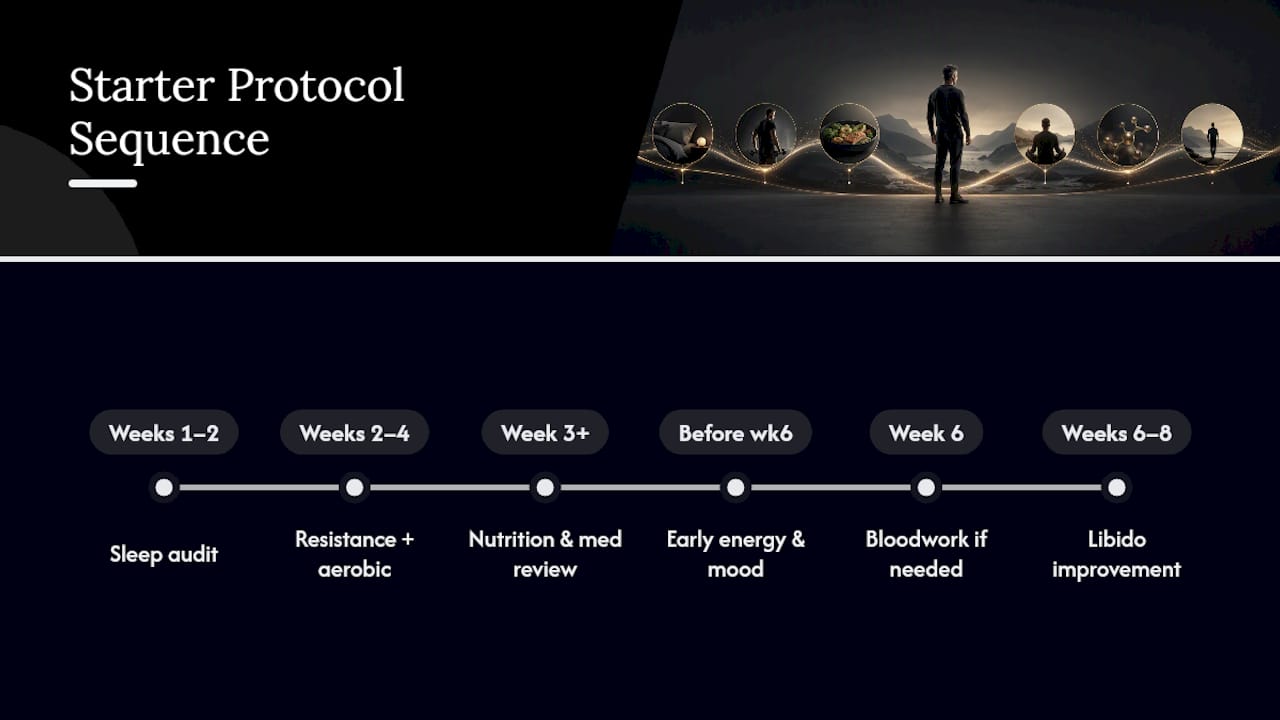
Expect early signals, better morning energy, steadier mood, before libido itself shifts, which typically follows by week six to eight as vascular and hormonal markers respond. Viridos has mapped this sequencing in more detail in its guide to natural support for suspected androgen deficiency and its executive-focused review of plant androgen concepts. A disciplined man treats supplementation, when appropriate, as a complement to this protocol under clinical guidance, never as a substitute for it.
Why the Testosterone Obsession Misses the Point
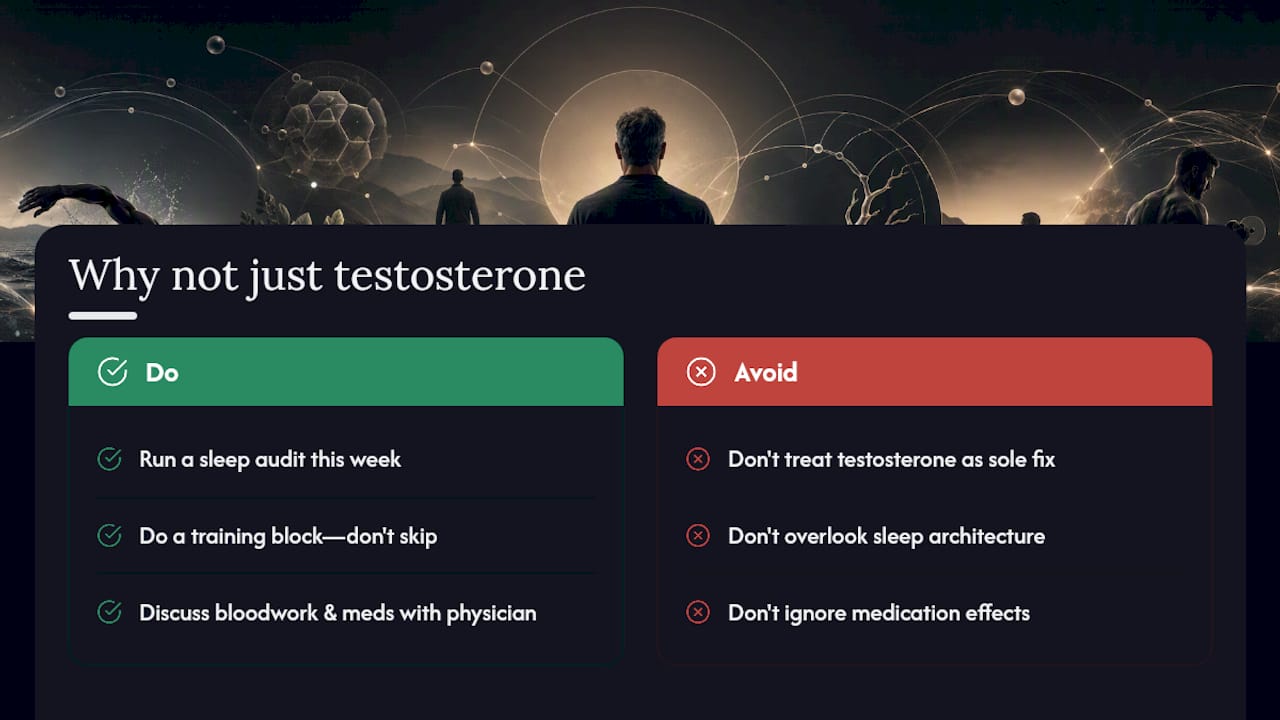
The most common mistake I see men make at 50 is treating testosterone as a single dial that explains everything and fixes everything if only it can be turned up. It is one input among several, and rarely the loudest one. Vascular fitness, sleep architecture, and the medications sitting quietly in a bathroom cabinet usually do more damage than a modest, age-appropriate hormone decline ever will.
What actually works is unglamorous: a sleep audit, a training block that does not get skipped when the calendar fills up, and a direct conversation with a physician about both bloodwork and prescriptions. Disciplined men already know how to run this kind of process in their work. The task is applying the same rigor here, starting with one audit this week, not a complete overhaul.
— Joakim
Precision Support for Men Who Have Already Done the Work
An offering exists for executives who have already tightened sleep, training, and diet and want a controlled, plant-derived layer on top of that foundation. This product is formulated for sublingual delivery with phytoandrogen-related compounds and produced in small batches under a controlled membership model rather than sold openly on a shelf.

This is not positioned as a substitute for the bloodwork, sleep study, or medication review outlined above. It is built to complement that clinical groundwork for a man who has already had the conversation with his physician and wants disciplined, ongoing support alongside it. Membership for this offering is controlled and limited to maintain quality rather than scaling to mass-market volume. If the protocol in this article describes where you already stand, review the Viridos membership page to see whether the program fits your situation.
This article is general information, not a substitute for advice from a qualified doctor. Consult a qualified healthcare professional about your own circumstances before acting on anything here.
Sources
- Därför sjunker testosteronet hos män med tiden | Testmottagningen
- Sexual Function in Men Older Than 50 Years of Age: Results from the Health Professionals Follow-up Study
- Can supplements save your sex life? | Harvard Health
- Aphrodisiac plants: pharmacology and toxicology review (PMC)