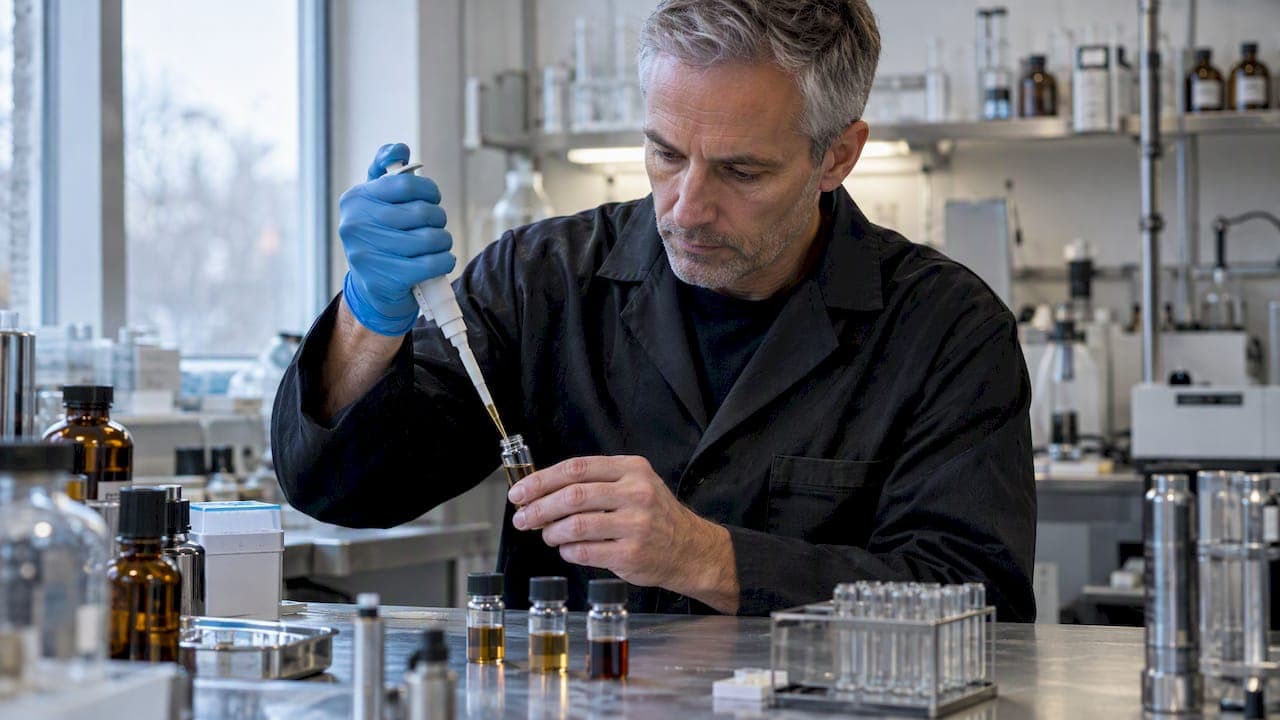
A standardized plant extract is one adjusted and documented to deliver a defined amount or range of specific marker constituents, not a loose botanical approximation. Before you trust the label, confirm three things: the Drug Extract Ratio (DER), the declared marker content in milligrams or percent, and whether a certificate of analysis (COA) is available on request. Standardization alone never guarantees efficacy or safety.
TL;DR:
- Standardized plant extracts must specify the extract ratio, marker content, and provide a certificate of analysis to ensure transparency.
- Markers are either active compounds linked to effects or analytical identifiers for batch consistency, with active markers being more relevant for efficacy claims.
- Batch documentation, including extraction solvents and assay methods like HPLC, is crucial for verifying product quality and adherence to regulation.
- Labels in Sweden and the EU require specific species naming, numeric dose declarations based on analysis, and disclaimers if health claims are made.
- Only products with complete, lot-matched COAs that confirm marker ranges and contaminant tests should be trusted for quality and consistency.
Table of Contents
- What "standardized plant extracts" actually means
- How manufacturers measure and document standardization
- Labeling and regulatory expectations in Sweden and the EU
- How to judge quality: the COA and trust signal checklist
- Examples worth knowing: ginseng, berberine, and curcumin
- How disciplined small-batch producers document standardization
- Executive takeaway: a procurement checklist worth applying
- A documented, small-batch option built for this standard
- FAQ
- Sources
What "standardized plant extracts" actually means
The term gets used loosely, so the distinctions matter. EMA guidance on herbal medicinal products defines a standardized extract as one adjusted to a defined content of constituents with known therapeutic activity, within a specified tolerance. A quantified extract, by contrast, is adjusted to a defined range of constituents whose contribution to activity is not fully established. Both differ from an unadjusted "native" extract, which carries whatever concentration nature and processing happen to produce.
That distinction runs straight into the question of markers. An active marker is a compound known or believed to contribute to the biological effect. An analytical marker exists purely for identification and batch consistency, with no claim of activity. Mixing these up is where marketing overreaches: a producer can report a marker percentage that proves the extract is authentic without proving it does anything.
Standardization exists because raw botanicals vary enormously by soil, harvest timing, and genetics. A disciplined process converts that variability into a repeatable dose.
Markers worth tracking on any label:
- Marker type: active (linked to effect) or analytical (identity only).
- Marker range: a percentage or milligram value, not a vague "contains extract" claim.
- Extract classification: standardized, quantified, or native.
How manufacturers measure and document standardization
Standardization is a documentation exercise as much as a chemical one. The starting point is DERgenuine, the ratio of raw plant material to finished extract before any adjustment, which EMA guidance requires producers to declare alongside the extraction solvent used. A DER of 10:1 extracted in ethanol behaves nothing like the same ratio extracted in water, so the solvent disclosure is not a technicality. It defines what actually ended up in the bottle.
Producers adjust extracts in two main ways: blending batches of differing natural potency to hit a target range, or adding excipients to dilute an overly concentrated batch. Both are legitimate when disclosed. Neither is acceptable when hidden behind a vague "proprietary blend."
Analytical confirmation typically relies on a short list of methods:
- HPLC (high-performance liquid chromatography): separates and quantifies individual marker compounds.
- UV-Vis spectroscopy: measures total compound classes, faster but less specific than HPLC.
- Mass spectrometry: confirms compound identity with high precision, often paired with HPLC.
EMA's guideline on specifications for herbal substances and preparations states that standardized extracts require quantitative determination of markers, specified acceptance ranges, and complete production and control documentation. That means a COA should show not just "contains ginsenosides" but a numeric result against a stated range, with the test method named.
Because no two harvests are identical, specifications are reported as batch averages with tolerances, commonly within a band such as plus or minus 10% of the declared value, rather than a single fixed number.
Labeling and regulatory expectations in Sweden and the EU
Regulation sets the floor for what a label must say, and Sweden's rules are specific. Under Livsmedelsverket's food supplement legislation, implemented through LIVSFS 2023:3, manufacturers must name the plant species, in Swedish or Latin, and state the amount of that species present in the recommended daily dose. Where a substance has a known physiological effect, the amount must be given numerically as a batch-average figure based on the manufacturer's own analysis, not an estimate or a marketing range.
At the EU level, EMA's quality guidance frames standardization for herbal medicinal products specifically, requiring documentation of the extraction process, the marker substance, validated assay methods, and defined tolerances before a product can carry that classification formally.
The line between a food supplement and a medicinal product matters more than most buyers realize. A product that claims to treat, cure, or prevent a disease crosses into medicinal territory and triggers an entirely different approval pathway, regardless of how it is sold.
Watch for:
- Species naming: Swedish common name or Latin binomial, not a trade name alone.
- Numerical dose declaration: a specific amount in the recommended daily serving, not "proprietary strength."
- Claim language: structural or performance language versus disease-related claims, which signal a regulatory mismatch.
How to judge quality: the COA and trust signal checklist
A certificate of analysis is the single most useful document a producer can hand you, and most will not volunteer it unless asked. Request one for the specific lot you are purchasing, not a generic template from the product line.
A credible COA should include marker identity and the assay result against a stated range, along with screens for contaminants that matter in botanicals: pyrrolizidine alkaloids, heavy metals, pesticide residues, and microbial limits. EFSA's Compendium of Botanicals catalogs species known to carry substances of potential concern, and its absence from that list does not mean a species is automatically safe, only that it has not been flagged.
Pro Tip: Ask specifically for the lot-matched COA, not a representative one, since representative documents can mask a weaker batch.
A practical sequence for evaluating any supplier:
- Request the COA tied to your exact lot number, not a general specification sheet.
- Verify the testing laboratory holds recognized accreditation and is independent of the manufacturer.
- Compare the declared marker percentage against the clinical or review literature for that compound.
- Cross-check the extraction solvent and DER against what the label claims.
- Confirm a GMP statement and traceable harvest origin accompany the batch.
Red flags include a refusal to share lot-specific testing, missing extraction solvent disclosure, marker values with no stated range, and an absence of any third-party lab name. Our guide on third-party testing and the COA checklist walks through this verification process step by step, and our breakdown of quality checks for small-batch supplements covers the documentation executives should expect before committing to a supplier.
Examples worth knowing: ginseng, berberine, and curcumin
Three botanicals illustrate how standardization claims show up in practice, and where the evidence does or does not keep pace with the marketing.
Ginseng extracts are commonly standardized to total ginsenosides, with declared ranges varying depending on extraction intensity. Evidence on fatigue and subjective energy exists in the literature but remains mixed in strength, which is a case where a precise marker percentage says more about manufacturing consistency than about guaranteed effect.
Berberine is typically standardized to a declared berberine content, and because berberine itself is both the active and analytical marker, assay precision matters more here than with botanicals that rely on proxy markers. A low-quality assay can overstate content meaningfully.
Curcumin extracts from turmeric are standardized to total curcuminoid percentage at high concentrations for concentrated products, but curcuminoids alone say little about bioavailability. Review literature notes that marker-based standardization is one part of an end-to-end quality system, covering agriculture, harvest timing, extraction, and analytics, rather than a single number that guarantees outcome. That distinction is why many curcumin formulations pair the marker declaration with a bioavailability-enhancing delivery method, since the raw curcuminoid percentage alone does not describe how much reaches circulation. Our explainer on low-heat green extraction covers how extraction method interacts with marker preservation across botanicals like these. Readers interested in how botanical consistency plays out in everyday categories may also find our partner analysis of black tea's consistent compound profile a useful parallel.

How disciplined small-batch producers document standardization
We treat standardization as a disclosure obligation, not a marketing line. That means publishing the DER, the extraction solvent, the marker identity, and the assay method behind every batch, with COA access available to those who ask. We favor low-heat extraction methods because elevated temperatures can degrade thermolabile markers before they ever reach the bottle, a tradeoff we weigh directly against shelf-stability targets. Traceability runs from harvest lot through to the finished formulation, so a batch number connects to a verifiable production record rather than a generic specification sheet.
Executive takeaway: a procurement checklist worth applying
Standardized extracts earn their place in a performance regimen only when the documentation behind them is complete. Before approving a supplier, request the DER, extraction solvent, marker identity, assay method, and a lot-matched COA. Reject anything built on a "proprietary blend" with no numeric marker disclosure. Accept only when the declared marker range aligns with what the evidence base actually supports for that compound, not what the label implies.
— Joakim
A documented, small-batch option built for this standard
We built our own production practice around the same documentation standard outlined above: small-batch Swedish production, disclosed extraction methods, and batch testing available to members who ask for it. If you are comparing a supplier's COA against the checklist in this guide, that comparison is exactly the discipline we expect from our own process.

Our membership runs on multiple tiers with details and current prices available on our pricing page. If the documentation standard here matches what you expect from a supplement in your own regimen, review the membership overview to see how the application process works.
This article is general information, not a substitute for advice from a qualified doctor. Consult a qualified healthcare professional about your own circumstances before acting on anything here.
FAQ
What does "standardized" mean on a plant extract label?
It means the extract has been adjusted to deliver a defined amount or range of a specific marker compound, verified through assay methods such as HPLC. The declaration should include the marker name, its percentage or milligram value, and the extraction ratio behind it.
What are some examples of plant-based medicines?
Common examples include ginseng extracts standardized to total ginsenosides, berberine extracts standardized to berberine content, and turmeric extracts standardized to curcuminoid percentage. Each relies on a declared marker range and a validated assay method rather than a generic botanical claim.
What is plant-based medicine?
Plant-based medicine refers to therapeutic preparations derived from botanical sources, ranging from traditional herbal remedies to regulated herbal medicinal products governed by frameworks like EMA's herbal medicinal product guidance. The regulatory classification depends on the claims made and the level of standardization documented.
How is standardized different from organic or wildcrafted?
Standardization concerns documented marker content and manufacturing consistency, while organic and wildcrafted describe growing or harvesting methods. A supplement can be organic without being standardized, and standardized without being organic, since the two labels answer different questions entirely.
Does a high marker percentage guarantee effectiveness?
No. A declared marker percentage confirms identity and manufacturing consistency, not proven clinical effect, since many markers are analytical rather than active. Evaluate the marker type alongside the available evidence for that specific compound before assuming a higher number means a stronger outcome.
Sources
- Livsmedelsverket — food supplements legislation
- European Medicines Agency — scientific guidelines on herbal medicinal products