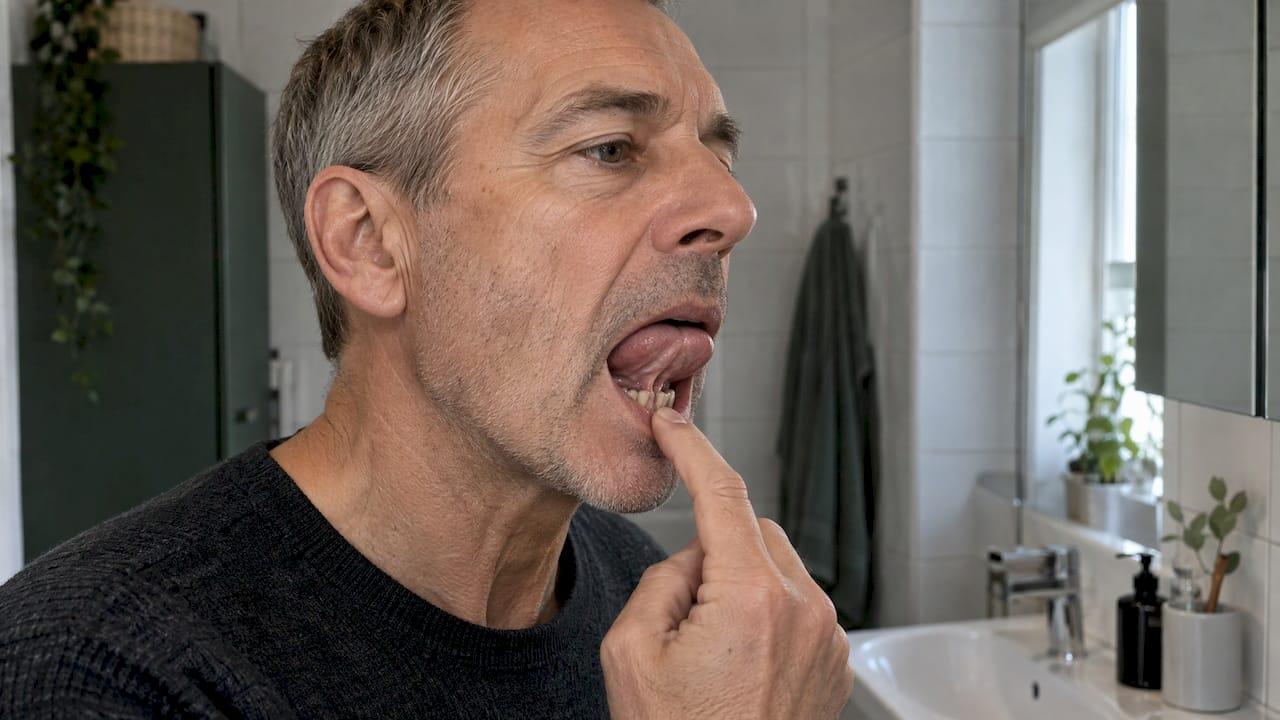
Sublingual means under the tongue. Buccal means between the cheek and the gum (1177 describes buccal tablets and powders as placed under the upper lip). Both routes deliver a dose through the lining of the mouth, so it enters circulation without first passing through the digestive tract and liver. The sublingual route is generally the faster of the two, because the tissue under the tongue is thinner. The buccal route suits formats that stay in place longer. For a precision oral spray, the sublingual site is the logical one, and the details of placement, timing and consistency decide how well it works for you.
This guide is written for men who run demanding schedules and prefer to understand a delivery route before they build a routine around it.
TL;DR
- Sublingual is under the tongue; buccal is between the cheek and gum. Both absorb through the oral mucosa and bypass hepatic first-pass metabolism.
- Sublingual absorption is generally faster because the epithelium is thinner. Buccal formats can support longer, extended release through mucosal adhesion.
- Contact time is the controllable variable: swallowing, eating or drinking before absorption is complete can reduce uptake.
- Not every compound suits these routes. Solubility, lipid solubility and molecular size decide it, so formulation matters more than the route name.
- Follow the instructions that come with your product, and consult your physician about any prescription medicine.
Table of Contents
- What the two terms mean
- How absorption differs between the two sites
- What determines how much actually gets absorbed
- Why sublingual suits a spray
- How to use a sublingual product well
- Choosing between sublingual and buccal
- What this means for a performance routine
- Perspective
- Access to VIRIDOS
- FAQ
- Sources
What the two terms mean
The mouth is lined with a mucous membrane, the oral mucosa, which is thin and rich in blood vessels. Two regions of it are used for delivery.
Sublingual refers to the floor of the mouth beneath the tongue. A peer-reviewed 2019 review by Susan Hua defines sublingual placement as under the tongue. Swedish public health guidance from 1177 says sublingual tablets and sprays are absorbed through the mucosa of the mouth and act within minutes.
Buccal refers to the cheek lining. The same review defines buccal placement as between the cheek and the gum. 1177 describes buccal tablets and powders as placed under the upper lip, where a tablet adheres to the gum when moist and acts for as long as it remains in place.
The word "buccal" comes from the Latin for cheek. If you only remember one distinction, remember this: sublingual is a quick route from a fixed spot, buccal is a slower, more sustained one from a different spot.

How absorption differs between the two sites
The difference comes down to tissue. According to Hua's review, sublingual absorption is generally faster than buccal absorption because the epithelium, the outer cell layer a compound must cross, is thinner there. A 2020 review by Lam and colleagues describes the sublingual mucosa as more permeable and faster acting, while buccal delivery may support extended release through longer adhesion.
| Feature | Sublingual | Buccal |
|---|---|---|
| Location | Under the tongue | Between cheek and gum (or under the upper lip, per 1177) |
| Tissue | Thinner, more permeable | Thicker, less permeable |
| Typical speed | Generally faster | Generally slower |
| Typical format | Spray, fast-dissolving tablet, drops | Adhesive tablet, film, powder |
| Duration | Short, defined window | Can be extended while the format stays in place |
| Passes through liver first? | No, enters systemic circulation directly | No, enters systemic circulation directly |
The last row is the reason both routes interest people who care about delivery. A compound absorbed through the mucosa enters systemic circulation and bypasses hepatic first-pass metabolism, the liver's initial processing of anything absorbed from the gut. Our article on the first-pass effect and sublingual delivery explains what changes in practice, and how uptake under the tongue works goes deeper on the mechanism.
Does the route actually change outcomes?
It can. A Swedish multicentre crossover study from 1987 enrolled 126 patients and compared sublingual and buccal glyceryl trinitrate formulations, a heart medicine. Buccal administration was more effective for prophylactic use before expected angina attacks: 74% of attempts versus 66%, with p<0.05. The point for you is not the drug. It is that site and formulation interact, and a longer-lasting buccal format can outperform a fast sublingual one when the goal is cover over time rather than speed.
What determines how much actually gets absorbed
The route is only the first variable. The research points to several others.
- The compound itself. Hua's review states that effective mucosal absorption depends on aqueous solubility, lipid solubility and molecular size. Not every drug or active is suitable for these routes.
- The formulation. How a compound is extracted, carried and presented decides whether it can cross the membrane at all. This is why two products placed in the same spot can perform differently.
- Contact time. Swallowing, eating or drinking before absorption is complete can reduce uptake, depending on the product.
- Saliva. Lam and colleagues explain that saliva helps a dose dissolve, but dry mouth (xerostomia) may impair absorption, and excessive saliva can produce a wash-out effect.
- Condition of the mucosa. Irritation or damage to the lining changes how it behaves.
Notice what is absent from the list: willpower and hype. Delivery is a matter of physiology and formulation, which is why we treat it with the same discipline as any other part of a performance routine. Our guide to oral mucosa absorption zones maps where uptake happens.
Why sublingual suits a spray
A spray distributes a measured dose across the floor of the mouth in one motion. That makes the sublingual site a natural fit: the tissue is thin, the area is reachable, and the format has no tablet to dissolve or adhere. A buccal format, by contrast, is designed to stay put against the cheek or gum and release over a longer period.
This is the reasoning behind VIRIDOS being formulated as a precision oral spray. Our approach to extraction and delivery is set out on the science page. If you are weighing delivery formats more broadly, liposomal vs sublingual compares the two on the criteria that matter to a busy professional.
How to use a sublingual product well
The product's own instructions always come first. Beyond that, the evidence supports a few habits.
- Sit upright or stand. 1177 advises this for oral-mucosa medicines, which keeps the dose where it belongs rather than running toward the throat.
- Place it precisely. Under the tongue for sublingual products. Do not aim for the cheek or the throat.
- Leave it alone. Hold the dose in place and avoid swallowing for as long as the instructions say. Contact time is what you are protecting.
- Do not eat or drink during absorption. 1177 notes that eating and drinking are possible with a buccal tablet in place, but should be avoided with the oral powder it describes. For a sublingual product, assume the same caution unless the leaflet says otherwise.
- Keep the timing the same each day. A routine you can repeat is worth more than a perfect one you abandon. Our 20 to 30 minute fasted routine and the guide to the best time for a sublingual spray by objective both build on this principle.
If you also plan around training, the logic of sequence is the same one used when deciding whether something goes before or after a workout: decide the order once, then keep it. For our own view of the training window, see what a mouth spray before training does and doesn't do.
A note on mouthwash and oral hygiene
Readers often ask whether mouthwash interferes. No source we have reviewed gives a product-independent rule, so the safest course is practical. Because rinsing, swallowing and drinking all shorten the time a dose sits on the mucosa, keep your rinse separate from your dose, and do not rinse, eat or drink immediately after placing it. Your product leaflet is the authority on the interval. If you have persistent dry mouth, irritation or sores, speak to your dentist or physician, since saliva and mucosal condition both influence absorption.
Choosing between sublingual and buccal
Use your goal and the format to decide, rather than the route name.
- You want a defined, quick window that you can place in a routine: sublingual.
- You want a dose that stays in place for longer, and the product is designed for it: buccal.
- You dislike tablets or want precise dosing by actuation: a sublingual spray.
- You take prescription medicine: use exactly the route your physician or pharmacist specified. Do not switch a prescribed medicine between sublingual and buccal on your own, since the two are not interchangeable.
For executives, the practical advantage of a spray is consistency. The same motion, the same place, the same time, in under a minute.
What this means for a performance routine
Men in demanding roles tend to treat their routines as systems: inputs, timing, measurement. Delivery belongs in that system. Sleep, training, nutrition and stress management remain the foundation. A well-chosen delivery route supports that foundation by making the one thing you control, how and when you take it, repeatable.
That is the idea behind performance longevity: not a single dramatic intervention, but small, disciplined choices sustained over years. Our Performance Journal collects our writing on these subjects.
Perspective
We built VIRIDOS around a simple conviction: a formulation is only as good as its delivery, and delivery is only as good as the discipline of the man using it.
Sublingual placement was a deliberate choice. The tissue under the tongue is thin and well supplied with blood, a spray gives a measured, repeatable dose, and the whole routine takes less time than a cup of coffee. For men who carry heavy responsibilities, removing friction from a routine is part of the design.
Our plant-derived formulation uses proprietary extraction methods to deliver phytoandrogen-related compounds, and we produce it in small batches in Sweden. We do not promise outcomes. We aim to support drive, clarity and consistency in men who are still in the arena, and we describe our approach openly so that you can judge it on its reasoning.
The route matters. The routine matters more.
Joakim
Access to VIRIDOS
VIRIDOS is offered through a controlled membership with limited cohort access. Applicants are approved individually, and approved members receive regular shipments of the oral spray. The Member plan is $99 per month and the Professional plan is $299 per month. You can read how membership works on the membership page.

FAQ
What is the difference between sublingual and buccal administration?
Sublingual administration places a dose under the tongue, while buccal administration places it between the cheek and gum. Sublingual absorption is generally faster because the tissue is thinner. Buccal formats can stay in place longer and support extended release.
Does putting something under your tongue make it work faster?
For suitable products, yes. 1177 says sublingual tablets and sprays are absorbed through the mucosa of the mouth and act within minutes. Speed still depends on the compound, the formulation and how long the dose stays in contact with the tissue.
Can I eat or drink right after a sublingual dose?
It is better to wait. Swallowing, eating or drinking before absorption is complete can reduce uptake, depending on the product. Check the instructions that come with your product for the exact interval.
Can any compound be taken sublingually or buccally?
No. Suitability depends on properties such as aqueous solubility, lipid solubility and molecular size, along with the formulation. That is why the product's design matters as much as the route.
Does dry mouth affect absorption?
It can. Saliva helps a dose dissolve, and a dry mouth may impair absorption, while excessive saliva can wash a dose away. If dry mouth is persistent, discuss it with your dentist or physician.
Sources
- Läkemedel som du tar genom munnen, 1177
- Advances in Nanoparticulate Drug Delivery Approaches for Sublingual and Buccal Administration, Hua, 2019
- Transmucosal drug administration as an alternative route, Lam et al., 2020
- Buccal versus sublingual glyceryl trinitrate administration, 1987
- Red light therapy before or after a workout