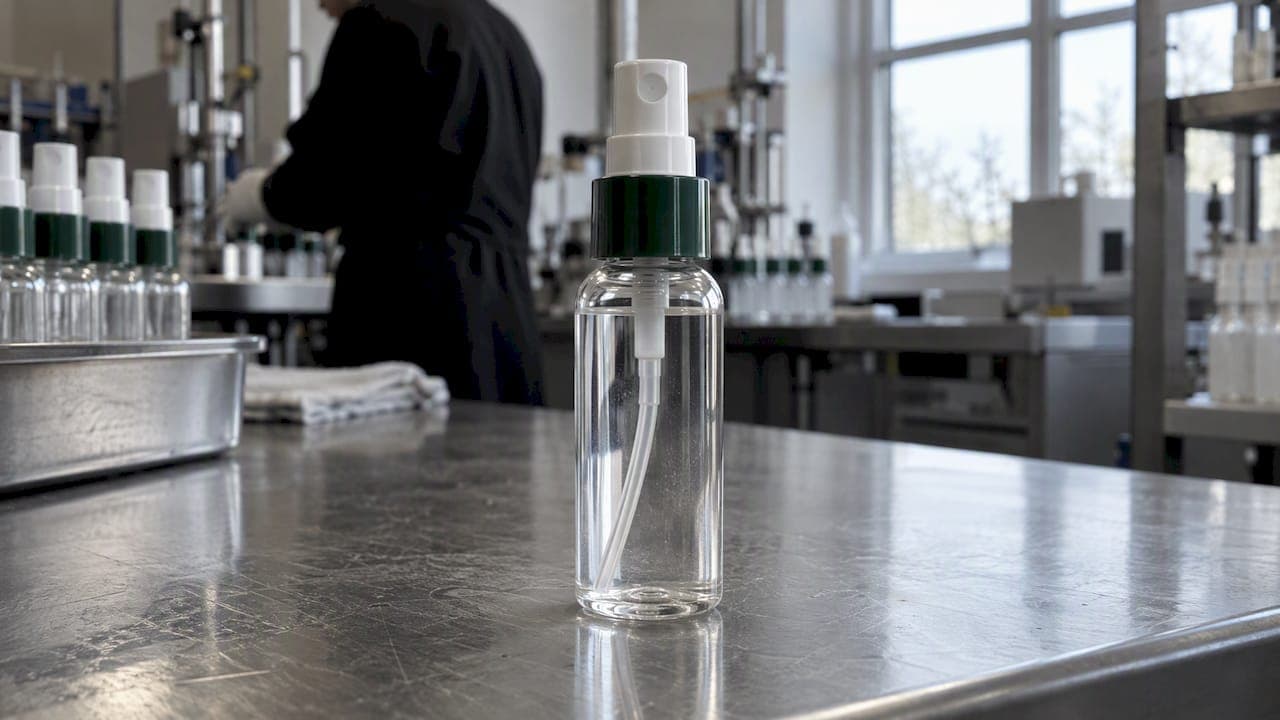
Dosing precision in an oral spray means that every actuation delivers the same amount, in the same place, under the same conditions. It rests on three things: a pump that repeats, a technique you repeat, and a label that states the dose plainly. If any one of them is loose, the product you bought is not the product you are using. This guide sets out how to judge each of the three, and what Swedish rules say about how spray products may be described.
TL;DR
- Precision is a property of the whole system: formulation, pump, your technique and the label. A premium formulation in a poorly handled bottle is not precise.
- Prime the pump, hold the bottle upright and use the same routine each time. These habits matter more than most users assume.
- In Sweden, a dietary supplement is regulated as food. It must be offered in measured doses, and it may not carry medical claims. Be wary of any spray that blurs this line.
- Evidence for sprays sold to fight colds remains weak according to the Swedish authority SBU. Apply the same discipline to any performance claim.
- Track your routine for a few weeks, not your impressions for a few days.
Table of Contents
- What dosing precision actually means
- Why the spray format raises the question
- Five variables that decide whether a spray is precise
- A repeatable technique, step by step
- Not every spray is dosed the same way
- What Swedish rules say about supplements and doses
- Read the evidence with discipline
- Our perspective: precision is a discipline, not a feature
- How membership supports a precise routine
- Comparing options without losing the thread
- Common mistakes that undermine precision
- FAQ
- Sources
What dosing precision actually means
The phrase is easy to say and hard to deliver. In practice it covers four separate questions.
- Dose consistency. Does each press release the same volume? A well-made metering pump is designed to do this. A worn or unprimed one is not.
- Placement consistency. Does the dose land where it is intended? With a sublingual spray that means under the tongue, not on the teeth or in the throat.
- Timing consistency. Is the dose taken at the same point in your day, relative to meals, sleep and training?
- Label clarity. Does the product state a dose per actuation and a recommended daily amount you can follow without guessing?
Most discussion focuses on the first question and ignores the other three. Yet for a man running a company on six hours of sleep, the second and third are where drift happens. You travel, change time zones, skip breakfast, rush a morning. The dose stays the same on paper while the conditions around it change.
If you want the broader frame for premium supplements in general, we cover it in Dosing Precision in Premium Supplements: What It Requires. This article narrows the lens to the spray format.
Why the spray format raises the question
A capsule is a fixed unit. You swallow it, and the dose is whatever the manufacturer pressed into it. A spray is different: the dose is produced by a mechanism at the moment you use it. That gives you flexibility, because you can divide an amount across several actuations. It also adds a variable that capsules do not have: the user.
The Swedish Medical Products Agency explains that the choice between a tablet, a liquid or a spray depends largely on how fast an effect is needed and where the substance has to act. Its own example contrasts an asthma spray, where relief can be felt almost at once, with a medicine whose effect appears only after weeks. The general lesson applies beyond medicine: the delivery form is a design decision, and it carries a technique requirement with it.
A sublingual spray places a formulation on the thin mucosa under the tongue. The philosophy behind that choice is local access. The point of the format is not speed for its own sake but a predictable route that does not depend on what else is in your stomach. That only works if the dose is actually placed where it is meant to go.
We cover the question of absorption in more detail in Mouth Spray Bioavailability for Executives.

Five variables that decide whether a spray is precise
1. The pump
The pump is the metering device. Look for a stated dose per actuation and a product that tells you how many actuations a bottle contains. If a brand cannot tell you either, it is describing a feeling, not a dose.
2. Priming
A new pump holds air. The first actuation or two may deliver a thin or uneven mist. Prime until the mist is uniform before your first real dose, and again if the bottle has stood unused for a long time. Follow the instructions printed with your specific product, since priming requirements differ between pumps.
3. Bottle orientation
Most pumps draw liquid through a tube that reaches the bottom of the bottle. Tilt the bottle too far, especially when it is nearly empty, and the tube can pull air. The result is sputtering and a smaller dose. Hold the bottle upright unless the instructions say otherwise.
4. Nozzle direction
If the spray lands on your teeth or the front of your tongue, part of the dose is swallowed or wasted before it reaches the intended tissue. Aim deliberately. For a sublingual spray, lift the tongue and direct the nozzle under it.
5. Routine
The same time, the same sequence, the same number of actuations. Routine turns a product into a protocol. It also makes any change in how you feel attributable to something you can name.
A repeatable technique, step by step
This is a general routine for a sublingual oral spray. Always defer to the instructions on your own product.
- Wash your hands and check that the nozzle is clean and dry.
- Hold the bottle upright. If the pump is new or has not been used for some time, prime it away from your face until the mist is even.
- Close your lips around nothing: keep the mouth open, lift the tongue and aim the nozzle at the tissue beneath it.
- Press firmly and fully in one motion. A half press delivers a partial dose.
- Keep your tongue still for a short moment and avoid swallowing immediately.
- Wait before eating or drinking, as your product's instructions advise.
- Wipe the nozzle and close the bottle. Store it as the label directs.
We set out a full morning protocol, with timing, in Fasted Sublingual Spray: A 20–30 Minute Routine for Consistency. If you are deciding when in the day to use a spray at all, The Best Time for a Sublingual Performance Spray, by Objective walks through the trade-offs.
Not every spray is dosed the same way
The search results for this topic mix very different products, and the dosing logic differs between them.
| Type of oral spray | How dosing is usually framed | What it means for precision |
|---|---|---|
| Medical device sprays for the throat | A fixed number of actuations at set intervals, with a daily maximum | Rigid schedule, defined by the manufacturer |
| Sprays for dry mouth or breath | As needed, often between meals | Flexible by design; the aim is comfort, not a fixed amount |
| Nicotine and other medicinal sprays | Dose per actuation, regulated as medicines | Strict, documented dosing under pharmaceutical rules |
| Supplement sprays | Measured dose per actuation, stated daily amount | Precision depends on label clarity and the user's routine |
Swedish public health guidance illustrates the second row. On bad breath, the national health portal 1177 describes oral products as something you try and adjust to your own needs. The clinical knowledge base for dental professionals says the same about dry mouth products: choose a sugar-free option and let the patient test what works. That is sensible for comfort products. It is the wrong standard for a performance supplement, where the purpose of the routine is consistency.
What Swedish rules say about supplements and doses
In Sweden, a dietary supplement (kosttillskott) is a food. The Swedish Food Agency's inspection wiki describes supplements as concentrated sources of nutrients or other substances, offered in measured units and taken in small measured amounts. A dose you can measure is therefore part of the category itself, not a marketing extra.
The boundary with medicines is just as important. The same authority explains that the classification of a product as a medicine is made on an overall assessment of ingredients, dosing instructions, purpose, claims and product name. Two consequences follow for you as a buyer:
- A supplement that promises to manage symptoms of disease is claiming to be something else. Look at how the product is described, not only at what is inside.
- Dosing language matters. A rigid therapeutic schedule, with intervals and maximum counts tied to a health condition, belongs to the world of medical devices and medicines, with the documentation duties that come with it.
For a fuller checklist, read 4 Legal Checks for Oral Spray Supplements in Sweden for Executives. On origin, Swedish Made Supplements: Five Checks Executives Must Verify covers what "Swedish" should and should not mean on a label.
Read the evidence with discipline
Precision in dosing is worth little if the claim behind the product is inflated. The Swedish Agency for Health Technology Assessment and Assessment of Social Services (SBU) reviewed vitamins, minerals and medical device products sold to prevent or shorten colds. Its report, published in August 2024, found the evidence for the device sprays weak, with many studies limited by method and by industry sponsorship.
A physician who contributed to the project put the position plainly in an interview with MåBra: better trials are changing the picture for some groups, but the science is not settled for the general population, and bold claims deserve scrutiny.
We take the same view of our own category. A spray is a delivery format. It is not proof. The questions to ask of any product, ours included, are these:
- Is the dose per actuation stated?
- Is the daily amount stated, and does it make sense?
- Does the company describe the product as a food supplement, and avoid medical language?
- Can you see how the formulation is made and where?
- Does the brand separate what is known from what is assumed?
Our perspective: precision is a discipline, not a feature
We build Viridos for men who carry real responsibility and who are tired of products that ask for belief instead of attention. Our view of dosing precision comes from that audience.
First, precision begins at production. We make our oral spray in small batches in Sweden because a smaller run is easier to hold to a standard. A formulation that is consistent from bottle to bottle is the foundation. Without it, your technique has nothing stable to be consistent with.
Second, we choose sublingual delivery as a philosophy of control. You decide when to take it, you place it yourself, and you can see exactly what you did. That puts the responsibility where a disciplined man wants it: with him.
Third, we ask members to keep a simple record. Time of day, number of actuations, whether you ate, how you slept. After a few weeks the record tells you more than any single morning will. It is the same habit you apply to a quarterly review: decisions are better when the evidence is inspectable.

Fourth, we do not promise outcomes. Our compounds are plant-derived and our language stays within what a food supplement may say. We would rather you judge the product by what it does for your routine over months than by an instruction to expect a dramatic change in a week.
The man who is still in the arena at sixty is rarely the one who found a shortcut. He is the one who made a sound routine hard to break.
— Joakim
How membership supports a precise routine
Viridos is offered through controlled membership, after an individual application. The Member plan is 99 USD per month and the Professional plan is 299 USD per month. Both are described on the pricing page. If you want to understand how access works before you apply, start with the membership overview, or read how we think about longevity and performance strategy.
Comparing options without losing the thread
If you are evaluating sprays more widely, compare them by the criteria above, not by the promise on the front of the box. Two of our guides do this by category, without relying on slogans: Top 5 Sublingual Spray Alternatives 2026 and Top 3 Oral Spray Supplement Alternatives 2026. For dose planning in a busy week, see Calculate Spray Supplement Doses for Busy Executives, No Guesswork. And if the formulation itself is the question, Standardized Plant Extracts: 10:1 DER Isn't Enough for Swedish Execs explains why a ratio on a label says less than it appears to.
Common mistakes that undermine precision
- Skipping the prime. The first press from a new or idle pump may be thin. Prime first.
- Tilting the bottle. Especially near the bottom of the bottle, tilting invites air into the tube.
- Half presses. A short, hesitant press delivers less than a full one. Press firmly and completely.
- Wrong target. A spray directed at the teeth or the front of the tongue is partly wasted.
- Changing three things at once. If you change the time, the dose and your diet in the same week, you learn nothing.
- Judging by one day. Travel, stress and poor sleep distort a single day. Judge across weeks.
- Storing carelessly. Heat and sunlight can affect any formulation. Keep the bottle as the label directs, and not in a hot car or a gym bag in summer.
FAQ
How many sprays make one dose?
It depends entirely on the product. The label should state the dose per actuation and the recommended number of actuations. Throat sprays sold as medical devices commonly use fixed schedules, while supplements follow the amount stated by the manufacturer. Never carry the dosing of one product over to another.
Do I need to prime an oral spray?
Usually yes, when the pump is new or has not been used for a while. Press away from your face until the mist is even, then take your dose. Check the instructions for your specific product, because pump designs vary.
Can I use a spray supplement as I would a medicine?
No. In Sweden, supplements are regulated as food and are not intended to manage disease. If you have a medical condition, take medication, or are unsure whether a supplement suits you, speak with your doctor or pharmacist before you start.
How long should I keep a routine before judging it?
We suggest a few weeks of consistent use, with a short daily log. A single day tells you about that day: sleep, stress, meals and travel all move the picture. Weeks of steady data tell you about the product.
Is a spray more precise than a capsule?
Not automatically. A capsule is a fixed unit, so it is precise by construction. A spray can be just as precise when the pump is well made and you use it with a consistent technique. The advantage of a spray is control over placement and timing, and that advantage is real only if you keep the routine disciplined.
Sources
- SBU: Effects of vitamins, minerals and medical device products on colds
- MåBra: Do ColdZyme and Viruseptin actually work?
- Swedish Medical Products Agency: How medicine works
- Swedish Food Agency inspection wiki: Dietary supplements
- Swedish Food Agency inspection wiki: Products related to dietary supplements
- 1177: Bad breath
- 1177 for healthcare professionals: Dental medicines, dry mouth