
TL;DR:
- Research shows that sustained mental focus and a clear sense of purpose independently predict increased longevity, with a two standard deviation shift associated with over eight extra years of life. Perceived social connection quality impacts mortality more than objective social isolation, emphasizing relationship depth over quantity for aging well. Incorporating purpose, mindset, and meaningful relationships into daily routines forms the thirdspan, a critical dimension that significantly influences lifespan beyond health metrics.
Sustained mental focus and a clear sense of purpose are among the most powerful predictors of how long you live. A 2026 PLOS ONE meta-analysis found that higher purpose predicts longevity independent of baseline health, with a relative risk of 0.83 for all-cause mortality. A two standard deviation shift in purpose correlates with over eight additional years of life. That number is not a motivational abstraction. It is a clinical signal. For professionals aged 40 to 65 operating in high-stakes roles, understanding the role of focus in longevity is not optional. It is the most underutilized performance variable in your arsenal.
What does science say about focus, purpose, and longevity?
The 2026 PLOS ONE research is the most rigorous evidence to date on how mental focus and purpose extend life. Critically, the study controlled for baseline health behaviors, meaning the effect of purpose on mortality is not simply a proxy for people who already exercise and sleep well. Adjusting for more objective health measures attenuates the association, but purpose retains independent effect even under stricter controls. This distinction matters for executives who already track their VO2 max and sleep scores. Purpose adds a layer that biomarkers alone cannot capture.

The American Heart Association reinforces this from a neurological angle. Brain health across the lifespan is shaped by psychological health, sleep quality, and social conditions, not just physical inputs. Cognitive decline risk decreases when mental health practices, quality sleep, and social integration are maintained from midlife onward. For a 50-year-old founder or executive, this means the mental habits you build now compound over decades.
Three findings from the current research base deserve direct attention:
- A relative risk of 0.83 for all-cause mortality is associated with higher purpose, placing it in the same tier of influence as established lifestyle factors like regular exercise.
- The American Heart Association identifies sleep, mental health, and social support as core inputs to brain aging, with effects that accumulate across life stages.
- Purpose's longevity benefit is biologically and clinically relevant, not merely a psychological comfort. Attention directed toward meaning changes physiology.
"The purpose–longevity link is not a soft finding. It survives adjustment for baseline health, behavioral confounders, and demographic variables. It belongs in the same conversation as diet and exercise." — PLOS ONE, 2026
How do social connections and mental focus interact in aging?
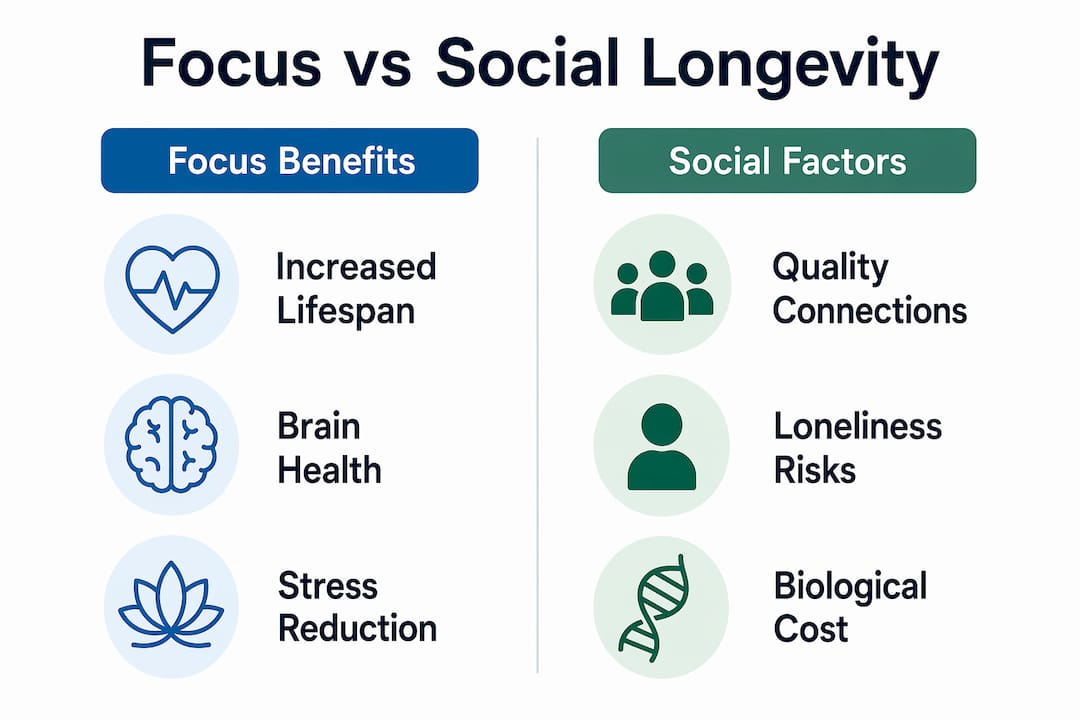
The relationship between social life and longevity is more nuanced than most professionals realize. A JAMA Network Open study introduced the concept of "social asymmetry," the gap between perceived loneliness and actual social isolation. The finding is counterintuitive: loneliness predicts mortality more strongly than objective isolation does. Socially vulnerable individuals showed hazard ratios of 1.13 for all-cause mortality and 1.16 for cardiovascular disease risk. Feeling disconnected is the variable that kills, not the size of your contact list.
A parallel finding from Nature Communications quantifies the biological cost of weak social support. Adults over 50 with low social support showed physiological age acceleration averaging 1.9 years older than peers with strong support networks. That acceleration was sustained over four years and represents 35% greater biological aging. For a 55-year-old executive, this is not a soft social science finding. It is a measurable shift in cellular aging driven by perceived relational quality.
| Social factor | Mortality or aging impact |
|---|---|
| High loneliness vs. low isolation | Hazard ratio 1.13 for all-cause mortality |
| Low social support (50+) | 1.9 years of physiological age acceleration |
| Strong social support | 35% reduction in biological age acceleration |
| Perceived connection quality | Stronger predictor than network size |
The practical implication is that focus on relationship quality, not quantity, is the lever. Executives who maintain two or three deeply engaged relationships outperform those with broad but shallow networks on longevity metrics. This reframes the importance of concentration for longevity: it is not just about cognitive output at your desk. It includes the deliberate attention you give to the people who matter.
Pro Tip: Audit your social portfolio the same way you audit your calendar. Identify the two or three relationships that generate genuine connection and schedule protected time for them monthly. Perceived loneliness, not isolation, is the mortality risk.
What is the "thirdspan" of longevity and where does focus fit?
Stanford Lifestyle Medicine introduced a framework in 2026 that redefines what it means to live long well. Beyond lifespan (how long you live) and healthspan (how long you live without disease), the thirdspan framework adds a third dimension: mindset, purpose, relationships, and joy. This is where mental focus and lifespan intersect most directly for high-performing professionals.
The thirdspan is not a soft add-on to your health protocol. Stanford's research shows that mindset influences mortality risk substantially, sometimes more than actual physical activity. Individuals who believed they were not active enough showed up to 72% higher mortality risk over 21 years, regardless of their objective activity levels. Belief and attention shape biology. That is not philosophy. It is measurable outcome data.
For professionals building a performance longevity strategy, the thirdspan framework offers a practical division of labor:
- Healthspan tasks: Sleep optimization, exercise programming, medical follow-up, nutrition protocols, and stress physiology monitoring.
- Thirdspan tasks: Mindset work, purpose articulation, relationship investment, and deliberate joy practices.
"Most executives I work with have the healthspan side covered. They track sleep, train consistently, and get their bloodwork done. The gap is almost always in the thirdspan. They have no system for purpose, no practice for joy, and no language for what flourishing actually means to them." — Stanford Lifestyle Medicine, 2026
The role of mindfulness in aging fits squarely in the thirdspan category. Mindfulness is not a relaxation technique. It is a mechanism for sustaining directed attention toward what matters, which is the operational definition of focus in this context. Professionals who practice structured reflection, whether through journaling, meditation, or deliberate review, consistently report higher scores on purpose and meaning measures.
How can professionals aged 40 to 65 cultivate focus for longevity?
Translating research into daily practice requires specificity. Generic advice to "find your purpose" does not survive contact with a 60-hour work week. The following framework is built for professionals who need precision, not inspiration.
-
Define your purpose in operational terms. Purpose is not a mission statement. It is the answer to: "What am I building, and for whom?" Write it in one sentence. Review it weekly. The PLOS ONE data shows that purpose predicts longevity independent of health behaviors, meaning this single cognitive habit carries measurable biological weight.
-
Separate healthspan and thirdspan tasks in your weekly review. Longevity coaching distinguishes these two categories deliberately. Healthspan tasks are measurable and medical. Thirdspan tasks are relational and psychological. Both require scheduled attention. Neither substitutes for the other.
-
Track perceived connection, not just social activity. The JAMA Network Open finding on social asymmetry means that attending networking events does not protect you. Feeling genuinely connected does. Ask yourself weekly: "Do I feel seen and supported?" That question is a longevity metric.
-
Monitor your mindset narrative around health behaviors. Stanford's data on belief and mortality risk means that how you talk to yourself about your activity levels matters clinically. If you consistently frame yourself as "not doing enough," you may be generating a mortality risk independent of your actual behavior. Reframe with evidence, not optimism.
-
Integrate joy tracking alongside performance metrics. Tracking joy and purpose alongside health metrics helps cultivate the balanced focus that the thirdspan framework requires. Use a structured journal or review system to log what generated genuine satisfaction each week, not just what you accomplished.
Pro Tip: The most effective longevity habit for executives is a weekly 15-minute review covering three questions: What gave me energy this week? Who did I connect with meaningfully? What am I building toward? This practice addresses healthspan, social connection, and purpose simultaneously.
For professionals who want to go deeper on healthspan for executives, the research consistently points to the same conclusion: the men who age best are not the ones who optimize hardest. They are the ones who focus most deliberately.
Key takeaways
The role of focus in longevity is measurable, independent of baseline health, and directly actionable through purpose, social connection, and mindset practices.
| Point | Details |
|---|---|
| Purpose predicts lifespan | A two standard deviation shift in purpose correlates with over 8 additional years of life. |
| Loneliness outweighs isolation | Perceived disconnection carries a 1.13 hazard ratio for mortality, stronger than objective isolation. |
| Social support slows aging | Low support accelerates physiological age by 1.9 years in adults over 50. |
| Mindset shapes mortality | Believing you are insufficiently active raises mortality risk by up to 72% over 21 years. |
| Thirdspan requires its own system | Healthspan and thirdspan tasks are distinct and both require scheduled, deliberate attention. |
Focus as the variable executives keep ignoring
I have worked with enough high-performing men in their 40s and 50s to recognize a pattern. They have the health side dialed in. They train, they sleep reasonably well, they get their labs done. What they are missing is not a supplement or a protocol. It is a clear answer to the question of what they are focused on and why.
The research on purpose and longevity did not surprise me. What surprised me was how resistant disciplined, data-driven men are to taking it seriously. There is a cultural bias in executive circles toward measurable inputs: VO2 max, HRV, testosterone levels. These matter. But the PLOS ONE data shows that purpose predicts mortality with a relative risk of 0.83, which is a stronger signal than many biomarkers these same men track obsessively.
The thirdspan framework from Stanford gave me language for something I had observed for years. The men who age with the most vitality are not the ones who optimized their way through their 50s. They are the ones who stayed curious, maintained real relationships, and kept building toward something that mattered to them. That is not soft. That is the data.
My honest view is that the role of mindfulness in aging is undervalued precisely because it cannot be easily quantified. But perceived loneliness, mindset narratives, and purpose clarity all have measurable mortality correlates now. The evidence base has caught up. The question is whether you will act on it before the compounding works against you.
— Joakim
How Viridos supports your focus and performance longevity
Viridos is built for the professional who takes longevity as seriously as performance. The Viridos Performance Journal is designed specifically to help executives track mental focus, vitality, purpose, and the thirdspan metrics that standard health apps ignore. It brings structure to the weekly review practice that the research consistently supports. For professionals who want a more personalized approach, the Viridos Executive Membership provides controlled access to performance formulations and longevity strategies tailored to high-responsibility men. This is not a generic wellness subscription. It is a precision tool for men who want sustained edge through every decade.
FAQ
Does focus actually improve life expectancy?
Yes. A 2026 PLOS ONE meta-analysis found that higher purpose is associated with a relative risk of 0.83 for all-cause mortality, independent of baseline health and behaviors. A two standard deviation shift in purpose correlates with over eight additional years of life.
How does mental focus affect physical health?
Mental focus directed toward purpose and meaning influences brain health, stress physiology, and social behavior, all of which the American Heart Association identifies as core drivers of cognitive aging and longevity. The effect is biological, not merely psychological.
Is loneliness or isolation more dangerous for longevity?
Perceived loneliness is more dangerous than objective isolation. JAMA Network Open research shows that social asymmetry, feeling more lonely than isolated, carries hazard ratios of 1.13 for all-cause mortality and 1.16 for cardiovascular disease risk.
What is the thirdspan and why does it matter for professionals?
The thirdspan is Stanford Lifestyle Medicine's term for the dimension of longevity beyond lifespan and healthspan, encompassing mindset, purpose, relationships, and joy. It matters because mindset alone can influence mortality risk by up to 72% over two decades, independent of actual physical activity levels.
How can executives start building focus for longevity today?
Start with a weekly 15-minute review covering purpose, meaningful connection, and energy sources. Separate healthspan tasks from thirdspan tasks in your planning system, and track perceived connection quality, not just social activity volume.