
TL;DR:
- Cognitive longevity involves actively preserving key brain functions to maintain decision-making and leadership skills into older age.
- Lifestyle factors such as sleep, blood pressure, exercise, and cognitive training significantly influence long-term cognitive health and organizational performance.
Cognitive longevity is the active preservation of memory, processing speed, attention, and executive function across the lifespan — sustaining the neural efficiency required for autonomous, high-stakes decision-making well into your 60s and beyond. For executives and founders, it is not a wellness concept. It is an operational competency.
Start today with these four moves:
- Measure your blood pressure now. Midlife hypertension is one of the most modifiable drivers of late-life cognitive decline.
- Set a fixed sleep window. Choose a consistent 7–8-hour block and protect it like a board meeting.
- Schedule a brisk 30-minute aerobic session this week. Aerobic exercise increases cerebral blood flow and spurs new synaptic connections.
- Book a baseline cognitive assessment. A validated digital test or brief neuropsychological screen gives you a performance benchmark to track against.
Your target outcome: a stable executive-function score at 3-month intervals, paired with blood pressure below 120/80 mmHg and consistent 7–8 hours of quality sleep.
Table of Contents
- Why cognitive longevity is mission-critical for leaders
- The cognitive domains that matter most for executives
- The evidence-backed pillars that protect your cognitive edge
- How to measure and track your cognitive health over time
- Your 90-day cognitive longevity action plan
- Common myths about cognitive aging worth correcting
- When to seek a professional cognitive assessment
- How genetics shapes your cognitive longevity strategy
- Key Takeaways
- The Viridos perspective on performance longevity
- Viridos supports your 90-day cognitive longevity plan
- Useful sources
Why cognitive longevity is mission-critical for leaders
Preserved executive function is not a personal health goal. It is an organizational asset. When your working memory degrades, multi-threaded decisions become error-prone. When processing speed slows, you miss the inflection point in a negotiation. When attention regulation fails under stress, cascading operational risk follows.
The CDC's Healthy Brain Initiative frames cognitive health as a multidimensional continuum spanning memory, language, judgment, attention, and the capacity to live a purposeful life — not a binary state you either have or lose. For men in high-responsibility roles, the relevant threshold is not dementia. It is the subtle erosion of judgment, resilience, and strategic clarity that precedes any clinical diagnosis by years.
A significant portion of dementia cases are attributable to modifiable risk factors — meaning the majority of cognitive decline risk is within your control.
Sleep loss alone measurably impairs prefrontal cortex function within 24 hours. Uncontrolled hypertension compounds vascular damage silently across decades. For a founder managing a $50M portfolio or a CEO navigating a board transition, these are not abstract risks. They are performance liabilities.
The cognitive domains that matter most for executives
The CDC defines cognitive health across nine functional elements. Four are most operationally relevant for men 40–65:
- Working memory: Holds and manipulates information in real time. Directly governs multi-threaded decision-making, financial modeling, and complex negotiation.
- Processing speed: The rate at which you integrate new information and generate responses. Declines gradually from the mid-40s; measurable under cognitive load.
- Sustained attention: The capacity to maintain focus across long meetings, dense documents, and high-pressure situations. Highly sensitive to sleep deprivation and chronic stress.
- Executive function: Planning, cognitive flexibility, inhibitory control, and judgment under uncertainty. The domain most predictive of leadership effectiveness — and the one most worth protecting.
Processing speed and working memory show the earliest age-related changes, often beginning in the mid-40s. Executive function and crystallized knowledge (accumulated expertise) are more resilient and can remain stable or even improve with deliberate practice well into the 60s. The critical insight: neuropathological changes linked to Alzheimer's-type pathology begin 20 or more years before symptoms appear, making your 40s and early 50s the highest-leverage window for intervention.
The evidence-backed pillars that protect your cognitive edge
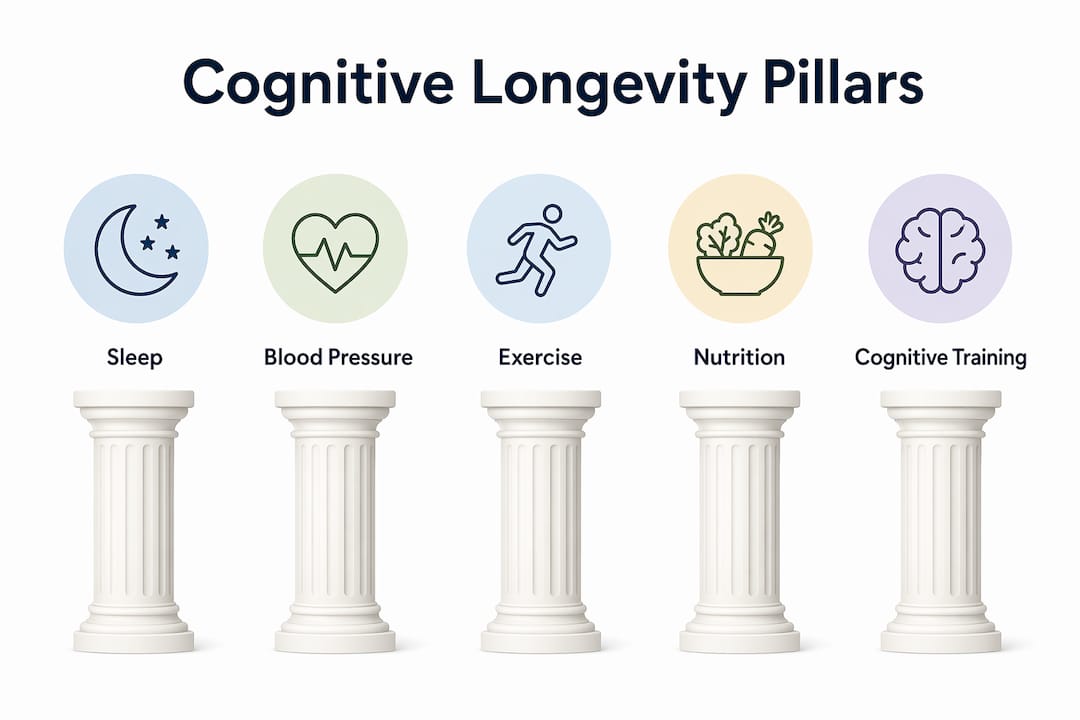
A combined approach — top-down executive-function training alongside bottom-up systemic health control — is the professional standard. Neither brain games alone nor lifestyle changes alone deliver the full benefit.
| Pillar | Primary mechanism | Evidence strength | Executive practice |
|---|---|---|---|
| Sleep (7–8 hrs, consistent timing) | Glymphatic clearance, memory consolidation | Strong | Fixed sleep/wake window; limit screens 60 min before bed |
| Aerobic exercise (3×/wk, 30–45 min) | Cerebral blood flow, neurogenesis | Strong | Zone 2 cardio; mobility work integrated |
| Resistance training (2×/wk) | Metabolic resilience, BDNF release | Moderate–Strong | Compound lifts; 45-min sessions |
| Blood pressure control (<120/80) | Vascular integrity, white-matter preservation | Strong | Daily BP log; dietary sodium reduction |
| Glycemic control with normal HbA1c levels | Reduces neuroinflammation | Strong | Mediterranean or MIND diet pattern |
| Strategy-based cognitive training (SMART) | Synaptic plasticity, neural connectivity | Moderate | 2–3 sessions/wk; structured training over passive games |
| Stress regulation | Cortisol reduction, hippocampal preservation | Moderate | Scheduled recovery; delegation protocols |
| Social engagement and purpose | Cognitive reserve, inflammation reduction | Moderate | Mentorship, peer groups, purposeful commitments |
| Mediterranean/MIND diet | Reduced neuroinflammation, vascular protection | Moderate | Cognitive-protective eating patterns |
Priority tier: Sleep and blood pressure first. These two levers compound every other intervention. Exercise second. Structured cognitive training third.
Pro Tip: For travel weeks, compress your aerobic sessions into two 45-minute runs and one resistance session rather than skipping entirely. Consistency across 12 weeks matters more than any single perfect week.
How to measure and track your cognitive health over time
Measurement converts intention into accountability. Use this numbered routine:
- Daily: Log sleep duration and quality (Oura Ring, WHOOP, or a written log), morning blood pressure, and subjective mental clarity on a 1–10 scale.
- Weekly: Record total aerobic minutes, resistance sessions completed, and any notable stress events or alcohol intake.
- Monthly: Complete a validated self-administered cognitive screen such as the MoCA Self or a digital executive-function task battery.
- Quarterly: Repeat a formal validated cognitive test (Cambridge Brain Sciences, CNS Vital Signs, or a neuropsychologist-administered battery) to detect meaningful change against your baseline. Check HbA1c every 6 months if metabolic risk is present.
- Annually: Full clinical review including fasting lipids, HbA1c, blood pressure trend, and a structured conversation with your physician about cognitive trajectory.
A critical note on interpretation: practice effects inflate scores on repeated tests, so use different parallel forms when available and weight 12-month trends over single-session results. A mixed measurement toolkit — validated digital tests, physiology trackers, and periodic formal neuropsychological testing — reduces false positives from noise. Escalate to a clinician if you observe a meaningful drop across two consecutive quarterly assessments, or if a family member or colleague notices functional changes before you do.
Your 90-day cognitive longevity action plan
Days 1–30: Establish the foundation
Week one is infrastructure. Set your sleep window and protect it. Measure your resting blood pressure every morning for seven consecutive days to establish a true baseline. Schedule three aerobic sessions per week in your calendar before anything else fills the slot. Begin a performance tracking log for sleep, BP, and daily clarity scores.
By day 30, your target: seven consecutive days of 7+ hours of sleep, blood pressure trending below 130/85, and three aerobic sessions per week completed consistently.
Days 31–60: Add structure and load
Introduce two weekly resistance sessions. Begin a structured cognitive training protocol — SMART-style strategy-based sessions, not passive app games. Add one purposeful social or mentorship commitment per week. Review your diet for Mediterranean alignment: more fish, olive oil, leafy greens, and nuts; less processed food and refined carbohydrate.
By day 60: first formal cognitive retest against your baseline. Expect sleep and mood improvements to be visible. Vascular and metabolic changes take 6–12 weeks to register in biomarkers.
Days 61–90: Consolidate and measure
Maintain all pillars. Add a stress-regulation protocol — scheduled recovery time, delegation of logistical tasks, and at least one weekly activity that combines social engagement with cognitive load (a peer advisory group, a strategy session with a mentor). At day 90, run your full quarterly cognitive assessment and compare against baseline.
Realistic timeline: Sleep quality and mood improve within 2–4 weeks. Blood pressure and HbA1c respond in 6–12 weeks. Measurable cognitive-training transfer — the kind that shows up on objective tests — typically requires 12+ weeks of consistent practice.
Common myths about cognitive aging worth correcting
- Myth: Decline is inevitable. Correction: Neuroplasticity persists into the 80s and 90s. Modifiable lifestyle factors account for roughly 40% of dementia risk.
- Myth: Brain games alone protect cognition. Correction: App-based games produce narrow, domain-specific gains. Strategy-based training (SMART) and physical exercise produce generalized, transferable improvements.
- Myth: Supplements can substitute for lifestyle. Correction: No supplement has demonstrated the evidence strength of aerobic exercise, sleep, or blood pressure control for cognitive protection. Treat unproven supplements as adjuncts at best.
- Myth: Genetics determines your outcome. Correction: Genetic risk (including APOE ε4 status) raises relative risk but does not determine fate. Lifestyle interventions modify expression of risk across all genetic profiles.
- Myth: Cognitive decline only matters after 65. Correction: The preclinical window opens in your 40s. Midlife is where the highest-leverage interventions land.
When to seek a professional cognitive assessment
Seek evaluation promptly if you notice any of the following:
- Rapid or stepwise decline in memory or executive function over weeks to months
- Functional loss: missed deadlines, financial errors, or difficulty with tasks previously handled without effort
- New focal neurological signs: word-finding failure, spatial disorientation, or personality change
- Sleep-disrupting cognitive symptoms: nighttime confusion, acting out dreams, or excessive daytime sleepiness despite adequate hours
Who to see: Start with a primary care physician who can order baseline labs (HbA1c, lipid panel, TSH, B12, CBC) and a brief cognitive screen. If concerns persist, request a referral to a neuropsychologist for a full battery, or a neurologist if focal signs are present.
What to bring: Your 90-day tracking log (sleep, BP, exercise), medication list, baseline cognitive test scores, and a written summary of the changes you have observed and when they began. This preparation cuts appointment time and sharpens the clinical picture immediately.
How genetics shapes your cognitive longevity strategy
Genetic factors set the terrain, but lifestyle determines how you traverse it. The APOE ε4 allele is the most studied genetic risk factor for late-onset Alzheimer's, carried by roughly 25% of the general population. Carriers face elevated relative risk, but the same modifiable pillars — vascular control, sleep, aerobic exercise, and diet — remain the most effective risk-reduction tools available, regardless of genotype.
Personalized approaches are gaining traction. Polygenic risk scoring, combined with biomarker panels (inflammatory markers, homocysteine, omega-3 index), can help identify which pillars to prioritize. A man with elevated cardiovascular risk and APOE ε4 status should weight blood pressure control and aerobic exercise more heavily than someone with a clean metabolic profile. Genetic information is most useful when it sharpens the priority order of interventions, not when it is used as a reason for fatalism or inaction.
Key Takeaways
Cognitive longevity is a measurable, modifiable operational competency — and the highest-leverage window to protect it is your 40s and 50s.
| Point | Details |
|---|---|
| Definition | Cognitive longevity means actively preserving memory, processing speed, attention, and executive function across the lifespan. |
| Top priority pillars | Sleep (7–8 hrs), blood pressure control (<120/80), and aerobic exercise (3×/wk) deliver the highest compounded return. |
| Measurement cadence | Track daily (sleep, BP), monthly (cognitive self-screen), and quarterly (validated objective test) to detect meaningful change. |
| 90-day commitment | Establish sleep and vascular baselines in days 1–30; add resistance training and cognitive training in days 31–60; consolidate and retest at day 90. |
| Genetics and personalization | APOE ε4 status raises relative risk but does not determine outcome; use genetic data to sharpen pillar priorities, not to accept decline. |
| Viridos | Viridos supports the 90-day plan with structured tracking tools and a performance-longevity membership designed for disciplined executives. |
The Viridos perspective on performance longevity
The conventional framing of cognitive health focuses on what you stand to lose. That framing is wrong for men still in the arena. The more useful question is: what does preserved cognition allow you to sustain? Sharper judgment at year fifteen of a company. Faster pattern recognition in a market shift. The capacity to mentor the next generation without your own signal degrading.
What most guides underestimate is the compounding nature of early intervention. A man who controls his blood pressure at 45 and builds a consistent sleep architecture does not just reduce risk. He builds a neurological reserve that amplifies every other performance investment he makes — training, nutrition, structured learning. The brain that is well-vascularized and well-rested responds to cognitive training differently than one running on chronic stress and four hours of fragmented sleep.
The other underappreciated variable is measurement. Most executives track revenue, pipeline, and physical output with precision. They track their cognitive performance almost never. That asymmetry is a blind spot. Baseline testing in your 40s, followed by quarterly objective reassessment, gives you the same data discipline you apply to your business. It converts cognitive longevity from an aspiration into a managed performance metric.
Viridos supports your 90-day cognitive longevity plan
The 90-day framework above requires consistent tracking, structured habit formation, and the kind of accountability that busy leaders rarely build alone. Viridos is built for exactly that.

The Viridos Performance Journal maps directly to the daily and weekly tracking routine outlined here: sleep windows, blood pressure logs, clarity scores, and training sessions in one disciplined format. The Viridos membership bundles structured guidance, community accountability, and performance-longevity resources designed for founders and executives who refuse to leave cognitive performance to chance. Products are produced in small-batch Swedish facilities, with a sublingual delivery philosophy built for precision and biological relevance. This is performance support, not medical treatment. For clinical concerns, consult a qualified physician.
Useful sources
- CDC Healthy Brain Initiative — Public-health framing of cognitive health as a multidimensional continuum; use for policy context and population-level risk data.
- Harvard Health: Protecting Against Cognitive Decline — Practical, evidence-grounded summaries of exercise, diet, and social engagement findings; accessible reference for lifestyle pillars.
- Scientific Reports: Measuring and Increasing Brain Health Span — Primary evidence for strategy-based cognitive training (SMART) and the combined top-down/bottom-up intervention model.
- Haute MD: What Is Cognitive Longevity? — Clinician-oriented definition of cognitive longevity and brainspan; useful for the 40% modifiable risk figure and midlife intervention window.
- WorldHealth.net: 2026 — The Year of Cognitive Longevity — Conference synthesis on neuroplasticity persistence and the emerging public-health priority of brainspan.
- National Institute on Aging: Cognitive Health and Older Adults — Primary U.S. government resource on cognitive health factors, SPRINT MIND trial data, and blood pressure thresholds.
This article is general performance information, not medical advice. Consult a qualified physician or neuropsychologist for clinical evaluation and personalized guidance.