
TL;DR:
- Sustainable performance involves maintaining high productivity over time without damaging people, systems, or the environment. It emphasizes long-term resilience through measurable KPIs and continuous improvement rather than short-term output. Embedding sustainability into management cycles builds organizational resilience and long-term stakeholder trust.
Sustainable performance is defined as maintaining high levels of productivity and efficiency over the long term without harming employees, the organization, or the environment. The concept integrates three forces that most executives treat separately: output capacity, human well-being, and environmental stewardship. Frameworks like Key ESG and ISO 20400 have formalized this definition into measurable management systems. The distinction matters because high performance that degrades people or resources is not performance at all. It is extraction. Understanding what is sustainable performance means recognizing that longevity, not intensity, is the real measure of executive and organizational success.

What is sustainable performance, and why does it matter?
Sustainable performance is the practice of achieving consistent, high-level productivity without degrading the health of people or the planet. It emphasizes balance, resilience, and resource regeneration rather than short-term output maximization. For executives, this reframes the core question from "how much can we produce?" to "how long can we produce at this level?"
The importance of sustainable performance becomes clear when you examine what happens without it. Organizations that prioritize quarterly spikes over long-term health face higher turnover, rising burnout rates, and compounding governance risk. Individuals who operate at peak intensity without recovery cycles lose cognitive sharpness, decision quality, and physical resilience over time.
The definition of sustainable performance also extends to the organizational level. Sustainability performance refers to how an organization performs across environmental, social, and governance topics that are material to its operations, as measured by metrics and KPIs that support decision-making. That scope covers carbon emissions, workforce health, supply chain ethics, and board accountability simultaneously.
For executives operating in high-demand roles, the importance of sustainable performance is not philosophical. It is structural. Organizations that build sustainability into their operating model optimize performance longevity and reduce exposure to regulatory, reputational, and human capital risk.
What are the key metrics and KPIs used to measure sustainable performance?
Measuring sustainable performance requires separating raw data collection from decision-useful KPIs. Most organizations collect far more sustainability data than they can act on. The real discipline is selection.
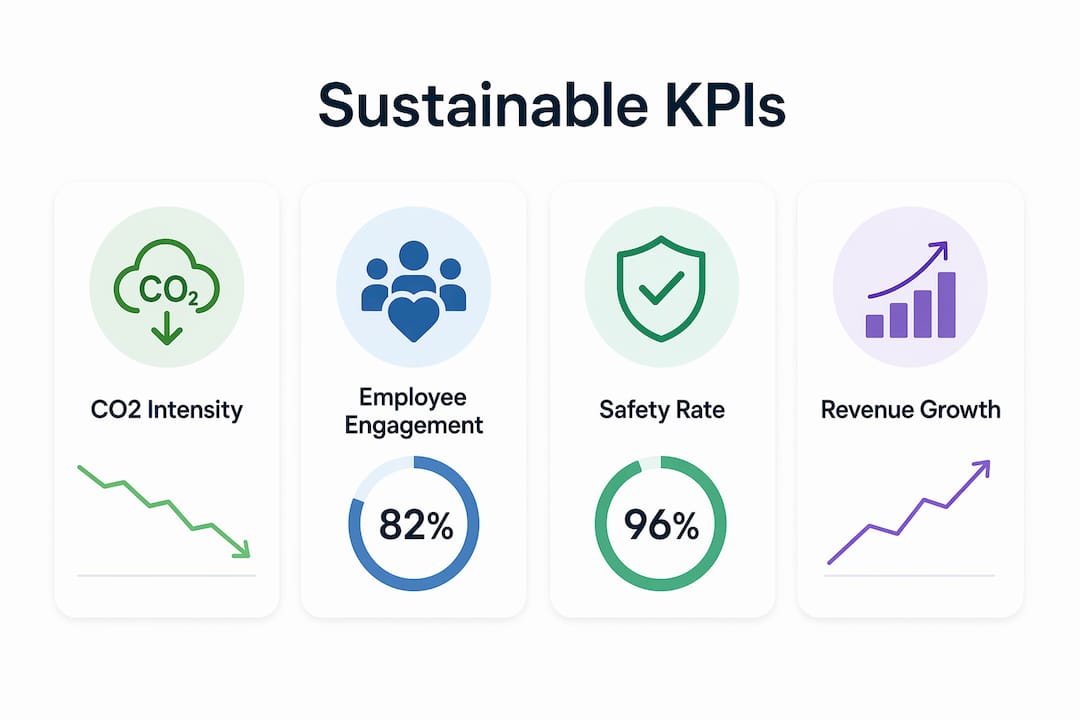
Not every ESG metric qualifies as a useful KPI. Decision-useful KPIs share three qualities: they are measurable, comparable over time, and directly tied to organizational priorities. A common pitfall is overwhelming teams with sustainability data yet failing to convert it into a focused set of KPIs that drive progress. Volume without structure undermines the entire measurement process.
Common sustainable performance metrics fall into three categories:
- Environmental: CO2 emissions per unit of output, total energy consumption, water use intensity, and waste diversion rates
- Social: Employee engagement scores, absenteeism rates, safety incident frequency, and workforce development hours
- Governance: Board diversity ratios, ethics violation rates, supply chain audit compliance, and executive pay ratios
Pro Tip: Start with five KPIs across the three ESG categories before expanding your measurement framework. Executives who track fewer, better-chosen indicators make faster and more consistent decisions than those tracking thirty metrics with no clear hierarchy.
The table below shows how to distinguish raw metrics from decision-useful KPIs in practice:
| Raw metric | Decision-useful KPI |
|---|---|
| Total CO2 emissions (tonnes) | CO2 emissions per $1M revenue, year-over-year |
| Number of safety incidents | Lost-time injury frequency rate per 200,000 hours |
| Employee survey responses | Engagement score, benchmarked against industry quartile |
| Energy consumption (kWh) | Energy intensity per unit of production |
Composite indices, such as those used in ESG ratings by MSCI or Sustainalytics, aggregate multiple KPIs into a single score for external benchmarking. For internal management, continuous measurement cycles outperform annual snapshots. Quarterly reviews tied to operational decisions keep sustainable performance metrics alive rather than archival.
How does sustainable performance management differ from sustainability reporting?
Sustainability reporting and sustainable performance management are related but serve fundamentally different purposes. Confusing the two is one of the most common strategic errors in executive leadership.
Sustainability performance management is a continuous strategic process. It defines objectives, implements initiatives, tracks progress with KPIs, and drives continuous improvement. Reporting, by contrast, is a disclosure function. It communicates past performance to external stakeholders through frameworks like GRI, SASB, or the TCFD.
"Sustainability reporting ensures transparency and accountability but does not drive operational change. Performance management sets targets, embeds sustainability in operations, monitors, and improves outcomes."
The distinction has direct consequences for executives. A company can publish a polished sustainability report while its internal operations remain unchanged. Reporting satisfies disclosure requirements. Management creates actual impact. Only converting sustainability intent into measurable management cycles unlocks real progress.
The four components of a functioning sustainability performance management system are:
- Strategy: Define material ESG topics and set measurable targets aligned with business objectives
- Implementation: Embed sustainability responsibilities into operational roles and processes
- Monitoring: Track KPIs continuously, not just at reporting intervals
- Continuous improvement: Use performance data to revise targets, address gaps, and raise standards over time
ISO 14001:2026 operationalizes this cycle by requiring organizations to embed continual improvement, leadership engagement, risk assessment, and compliance into everyday processes. That standard treats sustainability not as a reporting exercise but as a management discipline. Executives who adopt this framing gain a structural advantage in risk mitigation and long-term value creation.
What leadership strategies support sustainable performance in demanding roles?
At the individual level, sustainable work performance means maintaining occupational output indefinitely without physical or psychological breakdown. This counters the peak-intensity model that prioritizes quarterly spikes at the cost of long-term health. For executives in high-demand roles, the practical application requires deliberate planning rather than willpower.
The following four strategies form the foundation of personal sustainable performance:
-
Capacity-based planning. Map your actual energy across the week, not just your calendar. Identify when cognitive performance peaks, typically mid-morning for most executives, and protect that window for high-stakes decisions and deep work.
-
Scheduled recovery. Sustained performance demands planning that accounts for human energy and capacity cycles. Build recovery into the schedule as a non-negotiable block, not as leftover time after obligations are met.
-
Boundary-setting at the leadership level. Executives who fail to model clear availability limits create cultures of constant reactivity. Setting explicit boundaries on response times and meeting loads protects both personal capacity and team performance norms.
-
Aligning hard work with peak energy windows. Proactive scheduling that aligns the hardest work with peak energy times and schedules recovery leads to sustainable performance by avoiding burnout and preserving mental clarity.
Pro Tip: Block your two highest-energy hours each morning before your calendar fills with reactive work. Treat that block as a board meeting. No exceptions.
Culture reinforces or undermines all of the above. Organizations where leadership visibly practices recovery, models boundaries, and rewards output quality over hours worked build teams with far greater executive wellness and lower attrition. Mindfulness practices, whether structured meditation or deliberate transition rituals between work modes, reduce cortisol accumulation and preserve executive decision quality over multi-year timeframes.
How does sustainable performance build organizational resilience?
Sustainable performance is the structural foundation of organizational resilience. Companies that embed it into their operating model are better positioned to absorb shocks, retain talent, and maintain stakeholder trust through disruption.
The table below compares organizations that treat sustainability as a compliance function versus those that treat it as a performance management discipline:
| Compliance-oriented approach | Performance management approach |
|---|---|
| Annual sustainability report | Quarterly KPI review cycles |
| ESG data collected for disclosure | ESG data used for operational decisions |
| Sustainability owned by one team | Sustainability embedded across functions |
| Reactive to regulatory change | Proactive risk identification and mitigation |
| Short-term cost focus | Long-term value creation focus |
The link between ESG performance and governance quality is direct. Organizations with strong governance structures, clear accountability for sustainability targets, and continuous improvement cycles consistently outperform peers on risk-adjusted returns over five-year and ten-year horizons. This is not correlation. It is the result of better information, cleaner incentive structures, and more disciplined resource allocation.
For executives, the practical implication is that sustaining elite performance at the organizational level requires the same discipline as sustaining it personally. Both demand honest measurement, structured recovery from setbacks, and a long-term orientation that resists short-term pressure to extract rather than build.
Key Takeaways
Sustainable performance is the discipline of maintaining high output over time by managing human capacity, organizational systems, and environmental resources as assets rather than inputs to be consumed.
| Point | Details |
|---|---|
| Core definition | Sustainable performance means consistent high output without degrading people, systems, or the environment. |
| Measurement discipline | Select decision-useful KPIs tied to priorities rather than collecting large volumes of unstructured ESG data. |
| Management vs. reporting | Sustainability reporting discloses past performance; performance management drives continuous operational improvement. |
| Personal capacity planning | Align demanding work with peak energy windows and schedule recovery as a non-negotiable block. |
| Organizational resilience | Embedding sustainability into management cycles builds long-term risk mitigation and stakeholder trust. |
The misconception that costs executives the most
The most damaging misconception I encounter is that sustainable performance means working less. It does not. It means working with more precision about when, how, and at what cost.
I have watched capable executives burn through their best years running at full intensity with no structural recovery built in. They hit their numbers for three or four years, then plateau or exit. The output looked impressive until it stopped. That is not performance. That is a drawdown.
What actually works is treating your capacity the way a serious investor treats capital: protect the principal, deploy it where returns are highest, and never let short-term pressure force you into decisions that erode the base. Planning must accommodate energy patterns, recovery time, and trade-offs rather than assuming constant intensity. That insight from the IIL framework is one of the most practically useful reframes I have seen for executives who pride themselves on output.
The future of leadership performance is not about doing more. It is about maintaining the clarity and execution quality that compound over a decade. The executives I respect most are not the ones who worked the hardest in any given year. They are the ones still operating at a high level fifteen years later.
— Joakim
How Viridos supports long-term executive performance
Viridos is built for the executive who understands that performance longevity requires the same discipline as any other management system: clear inputs, consistent tracking, and honest assessment over time.

The Viridos Performance Journal is designed as a continuous performance management tool for executives who want to track capacity, recovery, and output quality across weeks and months, not just days. It applies the same KPI discipline described in this article to personal performance. For executives who want access to Viridos formulations and curated performance resources, the Viridos Membership provides controlled access to small-batch Swedish production and a premium executive performance program. Both are built for men who take the long view.
FAQ
What is the definition of sustainable performance?
Sustainable performance is defined as maintaining high productivity and efficiency over the long term without harming employees or the environment. It integrates output capacity, human well-being, and environmental stewardship into a single management discipline.
What are the most important sustainable performance metrics?
The most decision-useful sustainable performance metrics include CO2 emissions intensity, employee engagement scores, safety incident frequency rates, and energy use per unit of output. Key ESG frameworks recommend selecting KPIs that are measurable, comparable over time, and tied directly to organizational priorities.
How does sustainable performance management differ from sustainability reporting?
Sustainability reporting discloses past performance to external stakeholders. Sustainable performance management is a continuous internal process that sets targets, embeds sustainability into operations, and drives improvement. Reporting satisfies transparency requirements; management creates actual operational change.
How can executives achieve sustainable performance personally?
Executives achieve sustainable performance by aligning their most demanding work with peak energy windows, scheduling recovery as a fixed commitment, and setting clear boundaries on availability. This approach preserves cognitive clarity and decision quality over multi-year timeframes rather than optimizing for short-term output.
Why is sustainable performance important for organizational resilience?
Organizations that embed sustainable performance management into their operating model build stronger governance structures, better risk identification systems, and more consistent stakeholder trust. These factors compound into measurable advantages in long-term value creation and organizational durability.