
Most executives running at full capacity believe the answer to better performance is more hours, tighter schedules, and sharper focus. That belief is costing them. Research now shows that sustainable peak performance depends on integrating physical vitality, cognitive function, and emotional resilience, not just grinding harder. The leaders who maintain their edge into their 50s and 60s are not working more. They are working smarter across every dimension of their lives. This guide breaks down the science, the trade-offs, and the practical frameworks that actually move the needle for executives serious about long-term vitality.
Table of Contents
- Defining holistic performance for executives
- Why traditional optimization falls short: Time vs. energy
- The science of integrated training: Mind and body as performance drivers
- Navigating trade-offs: Financial, ESG, and sustainability performance
- Holistic performance in action: Practical frameworks for executives
- Why most executive performance advice misses the mark
- Optimize your executive journey with holistic science
- Frequently asked questions
Key Takeaways
| Point | Details |
|---|---|
| Holistic performance defined | Executive success now relies on physical, mental, and emotional integration, not just output. |
| Energy over time | Managing your energy and wellbeing delivers more sustainable results than working longer hours. |
| Research-driven routines | Combining physical and cognitive routines boosts cognition and helps executive leaders thrive. |
| Navigating trade-offs | Balance short-term results with sustainability to avoid burnout and maximize impact as a leader. |
| Next steps | Take action with frameworks and science-backed support for long-term high performance. |
Defining holistic performance for executives
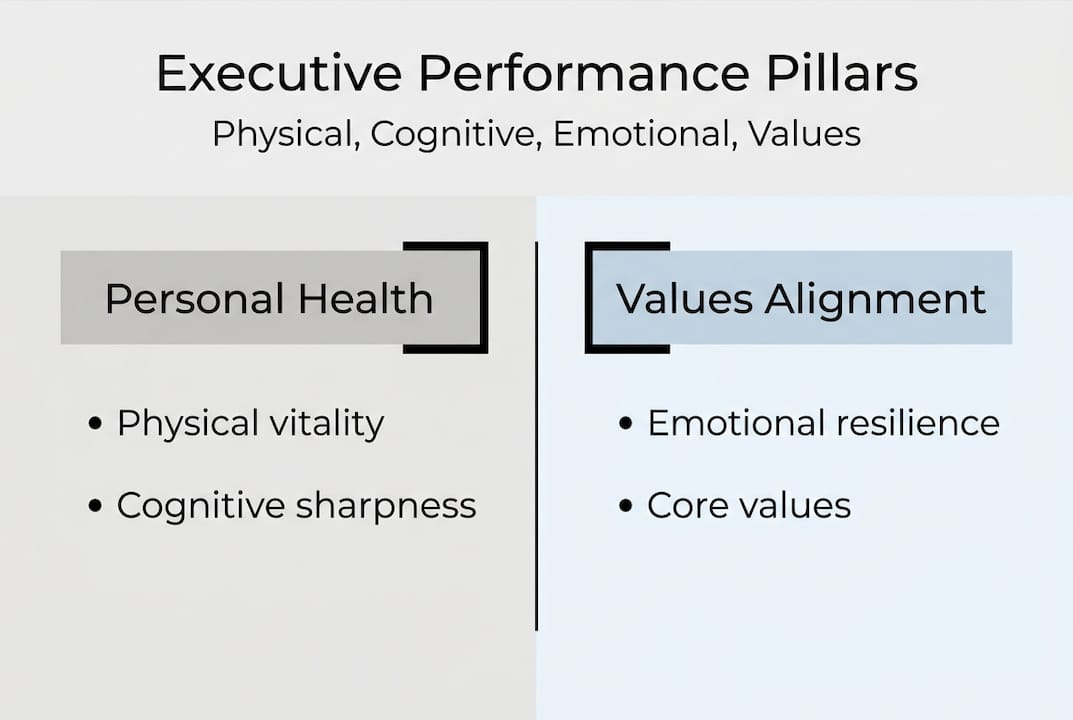
Holistic performance is not a wellness trend. It is a measurable, evidence-backed approach to sustaining high output across a long career. Where traditional performance models focus almost entirely on productivity and output, holistic performance integrates four core pillars: physical energy, mental sharpness, emotional regulation, and values alignment.
Think of it this way. A high-output quarter built on poor sleep, chronic stress, and zero recovery is not a win. It is a withdrawal from a finite account. Holistic performance keeps that account funded.
Research confirms that concurrent mind-body training produces measurable cognitive gains in adults, meaning the body and brain are not separate systems to optimize independently. They are one integrated performance engine. Executives who treat them that way gain a compounding advantage over time. For a deeper look at what this means day to day, the high-performance living guide offers a strong foundation.
Traditional vs. holistic performance: A quick comparison
| Dimension | Traditional model | Holistic model |
|---|---|---|
| Focus | Output and time | Energy and sustainability |
| Metrics | Revenue, hours, tasks | Vitality, cognition, resilience |
| Recovery | Seen as lost time | Built into the system |
| Time horizon | Quarter or year | Decade or career |
| Risk | Burnout and decline | Compounding performance |
The core pillars of holistic performance include:
- Physical vitality: Sleep quality, movement, nutrition, and hormonal health
- Cognitive sharpness: Focus, decision quality, working memory, and mental endurance
- Emotional regulation: Stress response, interpersonal effectiveness, and psychological safety
- Values alignment: Purpose-driven leadership that sustains motivation over the long run
Each pillar reinforces the others. Neglect one and the whole system weakens.
Why traditional optimization falls short: Time vs. energy
Calendar blocking, time audits, and productivity apps are useful tools. But they share a critical blind spot: they treat time as the scarce resource when, for most executives, energy is the real constraint.

You can have a perfectly optimized schedule and still make poor decisions at 4 PM because your prefrontal cortex is depleted. You can block two hours for deep work and produce nothing because your stress hormones are elevated from a difficult board call. Traditional time management simply does not account for these biological realities.
Energy management, by contrast, treats physical, cognitive, and emotional renewal as non-negotiable inputs to performance. It asks: when are you at your sharpest, and how do you protect and rebuild that capacity systematically?
Common failure patterns in traditional optimization:
- Scheduling high-stakes decisions in low-energy windows
- Treating sleep as a variable rather than a fixed performance input
- Ignoring recovery until breakdown forces it
- Measuring output without tracking the cost to the system producing it
"The problem is not a lack of time. It is a lack of energy to use the time you have well."
Pro Tip: Audit your energy, not just your calendar. Track your cognitive sharpness, mood, and physical energy across three days. You will quickly identify your peak performance windows and your most costly drains.
For practical tools on this, the energy management tips resource and the wellness optimization strategies guide offer actionable starting points built specifically for executive schedules.
The science of integrated training: Mind and body as performance drivers
If traditional approaches miss the mark, what does the research actually support? The answer is consistent: integrated physical and cognitive training produces the most significant performance gains for adults in the executive age range.
A large-scale analysis of concurrent training interventions found that combined mind-body routines yield significant cognitive improvements in older adults, including gains in executive function, processing speed, and working memory. These are not marginal improvements. They are the exact cognitive capacities that determine decision quality under pressure.
Key findings from the research:
- Interventions lasting 13 to 26 weeks produced the most consistent cognitive gains
- Combining aerobic exercise with cognitive training outperformed either approach alone
- Benefits included faster decision making, reduced stress reactivity, and improved memory consolidation
- Consistency mattered more than intensity in sustaining results
Performance gains by training type
| Training type | Cognitive benefit | Burnout reduction | Decision speed |
|---|---|---|---|
| Aerobic only | Moderate | Low | Moderate |
| Cognitive only | Moderate | Low | High |
| Combined (concurrent) | High | High | High |
| No structured routine | Decline over time | High risk | Declining |
Pro Tip: You do not need two-hour gym sessions. A 30-minute run followed by 15 minutes of focused cognitive work, done consistently four times per week, is enough to produce measurable gains within 13 weeks.
For executives thinking about the long arc of their performance, the healthy aging workflow provides a structured approach to building these habits into a demanding schedule.
Navigating trade-offs: Financial, ESG, and sustainability performance
Holistic performance does not stop at personal health. For executives leading organizations, it extends to how you balance short-term financial results with broader sustainability and social outcomes. And the research here is sobering.
Studies show that high financial performance often correlates negatively with ESG and sustainability outcomes. In other words, the harder you push for immediate financial returns, the more likely you are to create costs elsewhere, whether in your team's wellbeing, your organization's environmental footprint, or your own health.
This is not an argument against financial ambition. It is an argument for conscious balance.
Best-in-class executives track both dimensions:
- Financial metrics: Revenue growth, margin, return on capital
- Holistic metrics: Team retention, leader health indicators, sustainability benchmarks, and social impact scores
Pro Tip: Add one holistic metric to your quarterly review. Even a single measure, like average sleep hours during high-pressure periods or team stress indicators, will shift your decision-making in ways that protect long-term performance.
The tension between short-term wins and long-term sustainability is real. But leaders who ignore it tend to hit a wall, whether personally or organizationally, within five to ten years. For frameworks on managing this over a full career, performance longevity for success and longevity strategies for professionals are worth your time.
Holistic performance in action: Practical frameworks for executives
Theory without application is just interesting reading. Here is how to actually build holistic performance into your life as a working executive.
A 13-week starter framework:
- Week 1 to 2: Baseline audit. Track sleep, energy levels, decision quality, and physical activity for two weeks without changing anything. This is your data.
- Week 3 to 4: Anchor two non-negotiables. Pick one physical habit (30-minute morning movement) and one cognitive habit (15 minutes of focused single-task work before email).
- Week 5 to 8: Add recovery protocols. Structured wind-down before sleep, one full recovery day per week, and a weekly review of your energy patterns.
- Week 9 to 12: Integrate emotional regulation. Daily brief reflection, one stress-reduction practice (breathwork, cold exposure, or meditation), and proactive relationship investment.
- Week 13: Reassess. Compare your baseline data to current performance across all four pillars. Adjust and extend.
Research confirms that 13 to 26-week interventions produce the most durable cognitive and performance improvements. Short bursts do not compound. Consistent, medium-length commitments do.
"Small habits done consistently beat aggressive routines done sporadically. The compounding is in the consistency, not the intensity."
Pro Tip: Treat your holistic performance review the same way you treat a board review. Schedule it, prepare for it, and make decisions based on the data it surfaces.
For executives building these habits over years, the long-term executive health tips resource offers a practical extension of this framework.
Why most executive performance advice misses the mark
Here is the uncomfortable truth: most executive performance advice is optimized for people who want to feel like they are improving, not for people who actually want to improve. It sells urgency and novelty. Morning routines that take 90 minutes. Biohacking stacks that cost a fortune. Productivity systems that require more management than the work itself.
Real performance longevity is quieter and less glamorous. It is built on consistent sleep, deliberate recovery, integrated physical and cognitive training, and the willingness to say no to short-term intensity when it threatens long-term capacity. The research on self-optimization for resilience backs this up clearly.
The leaders who sustain their edge into their 60s are not the ones who pushed hardest in their 40s. They are the ones who built systems that protected their capacity while still delivering results. That is the real edge. And it requires healthy lifestyle routines that are boring by design and powerful by compounding.
Optimize your executive journey with holistic science
If this framework resonates, the next step is not another productivity app. It is a structured, science-backed approach to executive vitality that treats your performance as a long-term asset worth protecting.

At VIRIDOS, we build premium programs specifically for high-agency men who want sustained edge, not short-term spikes. Our approach is grounded in the same research referenced throughout this article, and it is designed for executives who operate at the highest level and need their performance systems to match. Explore the science behind holistic solutions and see how precision-designed support can extend your peak performance window by years, not months.
Frequently asked questions
What are the pillars of holistic performance?
Holistic performance is built on physical vitality, cognitive sharpness, emotional resilience, and alignment with core values. Research confirms that integrating these dimensions produces sustained leadership capacity over time.
How does holistic performance differ from standard productivity models?
Standard productivity models focus on time and output. Holistic performance focuses on managing energy, health, and sustainable habits. Energy management consistently outperforms time management for long-term vitality and results.
Does research support the benefits of holistic training for busy executives?
Yes. Multiple studies confirm that integrating physical and cognitive routines produces significant cognitive and wellbeing gains. Concurrent training interventions show measurable improvements in executive function and decision quality in adults.
Are there trade-offs between financial and holistic performance?
Studies show that high financial performance can sometimes conflict with social and sustainability goals, making conscious balance essential for leaders who want both short-term results and long-term organizational health.