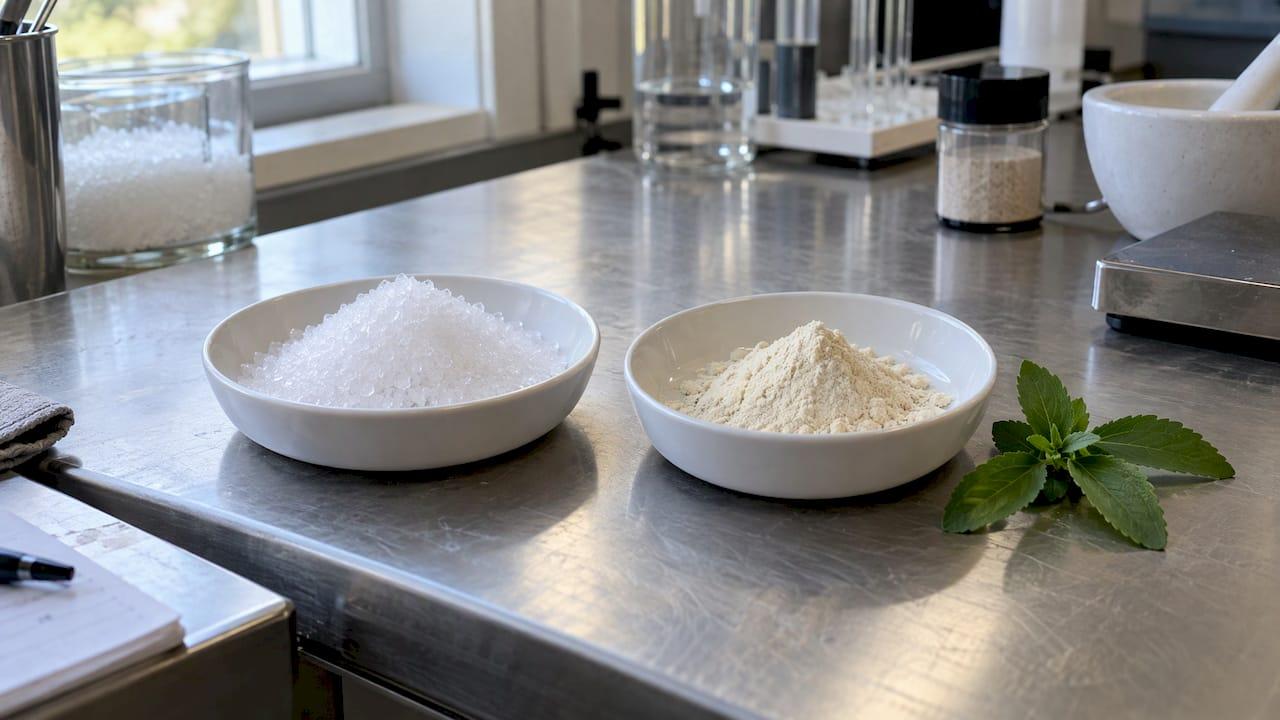
Xylitol and stevia solve different problems. Xylitol is a bulk sweetener that tastes close to sugar and gives tablets and lozenges body, but it carries a digestive ceiling and a recent cardiovascular question mark. Stevia is a high-intensity sweetener used in tiny amounts, with almost no energy and no measurable effect on blood sugar, but its taste depends heavily on purity. For a disciplined man who reads labels, the better choice is the one that fits the format, the dose and your own tolerance. This guide gives you the evidence to decide.
The question matters more than it looks. The sweetener is often the largest single ingredient by weight after the active compounds, and it decides whether you stay consistent with a daily routine. At VIRIDOS, we build for men who maintain standards over years, so we read excipients with the same attention as actives.
TL;DR
- Taste: xylitol has one of the most sugar-like taste profiles of 16 sweeteners tested; stevia, particularly older rebaudioside A extracts, can leave a lingering bitter or metallic note.
- Blood sugar: both have minimal effects on glucose and insulin in human studies. Stevia has essentially no energy; xylitol provides about 2.4 kcal per gram.
- Digestion: xylitol can cause laxative effects above roughly 20 to 40 g per day. Stevia is used in milligram quantities, so this rarely arises.
- Safety limits: the EU acceptable daily intake for steviol glycosides is 4 mg per kg of body weight per day, expressed as steviol. A 2024 study linked higher blood xylitol to cardiovascular events, and its authors call for long-term research.
- Not the same ingredient: stevia extract does not contain xylitol, though some products blend them.
Table of Contents
- What each sweetener actually is
- Taste: which one you will actually keep taking
- Calories, carbohydrates and blood sugar
- Digestive tolerance and dose
- Which is better for your supplement?
- Where this fits in a performance routine
- The VIRIDOS membership
- FAQ
- Sources
What each sweetener actually is
Xylitol is a sugar alcohol (a polyol), a five-carbon molecule produced by hydrogenating xylose from birch wood or corncobs. A 2025 review of low-calorie sweeteners describes it as about as sweet as sucrose, at roughly 2.4 kcal per gram, around 40% fewer calories than sugar. About half is absorbed in the small intestine. The rest is fermented by bacteria in the colon, which explains its digestive behavior at higher doses.
Stevia is the common name for steviol glycosides, extracted from the leaves of Stevia rebaudiana. The best-known is rebaudioside A. Stevia is roughly 200 to 400 times sweeter than sugar, according to the 2026 review of human clinical studies, with little to no energy. In the EU it is listed as additive E 960, with sub-letters a to d for the different grades.

The roles differ. Xylitol adds sweetness and substance: it is used in chewables, lozenges and tablets for sweetness plus bulk and mouthfeel, according to a 2025 industry article on natural sweeteners in nutraceuticals. Stevia adds sweetness only, in milligram amounts, and often serves to mask the bitterness of other ingredients.
Does stevia extract contain xylitol?
No. They are separate ingredients from different sources, with different chemistry. Where they meet is in blends: the 2026 review cites a study of a stevia blend with erythritol and xylitol, which produced a lower glucose response than dextrose. A product labeled "stevia" may therefore carry a polyol alongside it. The ingredient list tells you; the front of the pack does not.
Taste: which one you will actually keep taking
Consistency is the first performance variable of any supplement routine. A taste you tolerate for a week but dislike by month three is a poor formulation, whatever the ingredient science says. Research on taste in nutritional supplements notes that bitter off-tastes of some sweeteners, stevioside among them, are detected by the body's bitter receptors, and that unpleasant aftertastes can reduce consumption.
The sensory data is consistent:
- Xylitol tracks sugar closely. In a 2018 dose-response study of 16 sweeteners, xylitol's curve closely matched sucrose between 3.8% and 25% concentration and exceeded sucrose sweetness above 11.7%. It also has a cooling effect on the tongue.
- Stevia (rebaudioside A) had a flatter curve, with maximum perceived sweetness below sucrose. In a 2019 temporal sensory study, it showed prominent, long-lasting bitter, metallic and chemical side tastes, while xylitol had one of the most sucrose-like profiles of all 16.
The stevia picture is improving. The same 2025 industry article reports that newer rebaudioside M and D variants give a more sugar-like taste curve with notably less bitterness. Bitter or metallic notes can also be amplified by minerals, amino acids or botanicals in the formula, which is why formulators often pair stevia with another sweetener such as monk fruit.
So on taste alone, xylitol wins on sugar fidelity, and modern high-purity stevia narrows the gap. If you want a sense of how a naturally sweet profile behaves in a daily ritual, naturally sweet coffee is a useful parallel: sweetness that comes from the source rather than from additions.
Calories, carbohydrates and blood sugar
For men managing weight, glucose and energy across a demanding schedule, this is the comparison that matters most.
| Factor | Xylitol | Stevia (steviol glycosides) |
|---|---|---|
| Type | Sugar alcohol | Plant-derived high-intensity sweetener |
| Sweetness vs sugar | About 1:1 | About 200 to 400 times |
| Energy | About 2.4 kcal per g | Little to none |
| Blood glucose and insulin | Small rise, well below equal-sweetness glucose | No statistically significant effect in human studies |
| Typical role | Bulk, sweetness, mouthfeel | Sweetness, taste masking |
| Main limit | Digestive tolerance at higher doses | Taste, and the daily intake limit |
The US FDA's consumer guidance confirms that sugar alcohols such as xylitol are slightly lower in calories than sugar and do not cause a sudden increase in blood glucose, and that purified stevia extracts are generally recognized as safe.
The numbers are modest for both. A 2024 narrative review reports that single doses of 7 to 50 g xylitol caused small increases in glucose and insulin, significantly lower than equally sweet glucose loads, and that 24 g per day for five weeks had no effect on glucose, insulin or insulin resistance in healthy participants with obesity. The 2026 stevia review finds no statistically significant effects on glycemia, insulinemia, blood lipids, appetite hormones or the gut microbiome, with only modest body-weight changes versus sucrose.
Practically: in the doses a supplement contains, neither sweetener is a meaningful source of calories or a glucose event. The calorie difference only becomes real at the gram quantities found in chewable products.
Digestive tolerance and dose
Xylitol's limit is physical. The 2025 review reports laxative effects, including bloating, flatulence and osmotic diarrhea, above roughly 20 to 40 g per day. That is far above what a small supplement serving delivers, but it adds up if you also use xylitol gum, mints and sugar-free products. The 2025 industry article advises keeping sugar alcohols to single-serve or low-dose formats for the same reason. The EU has long required a warning on polyol-containing table-top sweeteners, stating that excessive consumption may induce laxative effects.
For stevia, the relevant ceiling is the acceptable daily intake. EFSA's November 2024 scientific opinion found insufficient justification to raise the EU value of 4 mg per kg of body weight per day, expressed as steviol equivalents, and confirmed steviol glycosides are authorized in 32 food categories. The WHO's expert committee on food additives confirmed the same 0 to 4 mg per kg range in 2026. Because stevia is so intensely sweet, a supplement uses very little, but it is worth remembering that tea, soft drinks and protein products may also contain it.
The 2024 xylitol and cardiovascular finding
A study published in June 2024 in the European Heart Journal by Cleveland Clinic researchers found that, in two cohorts of about 3,300 people, higher fasting blood xylitol was associated with a 1.57-fold adjusted hazard of major adverse cardiovascular events over three years. In healthy volunteers, a xylitol-sweetened drink raised blood levels and enhanced platelet responsiveness. The authors call for long-term safety studies. This is an association from observational data plus short experiments, and earlier WHO and EFSA assessments found no carcinogenicity or chronic disease risk for xylitol. For men over 40 with cardiovascular history, or on blood-thinning medication, the sensible step is to raise it with your physician before making xylitol a daily habit.
Sweden's food authority takes a measured view of the whole category. Its 2022 knowledge review of sweeteners notes that EFSA's 2022 evaluation concluded glycosylated steviol glycosides are safe as a food additive with the same acceptable daily intake as steviol glycosides, and that sugar alcohols, at least erythritol and xylitol, show the greatest potential to increase satiety. It describes the research field as complex and sometimes difficult to interpret, and says it will keep monitoring it.
Which is better for your supplement?
The answer depends on format.
- Chewables, lozenges and tablets: xylitol supplies bulk, mouthfeel and a clean sugar-like profile, and its cooling effect masks off-notes. Keep an eye on total daily polyol intake.
- Liquids and sprays: a high-intensity sweetener suits low-volume liquid formats. A 2026 formulation guide notes xylitol dissolves more slowly and is less suited to liquid forms, while higher-purity stevia gives sweetness at very low weight.
- Formulas with minerals: the same guide notes lower-purity stevia can interact poorly with metallic mineral actives such as magnesium, zinc and iron, so the grade of stevia matters.
- Sensitive digestion or a heart-health history: keep xylitol intake low and discuss it with your doctor.
The common mistake is to ask which sweetener is better in the abstract. A sweetener is a supporting ingredient. The better question is whether the label tells you which grade, how much, and whether the producer documents it.
How to read a sweetener line on a label
- Look for the specific name: "steviol glycosides (E 960a)" or "rebaudioside M" says more than "stevia extract".
- Check whether a polyol such as xylitol or erythritol sits beside it.
- Add up your daily polyol intake across gum, mints and supplements.
- Ask whether batch documentation is available. Our guide to the four-week certificate-of-analysis protocol shows how an executive can verify what is in a product, and how to identify a sophisticated supplement brand covers the wider signals of quality.
Where this fits in a performance routine
Sweeteners will not change your drive, clarity or recovery. Sleep, training, nutrition and the quality of what you take do that, and the supporting ingredients should simply stay out of the way. For the broader frame, read our guide to nutrition and performance and our review of what the evidence says about ergogenic aids. If you are weighing products in the testosterone-support category, what to check first for safety is the right starting point.
Our perspective
We approach every formulation decision, sweeteners included, as a question of discipline. Men in demanding roles do not need more ingredients; they need fewer, better-understood ones, taken consistently. That is why VIRIDOS is made in small batches in Sweden and delivered as a precision oral spray, with a sublingual delivery philosophy that keeps the format simple and the routine short.
Our approach to evidence is the same as to excipients: reasoning and uncertainty should stay inspectable. A 2024 signal on xylitol, a 2024 EFSA decision on stevia and a Swedish authority that calls the field complex are all reasons to read carefully, not reasons for alarm. We build for men still in the arena, who expect a clear label and a calm, professional explanation of what is in it.
Joakim
The VIRIDOS membership
VIRIDOS is a controlled-access membership: approved applicants receive regular shipments of our plant-derived performance spray, made in small batches in Sweden. The Member plan is 99 USD per month and the Professional plan is 299 USD per month. You can read how access works on the membership page, or see how the format works in our look at mouth sprays before training.

For executives and founders in Sweden, our guide to dietary supplements for entrepreneurs and the overview of sports nutritional supplements set out what holds up.
FAQ
Is xylitol healthier than stevia?
Neither is clearly healthier; they do different jobs. Stevia has little to no energy and no statistically significant effect on blood glucose in human studies, while xylitol has about 2.4 kcal per gram and a small glucose response. Xylitol has a digestive ceiling and a 2024 cardiovascular association under study, so stevia is the simpler choice for daily low-dose use.
Which tastes better, stevia or xylitol?
Xylitol tastes closer to sugar, with a cooling effect, and matched sucrose in sensory testing. Older stevia extracts can leave a bitter, metallic or licorice-like aftertaste, though newer rebaudioside M and D grades reduce it noticeably. Taste also shifts with the other ingredients in the formula.
What is the downside of xylitol?
Above roughly 20 to 40 g per day it can cause bloating, gas and loose stools. A June 2024 study also associated higher blood xylitol with more cardiovascular events over three years, and the authors call for longer-term research. If you have heart disease or take blood-thinning medication, speak with your doctor first.
Does stevia extract contain xylitol?
No. Stevia extract is made of steviol glycosides from the stevia leaf, while xylitol is a sugar alcohol made from birch wood or corncobs. Some retail products blend them, so read the ingredient list.
Sources
- Potential Effects of Low-Calorie Sweeteners on Human Health (2025)
- Stevia Rebaudiosides Usage as a Sugar Reduction Tool (2026)
- Natural Sweeteners in Nutraceuticals: Finding the Right Balance
- Taste Perception of Nutrients Found in Nutritional Supplements
- A Comparison of Psychophysical Dose-Response Behaviour (2018)
- Temporal sweetness and side tastes profiles of 16 sweeteners (2019)
- How Sweet It Is: All About Sweeteners, FDA
- Metabolic Effects of Selected Conventional and Alternative Sweeteners (2024)
- Directive 94/35/EC on sweeteners, EUR-Lex
- EFSA scientific opinion on steviol glycosides (2024)
- WHO JECFA steviol glycosides evaluation
- Xylitol is prothrombotic and associated with cardiovascular risk (2024)
- Livsmedelsverket, Kunskapsgenomgång om sötningsmedel (2022)
- Sweeteners in Dietary Supplements: Pros, Cons, Best Uses (2026)