
Workplace stress alters the HPA axis and floods the body with adrenaline and noradrenaline, which over time can flatten the natural cortisol rhythm, suppress sex hormones, and elevate cardiometabolic risk. This is the physiological reality behind arbetsstress och hormoner, the hormonal toll of chronic occupational pressure; left unaddressed, the pattern raises the risk of anxiety and burnout. Read the intervention section below, and if symptoms persist, take the findings to a clinician rather than waiting them out.
TL;DR:
- Chronic workplace stress flattens cortisol rhythms and increases cardiometabolic risk, with effort-reward imbalance showing the strongest hormonal association.
- Sleep disruption, poor recovery practices, and increased alcohol use worsen hormonal dysregulation and elevate long-term health risks.
- Reproductive hormones decline over months or years of unaddressed stress, impacting fertility for both men and women.
- Long-term hormonal dysregulation from work stress raises the risk of depression by impairing mood regulation circuits.
- Consistent recovery routines, organizational support, and targeted interventions can help restore hormonal balance and resilience.
Table of Contents
- How Workplace Stress Changes Your Hormones, Acute vs. Chronic
- Why Chronic Stress Flattens Your Cortisol Rhythm
- The Health Fallout: Anxiety, Burnout, and Cardiometabolic Risk
- Symptoms That Signal Hormonal Strain, and When to See a Doctor
- Practical Steps to Protect Your Hormonal Balance at Work
- An Executive Framework for Hormonal Resilience
- Workplace Stress, Hormones, and Reproductive Health
- The Long-Term Mental Health Toll of Chronic Work Stress
- A Closing Note on Discipline Over Willpower
- A Membership Built for Men Who Refuse to Decline
- Sources
How Workplace Stress Changes Your Hormones, Acute vs. Chronic
An acute deadline crisis and a grinding, months-long workload produce very different hormonal signatures, even though both fall under the concept of arbetsstress och hormoner.
In the short term, adrenaline and noradrenaline surge within seconds, raising heart rate, blood pressure, and blood glucose to mobilize energy for the task in front of you. This is the classic fight-or-flight response, and it resolves once the threat passes. Cortisol follows a slower arc: it normally peaks shortly after waking, the cortisol awakening response, and then declines steadily through the day. That decline is the signal researchers watch most closely.
Chronic pressure disrupts this rhythm rather than simply amplifying it. Instead of a sharp morning peak and clean afternoon drop, prolonged occupational strain is associated with a blunted or flattened cortisol slope, a pattern some occupational research on job strain and cortisol ties to what practitioners describe as fatigue debt.
Several other systems shift alongside the primary stress axis:
- Prolactin can rise under sustained psychological strain, sometimes affecting mood and libido.
- Growth hormone secretion, which is tied to overnight tissue repair, tends to suffer when sleep is fragmented by stress.
- Thyroid markers may shift subtly under chronic load, affecting energy and metabolic rate.
- Testosterone and estrogen frequently decline when the HPA axis stays activated for months rather than hours.
One caveat matters here: a single cortisol sample tells you little. Timing, recent meals, and even the time since waking swing the number substantially, which is why serious assessment relies on patterns, not one data point.
Why Chronic Stress Flattens Your Cortisol Rhythm
The HPA axis runs on a feedback loop: the brain releases corticotropin-releasing hormone (CRH), which signals the pituitary to release ACTH, which in turn tells the adrenal glands to produce cortisol. In a healthy system, rising cortisol feeds back to the brain and shuts the loop down. Chronic activation breaks that feedback.
This is the mechanism behind allostatic load, the cumulative wear of a stress system that never fully stands down. The Harvard Medical School overview of the stress response describes how sustained activation reallocates the body's resources away from repair and toward short-term survival functions, at a cost to long-term regulation.
The occupational evidence is real but modest. A large cohort study tracking diurnal cortisol found only modest associations between standard workplace stress models and cortisol patterns overall, but effort-reward imbalance, the mismatch between how hard you work and what you get back, showed the clearest link to a shallower afternoon decline, according to research on work stress and diurnal cortisol.
Three measurement approaches give a more honest picture than a single blood draw:
- Cortisol awakening response (CAR): the rise in the first 30 to 45 minutes after waking.
- Diurnal slope: the rate of decline from morning peak to evening trough.
- Hair cortisol: a retrospective measure reflecting weeks of average exposure rather than a single moment.
The Health Fallout: Anxiety, Burnout, and Cardiometabolic Risk
Hormonal dysregulation from workplace stress does not stay contained to a lab value. It shows up in mood, energy, and eventually in measurable cardiovascular risk.
Elevated and erratic cortisol sensitizes the brain's threat-detection circuitry, which is part of why chronic occupational strain tracks so closely with anxiety symptoms. Men and women appear to process this differently: women more often show heightened cortisol reactivity to interpersonal and social-evaluative stress at work, while men more frequently show stronger cardiovascular reactivity, including sharper blood pressure spikes under the same conditions.
Burnout, known clinically in Sweden as utmattningssyndrom, maps closely onto the blunted HPA pattern described above. The exhaustion is not simply psychological fatigue. It reflects a stress system that has stopped mounting a normal response because it has been running too long.
A striking figure underscores the stakes. Office workers experiencing both high job strain and effort-reward imbalance showed a 97% higher risk of atrial fibrillation compared to peers without those pressures, in a study of roughly 6,000 workers reported by JAHA researchers.
Behavioral fallout compounds the biology:
- Poor sleep amplifies next-day cortisol dysregulation.
- Increased alcohol use, often a coping response, disrupts hormone metabolism further.
- Reduced physical activity removes one of the strongest natural buffers against elevated stress hormones.
Symptoms That Signal Hormonal Strain, and When to See a Doctor
Watch for clusters rather than single symptoms:
- Persistent fatigue paired with disrupted sleep, especially difficulty waking feeling rested despite adequate hours.
- Concentration and memory lapses that did not exist before the current workload intensified.
- Declining libido or noticeable mood volatility, which often tracks with shifting sex hormone and cortisol patterns.
- Heart palpitations or unexplained blood pressure changes, particularly under deadline pressure.
Seek urgent care for chest pain, irregular heartbeat with dizziness, suicidal thoughts, or marked unintended weight change. These are red flags, not normal stress.
When you do see a clinician, bring specifics: your effort-reward balance at work, your decision latitude, shift patterns, and sleep timing. That occupational context helps a physician interpret hormone panels correctly, since timing-sensitive tests like cortisol are easy to misread without it.
Practical Steps to Protect Your Hormonal Balance at Work
Restoring a healthy stress response requires changes at both the organizational and individual level. Neither alone tends to be sufficient.
On the organizational side, the clearest lever is closing the gap between effort and reward, whether through compensation, recognition, or simply clearer scope. Expanding decision latitude, how much control you have over how work gets done, consistently correlates with lower physiological strain. Peer and managerial support also functions as a genuine biological buffer: Swedish workplace research links stronger social support at work to lower stress-hormone markers and better cardiovascular outcomes, independent of raw workload.
Individual practices matter just as much:
- Anchor sleep and wake times to protect the cortisol awakening response.
- Apply a 48-hour recovery principle after unusually demanding stretches, whether physical or cognitive.
- Keep resistance and aerobic training consistent rather than sporadic.
- Moderate alcohol, which disrupts both sleep architecture and next-morning cortisol.
Pro Tip: Block two 10-minute recovery windows in your calendar daily, mid-morning and mid-afternoon, and treat them as fixed meetings. Micro-recovery, taken consistently, does more for cortisol regulation than one long weekend off.
When symptoms persist past a few weeks despite these changes, occupational health referral and a phased return-to-work plan are reasonable next steps, and a guide to the stress management process for high-performing professionals outlines how to structure that escalation.
An Executive Framework for Hormonal Resilience
A resilience framework for hormonal balance emphasizes protecting the morning cortisol peak, allowing the rest of the day to follow accordingly. That means fixed sleep windows, alcohol limited under a 48-hour rule before demanding decisions, and scheduled micro-recovery rather than sporadic rest.
- Delegate decisions that do not require your specific judgment.
- Set explicit boundary contracts around after-hours communication.
- Manage evening light exposure to protect circadian wind-down.
Full detail lives in Viridos's cortisol balance framework for executives.
Workplace Stress, Hormones, and Reproductive Health
The link between chronic occupational stress and reproductive hormones is one of the least discussed consequences of arbetsstress och hormoner, and one of the most consequential for men planning families later in life.
Sustained HPA activation competes directly with reproductive hormone production. The body, under sustained pressure, deprioritizes reproduction in favor of systems it treats as more immediately survival-relevant, a reallocation the Harvard stress-response overview describes as a defining feature of allostatic load. In men, this often shows up as gradually declining testosterone, reduced libido, and in some cases measurable effects on sperm quality tied to prolonged high-cortisol states.
In women, chronic stress can disrupt the hypothalamic-pituitary-ovarian axis enough to affect cycle regularity, and elevated prolactin under stress can further interfere with normal ovulatory signaling. Couples working through fertility challenges while both partners hold demanding roles often face a compounding effect: two stressed endocrine systems instead of one.
None of this means a demanding career forecloses reproductive health. It means the timeline matters. A few weeks of intense pressure rarely leaves a lasting mark. Months or years of unaddressed effort-reward imbalance, poor sleep, and disrupted cortisol rhythm are a different matter, and the hormonal changes involved are gradual enough that many professionals do not connect the dots until they seek fertility evaluation. Bringing your occupational stress history to that conversation, not just your hormone panel, gives a clinician a fuller picture.
The Long-Term Mental Health Toll of Chronic Work Stress
Short-term stress sharpens focus. Sustained hormonal dysregulation from years of occupational strain does the opposite, and the mental health consequences compound quietly before they become obvious.
The mechanism runs through the same blunted HPA pattern discussed earlier. A cortisol system that no longer mounts a clean, well-regulated response leaves the brain's mood-regulation circuitry under-supported. Comprehensive reviews of stress physiology link this kind of prolonged dysregulation, combined with the autonomic and inflammatory changes that ride alongside it, to elevated long-term risk for depression, not simply situational low mood but a more persistent clinical pattern, according to research on stress and health pathways.
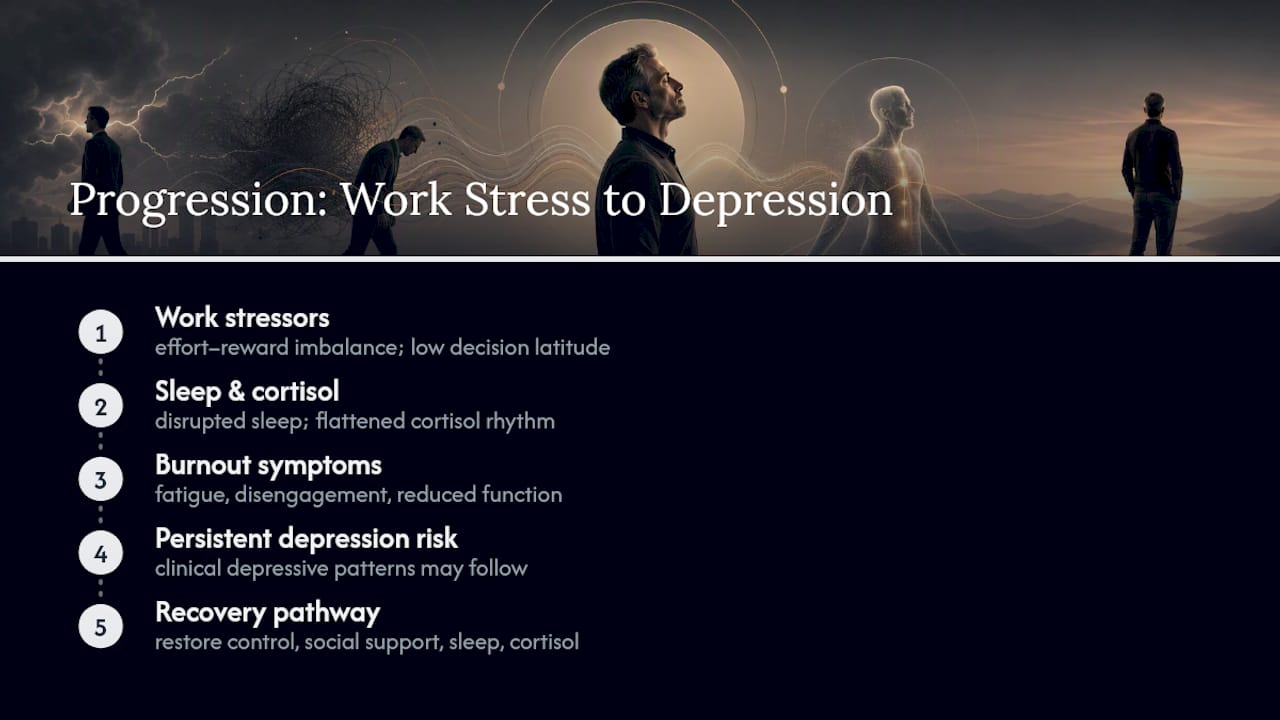
The progression tends to follow a recognizable arc: chronic effort-reward imbalance and low decision latitude at work, followed by disrupted sleep and flattening cortisol rhythm, followed by burnout symptoms, and in a meaningful subset of cases, a slide into depressive symptoms that persist even after the original workload eases. This is part of why burnout and depression are so often discussed together in occupational health literature. They are not the same condition, but the hormonal terrain that produces one makes the other more likely.
The encouraging counterpoint is that the same pathway runs in reverse. Interventions that restore decision latitude, rebuild social support, and re-anchor sleep and cortisol rhythm do not just relieve fatigue. They address the underlying endocrine pattern that mood symptoms grow out of, which is why workplace-level change and individual recovery practices both belong in any serious response.
A Closing Note on Discipline Over Willpower
The evidence does not reward heroics. It rewards consistency: fixed sleep windows, honest workload boundaries, and treating recovery as scheduled work, not an afterthought. Start with one lever, and build from Viridos's guide on why stress management matters for executives.
— Joakim
A Membership Built for Men Who Refuse to Decline
This membership is not a substitute for addressing effort-reward imbalance at work or seeing a physician about persistent symptoms. It is a structured complement for men who approach resilience as a discipline. The product delivers a phytoandrogen-focused formulation through a precision sublingual spray, developed in small batches, designed for absorption and consistency rather than volume.

Membership is controlled and cohort-based by design. Approved applicants receive ongoing shipments and access to a premium experience built around principles such as protecting circadian rhythm, supporting recovery windows, and providing an additional lever alongside sleep, training, and workplace boundaries. It is not a shortcut around the physiology described above but a way to reinforce it consistently.
If the framework in this article aligns with your approach to performance, consider reviewing the longevity performance strategy to explore whether membership may fit your current season of work.
Sources
- Urinary catecholamines and salivary cortisol on workdays and days off in relation to job strain among female health care providers
- Work stress and diurnal cortisol: evidence from an occupational cohort
- Understanding the stress response
- Stress and health: an overview of biological pathways