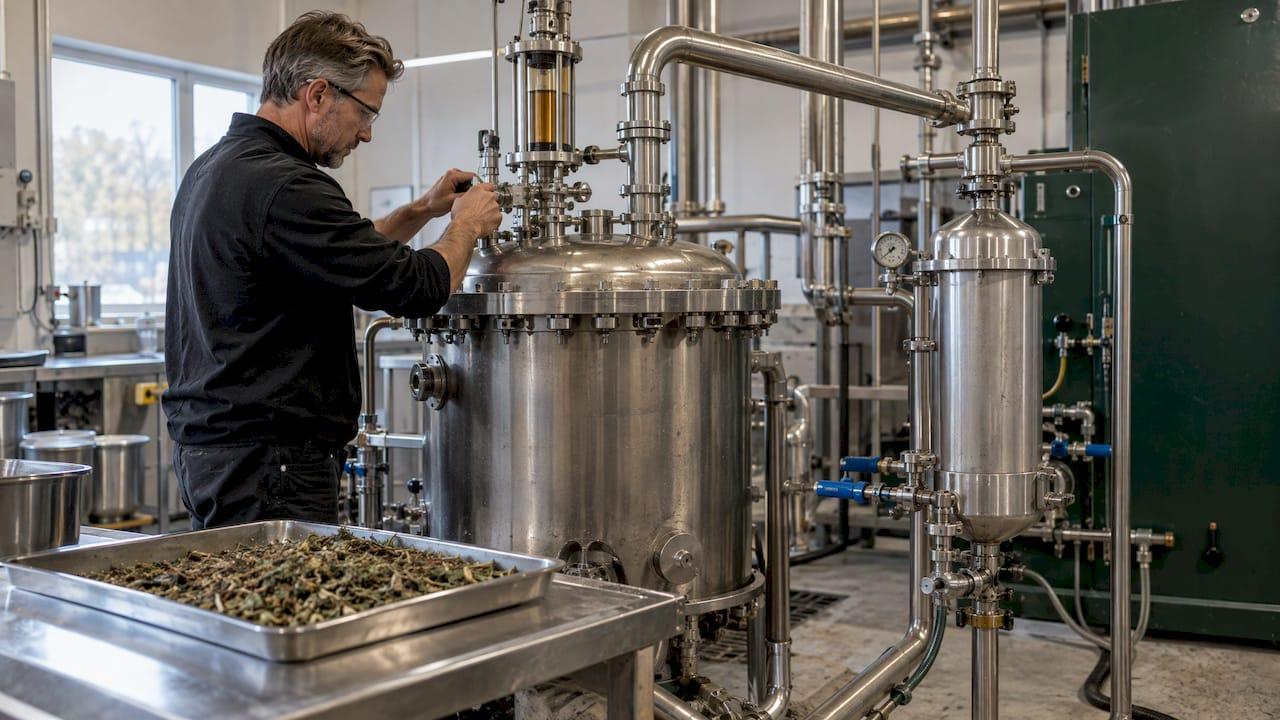
CO2 and ethanol are two different solvents, and each draws a different set of compounds out of the same plant. Supercritical CO2 selects mainly non-polar, oil-like molecules and leaves no solvent behind. Ethanol, especially mixed with water, reaches a broader range of compounds, and it can be chilled to improve its selectivity. Neither is universally better. The right method is the one matched to the chemistry of the plant and the purpose of the finished product. For a disciplined buyer, the useful skill is knowing which questions to ask of any extract, and why a precision-formulated format built on careful extraction deserves the attention we give it at VIRIDOS.
TL;DR
- Supercritical CO2 works above 31.1 °C and 73.8 bar, dissolves lipophilic (fat-soluble) compounds selectively and leaves no residual solvent.
- Ethanol, particularly hydroalcoholic blends such as 70 to 80% ethanol in water, recovers both polar and non-polar compounds and usually gives a much higher extract mass.
- Cold extraction means ethanol chilled between 5 °C and −80 °C, which limits the co-extraction of chlorophyll and waxes.
- Yield is not quality. A higher mass of extract says little about how concentrated or how clean the compounds you want actually are.
- The practical test of any extract is the full manufacturing sequence and the batch documentation, not the solvent name alone.
Table of Contents
- How the two methods work
- Side by side
- Yield is not the same as quality
- Cold extraction: what it means for herbs
- Choosing between them: a matching problem
- How to read an extract claim
- Delivery matters as much as extraction
- Our perspective
- Membership with VIRIDOS
- FAQ
- Sources
How the two methods work
Supercritical CO2
Carbon dioxide becomes supercritical once it passes 31.1 °C and 73.8 bar (7.38 MPa). In that state it moves like a gas and dissolves like a liquid. Plant material sits in a sealed vessel, the pressurized CO2 flows through it, and the loaded fluid passes to a separator where the pressure drops. The CO2 returns to gas and the extract is left behind. A 2024 review in TRAC explains why the method is favored: CO2 has a low critical temperature and pressure, is inexpensive, is available in pure form and leaves no harmful residues. Adjusting temperature and pressure allows selective extraction of specific components.
The weakness follows from the strength. CO2 is a low-polarity solvent. A 2025 comparative analysis notes that supercritical CO2 extracts low-polarity compounds well, but is not ideal for highly polar, water-loving molecules. To widen its range, operators add a small share of a polar co-solvent. According to a 2020 review of supercritical fluid extraction, ethanol or methanol is used at below 10% of the CO2 quantity to improve the solvation of alkaloids, phenolics and glycosidic compounds, and ethanol is preferred for being less toxic.
In plain terms: CO2 is a precision tool for fat-soluble compounds, and it can be extended with ethanol when the target is more polar.
Ethanol
Ethanol extraction is conceptually simpler. Milled plant material is soaked or percolated in food-grade alcohol, filtered, and the liquid is concentrated by evaporation under vacuum, with the ethanol recovered for reuse. The solvent can be pure or blended with water, and that choice matters more than most buyers realize.
Pure ethanol is a good solvent for moderately polar and non-polar compounds. Adding water brings in the water-soluble fraction as well. In a 2020 study on Cadaba rotundifolia leaves, 80% aqueous ethanol gave the highest extraction yield, 16.22% against 12.86% for pure ethanol, because a hydroalcoholic solvent can recover components soluble in either the water or the organic part. A 2025 Scientific Reports study on Boehmeria rugulosa wood found 70% aqueous ethanol gave the highest yield and the richest profile of flavonoids and phenols. That is the answer to why 80% ethanol is so common: it is a balanced solvent for a broad class of plant constituents. The same research makes the limit plain, though. The best ratio depends on the plant, and the ratio changes what you recover.
Side by side
The table summarizes the differences documented in the peer-reviewed literature. Most of the comparative data comes from hemp, which is the most heavily studied case, and the principles carry over to other botanicals.
| Factor | Supercritical CO2 | Ethanol |
|---|---|---|
| Typical conditions | 10 to 60 °C and 55 to 300 bar, 2 to 6 hours | Low temperatures, no high pressure required |
| Compounds favored | Non-polar, lipophilic compounds | Broad range, including polar compounds when mixed with water |
| Co-extracted material | Little | Chlorophyll, sugars, glycosides and other water-solubles unless chilled or cleaned up |
| Extract mass | Low | High |
| Residual solvent | Effectively none | Trace ethanol must be removed and tested |
| Equipment | High-pressure vessel | Standard vessels, chilling optional |
The temperature, pressure and processing ranges come from a 2022 Frontiers in Natural Products review. The same review reports that CO2 selectively extracts non-polar compounds with recoveries of 73 to 80%, while ethanol dissolves target compounds together with undesired water-solubles such as chlorophyll, sugars and alkaloid salts that require post-processing to remove.
Yield is not the same as quality
One of the most instructive comparisons is a 2024 hemp study by Chacon and colleagues. Ethanol delivered the greatest extract mass, 22 to 24%, against 1.3 to 1.8% for CO2. A reader who looks only at that number would conclude ethanol is far more productive. But the composition tells a different story. The CO2 extracts contained the most CBD (12.8 to 20.6 mg/g) and CBG (9.5 to 16.9 mg/g), while the ethanol extracts held the most of the acidic form, CBDA (3.2 to 4.1 mg/g). Part of that difference is processing: the CO2 workflow in the study included a heating step at about 95 °C for about 60 minutes.

The lesson for a buyer is that the two methods create different products, not better and worse versions of one product. A large, dilute extract and a small, concentrated one can both be legitimate. What matters is whether the maker states what the extract contains, per dose, and stands behind it with batch records.
A 2024 study on dandelion, milk thistle and chamomile seeds, published by Milovanovic and colleagues, shows the same logic outside hemp. Supercritical CO2 isolated mainly non-polar oils, with yields of 26.2 to 28.4% for dandelion and milk thistle seeds. Ethanol recovered both liquid and solid fractions. Aqueous ethanol raised the chamomile yield to 14.8% but lowered the milk thistle yield to 8.9%. The authors' point is that solvent polarity must be matched to each plant.
Cold extraction: what it means for herbs
Searches for cold extraction of herbs usually point to ethanol used at low temperature. The Frontiers review defines it as extraction with ethanol between 5 °C and −80 °C. The aim is to take the compounds of interest while leaving behind chlorophyll, triglycerides and waxes, which dissolve poorly in cold alcohol. The trade is energy: cooling a large volume of solvent is costly.
The effect is measurable. A 2020 patent on selective cannabinoid extraction reports that at −30 °C, compared with a 0 °C control, recovery of chlorophyll a fell to 19% and a C42 wax to 41%, while cannflavin A recovery stayed at 91%. In other words, the cold removes the unwanted fraction far faster than the wanted one. A 2024 paper also notes that earlier work found ethanol at −40 °C preserved more terpenes than room-temperature ethanol.
Cold extraction also has a second meaning in everyday use: any low-heat process that protects heat-sensitive molecules. This is the real reason temperature matters to a performance-minded reader. Aromatic and delicate compounds degrade with heat, and a method that stays gentle preserves more of the plant's native profile. We cover the producer's side of that question in low heat green extraction, and the equipment side of pressurized systems in our piece on scCO2 pump and back-pressure failures.
Choosing between them: a matching problem
The literature converges on one idea. The method should follow the molecule. The 2020 supercritical review recommends determining the best co-solvent through preliminary experiments that consider the sample type, the targeted compounds and the final application. A fixed rule, such as always CO2 or always ethanol, is not what the evidence supports.
A workable way to think about it:
- Fat-soluble, aromatic or volatile targets point toward CO2, where a clean, solvent-free extract is the priority.
- Polar, polyphenol-rich targets point toward aqueous ethanol, where recovering the water-soluble fraction is the priority.
- Mixed targets point toward CO2 with an ethanol co-solvent, or toward cold ethanol with a clean-up stage. In the Frontiers review, CO2 with an ethanol co-solvent at 26 to 43 °C and 69 to 100 bar reached 91% CBD recovery, with higher overall extraction rates and lower solvent-to-feed ratios.
Extraction is also only one stage. After it come filtration, concentration, purification, standardization and testing. A ratio change early in the sequence alters behavior all the way downstream. So the solvent is a useful clue about a product, but it is never the whole account of it.
How to read an extract claim
You do not need a chemistry degree to evaluate a supplement. You need a short list of questions, and the discipline to ask them consistently.
- What is standardized, and to what? A ratio such as 10:1 describes how much plant went in, not how much of any compound is in the result. We explain this in standardized plant extracts.
- Is there a batch certificate of analysis (COA)? A COA is the lab report for a specific production batch. Our five-step COA check walks through reading one.
- Who tested it? Independent testing matters more than in-house testing. See our third-party testing checklist.
- Are contaminants covered? Metals and banned substances belong on the report, as set out in our guides to heavy metal COAs and doping risk.
If you take part in tested sport or hold a role where a failed screening carries consequences, treat this list as part of your safety routine, not an optional extra.
Delivery matters as much as extraction
A well-made extract can still be wasted by a poor delivery format. We design around a sublingual philosophy: a precision oral spray, where the formulation is applied under the tongue rather than swallowed as a capsule. That is why our attention to extraction is not academic. The method we use to draw compounds from the plant, and the form in which they reach you, are one connected decision.
Our perspective
Men who run companies, portfolios and teams do not have time for vague claims. They need to know what is in the product, how it was made and whether the maker can show it.
At VIRIDOS we approach extraction as a question of biological relevance, not a contest between solvents. Our proprietary extraction methods are built to deliver phytoandrogen-related compounds in a precision oral spray, and we make it in small batches in Sweden because quality is easier to hold when volume is restrained.
We believe the discipline you apply to your work should apply to what you put in your body. That means evidence that stays inspectable, reasoning that stays traceable and uncertainty that is stated openly. Our aim is to support your judgment, not replace it, so that you can sustain your edge across decades, not quarters.
Performance longevity is built the way a career is built: through consistent, well-made inputs over a long time.
Joakim
Membership with VIRIDOS
VIRIDOS is a controlled-access membership. Approved applicants receive regular shipments of our plant-derived oral spray, produced in small batches in Sweden, with limited cohort access. Membership is offered in two plans: Member at $99 per month and Professional at $299 per month. You can review both on our pricing page and learn how the application works on the membership page.

For further reading on performance, discipline and longevity, the Performance Journal collects our editorial work.
FAQ
Is CO2 extraction better than ethanol extraction?
Neither is better in every case. CO2 gives a solvent-free extract and selects non-polar compounds, while ethanol recovers a wider range, including polar compounds when blended with water. The right choice depends on the plant and the compounds you want to retain.
Why is 80% ethanol used in plant extraction?
Water and ethanol dissolve different compounds, so a blend can recover both. In a study of Cadaba rotundifolia leaves, 80% aqueous ethanol gave a higher yield than pure ethanol. The ideal percentage still varies by botanical.
What is cold extraction of herbs?
It usually means ethanol extraction at low temperature, between 5 °C and −80 °C, which limits the co-extraction of chlorophyll and waxes. The Frontiers review notes that the cost is higher energy use for cooling. The term is also used loosely for any low-heat process.
Can ethanol and CO2 be combined?
Yes. A small share of ethanol is often added to supercritical CO2 as a co-solvent to improve the extraction of more polar compounds. The 2020 review describes concentrations below 10% of the CO2 quantity.
Sources
- Comprehensive comparison of industrial cannabinoid extraction techniques, Frontiers in Natural Products, 2022
- Effect of Hemp Extraction Procedures on Cannabinoid and Terpenoid Composition, 2024
- Critical analysis of green extraction techniques, TRAC, 2024
- Recent Advances in Supercritical Fluid Extraction, 2020
- Comparative analysis of extraction technologies for plant extracts, 2025
- Optimizing Green Extraction Methods, 2024
- Effect of extraction solvent on qualitative and quantitative analysis, 2020
- Effects of different solvents on phytochemical profiles, Scientific Reports, 2025
- US20200188812A1, Selective Extraction of Cannabinoids, 2020