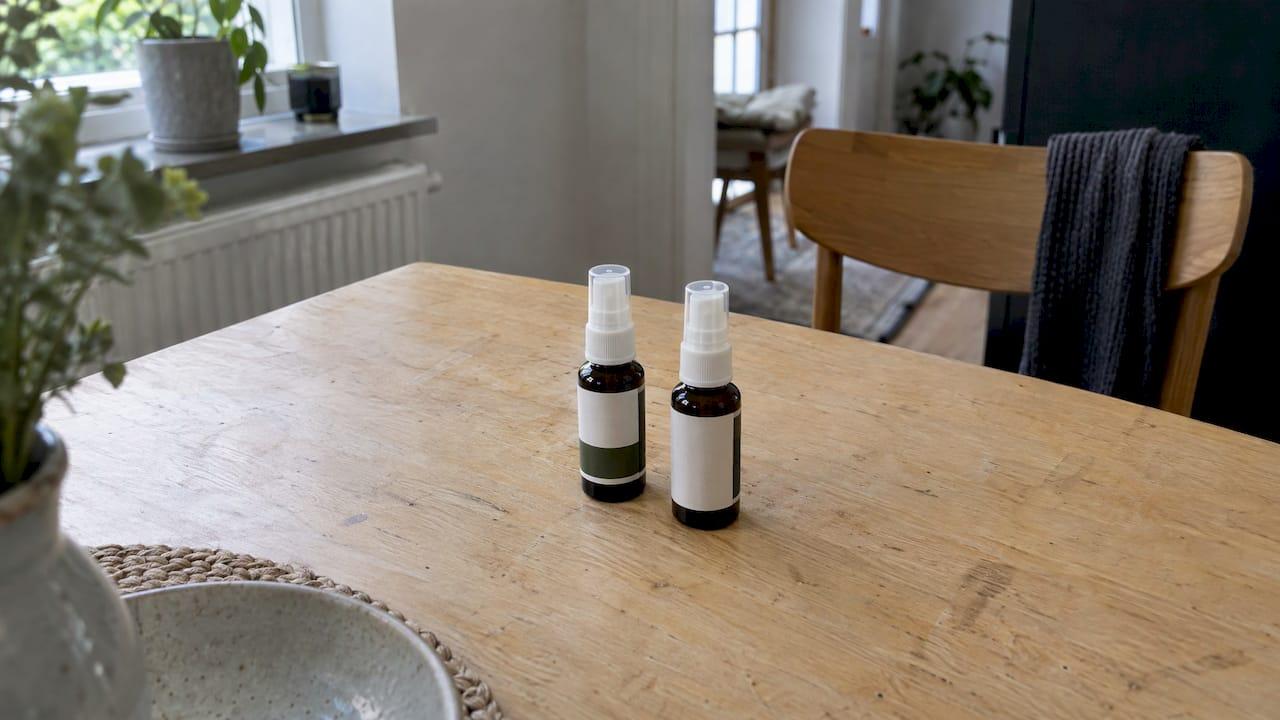
An ethanol-free herbal spray is an oral liquid made without ethyl alcohol in the finished product, usually with glycerin and water as the base. The claim is only as reliable as the label behind it. The producer states the final ethanol content, the full excipient list, the dose per spray and the durability date, and you can check each of them in about two minutes. This guide shows you how, in the order a disciplined buyer would work through it.
TL;DR
- "Ethanol-free" and "alcohol-free" are not automatically the same thing. Ethanol is one alcohol among several, and the extraction solvent does not decide what ends up in the bottle.
- Glycerin is the usual replacement for ethanol. It changes which plant compounds are carried and how stable the formula is, so it is a different design, not a like-for-like swap.
- "Preservative-free" is a stability question. Look for a durability date, storage instructions and a clear in-use period.
- Sweden regulates what a label may state and claim. A spray that promises disease outcomes is making the wrong kind of promise.
- Sore throat or other persistent mouth symptoms are a matter for a clinician, not for a supplement.
Table of Contents
- What "ethanol-free" and "alcohol-free" actually mean
- Glycerin in an oral spray: what it does
- Preservative-free: a question of stability
- What herbal oral sprays can and cannot promise
- The label checklist for an ethanol-free herbal spray
- Why delivery format deserves the same scrutiny as the plant
- Our perspective
- Membership with the same discipline
- FAQ
- Sources
What "ethanol-free" and "alcohol-free" actually mean
The two phrases are used as if they were interchangeable. They are not always.
Ethanol is the alcohol in drinks and in classic herbal tinctures. In chemistry, "alcohol" is a whole family of compounds. The US Food and Drug Administration notes, in its guidance on cosmetic labeling, that "alcohol" on a label refers to ethyl alcohol, and products labeled alcohol free may still contain fatty alcohols. That guidance concerns cosmetics, but it illustrates the point: the word on the front of the pack and the chemistry on the back can differ.
There is a second trap, specific to herbal products. The solvent used to extract a plant is not the same as the ethanol content of the finished product. The European Medicines Agency's overview of herbal monographs explains that the extraction solvent does not determine the ethanol content of the finished product, and the producer calculates the final amount and states it on the label and in the leaflet. A spray can be made from an extract that began in ethanol and still carry a very low residual amount. A label that says only "made without alcohol" does not tell you which of these you are holding.
So read for three things:
- The exact wording: ethanol-free, alcohol-free, or "contains less than" a stated percentage.
- The ingredient list, including every carrier and flavoring.
- A named producer you can contact with a question.
Our own guide to how to demand a milligram-per-dose figure for alcohol in a mouth spray walks through that conversation in more detail.
Glycerin in an oral spray: what it does
Glycerin, also called glycerol, is a sweet, viscous, plant-derived liquid. In alcohol-free sprays it is the most common base, usually blended with water. It does several jobs: it carries the active compounds, it gives the spray body and mouthfeel, and it contributes to stability.
The difference from a tincture is mostly one of solvent and extraction spectrum. Ethanol dissolves a wide range of plant constituents, including oily and resinous ones. Glycerin is a polar solvent and is best at water-soluble constituents. That means a glycerin-based preparation is a deliberately different formulation, not a weaker copy of an alcohol tincture. For a formulator, removing ethanol means re-engineering how each active dissolves and stays dissolved, including across temperature changes in storage and transport.
For you, the practical consequences are:
- Ask what is in the bottle, not only what is missing. A spray defined by the absence of ethanol tells you little about what it delivers.
- Look for a stated amount per dose. A reputable formula states active content per spray, not a vague "proprietary blend" total.
- Understand the extract. Extract strength is often summarized as a ratio, and a ratio alone does not describe quality. We explain the limits in why a 10:1 extract ratio is not enough.
Preservative-free: a question of stability
Preservative-free sounds clean. It also moves a burden onto the formula and onto you. Without a preservative, a water-containing liquid has to resist microbial growth by other means, such as its composition, its packaging and its storage conditions.
Pharmaceutical practice is conservative here. The UK NHS Pharmaceutical Quality Assurance protocol for oral liquids states that unpreserved multi-dose oral liquids should ideally be supplied as unit doses, and that any claimed in-use shelf life must be supported by data. It also says in-use periods for unpreserved products are normally kept to a maximum of seven days refrigerated.
Sweden's own hospital reference, ePed, makes a related point: the stated shelf life of an oral liquid applies only in its original packaging, and a solution moved out of it should not be kept beyond the short periods it recommends. These are hospital standards for medicines, not rules for supplements. They show how seriously stability is taken when nothing is added to protect the liquid.
What this means when you buy a preservative-free spray:
- Keep it in its original container. Do not decant it into a travel bottle.
- Follow the storage instruction exactly, including any request to keep it cool.
- Note the durability date and the stated period after opening.
- Prefer a producer that documents stability. Our guide to verifying mouth spray shelf life and asking for a certificate of analysis sets out what to request.
What herbal oral sprays can and cannot promise
The herbal spray category covers very different things, and the regulatory route decides what may be said.
The Swedish Medical Products Agency (Läkemedelsverket) describes three routes for herbal medicines: product-specific efficacy and safety data, established medicinal use supported by scientific literature, or traditional registration based on at least 30 years of use, 15 of them in the EEA. The agency adds that a traditional herbal medicinal product has its safety supported by literature or product data, while its efficacy rests on evidence of traditional use. Those routes apply to registered medicines. For readers curious about the wider tradition behind plant preparations, there is a plant medicine ritual guide on the cultural side of the subject.

A food supplement is a different product class. It is not registered for an indication, and under EU food-labeling rules food information must not mislead about a food's properties or attribute prevention, treatment or cure of illness to it. That is why a serious supplement describes support, contribution and daily habits, and why a page full of disease outcomes should lower your confidence.
Two practical conclusions follow. First, evaluate a spray against what it states, not against what you hope it does. Second, do not expect an herbal spray to substitute for care. If your interest is dry mouth, for example, Swedish dental guidance in Tandvårdens Läkemedel 2024-2025 points to saliva stimulation or saliva substitutes, plus attention to fluoride and oral disease risk, and your dentist is the right person to assess it.
When a sore throat needs a clinician
Most sore throats resolve on their own, usually within a week. UK NHS self-care guidance advises a GP review if a sore throat has not improved after a week, keeps recurring, is severe, comes with a temperature above 38°C or occurs with weakened immunity. Difficulty breathing or swallowing, drooling or rapid worsening calls for emergency help. In Sweden, call 112 for those signs and use 1177 Vårdguiden for advice on the rest. A men's performance spray is not a route for any of this.
The label checklist for an ethanol-free herbal spray
The European Medicines Agency requires that all excipients appear in medicine package leaflets, with those of known effect also identified on the label, and it lists ethanol among the excipients with dedicated safety guidance. Supplements follow food rules, but the same discipline is the right standard to apply. Use this table before you order.
| Check | What a clear label shows | Why it matters |
|---|---|---|
| Ethanol wording | Ethanol-free, or a stated residual amount | "Alcohol-free" alone is ambiguous |
| Ingredient list | Every carrier, sweetener and flavoring | Glycerin, water and any additives are visible |
| Dose per spray | Active content in mg per spray and sprays per serving | Lets you compare products and track intake |
| Extract description | Plant part, extract type and standardization | A ratio alone is not quality |
| Durability date | A date and a storage instruction | The basis of preservative-free stability |
| Period after opening | A stated in-use period | Unpreserved liquids are time-sensitive |
| Producer details | Name and address of the responsible business | Required for food information in the EU |
| Claims | Support and contribution language, no disease outcomes | Misleading claims are not permitted |
The EUR-Lex summary of food labeling lists the product name, ingredient list, net quantity, durability date, storage or use conditions and the responsible business among the required food label information. Our guide to what a Swedish supplement label must state applies this to the Swedish market, and the legal requirements for food supplements in Sweden cover the wider framework.
Safety before you start
Plant compounds are active, and active compounds can interact with medication. If you take prescription medicine, particularly for blood pressure, blood thinning, mood or heart rhythm, speak to your physician or pharmacist before adding any herbal product. We cover the mechanism in P450 interactions with herbs and the timing in drug interaction risk windows. Keep any spray out of reach of children, and do not exceed the stated serving.
Why delivery format deserves the same scrutiny as the plant
Executives tend to judge a supplement by the plant and forget the vehicle. The format determines how precisely you can dose, how consistent each serving is and how the product behaves in a briefcase, on a flight or in a hot car. A precision spray offers a repeatable, measured serving that a tincture dropper or a loose powder does not, provided the formula is stable and the label is honest about what a spray contains.
That is why we treat the formulation, the stability data and the paperwork as one subject. A well-designed ethanol-free spray is one where the solvent system was chosen deliberately, the stated dose is checkable and the shelf life is documented.
Our perspective
Every month we are asked the same thing in different words: how does a disciplined man tell a considered product from a well-marketed one?
Our answer is that the product should let you inspect its evidence, its reasoning and its uncertainty. That is the standard we hold ourselves to. We favor small-batch Swedish production because it keeps decisions traceable, and we favor a sublingual, precision-spray philosophy because a measured serving is a form of respect for your time and your routine.
A label that tells you what is in the bottle, how much, and for how long it holds is the beginning of trust. Claims about disease have no place in this conversation, and we do not make them. What we offer is a plant-derived formulation, built with proprietary extraction methods, for men who intend to keep performing: with drive, clarity and consistency, year after year.
Reading labels carefully is not skepticism. It is the same judgment you apply in every other decision you own.
Joakim
Membership with the same discipline
VIRIDOS is a plant-derived performance spray for men, formulated as a precision oral spray using proprietary extraction methods and produced in small batches in Sweden. Access is by application, in limited cohorts, through a membership. The Member plan is 99 USD per month and the Professional plan is 299 USD per month. You can read how membership works on the membership page, or see how we think about executive performance.

If you are comparing formats first, our overview of plant-derived performance spray options sets out the criteria, and the legal checks for oral spray supplements in Sweden cover the compliance side. Before using any supplement for performance, also read what to check first on natural testosterone booster safety.
FAQ
Is ethanol-free the same as alcohol-free?
Not always. Ethanol is the alcohol found in drinks and tinctures, while "alcohol" can also describe other compounds such as fatty alcohols. Check the ingredient list and look for a stated residual ethanol amount instead of relying on a single front-of-pack phrase.
Why do alcohol-free sprays use glycerin?
Glycerin is a plant-derived liquid that dissolves water-soluble constituents, adds body and helps keep the formula stable. It extracts a different range of compounds than ethanol, so a glycerin-based spray is a different formulation, not a direct substitute. The label should show what it contains and in what amount.
How long does a preservative-free spray last once opened?
It depends on the formula, and the label should say. Hospital guidance for unpreserved oral liquids keeps in-use periods short, up to seven days refrigerated in the NHS protocol, so follow the producer's instruction and keep the spray in its original container.
Can an herbal spray replace medical advice for a sore throat?
No. Most sore throats improve within a week, and NHS guidance advises seeing a GP if one has not improved after that time, is severe, keeps returning or comes with a high temperature. Trouble breathing or swallowing needs emergency help.
Sources
- Paediatric uses of herbal medicines, European Medicines Agency
- "Alcohol Free", US Food and Drug Administration
- NHS PQA protocol, Part 3: Oral Liquid Medicines
- ePed best practice on oral liquids
- Herbal medicinal products and natural medicinal products, Swedish Medical Products Agency
- Labelling, presentation and advertising of foodstuffs, EUR-Lex
- Tandvårdens Läkemedel 2024-2025
- Self Care Information for Patients: Sore Throat, NHS South West London
- Excipients labelling, European Medicines Agency
- Plant Medicine Healing Ritual: A Practical Guide