
TL;DR:
- Resilience is a skill that can be developed through deliberate practice and frameworks.
- True resilient performance involves quick recovery, adaptive learning, and extracting meaning from setbacks.
- Long-term resilience for leaders depends on habits, authentic leadership, and integrating resilience into daily routines.
The most dangerous myth in executive leadership is that resilience is something you either have or you don't. Leaders who subscribe to this belief grind through adversity on willpower alone, burning reserves they can't replenish. Modern performance science tells a different story. Resilience is a skill, and like any skill, it responds to deliberate practice, smart frameworks, and the right environment. What separates the executives who sustain peak output across decades from those who plateau or flame out isn't toughness. It's their ability to build, refine, and protect their capacity to recover and keep moving forward.
Table of Contents
- What does resilient performance actually mean?
- Science-backed frameworks for building resilience in leaders
- Mindsets and habits: sustaining resilient performance long-term
- Adaptability vs resilience: which matters most for modern leaders?
- Action plan: elevate your resilient performance as a leader
- Why most resilience programs fail high-performing men and what actually works
- Elevate your resilience: level up with premium performance tools
- Frequently asked questions
Key Takeaways
| Point | Details |
|---|---|
| Resilience is developed | High-level resilience in leaders is built through intentional strategies, not just born from adversity. |
| Mindfulness accelerates progress | Scientifically-backed mindfulness and emotional reset routines actively rewire stress responses and cultivate adaptability. |
| Meaning and optimism matter | Finding purpose in your career and maintaining optimism strengthens your resilience, especially in turbulent times. |
| Adaptability complements resilience | Blending resilient recovery with agile adaptation is critical for leaders navigating uncertainty. |
| Track and reflect regularly | Ongoing reflection, journaling, and measurement ensure resilience strategies become sustainable executive habits. |
What does resilient performance actually mean?
Now that we've reframed resilience, let's clarify what resilient performance truly means for leaders over 40.
Most executives conflate resilience with stoic endurance. They equate it with the ability to absorb punishment, mask stress, and keep showing up. That definition is both incomplete and quietly damaging. True resilient performance means sustaining high output while recovering quickly from friction, setbacks, and change. It's not about how hard you can push. It's about how efficiently you return to full capacity after you've been tested.
There's a meaningful distinction between bouncing back and bouncing forward. Bouncing back is reactive. Bouncing forward means you extract meaning from adversity and adapt your approach. The leaders who build lasting resilience do both. They process what happened, reset their emotional state, and integrate the lesson before the next challenge arrives.
Two psychological levers sit at the core of this process: career meaning and optimism. Research involving 6,772 employees across 28 countries found that age affects career resilience through dual mechanisms: a negative path through lower optimism and a positive path through higher career meaning. In plain terms, as leaders age, they can lose the blind optimism of youth, but they gain access to a deeper sense of purpose that more than compensates if they cultivate it deliberately. Leaders who invest in understanding why their work matters consistently outperform those relying purely on drive.
Key characteristics of resilient performance include:
- Rapid recovery time from high-pressure events without extended energy depletion
- Consistent decision quality even when operating under sustained stress
- Proactive meaning-making that reframes setbacks as data, not failure
- Adaptive recalibration of priorities when conditions change suddenly
The resilience vs adaptability debate is increasingly relevant in AI-driven environments where the rules of the game shift faster than traditional resilience strategies can handle. For leaders using a high-performance living guide as a foundation, the goal is to blend both: the stability of resilience with the agility of adaptability.
"Resilient performance is not a destination. It is a dynamic, ongoing process of recovery, recalibration, and forward movement under pressure."
Science-backed frameworks for building resilience in leaders
With a shared definition, let's break down the evidence-backed frameworks leaders harness to develop high-level resilience.

One of the most relevant developments in applied performance science is the emergence of programs specifically designed for high-performing men. The Emotional Reset Method, developed by Dr. Ken Martz, uses neuroscience, mindfulness, and performance psychology to rewire emotional patterns in men who carry the weight of provider and problem-solver roles. What makes this framework distinct is its language. It doesn't ask executives to "process their feelings." It gives them a technical protocol that fits the way high-agency men actually think and operate.
The core insight is that high-performing men often experience emotional isolation precisely because of their leadership identity. They believe that showing vulnerability or stress signals weakness to their teams and peers. Over time, this isolation creates a backlog of unprocessed emotional data that degrades decision-making, creativity, and interpersonal performance. Addressing this isn't a clinical exercise. It's a performance upgrade.
Evidence from midlife men's resilience research confirms that targeted approaches integrating somatic awareness and mindfulness in practical language are most effective for this demographic. The word "somatic" simply means body-based. When your body is chronically activated from stress, your cognition narrows. These frameworks teach leaders to read physical signals and intervene early, before performance degrades.
Actionable methods worth building into your weekly routine:
- Daily mindfulness practice (10 to 15 minutes): Not meditation for relaxation, but structured attention training that sharpens executive function under pressure
- Structured emotional resets: Brief, scheduled intervals to process friction points before they compound into larger stress loads
- Peer-to-peer executive debriefs: Structured conversations with other senior leaders that normalize challenge and provide social context
The self-optimization guide from VIRIDOS expands on how these practices compound over time. For leaders who want a quick-start reference, the optimization tips for executives offer a practical entry point.
| Framework | Core mechanism | Best use case | Limitation |
|---|---|---|---|
| Emotional Reset Method | Neuroscience-based emotional rewiring | Managing accumulated stress in high-pressure roles | Requires consistent daily practice |
| Somatic mindfulness | Body-signal awareness to interrupt stress cycles | Pre-meeting or post-conflict resets | Learning curve for skeptics |
| Cognitive reframing | Reinterpreting adversity through a new lens | After setbacks or performance failures | Can feel abstract without structure |
Pro Tip: If formal meditation feels off-brand for your executive identity, start with a 5-minute structured breathing protocol before your most demanding meetings. The physiological benefit is identical, and the language is operational, not clinical.
Mindsets and habits: sustaining resilient performance long-term
Moving from frameworks to habits, it's time to examine how daily mindset and behavioral tweaks support long-term resilience.
The most overlooked variable in executive resilience is the impact of leadership style on your own capacity to sustain performance. Authentic leadership boosts employee resilience through vigor (β=0.548) and role-based self-efficacy (β=0.619), and the mechanism is self-reinforcing. When you lead authentically, your team becomes more resilient, and that organizational resilience feeds back into your own. The leader who creates a resilient culture doesn't have to carry the full weight of adversity alone.
There's an important caveat in the data. Traditionality negatively moderates the relationship between authentic leadership and vigor, meaning the more rigidly leaders hold to conventional power structures and emotional norms, the less they benefit from authentic connection. For men who have built their identity around being the unshakeable authority, this is a challenge worth sitting with.
The career meaning mechanism also matters in volatile environments. High unemployment weakens older workers' resilience through the optimism pathway, but a strong education culture and sense of meaning provide a buffer. In practical terms, this means deliberately investing in learning, mentorship, and purposeful work protects your resilience even when external conditions deteriorate.
"Leaders who anchor their resilience in meaning rather than momentum are the ones who outlast every market cycle."
Five habits that fuel resilient performance over the long term:
- Proactive meaning review: Monthly, write out three ways your current work connects to your longer-term mission. This prevents drift and keeps your optimism grounded in reality.
- Adaptive learning rotation: Commit quarterly to acquiring a skill or perspective outside your current domain. This builds cognitive flexibility that transfers directly to crisis performance.
- Regular emotional resets: Schedule these as deliberately as board meetings. They are not optional maintenance. They are core performance infrastructure.
- Authentic connection rituals: Weekly, have at least one conversation with a peer, mentor, or team member that goes beyond tactical updates. Depth of connection fuels resilience at the organizational level.
- Recovery auditing: Track your energy, mood, and decision quality weekly. Data makes the invisible visible and helps you intervene before deficits become crises.
The performance longevity strategy and wellness optimization resources from VIRIDOS offer structured approaches to embedding these habits at the executive level.
Pro Tip: Replace the phrase "work-life balance" in your internal dialog with "recovery architecture." Balance implies equal weights. Architecture implies intentional design. The language shift alone changes how seriously you protect recovery time.
Adaptability vs resilience: which matters most for modern leaders?
Equipped with evidence and habits, it's crucial to sort out the debate: should modern leaders focus on resilience, adaptability, or both?
The short answer is both, but the sequencing matters. Resilience is your ability to recover and maintain function after adversity. Adaptability is your capacity to pivot and create new approaches when the environment fundamentally changes. They serve different functions and are activated in different contexts.
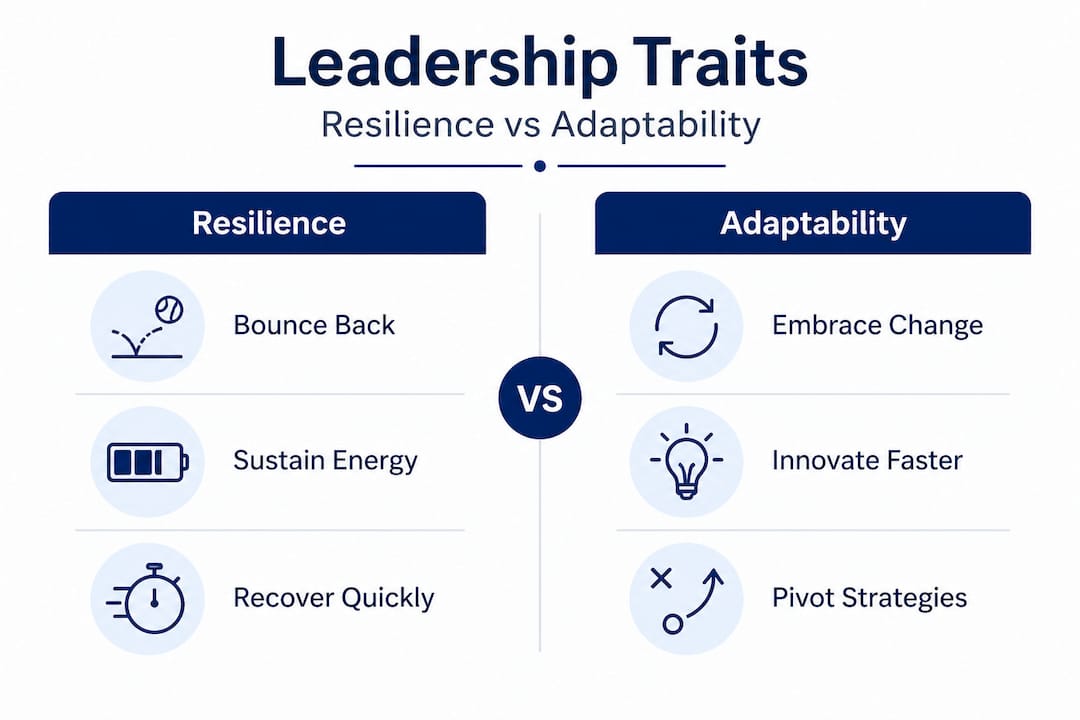
The adaptability argument is gaining momentum in leadership circles, particularly in the context of AI-driven disruption and compressed business cycles. Some researchers and consulting firms argue that in genuinely volatile environments, the ability to reinvent your approach matters more than the ability to recover from setbacks. The pushback is that you cannot adapt effectively if your cognitive and emotional resources are depleted. Resilience creates the platform for adaptability to function.
| Dimension | Resilience | Adaptability |
|---|---|---|
| Core function | Recover and restore | Pivot and innovate |
| Activated by | Adversity and setbacks | Environmental change |
| Time horizon | Short to medium term | Medium to long term |
| Risk if overemphasized | Rigidity, endurance culture | Instability, lack of continuity |
| Best paired with | Emotional resets, meaning review | Adaptive learning, scenario planning |
Scenarios where each trait is more strategic:
- Resilience is primary when managing a team through a crisis that requires sustained leadership presence and operational continuity
- Adaptability is primary when your industry model is being disrupted and the old playbook no longer generates competitive returns
- Both are required during organizational transformation, where you need the stability to lead through uncertainty while redesigning the business simultaneously
The holistic frameworks for vitality resource maps how these two capabilities can be developed in parallel without compromising either. The key insight is that they feed each other when cultivated intentionally. Resilient leaders adapt better because they're not operating from depletion. Adaptable leaders recover faster because they've built cognitive flexibility into their daily practice.
Action plan: elevate your resilient performance as a leader
Finally, let's put everything together in a hands-on action plan tailored for leaders ready to move from insight to transformation.
The gap between knowing and doing is where most executive development fails. You can understand every framework in this article and still default to grinding through adversity on willpower when the pressure spikes. The goal of this action plan is to make resilience practices automatic by embedding them into existing routines rather than adding new obligations.
Programs targeting emotional isolation in men who identify as providers and problem-solvers work best when they integrate somatic and mindfulness approaches in language that matches how these men already communicate: precise, operational, and results-focused. Apply the same standard to your own resilience practice.
Key steps to embed resilience at the daily, weekly, and quarterly level:
- Daily (5 to 10 minutes): Begin each morning with a structured breathing reset before your first meeting. Review one current source of meaning in your work. Set one recovery intention for the day.
- Weekly (30 minutes): Complete a brief performance and energy audit using a structured journal. Note what depleted you, what restored you, and what decision quality looked like across the week. Identify one pattern worth adjusting.
- Monthly (60 minutes): Review your career meaning statement. Assess whether your current priorities align with your longer-term mission. Schedule any adaptive learning or peer debrief conversations that have slipped.
- Quarterly (half day): Complete a resilience deep-dive. What have been your biggest sources of friction? What recovery strategies worked best? Where did adaptability need to replace persistence? Adjust your framework accordingly.
- Ongoing: Track your emotional reset frequency and recovery time after setbacks. As these numbers improve, you'll have concrete evidence that resilience is a skill you are actively building, not a trait you are hoping to maintain.
The sustaining elite performance resource provides an expanded roadmap for leaders who want to go beyond these five steps.
Pro Tip: Use an executive journal designed for structured reflection rather than a blank notebook. Pre-formatted prompts eliminate friction and keep your review sessions productive. Consistency in format makes week-over-week comparison meaningful.
Why most resilience programs fail high-performing men and what actually works
Here's the uncomfortable truth about most resilience programs: they're designed for a general audience and delivered in language that alienates the exact leaders who need them most. Workshops that lead with emotional vulnerability, circle sharing, and clinical terminology create immediate resistance in men who have built decades of identity around decisive, self-sufficient performance. The resistance isn't ego. It's a signal mismatch between the format and the audience.
The leaders we see at VIRIDOS who build lasting resilience share a common characteristic: they approach it the same way they approach any high-stakes performance domain. With data, structure, and consistent iteration. They don't "work on their feelings." They audit their recovery metrics, test new protocols, and refine what works. The language of performance, not the language of therapy, is what opens the door.
What genuinely separates lasting resilience from surface-level fixes is personalization and meaning. Generic advice to "practice gratitude" or "build a support network" doesn't land because it doesn't connect to the specific sources of meaning that drive a particular leader's performance. The programs that work identify what matters most to you, professionally and personally, and build resilience practices around protecting and reinforcing those anchors.
The resilience insights journal at VIRIDOS is built on this principle. Resilient performance is not a box to check. It is a dynamic process that requires ongoing attention, honest self-assessment, and the willingness to adapt your approach as you and your environment evolve.
Elevate your resilience: level up with premium performance tools
Ready to move from theory to practice? The frameworks in this article only deliver results when they're implemented consistently, and consistency requires the right tools and environment to support it.
VIRIDOS builds premium performance tools specifically for men who operate at the highest levels of professional demand. The Performance Journal is designed to make structured resilience practice a daily habit, with prompts that align directly with the frameworks covered here, including emotional resets, meaning review, energy auditing, and adaptive learning tracking. Small-batch Swedish production and a premium membership experience mean you're working with tools that match the standard you hold yourself to. If you're serious about building resilient performance that compounds over years, not weeks, this is where you start.
Frequently asked questions
How can I measure my resilience as a leader?
Track recovery time from setbacks, energy consistency across the week, and your ability to find meaning after challenges. These three indicators give you a concrete, quantifiable picture of where your resilience stands and where it's improving.
What's the difference between adaptability and resilience for executives?
Resilience is your capacity to recover after adversity, while adaptability is your skill at pivoting to entirely new approaches when conditions change. Both are essential, but in AI-driven volatile environments, leaders need to lean more heavily on adaptability while maintaining resilience as their operational foundation.
Are resilience-building practices different for men over 40?
Research shows no gender difference in core resilience and coping mechanisms, but effective programs for male executives use practical, masculine language and operational frameworks rather than clinical or therapeutic approaches. The tools are the same; the delivery and framing are tailored.
How can meaning and optimism impact my career resilience?
Career meaning and optimism are two distinct pathways: purpose buffers stress and sustains performance across challenging conditions, while optimism keeps you forward-oriented. Together, they function as your deepest resilience infrastructure.